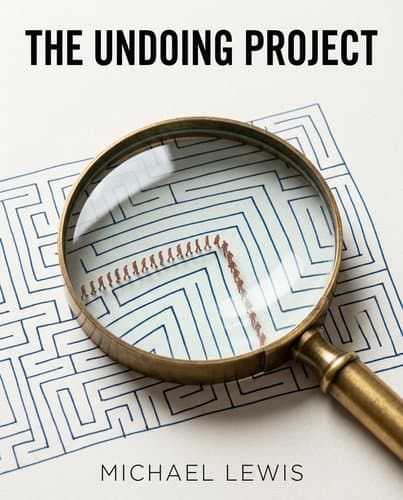
30334134_the-undoing-project
by Michael Lewis
Two brilliant psychologists dismantled the myth of human rationality—then watched their own friendship unravel under the very cognitive biases they'd exposed.
In Brief
Two brilliant psychologists dismantled the myth of human rationality—then watched their own friendship unravel under the very cognitive biases they'd exposed. Michael Lewis reveals how Kahneman and Tversky's discoveries rewired economics, medicine, and sports by proving our minds are predictably, systematically wrong.
Key Ideas
Early Labels Defeat Later Evidence
When you label something — a person, a situation, a candidate — with a nickname or first impression, you've already rendered a verdict that subsequent data will struggle to override. Build processes (blind reviews, structured scoring) that delay labeling until evidence is in.
Precommit to Criteria Upfront
Before a high-stakes judgment (hiring, diagnosis, investment), write down the criteria and weights you'd use ideally, then follow that formula — your 'theoretical self' consistently outperforms your 'in-the-moment self' who is tired, distracted, or dazzled by a shirtless photo.
Loss Framing Changes Your Choice
Before making any important decision, deliberately reframe it: if it's currently presented as a gain, restate it as avoiding a loss. If the choice changes, the frame is driving you, not the merits.
Who Anchors First Wins
Whoever anchors a number first in a negotiation or estimate sets the magnetic field that pulls all subsequent judgments. State your number before asking for theirs — and be suspicious of any estimate you form after hearing someone else's.
Endings Shape Lasting Impressions
Last impressions are disproportionately lasting: the ending of an experience — a meeting, a medical procedure, a negotiation — shapes memory and future behavior more than its total duration or average discomfort. Design endings deliberately.
Build Systems, Not Just Awareness
Knowing about a cognitive bias makes you somewhat more vigilant but does not override the underlying mechanism. Institutional structures — checklists, algorithms, blind review processes, pre-mortems — protect you in ways that personal awareness alone cannot.
Who Should Read This
Curious readers interested in Behavioral Economics and Cognitive Psychology and the science of how the mind actually works.
The Undoing Project
By Michael Lewis
9 min read
Why does it matter? Because the assumptions you have about your own judgment are the ones most likely to get you killed.
You probably walked into this book thinking data beats intuition — that the Moneyball lesson is simple: trust the numbers, fire the scouts, win. Then two researchers who'd spent twenty years studying exactly those errors sent Lewis a note that amounted to: nice illustration, but you missed the actual point. The systematic errors that made the Oakland A's rich weren't random market noise. They were the mind doing exactly what minds always do. Daniel Kahneman and Amos Tversky had already mapped the whole architecture of it, decades earlier, without anyone in baseball noticing. That gap — between what Lewis thought he'd written and what he'd actually stumbled into — is this book. The part that makes it genuinely strange: knowing this doesn't protect you.
Your Brain's Mistakes Follow a Predictable Script — and Warnings Don't Stop Them
In the summer of 2007, a shirtless photograph nearly cost one of basketball's best players his career. Daryl Morey had been hired to run the Houston Rockets on a simple premise: replace gut feeling with data. His statistical model loved Marc Gasol, a pudgy 22-year-old center playing in Europe. Then someone found a photo. Gasol was baby-faced, with soft pecs that jiggled, and the Rockets staff christened him "Man Boobs." The nickname became a verdict. Morey, not yet confident enough to push back, stayed quiet while Memphis took Gasol 48th — a draft slot where landing even a serviceable bench player runs about one in a hundred. Gasol made two All-Star games.
Morey immediately banned nicknames. Right call — but also a telling one, because the problem wasn't the nickname. The nickname was a symptom. The moment a label attached to Gasol, it reorganized how everyone in the room saw him. The model's data didn't change, but everyone in the room had already stopped seeing it. A photograph had hijacked a room full of professionals whose job was not to be hijacked.
Morey started keeping a list.
This is the part where it gets genuinely strange. Once you see the patterns, you'd expect that naming them out loud would be enough, that a roomful of smart, motivated people, warned in advance, could catch themselves in the act. Morey tried this. Before one trade deadline, he stood at a whiteboard and listed the biases he was worried about: confirmation bias, the endowment effect, present bias, hindsight bias. He named every one.
Then, during an NBA lockout, he took a behavioral economics class at Harvard Business School. On day one, the professor asked everyone to write down the last two digits of their phone number, then estimate how many African countries belong to the United Nations. The results were stark: people with higher phone digits gave systematically higher country estimates. The two numbers had nothing to do with each other. Then she announced she was about to do it again — she was, right now, about to anchor everyone in the room. She ran the exercise. Everyone was still fooled.
That's the shift. Errors in expert judgment aren't occasional lapses — a bad day, a weak dataset, something correctable with better tools or smarter people. They're patterned. And the patterns hold even after someone hands you a map of them.
A Formula Built From a Doctor's Own Rules Outdiagnoses That Doctor
Knowing about a bias, it turns out, doesn't protect you from it. The same radiologist, shown the same stomach X-ray twice, will give two different diagnoses. Not because anything changed. Because people are not machines.
In the early 1960s, psychologists at the Oregon Research Institute, a private lab in a former Unitarian church in Eugene, set out to understand how expert judgment actually worked. They found a group of radiologists and asked them a simple question: what do you look for when diagnosing stomach cancer? The doctors named seven factors: ulcer size, border shape, crater width, and others. Those cues, they explained, were the basis of every call they made.
The researchers then gave each doctor ninety-six stomach X-rays to assess, on a seven-point scale from definitely benign to definitely malignant. Unknown to the doctors, a handful of those images appeared twice in the stack — exact duplicates, shuffled in without warning. All the data went onto punch cards, mailed to UCLA, processed by the university's mainframe. Then the researchers built a comparison model using the seven factors the doctors had described, weighting each one equally.
The results were, in Lew Goldberg's word, "terrifying." The doctors didn't agree with each other. More startling: each doctor contradicted himself on identical cases. Same image, same doctor, different verdict. And when the researchers put that formula against the doctors (built entirely from the criteria the doctors had named), the formula won. It outperformed not just the group average. The single best doctor.
Here's the part that stops you: the formula contained nothing the doctors hadn't already provided. They had handed someone the rules to a game, then lost to those rules.
Goldberg's explanation was almost gentle. Doctors get tired, distracted, half-convinced a case is already settled before they've really looked. A formula doesn't. It applies the same weights every time, without flinching or growing bored. The edge wasn't superior knowledge — just the absence of noise.
The deeper finding is structural: the unreliability doesn't replace the expertise, it lives alongside it. A radiologist can genuinely know what malignant ulcers look like and still rate the same one differently on a Thursday afternoon than a Monday morning.
The Partnership That Discovered the Mind's Architecture Was Powered by the Mind's Architecture
In the spring of 1969, Amos Tversky walked into Danny Kahneman's graduate seminar at Hebrew University to describe research he found perfectly reasonable. A psychology lab in Michigan had run subjects through a poker-chip experiment: drawing chips from a bag, updating their odds estimates after each draw. The conclusion: humans behaved like "conservative Bayesians," processing new information in roughly the right direction, just not quite far enough. A tidy, reassuring finding.
Danny found it idiotic.
He'd spent years watching statistics students ignore base rates, draw sweeping conclusions from tiny samples, and replicate findings on samples so small they had a coin-flip chance of reflecting the broader population. He himself had made exactly those errors. Danny pushed back hard, in the blunt Hebrew University tradition where "I pushed him into the wall" described a perfectly normal conversation.
What happened next was, by every account, unprecedented for Amos. He left the seminar rattled, found a friend in the corridor, and dragged him into an empty room. "You won't believe what happened to me," he said. He was genuinely shaken: the Michigan researchers had treated perception and judgment as separate things, something you could study in sequence, and he now thought that was wrong. The man who had never lost an argument, whose first instinct on any intellectual problem was already better than most people's final answer — that man had just been moved.
This is the part worth sitting with. They were not similar minds who found each other. They were structural opposites who stumbled into the exact asymmetry that made the other necessary.
Amos was certainty. His office held, in its entirety, a single pencil on the desk. He assumed he was right, and the record bore him out; he'd been spectacularly right, repeatedly. Danny was doubt. His office was buried under open books abandoned mid-page, half-formed sentences on scraps, the physical record of a mind that kept questioning its own conclusions. A single dismissive comment from a student could send him into weeks of self-recrimination.
Amos was an optimist by deliberate choice, having reasoned himself into it: a pessimist lives the bad outcome twice, once in dread and once in fact. Danny was constitutionally pessimistic. Amos demolished illogical arguments; Danny asked of the same arguments, "What might that be true of?" Amos wrote with the swagger of someone who expected to be right. Danny, alone, would have hedged every claim into near-invisibility.
Together, they had what neither had separately: Amos gave Danny the nerve to assert something; Danny gave Amos a reason to suspect the obvious. Their first joint paper claimed, with Amos's confidence and Danny's evidence, that even trained statisticians were systematically deceived by their own data. By the end, neither of them could have told you which idea had started with whom.
You Don't Choose Between Options — You Choose Between Descriptions of Options
Imagine you're a physician choosing between two treatment programs for a patient. One option guarantees a partial rescue; the other is a gamble that might save everyone or leave everyone to die. You'd want to weigh them carefully, on the evidence. But what if the same two options, with identical odds and identical outcomes, felt completely different depending on whether you were told about lives saved or lives lost? Not slightly different. Different enough that you'd choose the opposite one.
This is what Danny and Amos demonstrated with what became known as the Asian Disease Problem. Two groups received the same scenario: an unusual disease was expected to kill 600 Americans, and two programs were available. The first group was told Program A would save 200 people for certain; Program B offered a one-in-three chance of saving all 600, two-in-three chance of saving no one. Most people chose the certain rescue.
The second group got the same mathematics, reframed. Program C: 400 people would die for certain. Program D: a two-in-three chance all 600 would die, one-in-three chance no one would. Most people chose the gamble.
Those are the same decision. Saving 200 out of 600 is identical, mathematically, to 400 out of 600 dying. A one-in-three chance of saving everyone is the same as a one-in-three chance no one dies. Only the vocabulary changed — lives saved versus lives lost — and that single shift flipped the majority. The numbers were unchanged. The frame was everything.
The asymmetry behind this is what Danny and Amos had just finished mapping. Losses sting roughly twice as hard as equivalent gains feel good. Two people can end up at exactly $5 million — one who gained from $1M, one who fell from $9M — and they won't feel the same at all. Frame a choice around what you stand to gain, and people reach for the certain option. Frame it around what you might lose, and they become gamblers. The frame doesn't tilt the decision. It is the decision.
Here's what makes this genuinely uncomfortable: understanding the mechanism doesn't free you from it. After the Yom Kippur War, Danny tried a fix: bringing precise numerical probabilities to Israel's foreign ministry instead of the usual analytic essays that each reader could interpret however they liked. He presented one number to the director-general. The director-general was unmoved.
Danny's conclusion, which he held for the rest of his career: "No one ever made a decision because of a number. They need a story." Even the man who drew the map couldn't find the exit.
The Men Who Named the Biases Couldn't Escape Them — But the Knowledge Still Changed the World
In April 1979, Danny delivered his first public lecture on what he called the undoing project: the rules governing how the mind rewrites events that have already happened. Amos's old mentor approached them afterward with genuine wonder, asking where all the ideas came from. Amos answered in eight words: "Danny and I don't talk about these things."
Danny marked it as the beginning of the end.
This is the part where it gets genuinely strange: Danny had just spent an hour explaining exactly what he did next. His theory held that when people undo a painful event, they fix on a single actor and rewrite that actor's choices while leaving everything else intact. When Danny tried to undo Amos's dismissal, he didn't think: If only Coombs hadn't asked that question. He thought: If only Amos were capable of self-effacement. Amos was the actor in Danny's imagination. Amos was the variable. Danny had identified, almost taxonomically, each rule of the mind's counterfactual engine — and then his own mind ran the engine exactly as described, on the very night he'd described it.
The partnership that mapped the architecture of human error demonstrated that architecture perfectly in its own collapse. The credit asymmetry Danny named and felt, the narrative each man insisted was simply true — neither could see the other's version clearly, which is exactly what their research predicted. Amos told Danny he'd caused more pain in his life than anyone. Danny had to bite his tongue not to say the same.
The knowledge that couldn't hold the friendship together still escaped into the world, and here's what it did. Cass Sunstein, a law professor who said reading their work had rewired how he thought about almost everything, joined Obama's administration in 2009 and overhauled how the government designed choice. He smoothed the path between homeless children and free school meals, eliminating the enrollment steps that kept eligible kids from lunch. In the year after he left, forty percent more poor children ate free school lunches. The insight that couldn't save the partnership fed millions of children.
That gap — between what we know and what we can do with ourselves — is the book's real subject. Danny and Amos proved that human beings construct stories, follow paths of least resistance, and feel losses more sharply than equivalent gains. They were right. They were also those human beings.
The Model of Amos
Near the end, Amos told Danny to trust the model of him Danny was carrying in his head. It was permission, and also proof. Two men who spent twenty years demonstrating that we never touch reality directly — only the story we'd already decided to tell about it — had built models of each other that neither could revise when the friendship started breaking. They knew exactly what was happening. They couldn't stop it. That's not a failure of the work. That's the work. The knowledge doesn't rescue you from being human; it just lets you see, with unusual clarity, exactly how human you are. When Danny picked up the phone in October 2002, it was Amos's model in his mind that traveled to Stockholm. The model outlasts the modelers. That turns out to be enough — not everything, but enough.
Notable Quotes
“This is a stupid game.”
“I did it over and over, kicking and screaming.”
“it seemed kind of practical.”
Frequently Asked Questions
- What is The Undoing Project about?
- The Undoing Project chronicles the partnership of psychologists Daniel Kahneman and Amos Tversky. Michael Lewis's book explores how their research revealed that "human judgment follows systematic, predictable patterns of error rather than random noise." The book equips readers with insight into cognitive biases—anchoring, loss aversion, framing effects—and demonstrates why institutional structures like checklists and blind reviews protect decisions in ways self-awareness alone cannot. Through the scientists' partnership, Lewis shows how we systematically misjudge situations and provides strategies through better processes to correct these patterns.
- What are the key takeaways from The Undoing Project?
- The Undoing Project offers several major lessons about judgment and decision-making. When you label something with a first impression, you've rendered a verdict that subsequent data will struggle to override—use blind reviews and structured scoring instead. Pre-commit to decision criteria; your "theoretical self" consistently outperforms your "in-the-moment self." Deliberately reframe decisions to test if the frame drives you. "Whoever anchors a number first in a negotiation or estimate sets the magnetic field that pulls all subsequent judgments"—state your number before asking for theirs. Finally, "last impressions are disproportionately lasting," shaping memory and future behavior more than total duration.
- What cognitive biases does The Undoing Project explain?
- The Undoing Project explores fundamental cognitive biases from Kahneman and Tversky's research. Anchoring bias occurs when the first stated number creates a mental reference point for all subsequent judgments. Loss aversion shows that people fear losses more than they value equivalent gains, which can be exploited through reframing—presenting the same choice as avoiding a loss rather than achieving a gain produces different decisions. Labeling effects occur when initial impressions resist new evidence. The book demonstrates these biases are systematic and predictable. Michael Lewis argues that "institutional structures—checklists, algorithms, blind review processes, pre-mortems—protect you in ways that personal awareness alone cannot."
- How can I apply The Undoing Project's insights to make better decisions?
- The Undoing Project provides practical strategies for high-stakes decision-making. Before important decisions like hiring or diagnosis, write down your criteria and weights in advance, then follow that formula consistently. Implement blind reviews and structured scoring to delay labeling until evidence is complete. Deliberately reframe decisions to check if the frame drives your choice rather than the merits. In negotiations, "whoever anchors a number first in a negotiation or estimate sets the magnetic field that pulls all subsequent judgments"—state your number first. Recognize that "last impressions are disproportionately lasting," shaping memory more than total duration. Most importantly, use institutional structures like checklists and algorithms rather than personal awareness alone.
Related Book Summaries
Read the full summary of 30334134_the-undoing-project on InShort