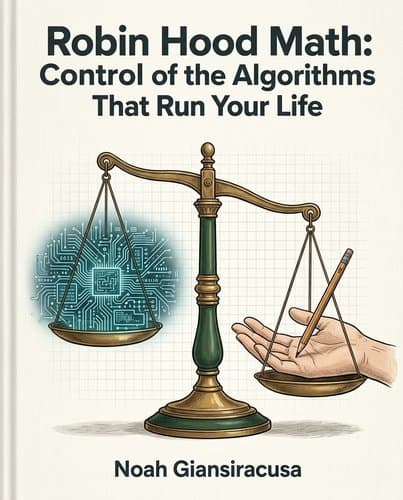
221267112_robin-hood-math
by Noah Giansiracusa
The same mathematical formulas corporations use to manipulate you can be weaponized in your favor—decode how rankings are rigged, why debunking misinformation…
In Brief
Robin Hood Math: Take Control of the Algorithms That Run Your Life (2025) explains how corporations and algorithms use mathematical formulas to manipulate consumer decisions — and shows you how to use those same tools to fight back.
Key Ideas
Ranking shifts signal methodology changes
When a ranking shifts dramatically year-over-year without underlying data changing, the weights changed — find out who changed them and why before trusting the result.
Silence misinformation rather than debate it
Commenting on misinformation to debunk it scores the post far more engagement points than a Like or a Share; the only way to starve bad content is to withhold all interaction, including correction.
Expected value works for repeated decisions
Use expected value for repeated, low-stakes decisions (which commute route, whether to guess on a standardized test); avoid applying it mechanically to high-stakes one-off choices where downstream consequences can't be priced.
Ask base rates before test results
Apply Bayesian updating to medical test results by always asking the base rate question first: given someone with my age and history, how likely is this condition before the test? A positive result on a rare condition is far less alarming than it appears.
Kelly criterion prevents portfolio ruin
Use the Kelly criterion as a portfolio heuristic: never bet more than (2p-1) of your stake on any single position, where p is your honest probability of being right — this prevents ruin even with favorable odds.
Sort by reviews to save money
On Amazon, change the default sort from 'Featured' to 'Avg. Customer Review' and filter out Sponsored labels; the Featured sort costs users roughly 25% more than the best available option on average.
Romer's rule accounts for loss aversion
When assessing a risk, price it using Romer's rule: (cost of harm × probability of harm) × 2. The doubling accounts for the psychological reality that losses hurt more than equivalent gains feel good.
Correlated errors defeat collective wisdom
Crowd wisdom only cancels error when the crowd's mistakes are independent; if everyone's wrong in the same direction (shared bias, social pressure, hidden covariance), averaging inherits the distortion rather than removing it.
Who Should Read This
Science-curious readers interested in Behavioral Economics and Decision Making who want to go beyond the headlines.
Robin Hood Math: Take Control of the Algorithms That Run Your Life
By Noah Giansiracusa
13 min read
Why does it matter? Because the same math used to reduce you to a data point can be used to fight back.
Right now, without knowing it, you are being scored. Your morning commute generated a Wikipedia's worth of data. Your grocery run fed a database that dwarfs the Library of Congress. The app you opened before your eyes fully adjusted to the light ran your behavior through a formula and decided what version of reality to show you. None of this required your consent, and none of it is particularly secret — the math behind it is more readable than anyone warned you. That's the uncomfortable joke at the center of Noah Giansiracusa's Robin Hood Math: the formulas that corporations use to reduce you to a monetizable data point aren't locked in some impenetrable vault. They're weighted sums and probability calculations. And the moment you see how they actually work, you stop being the variable in someone else's equation and start doing the math yourself.
You Are Already Living Inside Someone Else's Formula
A hospice chaplain in Minneapolis sits with a dying patient, offering presence in someone's final hours. Her employer is tracking this. The visit earns her one productivity point. When the patient dies and she attends the funeral, she earns one and three-quarters points — because apparently death is worth more than dying.
This isn't an outlier. It's the logical endpoint of a system that has been quietly running in the background of your life for years. Eight of the ten largest private employers in the United States already monitor workers through productivity-tracking software, tying pay and continued employment to data streams the employee never sees and rarely consented to. Your grocery store operates at the same scale: Kroger holds over 35 petabytes of customer data — half again the size of the Library of Congress's entire digital holdings — and sells portions of it to outside companies.
What's striking isn't the scale alone. These aren't random data hoards. They're inputs into formulas — weighted systems that have already assigned you numbers, ranked you, priced you, and made decisions about you before you walked in the door. The hospice chaplain's employer didn't just track her work. It converted human compassion into a scoreable unit and slotted it into a calculation. Name the architecture and it stops being invisible. Name it, and you can start learning to read it — and push back.
Rankings Are Just Weighted Sums — and Someone Chose the Weights
Every ranking you've ever trusted — college admissions lists, country risk scores, credit ratings — is a weighted sum. Someone chose the factors, someone assigned the numbers, and the result looks authoritative because it comes out as a single clean figure. The math is real. The objectivity is not.
Columbia spent years gaming this. On the U.S. News Best Colleges list, the school climbed steadily until 2022, when it hit number two in the country — tied with Harvard and MIT, behind only Princeton. The following year it landed at number eighteen. Same school, same faculty, same campus. What changed was that a Columbia math professor named Michael Thaddeus spent his spare time actually reading the data Columbia had submitted to U.S. News, then published a 21-page analysis of what he found. Columbia had reported $3.1 billion in instructional spending — more than Harvard, Yale, and Princeton combined — by counting expenses at its affiliated hospital as educational costs. U.S. News had been weighting that figure at 10 percent of the total score. Suddenly number two made sense, and so did the freefall once the bookkeeping was exposed.
Weighted sums work like this: pick the factors, assign each a percentage weight, multiply a school's score on each factor by its weight, and add everything up. The formula looks rigorous. But every choice inside it is a judgment call — which factors count, how heavily, and whose reported data gets trusted. The number at the end isn't a measurement of reality. It's the output of those choices.
Once you understand that, you can read any ranking the same way: find the factors and their weights, then figure out who's reporting the underlying data and what they gain from reporting it favorably. See the choices, and you can question them, game them, or blow them up — just like Thaddeus did with twenty-one pages of math.
Your Attempt to Fix the Internet Is Making Things Worse
Here's what actually happened at the mechanical level: you handed that post the highest-value gift the algorithm accepts.
The social media feed isn't organized by truth or quality or chronology. It's a ranking system — a weighted sum, exactly like the college lists from the last section — where every action you take on a post carries a point value, and those points determine what millions of people see next. Facebook whistleblower Frances Haugen revealed that Facebook's engineers had assigned explicit scores to every form of engagement. A Like earned one point. The angry-face emoji, for years, earned five — the same as the love reaction — because both reliably predicted that a user would keep scrolling and generate more ad revenue. Outrage was architecturally equivalent to delight.
Here's the arithmetic. Imagine three posts competing for the top of your feed. A puppy video scores 2.2 points based on your history with cute content. A friend's job announcement scores 4.5. Then there's your uncle's claim that 5G towers caused COVID. You're not going to like it or love it — those probabilities are zero. But there's a decent chance, say 20 percent, that you'll comment to set the record straight. Comments, in Facebook's internal system, are worth 30 points. So the conspiracy post scores 30 multiplied by 0.2: six points. It jumps to the top of your feed, above the puppy, above the job update. Your corrective impulse, your attempt to fight misinformation, is precisely what elevated it.
And it doesn't stop with you. The algorithm reads your engagement as a signal that other users in your network are also likely to engage. Your debunking comment boosts the post in your uncle's other friends' feeds too. The more earnestly you argue, the wider the distribution.
This is the machinery behind a pattern millions of people have noticed but couldn't quite explain — why the angriest, most inflammatory posts keep finding their way to the top. Nobody at Facebook programmed the algorithm to reward conspiracy theories specifically. They programmed it to maximize engagement points, and the rest followed. Once you see the formula, the feed stops feeling like a reflection of what people care about and starts looking like what it is: a ranking built by engineers whose bonuses depended on keeping you agitated and online. And once you understand how the formula works — once you can see the score — you can start thinking about which formulas are actually worth learning.
Expected Value Is a Superpower — Until It Becomes a Religion
In 2004, a Croatian gambler named Niko Tosa walked into the Ritz Club in London and won £1.3 million at roulette. He didn't predict which number would hit. He used what's called a neighbors bet — covering five adjacent numbers on the wheel at once — and he'd noticed that a slight mechanical imperfection in this particular wheel made those five numbers come up more than chance alone would predict. That tweak was enough. By shifting the expected value of his bet from negative (the house's favor) to positive (his), he turned a casino into an ATM.
That's the expected value formula in its purest form: add up every possible outcome, weight each by its probability, and you get what you can expect on average. Tosa's bet paid more than it cost, on average, so he played it repeatedly. The math did the rest.
The formula works for any situation you face repeatedly — SAT guessing, which commute to take, whether to buy the extended warranty. When you can keep playing, small positive edges compound into large consistent wins. Texas lottery syndicates do the same thing, legally and unglamorously: wait until the jackpot is large enough that a ticket's expected value turns positive, then buy millions of them. A group spent $26 million at a fishing store in Colleyville in April 2023 to capture a $95 million prize. Not exciting. Mathematically sound.
Now meet Sam Bankman-Fried, who tried to run his entire life this way. He once told his assistant there was a '60 percent chance' he'd show up to a social event they'd planned together — treating a personal commitment as a probability distribution rather than a promise. That wasn't a quirk. It was the operating system. SBF believed, and said publicly, that he'd take a coin flip offering a 51 percent chance to save all of humanity even if the other 49 percent meant destroying it. The expected value is positive, so you take the bet. QED.
The problem is that the formula has load-bearing assumptions that SBF quietly dropped. Expected value only works when you can keep playing — when no single bet wipes you out. Tosa could walk away and come back. A coin flip for civilization cannot be replayed. There's also what the formula simply cannot price: trust. When your assistant learns you gave her a 40 percent chance of being stood up, she stops making plans with you. When your employees discover you're running the same calculation on their livelihoods, they leave or they should. FTX collapsed in November 2022, and SBF was convicted on seven counts of fraud. The math didn't fail him. He failed the math — by applying a tool designed for repeated low-stakes decisions to one-shot bets with other people's money, and by mistaking 'positive expected value' for 'therefore no one gets hurt.'
EV thinking is genuinely useful. It will make you a better guesser, a smarter commuter, and someone who never buys an extended warranty again. It stops being useful the moment you treat it as a complete moral philosophy, ignore the size of individual bets relative to your total resources, or forget that some losses — in trust, in relationships, in freedom — don't show up in the calculation at all.
The Crowd Is Smarter Than You — Except When Everyone Is Wrong Together
Imagine asking a thousand strangers to guess how many marbles are in a jar. Most guesses are wrong, but they're wrong in all directions — some too high, some too low. When you average them, the errors cancel out, and the result is often startlingly close to the truth. But now imagine everyone in the room got their estimate from the same newspaper article that accidentally doubled the actual count. Every guess skews high. Averaging them doesn't cancel the error — it enshrines it.
In 1906, Francis Galton watched 800 fairgoers guess the slaughtered weight of an ox at a livestock fair in Plymouth. He expected the crowd to be embarrassingly wrong. Instead, the median guess of 1,207 pounds landed within one percent of the actual 1,198. The errors had scattered randomly enough that they washed each other out. Galton had accidentally demonstrated something powerful: diverse, independent guesses are a noise-canceling machine.
Nate Silver built his career on this. His weighted average of polling data called 49 states correctly in 2008 and all 50 in 2012. The weights were assigned based on each pollster's historical accuracy — a kind of trust score. The formula worked because the polls, while imperfect, failed in different directions.
Then 2016 happened. Trump voters, for reasons researchers are still debating, consistently underreported their intentions to pollsters. This wasn't random noise scattered across the sample — it was a systematic tilt running through nearly every poll simultaneously. When Silver averaged them, he didn't cancel the error. He averaged it in. The polls moved together, failed together, and the consensus that Clinton would win reflected not the electorate but the shared blind spot of an entire industry. The problem has a name in statistics — covariance — but you don't need the term to grasp the concept: when errors all tilt in the same direction instead of scattering randomly, averaging them together just averages in the bias.
Before you trust a consensus, ask whether the sources feeding into it are genuinely independent. If they're all reading from the same data or exposed to the same cultural assumptions, the average you compute isn't wisdom of the crowd. It's one opinion, repeated loudly.
Bayes's Formula Is How You Update Without Overreacting
Alan Dershowitz thought he had the math on his side. Defending O.J. Simpson in the 1990s, he argued that domestic abuse evidence should be thrown out — because statistics showed fewer than one in 2,500 abusers ever go on to kill their partners. Vanishingly rare. Irrelevant. Case closed.
A statistician named Jack Good, who had spent World War II cracking the Enigma code with Alan Turing using Bayesian methods, published a brief letter pointing out that Dershowitz had asked the wrong question entirely. The right question wasn't: what fraction of abusers become killers? It was: given that a woman has been murdered and her husband previously beat her, what are the odds he did it? Run the numbers correctly and the answer flips from reassuring to damning — roughly a 90 percent chance the abusive husband is the killer. Dershowitz had taken a probability that sounded exculpatory and used it as though it meant something it didn't. He ignored what statisticians call the base rate: the context that changes everything.
That mistake is exactly what Bayes's formula exists to catch. Take a mammogram that flags something unusual in a young woman with no family history of breast cancer. The report might note a 5 percent chance of malignancy, which sounds alarming. But that number has to be filtered through her low prior risk — her age, her history, how rare this cancer actually is in women like her. Once you do that, the frightening-sounding figure shrinks to something far less frightening. The evidence matters. It just doesn't get to erase what you already knew. You update — you don't restart from zero.
Risk Isn't What You Lose — It's the Shape of What You Might Lose
Most people think of risk as a number — the chance something bad happens, multiplied by how bad it is. Useful, but it misses what actually ruins people: the shape of the distribution around that number, specifically how much swing exists in the outcomes and whether your strategy survives a bad streak.
In 2016, a group of finance students and young professionals sat down to play a coin-flip game designed by investment analyst Victor Haghani. The coin was biased in their favor — 60 percent chance of heads — and they had 30 minutes to bet from a $25 starting stake, with a $250 cap on winnings. The math was unambiguous: this was a winning game. Yet when the session ended, only 13 of the 61 players had hit the cap. Nearly a third went completely bust. Some had bet the whole stack on a single flip. Others rode momentum up and crashed down. A few bet so conservatively they barely moved.
The formula that would have saved them is called the Kelly criterion: bet exactly 2p minus 1 as a fraction of whatever you currently hold, where p is your probability of winning. At 60 percent odds, that's 0.2 — bet 20 percent of your pool each round, no more. Had all 61 players followed that rule, 58 would have reached the maximum payout. The formula forces you to bet larger when you're ahead and smaller when you're behind, which is the opposite of how most people play. Its logic is rooted in something counterintuitive about money: each additional dollar is worth less than the last. Going from $25 to $50 is life-changing at that scale; going from $225 to $250 barely registers. The Kelly criterion encodes that reality mathematically — double it, not as padding, but because losing $100 hurts more than winning $100 feels good, and the math should reflect that. A losing streak can never wipe you out if you're always betting a fixed fraction of what remains.
The Individual Hacks Are Real — But the Game Is Rigged by Design
Can a handful of personal tricks — switching Amazon's default sort, typing a minus sign into Google — actually level the playing field against trillion-dollar platforms? They help, and some help meaningfully. The Markup's machine-learning audit of Amazon found that switching from the default 'Featured' sort to 'Average Customer Review' can save shoppers roughly 25 percent, because the Featured ranking is a paid placement system: 60 percent of top results are ads, and half of the remaining unpaid spots promote Amazon's own house brands — products representing just 6 percent of total inventory. That sort change is real money every time you use it. So are the Google search tricks: click the 'Web' tab to strip out AI summaries and shopping carousels that have pushed organic results to 616 pixels of screen space by 2020, nearly doubling the digital real estate captured before a human-written result appears.
But here's the honest accounting. These hacks work at the individual level precisely because most people don't use them. If everyone optimized simultaneously, the platforms would retune their algorithms — they've done it before. The pressure producing these dynamics doesn't come from bad engineering decisions that better consumer behavior can patch. It comes from the math of how these businesses grow. Nobel laureate economist Paul Romer identified what makes tech companies structurally different: their most valuable input — user data — is shareable. Twice as many workers with twice the materials build roughly twice as much. But twice as many users generating data for an algorithm produces more than twice the value. Google Maps gets better for every user simultaneously from every other user's route data — the same data trains every product at once. This superlinear growth is why market concentration in tech isn't a phase; it's a consequence of the arithmetic. A flat tax on advertising revenue does nothing to counter it: double the revenue, double the tax, the advantage stays intact. Romer's proposed fix is a progressive, superlinear tax — one where the burden more than doubles as revenue doubles, specifically designed to offset the compounding edge that proprietary data provides.
So use the sort filter. Learn the search syntax. These are genuine tools and they work right now. But hold them alongside the larger picture: knowing how the sort works is how you protect yourself today, and understanding why it's rigged by design is how you argue for changing it.
The Formula You Already Had
Here's what the book is really asking you to sit with: none of this was secret. The chaplain's point system was written down somewhere. Facebook's engagement weights were in an internal document. Columbia's submitted figures were available to anyone who asked for them — and one math professor did. The formulas weren't hidden behind locked doors; they were hidden behind the assumption that you weren't the kind of person who reads formulas. That assumption was the whole security system.
When Giansiracusa's family adopted a dog, they ran the decision through expected value, Bayesian priors, a rough Kelly check on the budget, and a weighted sum of lifestyle factors. Every tool in this book, applied to one golden retriever. The point isn't to live like a spreadsheet. It's that once you know what the numbers are actually measuring — and who benefits from the measurement — you stop being a variable someone else is solving for. You pick up the pen. That's it.
Notable Quotes
“inaccurate, dubious, or highly misleading.”
“We knew that we could prove, if we had to, that an infinitesimal percentage—certainly fewer than 1 out of 2,500—of men who slap or beat their domestic partners go on to murder them.”
Frequently Asked Questions
- What is Robin Hood Math about?
- The book explains how corporations use mathematical formulas to manipulate consumer decisions and teaches readers how to use those same tools defensively and strategically. Drawing on Bayesian reasoning, expected value, and the Kelly criterion, Robin Hood Math (2025) provides practical techniques to decode rankings, evaluate risks, and make sharper decisions in everyday life. It empowers readers to become more aware of algorithmic manipulation, understand the mathematical logic that drives it, and apply protective strategies.
- How can I spot when a ranking algorithm has been manipulated?
- "When a ranking shifts dramatically year-over-year without underlying data changing, the weights changed — find out who changed them and why before trusting the result." This principle helps you identify algorithm manipulation and corporate bias. Platforms often adjust weights without public disclosure to favor certain outcomes. By recognizing this pattern, you can demand transparency and explanations for changes. Always compare methodology across years and verify that ranking changes align with actual data shifts before relying on those rankings.
- How should I use expected value and the Kelly criterion for decision-making?
- "Use expected value for repeated, low-stakes decisions (which commute route, whether to guess on a standardized test); avoid applying it mechanically to high-stakes one-off choices where downstream consequences can't be priced." Meanwhile, "Use the Kelly criterion as a portfolio heuristic: never bet more than (2p-1) of your stake on any single position, where p is your honest probability of being right — this prevents ruin even with favorable odds." Together, these methods optimize decisions at different scales.
- How can I resist algorithm manipulation on Amazon and social media?
- "On Amazon, change the default sort from 'Featured' to 'Avg. Customer Review' and filter out Sponsored labels; the Featured sort costs users roughly 25% more than the best available option on average." On social media, understand that "Commenting on misinformation to debunk it scores the post far more engagement points than a Like or a Share; the only way to starve bad content is to withhold all interaction, including correction." These tactics help you resist daily manipulation.
Related Book Summaries

Read the full summary of 221267112_robin-hood-math on InShort