41796203_madame-fourcade-s-secret-war
by Lynne Olson
She commanded 3,000 spies across Nazi-occupied France without a title, survived Gestapo capture, and delivered the intelligence that helped destroy Hitler's…
In Brief
Madame Fourcade's Secret War (Marc) chronicles Marie-Madeleine Fourcade's leadership of Alliance, France's largest WWII spy network, and the institutional forces that erased her from history. It reveals how authority built on trust outlasts formal mandates, why resistance work's secrecy guaranteed its leaders' obscurity, and how postwar political narratives systematically sidelined women who did the most dangerous work.
Key Ideas
Secrecy Ensures Impact, Prevents Recognition
The most strategically decisive resistance work is often the least celebrated: Alliance's espionage was what MI6 most needed and what history least remembers, because secrecy that made the work possible also made recognition impossible.
Demonstrated Competence Outweighs Official Authority
Authority built on demonstrated results can outlast authority granted by institutions — Fourcade held 3,000 agents across four years of Gestapo pressure without a formal mandate from any French authority, because her lieutenants trusted her judgment, not her title.
Expansion Inevitably Compromises Security
In any clandestine or high-risk organization, growth and vulnerability are structurally inseparable: every new person you trust is a new exposure, and there is no configuration that is simultaneously large enough to matter and secure enough to be safe.
Intelligence Collectors Perished Before Impact
The people who provided the intelligence that changed specific battles were almost never the ones who survived to receive credit for it — Rousseau's V-2 report helped detonate Peenemünde and she spent the rest of the war in a concentration camp, never knowing what her information had done.
Postwar Victors Rewrote Resistance History
When evaluating historical credit for wartime resistance, examine who controlled the postwar narrative: the Gaullists and Communists who dominated French resistance historiography had structural reasons to exclude networks with Vichy ties and women leaders, bending the record to serve postwar political purposes.
Sexism and Silence Made Women Invisible
Women who accomplished the most in Alliance consistently spoke least about it afterward — a pattern driven by internalized gender norms, institutional sexism, and the correct understanding that they would not be believed — making them uniquely vulnerable to historical erasure.
Who Should Read This
History readers interested in Political Figures and Military History who want a deeper understanding of how we got here.
Madame Fourcade's Secret War
By Lynne Olson
11 min read
Why does it matter? Because the largest spy network in occupied France was run by a woman, and you've probably never heard her name.
A woman lies on a cot in a Gestapo cell, July 1944, sweating through her disguise — drab clothes, dyed hair, a dental prosthetic, forged papers that say her name is Germaine Pezet. In her pocket: a cyanide pill. She decides not to take it. Not from hope, exactly, but from a specific calculation: she commands 3,000 agents across occupied France, her network just helped make D-Day possible, and if she dies here, everything dies with her.
She was right about the first part. The story nearly died anyway. Marie-Madeleine Fourcade ran the largest Allied intelligence network in France (the only woman to lead a major Allied spy network in any occupied country) and was written out of the record the moment the war ended. The book traces how she built something the Allies couldn't have won without, survived enemies on both sides, and watched her own government hand the credit to men who had done far less.
The Resistance Everyone Celebrates Was Not the Resistance That Won the War
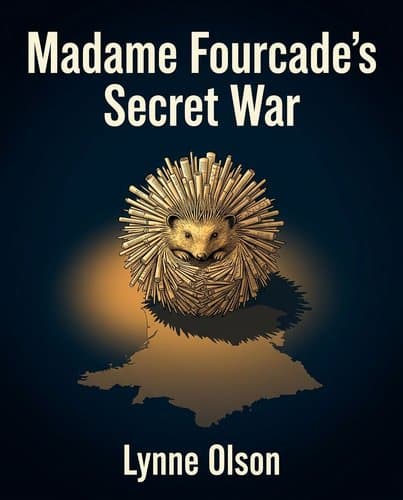
Consider the hedgehog. It's the last animal you'd put on a wartime memorial: too soft, too domestic, too garden-bound to read as a threat. Yet Marie-Madeleine Fourcade, who ran the largest Allied spy network in occupied France during World War II, chose Hedgehog as her personal code name. The choice is a key to the whole book.
The hedgehog doesn't look dangerous. When threatened, it curls into a tight ball, driving every spine outward — until even a lion, as one of Fourcade's friends observed, would think twice about taking a bite. That describes the kind of resistance that actually decided the war: unglamorous by design, invisible until the moment it wasn't, and almost entirely missing from the history books.
The French resistance divided into three strands. Saboteurs got the films and the memorials — bridge explosions, railway cuts, dramatic raids. But before D-Day in June 1944, they contributed almost nothing to the Allied cause. Escape lines did heroic work, smuggling downed airmen across occupied borders, but their strategic effect was small. Espionage was different. Intelligence networks fed the Allied high command what it needed to plan and fight: troop movements, submarine sailing schedules, coastal gun emplacements, the designs and launch sites of Germany's V-weapons. Without that intelligence, the Allied campaign would have been, quite literally, guesswork.
Fourcade's network, Alliance, was the largest of these operations, roughly 3,000 agents across every major French city and port. Yet it has nearly vanished from memory, because secrecy was the condition of its existence. You can't make a movie about a war won in silence. The result is a grotesque inversion: the resistance that mattered most is the one least remembered.
Being a Woman Was Fourcade's Best Cover — and Her Permanent Liability
The MI6 officer who arrived in Madrid in late 1941 had been told what to expect: the chief of Alliance, France's most valuable spy network, would be waiting for him. He walked in, saw a composed blonde woman in a silk dress and a French naval officer standing beside her, and looked instinctively to the man. Jean Boutron had to clarify. She was the one. Eddie Keyser, traveling under cover, stared at Fourcade for several seconds, his expression betraying exactly what she'd spent two years trying to prevent.
She had concealed her identity from MI6 precisely because she'd feared this moment. Hundreds of intelligence reports had gone to London under her code name, POZ 55, without revealing the person behind them. She told Keyser plainly: she'd been afraid that if the British learned a woman ran Alliance, they would withdraw their support and leave her agents exposed.
Fourcade's gender had been her greatest operational asset. Alliance's founder, code-named Navarre, had partly recruited her on the logic that no one would suspect a woman. The Germans shared the assumption: they saw women as wives and mothers, not intelligence chiefs, and that blind spot let female agents pass checkpoints that stopped men, carry documents that searched men didn't touch, run courier routes that surveilled men couldn't safely use. Women eventually made up roughly a fifth of Alliance's agents, effective in direct proportion to how thoroughly their enemies underestimated them.
But inside every institution Fourcade depended on — MI6, the French military command, de Gaulle's Free French — the same assumption worked against her. Authority was presumed male. When Navarre was arrested and senior officers began packing up to leave, she held them through argument and nerve alone, without any formal transfer of power. No one handed her command. She claimed it by refusing to surrender it, encoding a message to London within hours: network intact, everything continuing, confidence unshakable. MI6's reply came back with a single question: "Who is taking over?" Her answer: I am. As planned.
The results eventually forced acceptance. When Léon Faye — Alliance's deputy, the man who'd helped build it into a 3,000-person operation — recruited a skeptical air force colonel, the colonel asked who ran the network. "A woman," Faye said. "But not just any woman: an indisputable and undisputed leader. Even the English have accepted her." The phrase "even the English" was not a compliment. It was a statement of what it had cost. And what that cost had built was already running across occupied France.
Alliance's Biggest Intelligence Coups Always Arrived Paired With Catastrophe
Robert Douin and his fourteen-year-old son Rémy spent the spring of 1944 cycling the Normandy coastline — the art school director and his apprentice, stopping here and there with a sketchbook. He had spent years restoring local churches, which gave him a reason to be in their bell towers, and the towers gave him unobstructed views of the coast below. He used them to map every gun emplacement, beach obstacle, and fortification he could see, while Rémy noted antitank trenches and the paths Allied soldiers would later use to climb off the beaches. A fisherman in their network stole Wehrmacht flyers warning ships away from coastal artillery practice — each one naming the battery conducting the exercise. It all went onto a single canvas that grew, section by section, to fifty-five feet.
When Alliance's Normandy chief Jean Sainteny unrolled it on a London floor on March 16, 1944, it showed every German fortification and defensive position along the coast where the Allies planned to land. It was the most complete picture of the invasion coast the Allied command possessed.
Sainteny had offered Douin a Lysander flight to safety before the arrests started. He declined. The map wasn't finished, and leaving would mean abandoning the people who'd helped build it.
He finished it. It reached London. On June 6, as Allied soldiers waded ashore carrying copies of Douin's work, Douin and eighty other resistance members were taken from their cells in a Caen prison and shot in the yard. Their bodies were loaded onto trucks and never found.
The map used. The mapmaker executed. On the same morning.
Douin's story isn't the exception in Alliance's war. It's the rule. Jeannie Rousseau, a young Frenchwoman fluent in German, spent months at Parisian officer gatherings acting astonished whenever Germany's secret weapons program came up, insisting aloud that what they described was impossible, until one exasperated officer pulled actual V-2 blueprints and a map of the Peenemünde test site from his briefcase to prove her wrong. She reconstructed everything from memory that night at a safe house. Her report reached Churchill the following day. Eight months later, six hundred RAF bombers struck Peenemünde, killing roughly 180 scientists and engineers and delaying both programs enough that neither reached London before D-Day. Rousseau spent the rest of the war in a German concentration camp, never knowing what her report had done.
The intelligence was extracted, transmitted, and used. The people who obtained it were taken.
Every New Agent Alliance Recruited Made the Network Both Stronger and More Fragile
The greatest threat to Alliance was never the Gestapo — it was Alliance itself. Every agent recruited was another person who could be arrested, another link in a chain that someone else could pull. Fourcade understood this with brutal clarity. "Two agents are weaker than one, three are weaker than two, four are weaker than three," she told an interviewer after the war. "Each one that you take on is an additional security risk, an additional person who can betray you all." She said this as the leader of a network that had grown to three thousand people, which tells you something about the corner she was in.
The collapse of Alliance's Paris network in September 1943 makes the paradox concrete. By that point, the organization was sophisticated enough to have a dedicated protection team: agents assigned specifically to secure Lysander landing operations, the moments when the network was most exposed. Jean-Paul Lien, a former railway worker from Alsace, had already been assessed by his previous commander as utterly without competence or conviction, but that assessment never traveled. Lien settled in Lyon, befriended Alliance's Paris security chief, and made himself indispensable by arguing that Lysander landings needed stronger protection. He was right about the threat. He was the threat.
Because he'd positioned himself inside the protection apparatus, Lien knew exactly when Léon Faye and Ferdinand Rodriguez, Alliance's two top leaders, were returning from London. He transmitted the date to the Gestapo. Both men were arrested on the train to Paris. In the weeks that followed, more than 150 additional agents were taken. The entire Paris network was gone. Lien collected two million francs.
The irony is almost too neat: Alliance built a dedicated protection apparatus to shield itself from exactly this kind of attack, and the attack came from inside it. You could call it a structural failure, but that implies there was a structure that would have worked. Fourcade couldn't have operated without growing, couldn't have grown without trusting, and couldn't have trusted without accepting that some portion of that trust would be catastrophically wrong. She knew it, and she kept growing anyway.
The Cost Was Paid in Specific People With Specific Names
Ferdinand Rodriguez, a British radio operator who had spent fifteen months in Nazi captivity, lay in his cell at Schwabisch Hall on the night of August 20, 1944, listening. He had been shackled so long that his wrists bore permanent marks. Condemned to death eleven months earlier, he had outlived the review period that should have killed him, then survived fifty-seven more days beyond that — and now footsteps were approaching on the iron stairs.
A nearby door swung open. He clutched his rosary and began to pray.
Three. Four. Five. Six. Nothing came from the corridor but the sound of feet descending stairs. Hail Mary, full of grace, the Lord is with thee. Seven. Eight. Nine. Ten. Blessed art thou among women, and blessed is the fruit of thy womb, Jesus. Eleven. Twelve. Thirteen. Holy Mary, mother of God, pray for us sinners, now and at the hour of our death.
A guard stopped outside his door. Moved on.
Seventeen. Eighteen. Nineteen. Twenty. Twenty-four.
The footsteps stopped. Every door but his had opened. The next morning a fellow prisoner confirmed what he already knew: all of them were gone.
Rodriguez survived because the Germans had calculated he was worth something in a hostage exchange. They traded him in January 1945 for a captured Abwehr spy, and he walked out of the fortress at 116 pounds, so wasted that a doctor could feel his backbone through his abdomen. He made it to Paris and found Fourcade. His only thought, she said, was for the others.
What Fourcade learned from him, and from the pilgrimage the two of them made through eastern France and Germany in spring 1945, was that the 438 Alliance agents who were executed had not slipped into historical abstraction. They had died in specific places, by specific methods, on specific days. At Natzweiler-Struthof in Alsace, 108 agents, sixteen of them women ranging in age from twenty to eighty, had been shot one by one in an underground vault and their bodies hoisted to a crematorium directly above. When Fourcade stood in that vault, the only physical evidence she could find was a flattened bullet in a drainage grid and dried blood. In a single week in November 1944, regional Gestapo chief Julius Gehrum personally toured prisons along the French border and killed 68 agents in forest clearings and from boats in the Rhine, timed to the Allied advance so that rescue would arrive a few days too late.
At Heilbronn, she watched men disinterred from an apple orchard. She recognized Lucien Poulard, twenty-four years old and head of the Brittany sector, not by his face but by what he was wearing: the dressing gown she had chosen for him in London six weeks before he was taken.
The 438 are not a number. They are that.
Fourcade Survived the Gestapo. Then Her Own Side Erased Her.
What does it take to forget someone who led 3,000 agents, supplied the intelligence that shaped D-Day, and survived four years of Gestapo pursuit? In Fourcade's case, the machinery was already in place before the war ended.
De Gaulle created the Compagnons de la Libération, France's formal honor roll of resistance heroes, during the war. By the end, 1,038 names appeared on it. Of those, 1,032 were men. Three Alliance members made the list. So did Fourcade's ex-husband, who commanded a regiment during the southern France landings. The only woman who had actually led a major intelligence network, the largest Allied spy operation in France, was not on it.
The Gaullists and French Communist Party jointly controlled the postwar narrative, and they agreed on one thing: no one with Vichy ties, however tenuous, could be credited as a resister. Alliance had been founded in Vichy France, the unoccupied zone, before it aligned with the Allies, and that geographic origin was weaponized as evidence of collaboration. Fourcade had spent four years proving that the network's origins had no bearing on what it stood for. Her agents came from every political stripe, including Communists. But the accusation didn't require evidence. It only required repetition.
What makes this harder to dismiss as political score-settling is what happened inside Fourcade herself. After the war, asked about her role, she described herself to an interviewer as "the wife of an officer, the mother of a family, a member of no political party, and a Catholic." Olson calls this "rather humble, and misleading." It's also something more unsettling: the internalized form of the same erasure. The women who had risked the most in the resistance tended afterward to speak the least. External silence and internal silence had worked on each other so long they became indistinguishable.
Fourcade died in 1989. France gave her a funeral at Les Invalides — the first woman ever accorded that honor, in a building where Napoleon is buried — and then quietly forgot her again. Knowing her name, and what it took to earn it, is the corrective the historical record never bothered to make.
The Question Jeannie Rousseau Said She Couldn't Understand
When journalists asked Jeannie Rousseau after the war why she'd risked her life passing German rocket intelligence to the British, she said she didn't understand why anyone would ask — doing what you were capable of doing was simply a moral obligation. That logic drove every Alliance agent into cellars and church bell towers and blackout-curtained safe houses. And it quietly drove the survivors into something harder afterward: making themselves small enough to exist in a France that had no interest in accounting for them. Fourcade received a state funeral at Les Invalides. She never made the Compagnons de la Libération list. Rousseau waited fifty years for any recognition at all. The historical record, left to itself, was content to leave it that way. You've now read these names. You know what the map cost, and who paid for it. That's not nothing — it's the one corrective that cost nothing to deliver and that France still somehow failed to make.
Notable Quotes
“You seemed interested in what I said yesterday at your brother-in-law's. I want to tell you more and to ask you to help me in a task that I cannot do alone.”
“One of my Belgian friends has procured secret dossiers that expose the intentions of the German high command,”
“I need to get them quickly. Such documents must not travel by mail. You have a car. You must go to Brussels and collect them. I will pay all expenses.”
Frequently Asked Questions
- What is Madame Fourcade's Secret War about?
- Madame Fourcade's Secret War chronicles Marie-Madeleine Fourcade's leadership of Alliance, France's largest WWII spy network, and the institutional forces that erased her from history. Lynne Olson reveals how authority built on trust outlasts formal mandates, why the secrecy that made resistance work possible also guaranteed its leaders' obscurity, and how postwar political narratives systematically sidelined women who did the most dangerous work. The book demonstrates how those providing intelligence that changed specific battles were almost never the ones who survived to receive credit, making Alliance's story essential to understanding how historical records get constructed and controlled.
- Why is Marie-Madeleine Fourcade significant in World War II resistance history?
- Marie-Madeleine Fourcade held 3,000 agents across four years of Gestapo pressure without a formal mandate from any French authority, because her lieutenants trusted her judgment, not her title. Her significance lies in demonstrating that authority built on demonstrated results can outlast authority granted by institutions. Alliance's espionage was what MI6 most needed and what history least remembers, because secrecy that made the work possible also made recognition impossible. Her leadership reveals how the most strategically decisive resistance work is often the least celebrated in historical records.
- What structural challenges does the book reveal about clandestine organizations?
- In any clandestine or high-risk organization, growth and vulnerability are structurally inseparable: every new person you trust is a new exposure, and there is no configuration that is simultaneously large enough to matter and secure enough to be safe. This insight from Fourcade's management of Alliance demonstrates the paradox facing underground networks—the work requires scale to be strategically significant, yet scale inevitably increases exposure. Fourcade navigated this impossible situation for four years while managing thousands of agents under constant Gestapo pressure, illustrating how effective resistance leaders often operate where perfect security and operational effectiveness are fundamentally incompatible.
- Why were women resistance leaders systematically excluded from postwar historical narratives?
- When evaluating historical credit for wartime resistance, examine who controlled the postwar narrative: the Gaullists and Communists who dominated French resistance historiography had structural reasons to exclude networks with Vichy ties and women leaders, bending the record to serve postwar political purposes. Women who accomplished the most in Alliance consistently spoke least about it afterward—a pattern driven by internalized gender norms, institutional sexism, and the correct understanding that they would not be believed—making them uniquely vulnerable to historical erasure. This deliberate omission shaped how WWII resistance is remembered today.
Related Book Summaries
Read the full summary of 41796203_madame-fourcade-s-secret-war on InShort