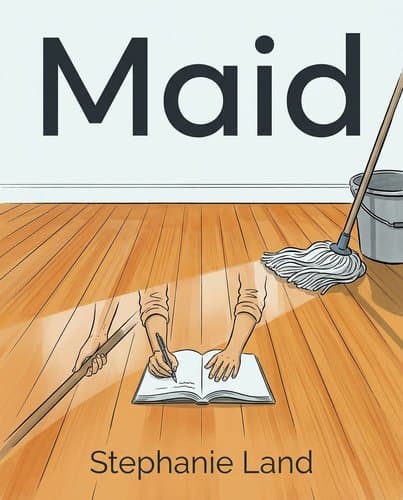
39218350_maid
by Stephanie Land
Scrubbing strangers' toilets while navigating a benefits system that punishes every dollar earned above the poverty line, Stephanie Land exposes how American…
In Brief
Maid (Janu) chronicles Stephanie Land's years as a single mother cleaning houses to survive, using her experience to map the structural mechanics of American poverty.
Key Ideas
Interlocking systems engineered for survival only
Poverty in America is not one hardship but a system of interlocking programs — each with its own intake appointments, income-reporting requirements, and compliance humiliations — calibrated to sustain survival, not enable escape. Understanding this architecture changes what 'she just needs to work harder' means.
Benefits cliff creates work disincentive
The benefits cliff is structural and deliberate: earning $50 more can eliminate assistance worth far more, creating a concrete financial incentive to stay poor. The next time you wonder why someone doesn't simply work more hours, this is the answer the system has built in.
Hidden costs eliminate effective wage
Low-wage domestic labor is not protected by the minimum wage you see on paper. Unpaid travel time between jobs, self-supplied equipment, and the physical destruction of the work itself mean the effective wage is substantially lower — and the body's depreciation is never reimbursed.
Poverty mindset is rational adaptation
The 'poverty mindset' — the inability to plan five years ahead or save — is not a character flaw. It is rational triage: when every dollar is already spoken for and one car repair ends everything, planning for retirement is not denial, it's an irrational use of mental energy. Recognizing this distinction matters for how you think about policy.
Comfortable ignorance enables systemic blindness
The people who say 'You're welcome' at the grocery store, or 'my tax money pays for that,' are not villains. They are ordinary people operating on comfortable assumptions they've never had to test. Catching that reflex in yourself — before you say it — is the specific thing this book asks of you.
One escape story, millions waiting
Stephanie Land's exit from poverty required talent, a blog, Barbara Ehrenreich, the Economic Hardship Reporting Project, a car accident her daughter survived by inches, and a back that didn't give out. The specific conditions of that escape matter: they are not reproducible by will alone, which is why the foreword names the millions of women still waiting to be heard.
Who Should Read This
Readers who connect with first-person stories about Memoir and Social Issues and want to see the world through someone else's eyes.
Maid
By Stephanie Land & Barbara Ehrenreich
9 min read
Why does it matter? Because the poverty you've imagined bears no resemblance to the one Stephanie Land survived.
The assumption most readers bring to Maid is wrong. They expect an inspiring rags-to-riches story — a woman who worked hard, kept going, and clawed her way out of poverty, proof the system works if you push hard enough. What they get is something more unsettling: a precise, granular account of what survival actually costs, measured not in dollars but in the specific indignities that come with them. The physical toll of scrubbing strangers' bathrooms for near-minimum wage. The shame engineered into every form you fill out and every checkout line you navigate. And the quiet cruelty of the comfortable people drifting through the margins of this story — people who have probably said or thought exactly these things. People who sound familiar. The question Maid leaves you with isn't whether Stephanie Land made it out. It's what it cost her to stay in place long enough to try.
The Job That Pays Too Little Also Takes Everything Else
On the second day at the double-wide trailer, Stephanie Land was alone. No cell reception, which meant if the day care called about Mia's fever, no one could reach her. The previous tenant had left behind a kitchen ceiling spattered with chili, a shower furred with black mold, and a master bathroom toilet she'd been avoiding all morning. When she finally knelt in front of it — dried piss crusted around the base, the underside of the seat stippled brown and yellow, the bowl stained a chalky blue that would need a pumice stone — she stood up and walked outside.
She sat on the porch in drizzling rain for fifteen minutes. She said out loud that they didn't pay her enough for this. Then she yelled it into the trees.
It's easy to read that moment as despair. It's actually arithmetic.
Stephanie works for Classic Clean, a licensed and bonded residential cleaning company in Stanwood, Washington. Starting wage: $8.55 an hour — Washington State minimum in 2009. After training: $9. Company policy caps the day at six hours to prevent fatigue injuries. She isn't paid for driving between houses, which can eat two hours out of any given day. She brings her black company t-shirts and cleaning rags home each night and launders them at her own expense. If she were somehow fully booked (the six-hour cap makes that structurally impossible), she could make $18,720 a year. She cannot make $18,720 a year.
The $275 she receives monthly in child support goes entirely to gas, the cost of transporting Mia back and forth to her father for visitation. Travis, the man she moved in with on a horse farm four months into dating, expects her to help muck forty to eighty horse stalls on weekends in exchange for a roof. If she loses this job, she loses the only money keeping her from being wholly dependent on him. Walking out of that trailer means desperate months ahead, debt, and losing whatever grip on herself she still has.
She gets up and goes back inside. She tells herself this isn't where her story ends.
Being Poor Felt Like Probation — The Crime Being a Lack of Means to Survive
Every program Stephanie Land applies for carries a hidden assumption: she needs to be corrected. Not helped — corrected. When a spot opens at the emergency shelter in Port Townsend, caseworker Julie calls her lucky. Stephanie gives it a name: being poor felt like probation. The crime being a lack of means to survive.
The logic compounds with each new program. A year earlier, Stephanie sat through a three-hour seminar on energy efficiency, required to receive a $400 heating fuel grant through LIHEAP. The instructor, Mark, explained how to turn off lights. He advised against preheating ovens. He recommended leaving hot bathwater to sit so the heat could warm the room. The lesson wasn't about electricity. It was about demonstrating that poor people can learn.
Mark returns, in the same flannel shirt and slightly longer ponytail, to teach the rental assistance class. Stephanie takes unpaid time off work and arranges childcare to attend. The subject is Section 8 — a federal housing voucher that caps rent at thirty to forty percent of a tenant's income and covers the rest, never expiring. On paper it sounds substantial. Jefferson County's waitlist runs a year; most counties run five or more; some have stopped accepting new applicants entirely. Stephanie is on three lists simultaneously. The class exists because landlords can legally refuse Section 8 tenants, and many do. When a pregnant woman in the room describes a landlord who wouldn't rent to "Section 8 people" because they'd trash the place, Mark concedes it happens. He stuffs his hands in his pockets. Not illegal, he says. Not quite discrimination.
And the cost of attending the correction (the unpaid hours, the arranged childcare, the missed wages) comes out of the income the program was meant to supplement.
She Knew Her Clients Better Than Their Families Did — And They Never Knew She Existed
Take the small place on a bluff with water views: three rooms, a nurse and her husband, two incomes, the kind of property you actually have to earn. From outside: a life assembled correctly. Stephanie Land spent years arriving at the other version, the one no one manages for guests. She saw her clients more clearly than anyone who loved them did, and none of them knew she'd been there. The Porn House took twenty minutes. She read the whole story.
The husband's chair had a basket of certain kinds of magazines beside it. The back room by the laundry held a neatly made twin bed with nurse scrubs folded on the seat. She slept there. Behind the bed, a nook of romance novels, the grocery-store kind with muscled men on the covers. Above the kitchen sink, someone had framed a sign that said they were staying together for the cat and hung it where they'd both see it every morning. Stephanie cleaned around the chair without moving the basket. You learn not to disturb the things that have been in the same spot long enough to mean something.
Envy is the expected response from someone scrubbing a house she couldn't afford to live in. What Stephanie actually felt was stranger: she understood this couple better than they probably understood each other. Two people in the same house, each privately rehearsing a different life — one through a magazine, one through a paperback — held together not by love or choice exactly, but by a pet and the weight of staying. She recognized it. Back home, she lay with her back to Travis while he watched TV.
The Porn House couple aren't exotic. They're people who drifted into separate rooms so gradually they may not have noticed. Someone bought that sign, thought it was funny, and hung it in the kitchen. Houses keep evidence of everything their owners forgot to hide, and cleaners are the only ones paid to look and then pretend they didn't.
Stephanie's job was to erase all signs of having been there. She dressed the beds, vacuumed the carpet lines back in, and left. Invisible.
The Cruelest Things in This Book Are Said by People Who Mean Well
Melissa called while Stephanie was still in the homeless shelter. She'd heard things were bad and called to listen, which is what good friends do. Stephanie walked her through the plan — food stamps, WIC checks (a federal nutrition voucher program), gas vouchers, low-income housing, energy grants, childcare. The whole machinery of survival. Melissa listened.
Then she said: "You're welcome. My tax money's paying for all of that."
Not mockingly. The way you might say it when a friend hasn't noticed you picked up the check.
Stephanie froze. She faked Mia crying, hung up, walked into her daughter's room, sat on the edge of the bed watching her chest rise and fall. What she didn't say to Melissa, what she catalogued in the silence: there is no welfare, not in the sense Melissa imagined. No office where you walk in and request enough cash to cover the gap between what you earn and what survival costs. What exists is food stamps — a few hundred dollars a month for groceries. A food bank. Programs that require paperwork and seminars and proving you're poor in seven separate ways. There is no money that makes up the difference. She could have explained all of this. Instead she opened Facebook and quietly blocked Melissa.
Melissa isn't a villain. She called. She listened. She almost certainly considers herself sympathetic to people in hard circumstances. But "my tax money's paying for all of that" is a specific kind of sentence. It converts a safety net into a personal favor. Stephanie's survival becomes something Melissa is doing for her, not a floor society maintains for everyone who might one day need it. The claim of credit turns the conversation into a ledger, and Stephanie's place in it is debtor.
Months later, a stranger at a grocery store will say the exact same words — "You're welcome!" — after watching Stephanie stand her ground to get her WIC-approved milk. The phrase travels well. It belongs to anyone who pays taxes and has decided that entitles them to weigh in on what a poor person deserves.
Stephanie never tells Melissa what she'd thought to say. She already knows it wouldn't matter. Melissa has a story about who gets government assistance and why, and the actual arithmetic of Stephanie's survival isn't going to revise it. That's the lonelier truth: not that Melissa is wrong in an arguable way, but that she can afford not to be corrected.
The System Punishes You for Getting Better
Here's a question the welfare system has no good answer to: what happens when you earn a little more?
One month, extra clients bring Stephanie fifty dollars above her usual income. On paper, progress. In practice, her childcare co-pay rises by the same amount. In worse months, that marginal income pushes her past a threshold entirely: hundreds of dollars in grants gone because she earned dozens more. No incentive to save, no upward trajectory, no pathway out. The system kept her, she writes, "scraping the bottom of the barrel, without a plan to climb out of it." Every small improvement got absorbed, sometimes reversed, by the very programs that made working possible. The trap wasn't incidental to the system. It was the system.
She organizes her problems the way she cleans a house: top to bottom, left to right. On a given Tuesday, the top-left corner holds the car making that noise again, Mia's sinus infection, and a court date that can't move. Beside it: a dentist appointment that keeps getting pushed. Below that: the electricity bill. She works through them in order. Retirement savings and a college fund never reach the corner, not from despair or a failure of imagination, but because the math doesn't allow it. When one flat tire can collapse everything (and for Stephanie, it has), allocating mental energy toward a future you can't afford to plan for is its own kind of waste. Economists and advice columnists call this the poverty mindset, a failure of long-term thinking. What it actually is, under these conditions, is accurate math. It's what careful thinking looks like when the margins are this thin.
What Stephanie's experience shows is that safety net programs are calibrated to hold you at a specific altitude — just barely functional, never accumulating — and that any upward pressure you apply gets redistributed back into the cost of staying afloat.
The Exit Was Real. It Was Also an Accident.
The exit was real. Stephanie Land cleaned houses, kept an online journal, and eventually wrote a book that ended the cleaning. But the book exists partly because Barbara Ehrenreich happened to build an organization (the Economic Hardship Reporting Project) designed specifically to find working-class writers, and then happened to notice Stephanie and pull her in.
Ehrenreich says this plainly in the foreword. She isn't a detached blurbist; she's the person who read Stephanie's early drafts, helped shape her pitches, and placed her work in the New York Times and the New York Review of Books. Without that, there is no memoir. And Ehrenreich knows it, which is why her foreword closes not with celebration but with a warning: if this book moves you, remember how close it came to never existing. Stephanie might have been disabled by the kind of injury that quietly destroyed every coworker Ehrenreich knew at The Maids International. She might have collapsed under the accumulated weight. Think, Ehrenreich writes, of the millions of women in the same position who will never be heard.
The Still Life with Mia blog shows how real the hard-won part was. Stuck in an apartment so cold that stuffed animals froze to the glass, earning wages the system would claw back the moment they climbed, Stephanie made a deliberate choice: stop writing about struggle, start documenting moments of grace — Mia's face lit over watercolors, Mia red-cheeked in snow licking a pink mitten. She called it Still Life with Mia. The blog was survival strategy and writer's practice at once. She was building the discipline and the eye that would eventually catch Ehrenreich's attention, sitting at a kitchen table in a freezing apartment, watching her daughter paint.
Both truths hold at the same time. The escape was real, earned through years of physical labor and deliberate attention to beauty under terrible conditions. It also required a specific person to build a specific organization and to look in Stephanie's direction. The millions still cleaning houses, waiting for someone to look, carry the same potential. The book just can't tell you who's next.
The Woman Cleaning Your House Right Now
On Sentinel Mountain, Mia has already rounded the switchback while Stephanie labors up behind her, the university campus where she'll graduate visible in the valley below. It's a genuinely beautiful ending, and you're allowed to feel it fully. What the foreword won't let you leave with, though, is the comfort of treating it as proof. The exit was real, and it was also specific: a blog, a reader who happened to run an organization, a back that held. The woman who'll clean your hotel room next month may be keeping her own record of small, stubbornly beautiful moments, for no audience yet. This book exists because someone looked.
Notable Quotes
“I said, smoothing out my cargo shorts and second-guessing my decision to wear sandals.”
“All the way to the M,”
“William said, his eyebrows rising.”
Frequently Asked Questions
- What does Maid reveal about poverty in America?
- Maid reveals that poverty in America functions as a system of interlocking programs designed to sustain survival, not enable escape. Each program—from SNAP to housing assistance to childcare subsidies—comes with its own intake appointments, income-reporting requirements, and compliance humiliations. Rather than a single hardship, poverty is an engineered architecture where programs trap people in place. Land's experience as a single mother cleaning houses maps how this system works: when earnings rise, benefits are clawed back; when unexpected costs emerge, the structure collapses. The book shifts understanding from "she just needs to work harder" to recognizing how the system is calibrated to prevent escape through work alone.
- What is the benefits cliff and why does it matter?
- The benefits cliff is a structural trap built into America's welfare system: earning $50 more can eliminate assistance worth far more, creating a concrete financial incentive to stay poor. Someone making $15,000 annually might lose $300 in SNAP benefits, $200 in housing assistance, and $400 in childcare subsidies for a small raise. This explains why someone doesn't simply work more hours—the next hour of work actively reduces their net income because lost benefits exceed additional wages. Understanding this distinction is crucial for policy reform and recognizing that poverty decisions are rational responses to perverse incentive structures, not reflections of ambition.
- What is the real wage for house cleaners?
- The minimum wage on paper tells a false story about house-cleaning labor, where workers are effectively self-employed contractors. Unpaid travel time between client homes means a $16/hour job becomes $11/hour after commuting. Workers supply their own cleaning equipment and vehicles. Most critically, the physical destruction of the work—damaged joints, chronic pain, worn-out backs—is never reimbursed. The effective wage, accounting for uncompensated time and physical depreciation, is substantially lower than advertised. Land's account reveals that domestic labor exists in a zone where labor protections don't reach, making the real cost of this work invisible to employers and society.
- Why do people in poverty struggle to plan and save money?
- The "poverty mindset"—the inability to plan five years ahead or save—is not a character flaw but rational triage. When every dollar is already allocated to rent and food, and a single car repair triggers collapse, planning for retirement becomes an irrational use of mental energy. The cognitive demand of poverty itself—managing which bills to defer, which needs to meet—exhausts the mental resources available for long-term thinking. This is not denial or laziness. Recognizing this distinction fundamentally changes how we discuss poverty policy, redirecting blame from individual character to systemic design. It reveals the problem isn't who people are but what circumstances rationally demand of them.
Related Book Summaries

Read the full summary of 39218350_maid on InShort