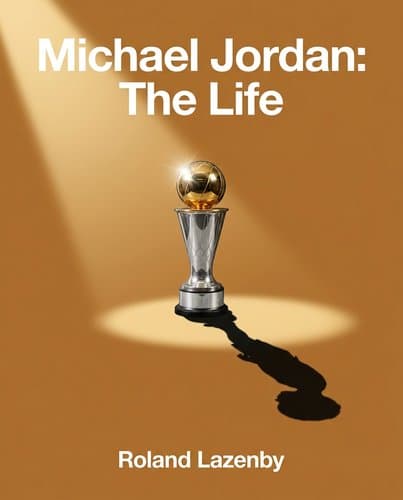
18453086_michael-jordan
by Roland Lazenby
Michael Jordan's relentless dominance wasn't genius or genetics—it was a multigenerational wound, a father's contempt transformed into an unstoppable…
In Brief
Michael Jordan: The Life (2014) draws on extensive interviews and research to trace Jordan's rise from a complicated family dynamic to global athletic dominance. Lazenby argues that Jordan's relentless competitive drive was rooted in psychological wounds rather than simple ambition, giving readers a framework for understanding how personal history shapes extraordinary — and sometimes destructive — performance.
Key Ideas
Wounds fuel relentless competitive drive
The fuel behind exceptional performance is rarely rational ambition — it's often an old wound seeking resolution. Understanding where your drive comes from doesn't diminish it, but it does explain why it can never be fully satisfied.
Greatness exacts a relational cost
The people closest to a great competitor often pay a disproportionate cost. Jordan's teammates, family members, and subordinates all absorbed the overflow of a compulsion that had no off switch — recognizing this pattern in high-performers around you (or in yourself) is the first step to managing it.
Competitive excellence fails in business
Commercial greatness requires different skills than competitive greatness — and the qualities that make someone unstoppable in one domain can make them toxic in another. Jordan's 'will to win at all costs' built an empire on the court and destroyed relationships and franchises in the boardroom.
Paternal dismissal becomes life's engine
Parental dismissal, even casual or unintentional, can become a life's organizing engine. James Jordan's offhand contempt created a competitor the world had never seen — but Jordan's sister's testimony makes clear that the same household produced damage that never appeared in any stat line.
Character emerges when competition ends
The most revealing moment of a winner's character isn't the championship — it's what they do when there's no game to win. Jordan's retirement periods expose what the competition had always been covering: a restlessness that was never really about basketball.
Who Should Read This
Readers interested in Memoir and Business Leaders, looking for practical insights they can apply to their own lives.
Michael Jordan: The Life
By Roland Lazenby
14 min read
Why does it matter? Because the man who made everyone 'Be Like Mike' was running from something his whole life.
Everyone knows the tongue. The hang time. The six rings. The image is so complete it feels less like a man than a verdict — here is what human athletic perfection looks like, period. But Roland Lazenby spent years pulling at the thread behind that image, and what unraveled is stranger and more unsettling than the myth. Because the same engine that produced the greatness — the titanium refusal to accept dismissal, the need to conquer every room he ever walked into — also produced the bullying, the gambling, the failed executive, the Hall of Fame speech that left an arena in uncomfortable silence. The wound and the gift were never separate things. They came from the same place, four generations deep in the Carolina soil, and the question this book asks — quietly, devastatingly — is whether a man can be the greatest who ever lived and still be running from something he never quite caught.
The Wound Was Inherited Before He Was Born
One afternoon in Wilmington, North Carolina, a young Michael Jordan went out to the backyard to help his father work on a car. James Jordan asked him to hand over a nine-sixteenths wrench. Michael didn't know what that was. James had no patience for the confusion. "You don't know what the hell you're doing," he told his son. "Go on in there with the women." Michael's sister would later say that this dismissal — repeated in manner and attitude throughout his childhood — became the engine of everything that followed. Each championship, each conquest, each moment when he refused to let a game slip away was, on some level, his answer to that backyard sentence.
What makes this strange is that James Jordan had heard a version of it himself. His own father, Medward, treated him with the same contempt, and James left Teachey for the Air Force partly to outrun it. The wound didn't originate with James either. Go back one more generation and you find Dawson Jordan — Michael's great-grandfather, five feet five, crippled in one leg, steering enormous chains of log rafts down the Northeast Cape Fear River through tidal surges and river bends. The work killed men. Dawson did it as a young teenager, on his own account, not for a boss. He made almost nothing. He survived. When Michael was small, Dawson was still hitching a mule to an oxcart, greasing the axle silent for moonshine runs through the Carolina dark. He died in 1977, days after Michael turned fourteen. Decades later, the mere mention of the old man's name could bring Michael to tears. "He was tough," Jordan said. That was the whole eulogy. It was enough.
What Lazenby's biography makes you see is that Jordan inherited something more specific than drive: the refusal, passed down through three generations of men who'd been dismissed or broken by circumstance, to stay down. The tragedy is that the household where this was forged was also a place of concealed damage. In 1975, Michael's older sister accused James Jordan of years of sexual abuse. Their mother heard the accusation, confronted her husband, and made the calculation that keeping the family intact — preserving James's job, the house, the middle-class stability — mattered more than what her daughter said had been done to her. Michael, twelve years old at the time, knew none of this. He just kept playing.
The Cut Didn't Break Him — It Became His Fuel
Jordan's competitive fury wasn't a gift. It was a manufacturing process, and the varsity cut at Laney High School in 1978 was where the machinery got installed.
The facts are simple and slightly absurd: a fifteen-year-old who had been the best player on his ninth-grade team checked the alphabetical list posted by coach Pop Herring and didn't find his name. The only sophomore selected was his friend Leroy Smith — six feet seven, and, as Smith himself would later admit, chosen for his height rather than his ability. Jordan walked home alone, locked his bedroom door, and wept until he couldn't anymore. He was careful that no one heard him.
What happened next is where the story turns. Rather than quit — and he considered it — Jordan played the entire following season on the junior varsity squad. He averaged 28 points a game and twice scored more than 40 in contests with only six-minute quarters. The numbers don't fully capture it. He was playing as though the varsity coaches were watching every possession, furious and unforgiving, settling the argument with each basket. When the season ended and Laney entered the district playoffs, no one called Jordan up to the roster. The coaches apparently never discussed it. So he dressed as the team manager, carried another player's gear through the door to avoid paying admission, and sat at the end of the bench actively wanting his own team to lose — certain, with the logic of a wounded sixteen-year-old, that their defeat would prove what their indifference had denied him.
The cruelty he felt that night never really left him. That's the thing Lazenby keeps circling back to. Jordan would later say that whenever workouts grew painful enough to make him want to stop, he'd picture that list on the locker room wall without his name on it — and keep going. The cut didn't break him. He turned it into infrastructure.
Greatness Is Recognized in One Possession
Tom Konchalski is having breakfast in the camp cafeteria when Brendan Malone walks in, still annoyed from driving back after a family emergency, and asks to see his team. Konchalski had been left explicit instructions: draft Greg Dreiling and Aubrey Sherrod, the same two players who'd won Malone the camp championship the year before. Sherrod was considered the best shooting guard in the entire rising senior class. Konchalski got Dreiling. He did not get Sherrod. Instead he drafted an unknown kid from Wilmington, North Carolina, who had played exactly one year of varsity high school ball. Malone, in Garfinkel's telling, went ballistic. Then he walked out to the asphalt courts and watched the kid move. He went quiet.
This is where the legend actually begins — not with the rings, not with the hang time, not with the tongue. Howard Garfinkel, running Five-Star that July of 1980 — the premier high school basketball camp of the era — caught a glimpse through his office window of an unknown player rising for a jumper with three defenders around him and found that nobody else in the frame had left the ground. That image had a name in Garfinkel's world: a one-possession player, meaning all you needed was one possession to know. Konchalski, a scout who had seen the same thing the night before during opening tryouts, quietly overrode his instructions.
What's easy to miss is how close this recognition came to not happening at all. Jordan wasn't supposed to be there. Street and Smith's Yearbook didn't have him in its top 650 prospects. Dean Smith's staff had been trying to keep him hidden to avoid a recruiting war. It was Roy Williams — a graduate assistant, not even a full coach — who quietly called Garfinkel and pushed until a spot was made. The boy from Wilmington showed up nervous, sweating through his hands, certain he was the least consequential person on the court. He walked out nine days later with nine trophies. His father, who had spent years imagining his son's future as a baseball player, stopped imagining anything else.
His Mother Closed the Nike Deal, Not Him
The night before Jordan and his family were scheduled to fly to Oregon for Nike's presentation, he called his parents and said he wasn't going. He was twenty-one years old, tired of traveling, and he didn't even like Nike shoes. He preferred Adidas — they came out of the box ready to wear. Deloris Jordan told her son he would be at the airport. He was.
What happened in that Oregon meeting is the real origin story of the empire. Jordan sat through the presentation stone-faced, arms folded against being impressed. When he looked at the red-and-black prototype shoe, he told the room it was 'the devil's color.' Sonny Vaccaro — the rumpled Pittsburgh hustler who had staked his $24,000-a-year salary on this single bet — watched the young man drift, but he couldn't stop watching Deloris. Specifically, he watched her face when Nike's representatives explained the royalty structure: her son would receive twenty-five cents on every Air Jordan sold. Something crossed her expression that told him everything. 'Someone was making them a partner instead of paying them a wage,' he recalled. She was a sharecropper's granddaughter. She knew in her bones what it meant when the person doing the work owned nothing of what they produced.
Vaccaro later called it a 'black power' moment — not the protest kind, but the economic kind. What Deloris grasped, sitting in that room, was something she'd understood her whole life and her son had not yet had to: that there was a version of this where they left with a check, and a version where they left with a stake. Michael just wanted to know if he could get a car. Vaccaro pulled two toy cars from his pocket and slid them across the table. That night at dinner, Jordan finally relaxed, charmed an upscale restaurant full of strangers, and let the Nike executives see the 'certain something' — the ease across all rooms — that the deal was actually betting on.
Deloris told her son: they want us as a partner. He listened. The NBA promptly banned the red-and-black shoes, fining Jordan $5,000 per game every time he laced them up. Nike paid every fine, filmed the ban into a television commercial, and turned a league prohibition into a $150 million marketing campaign. The whole machine ran on the decision Deloris made in a room her son hadn't even wanted to enter.
The Wound Ran Downhill onto His Teammates
What if the bullying was never really about basketball? Jordan's habit of tormenting teammates — calling Horace Grant 'Dummy' to his face for years, leading the locker room in barnyard noises when GM Jerry Krause walked in, telling a grown Larry at a shoe signing, 'Just remember whose name is on your shoes' — gets filed under competitive greatness, the acceptable tyranny of genius. But watch where the behavior comes from and it looks less like a management style and more like a wound that never healed, redirected daily onto whoever was nearby. Every teammate was Larry. Every authority figure was James Senior.
The same emotional reservoir that produced the cruelty also produced something else. Assistant coach Johnny Bach watched Jordan, before home games at the old Chicago Stadium, spend time alone with children who were terminally ill or badly disfigured. In one instance, a child whose face had been burned beyond recognition was placed on the Bulls' bench during a game. An official told Jordan this violated league rules. Jordan looked at him and said the boy was staying. He left team timeouts to check in with the child, asking whether he'd liked a particular jump shot. Bach said he and John Paxson had tears running down their faces watching it. Jordan insisted none of it ever be mentioned to the press. The same man leading the locker room in mockery of his own GM was also, quietly, absorbing the grief of strangers who had nowhere else to take it.
The machinery ran on one fuel source and produced two entirely different outputs depending on the direction it was pointed. Toward the vulnerable, it generated tenderness. Toward anyone who might compete with him — or remind him of inadequacy — something colder. Jerry Krause caught the cold version every day. Jordan couldn't separate the GM from the larger category of people who had doubted him or stood in his way.
Which makes Game 5 of the 1991 Finals the genuine miracle. Late in the fourth quarter, with a championship available, Jackson called timeout and asked Jordan twice who was open. Jordan stared at the floor both times. The question wasn't really about positioning. It was asking whether Jordan could, finally, trust someone enough to give them the ball in the moment that mattered most. He looked up. 'Pax.' Jackson told him to throw Paxson the ball. Jordan did it five times in the final four minutes. Paxson made every shot. The Bulls closed out the Lakers.
Afterward, Jordan sat in the locker room with his father and wept in a way he said he had never allowed in public before. James Senior held him. It's worth pausing on that image: the man who had spent a career re-inflicting his father's wound on everyone around him had, for one brief sequence, let it go — and the release came not from dominating the moment himself, but from trusting somebody else to finish it. He'd won. It had required giving the ball away.
The Icon and the Gambler Were the Same Compulsion
Richard Esquinas had warned him. Explicitly, plainly, almost pleading: I do not want this game, but if you lose, you pay. Jordan lost, bringing his tab to $1.252 million. Then he drove to Wilmington for a ribbon-cutting ceremony on a stretch of Interstate 40 named in his honor, stood in the Indian summer heat, and wept while his father beamed beside him wearing a 'Be Like Mike' button on his lapel.
Hold those two images next to each other and you see the whole thing. The machinery that built Michael Jordan — the absolute refusal to accept a loss, the compulsion to chase a deficit until it was settled or catastrophically worse — operated identically whether the arena was a basketball court or a golf course. On the court, this drive was called greatness. On the Aviara Golf Club fairways in San Diego, where Jordan had chased a $98,000 loss into a $626,000 hole and then demanded one more double-or-nothing until Esquinas finally relented and Jordan lost again, the same drive was called a problem.
Jordan told Esquinas he could easily absorb a $1.2 million loss. He may have believed it. What he couldn't absorb — what he had never been able to absorb since a fifteen-year-old locked his bedroom door in Wilmington and wept over a roster list — was the idea of staying down. The debt, like the cut, became something to chase. You could see the same instinct surface in smaller forms all season: when he draped an American flag over the Reebok logo at the Olympic medal ceremony in Barcelona, nobody at Nike asked him to do that. It was purely his, the same territorial possessiveness applied to a corporate logo that he applied to a fourth-quarter lead. Nothing that carried his name would be conceded without a fight.
What makes the gambling story something other than a cautionary tale about celebrity excess is what it reveals about the engine itself. Jordan didn't gamble despite the competitive drive; he gambled because of it. The compulsion never distinguished between venues. It produced the back-to-back championships. It produced the million-dollar golf debts and, separately, a $57,000 check made out to Jordan that police found in the possession of a convicted cocaine dealer — a detail that landed in the papers that same year with no clean explanation attached. Same fuel. Same machinery. The difference was only the surface it ran on. The only question the machinery ever asked was: are you going to quit, or are you going to raise the bet.
The Wound Never Healed — It Just Changed Targets
The original audience for Jordan's victories was his father. James Jordan was the man he had spent his entire career trying to impress, the man who had told him to go back inside with the women. In July 1993, James died in a swamp creek just across the South Carolina border, shot once in the chest by two teenagers who only realized who they'd killed when they checked his wallet. His cranberry-colored Lexus — the one Michael had given him, vanity plate UNC0023 — turned up stripped on a dirt road outside Fayetteville. The body had already been cremated by a part-time county coroner who said he lacked refrigeration. What followed was a conspiracy theory machine that ran for years, grinding away at the idea that Michael's gambling debts had gotten his father murdered. Jordan had to personally call a Chicago broadcaster to ask him to stop. The NBA closed its inquiry and said nothing. His father's murder became something Jordan couldn't avenge or argue with or score 40 points against. The machinery had no target.
His first retirement, the baseball years, the return — these are usually told as grief or restlessness or competitive curiosity. Probably all three. But underneath each move was the same problem: the original audience was gone, and no substitute ever held. Phil Jackson came closest. He had decoded Jordan in ways no one else had — at the end of the dynasty, Jordan wrote a poem for the team, and Jackson burned it in a Folgers coffee can and told the players those memories were theirs alone. When Jackson chose to leave anyway, Jordan felt it as abandonment. Steve Kerr, years later, heard the story and said the poem would have been worth millions. Jackson had burned millions of dollars in a coffee can to protect something private, and left anyway. The trust Jordan had spent years barely learning to extend got folded back up.
The Hall of Fame speech in 2009 was the mask finally slipping all the way off. He stood at the podium in Springfield and spent the ceremony relitigating every slight he had preserved since adolescence — the varsity cut, Dean Smith, Jerry Krause, a hotel room dispute with Pat Riley. Rick Reilly called it the Exxon Valdez of speeches. Krause, of all people, said the audience finally understood something he had known for decades: Jordan remembered everyone who had ever doubted him, and he kept every one of those memories in perfect condition. The speech didn't come from nowhere. It came from a man who had spent fifty years answering a question his father asked in a backyard in Wilmington, and who still, in the room where his life's achievement was formally recognized, couldn't stop answering it.
What the Wound Was Actually Asking For
The speech and that vanity plate are symptoms of the same unanswered question — just separated by fifteen years and James Jordan's death. The plate read UNC0023. James Jordan drove that car like it was proof of something — proof that the boy from Teachey had mattered, that his son had seen him, that the distance between a sharecropper's field and a Lexus dealership could be measured and crossed. When Michael got the news, he knew before anyone told him, because he knew what that car meant to his father. You can win six championships and still not be able to protect the one person you were winning them for. That's what the Hall of Fame speech was really about — not Krause, not Pat Riley, not some hotel dispute decades gone. It was a man still standing at the edge of a backyard in Wilmington, still holding out the right wrench, still waiting for the nod that never came. We tend to treat greatness as arrival. Jordan's whole life suggests it was motion — specifically, the motion of someone running toward a man who stopped being able to see him long before he died.
Notable Quotes
“I can tell you she is one of the most impressive people I’ve met in my life,”
“because she was able to negotiate this life for her son.”
“I said it, and I’m so glad I said it,”
Frequently Asked Questions
- What is Michael Jordan: The Life about?
- Michael Jordan: The Life (2014) traces basketball legend Michael Jordan's journey from his complicated family background to becoming a global athletic icon. Author Roland Lazenby draws on extensive interviews and research to argue that Jordan's relentless competitive drive was rooted in psychological wounds rather than simple ambition. This psychological framework becomes the key to understanding how personal history shaped Jordan's extraordinary—and sometimes destructive—performance both on and off the court. The book examines not just his athletic achievements but the hidden costs of his competitive nature.
- How did Michael Jordan's father influence his competitive drive?
- Lazenby argues that parental dismissal, even when casual or unintentional, can become a life's organizing engine. James Jordan's offhand contempt created a competitor the world had never seen, driving his son toward extraordinary athletic achievement. However, Lazenby also emphasizes through Jordan's sister's testimony that the same household dynamic that produced a champion also inflicted damage that never appeared in statistics or accolades. The book explores how the same family environment created both his unmatched competitive fire and lasting psychological wounds that shaped his relationships throughout life.
- What are the key takeaways from Michael Jordan: The Life?
- The book reveals that exceptional performance is rarely rooted in simple ambition—it stems from psychological wounds seeking resolution. Lazenby emphasizes that understanding the source of your drive doesn't diminish it but explains why it can never be fully satisfied. A critical theme is that high-performers' relationships often suffer disproportionately: teammates, family, and subordinates absorb the overflow of an unmanageable competitive compulsion. The book also distinguishes between competitive and commercial greatness, showing how qualities that made Jordan unstoppable on court—his 'will to win at all costs'—destroyed relationships and franchises in the boardroom.
- What does Michael Jordan: The Life reveal about his character away from competition?
- Lazenby argues that the most revealing moment of a winner's character isn't victory—it's what happens when there's no competition. Jordan's retirement periods exposed a fundamental restlessness that competitive basketball had always masked. Rather than finding peace or pursuing meaningful non-sport endeavors, Jordan struggled with the void left by competition, suggesting his drive was never truly about basketball itself but about the deeper psychological need for conquest and validation. This revelation transforms how readers understand Jordan's entire career, showing that even his greatest achievements couldn't satisfy the wound at his core.
Related Book Summaries
Read the full summary of 18453086_michael-jordan on InShort