16131189_mo-meta-blues
by Ahmir "Questlove" Thompson, Ben Greenman
Questlove can't remember his life without a record attached to it—and that's exactly the point. This memoir decodes how a drummer from a legendary collective…
In Brief
Mo' Meta Blues (June) traces Questlove's life through the records that shaped it, using memoir and music criticism to examine what it costs to maintain a collective artistic identity in a culture that rewards individual branding.
Key Ideas
Music and memory structurally preserve identity
Memory and music are structurally fused, not just emotionally linked — Questlove literally cannot recall an experience without its corresponding record, which means protecting your relationship with the music you love is actually protecting your ability to remember who you were
Collective friction creates irreplaceable collaborative breakthroughs
The collective model of making art — where tension, sibling rivalry, and competing constituencies produce something none of the individuals could make alone — doesn't just yield better work; it's a fundamentally different argument about what art is for
Discomfort signals genuine radicalism, not excellence
Recognizing when something will change history feels different from recognizing when something is excellent: excellence produces enthusiasm, but genuine radicalism produces paralysis and discomfort first. Trust the discomfort
Honest peer feedback versus approval-chasing differ
Creative humiliation (the 'sign of death' headbob from your peers) and strategic humiliation (the Pharrell bathroom mirror speech) look similar from inside but produce opposite results — the difference is whether you're responding to honest feedback or chasing someone else's approval
Compromise paradoxically reveals your authentic strengths
The thing that looks like selling out may actually be the only space left where your real strengths get to matter — but you can only recognize that if you've felt the full weight of what you gave up to get there
Who Should Read This
Readers who connect with first-person stories about Memoir and Artistic Expression and want to see the world through someone else's eyes.
Mo' Meta Blues
By Ahmir "Questlove" Thompson & Ben Greenman
15 min read
Why does it matter? Because the last band standing is also an argument about what we lost.
Most music memoirs are built around a single lie: that genius is solitary. One person, one lightning-bolt moment, one ascent. This book refuses that. What Questlove is actually tracing is a vanishing — the slow, economically-enforced death of the group model in hip-hop, the collective-as-creative-engine replaced by the solo act and the easy check. What you're about to read isn't a triumph narrative. It's something rarer: an elegy written by someone still standing in the middle of what's being mourned, whose own band became the last living evidence that another way was possible, and who loved music obsessively enough to notice exactly when, and exactly how, the thing he loved started disappearing.
Music Isn't What You Remember — It's How You Remember
A three-year-old Ahmir Thompson comes sprinting out of the bathroom, wet and furious about being in the bath, and crashes into a radiator. The burn scars his leg for the next sixteen years. What makes this memory strange — and what makes it the key to everything that follows — is what was on the television at that exact moment: Curtis Mayfield performing the bridge of "Freddie's Dead," the part where the horns swell and modulate into something almost unbearably tense. Decades later, Questlove cannot hear that song without the sensation flooding back. The music didn't accompany the trauma. It became the trauma, fused at the molecular level, so that the two things are now one indivisible object in his nervous system.
Questlove isn't telling you records provided a soundtrack to childhood in West Philadelphia. He's telling you music was the filing system itself — the actual structure by which experience got encoded and stored. Every clear memory he has from those early years arrives already paired with a specific record or a moment on Soul Train. The two cannot be separated because they were never separate to begin with. When he catalogs his record collection year by year in the book's appendix, he isn't being indulgent. He's showing you the architecture of a mind.
His manager and intellectual sparring partner, Rich Nichols, understood this so deeply that he arrived at the opposite conclusion: once he truly loves a piece of music, he refuses to play it again. His reasoning is precise and a little devastating. A second listening doesn't reinforce the original feeling — it begins replacing it with analysis, with context, with the smell of a tour bus. The memory is more real than the record. "As you get older," Rich said during one of his marathon phone calls with the book's co-writer, "feelings are harder to come by." For Questlove, that statement isn't pessimism.
Hiding Prince in a Floor Tom Is Also a Theory of Survival
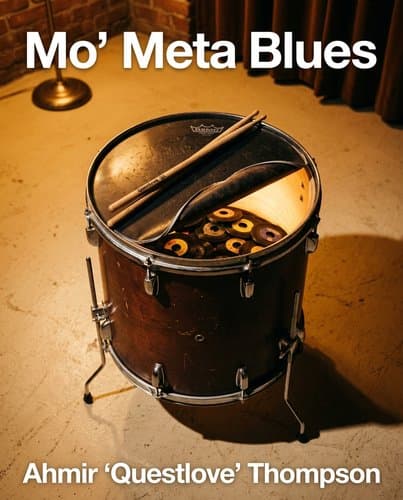
His father snaps the second disc of a double album over his knee — slowly, deliberately, in full view of a twelve-year-old Ahmir — and then leaves the room satisfied that the problem is solved. What he doesn't know is that the first disc survived, already hidden between the mattresses. The record is Prince's 1999, and Ahmir has already bought and lost it four times. He will buy it four more times before 1987. Between purchases, he learns to improvise: he routes cassettes through a friend who makes copies, then conceals the tapes inside one of his floor toms, stuffed behind a pair of opaque Remo Ebony drumheads pulled loose from the shell. When he wants to listen, he puts on headphones and plays something completely different on the drums above, so that anyone watching sees only a kid practicing. The contraband is in the drum. The actual music is in his ears. His hands are playing a cover story.
This is cleverness, yes, but it's also the first version of the move he'll make for the next thirty years. The floor tom maneuver is a survival technique — a way to preserve access to music his parents had decided was satanic, partly on the evidence that the album title, inverted, spells 666, and the numeral 1, also inverted, resembles something no one in their church wanted near a child. But the technique is also a philosophy. You keep the serious thing hidden inside the expected thing. You perform what the room requires while the real work happens underneath, inside, out of sight. The Roots will spend decades doing exactly this — making albums that satisfy a hip-hop audience on the surface while encoding an argument about jazz, funk, and the entire lineage of black American music in the structure beneath.
The floor tom was just the moment the education went underground.
The Last Hip-Hop Band Didn't Start With a Plan — It Started With a Lie
The Roots didn't start because two talented people recognized each other's gifts and decided to build something. They started because Questlove told a lie to impress a girl and then had to live inside it.
His target was Amel Larrieux — a beautiful, unattainable classmate at Philadelphia's High School for Creative and Performing Arts who would later front the R&B group Groove Theory. They were talking about Prince's Parade while waiting in the token line when Questlove heard himself claim that he and Tariq already had a group together. She smiled, held his gaze a beat too long, and asked if they were doing the school talent show. He said yes. And just like that, a band existed.
What happened next is the actual founding document of the Roots. To perform in the show, Questlove needed a backing band — which meant recruiting from the two warring factions of CAPA's jazz kids, the Wynton Marsalis traditionalists and the Frank Zappa iconoclasts, both camps united by their contempt for hip-hop. He got bass player Christian McBride to participate by obscuring the transaction: McBride agreed to loop a James Brown groove without being told it would anchor a rap performance. The jazz purist played the funk sample. Tariq rhymed over it. The whole thing was built on misdirection from the bottom up.
They performed on Valentine's Day, 1989, under the name Radio Activity. There was no manifesto, no plan to become the last live-instrument hip-hop band of their era. There was a lie, a talent show deadline, and a technique Questlove would keep using for the next thirty years: hide what you're actually doing inside something the room is already willing to accept.
The lie worked because the organic process it set in motion was truer than any plan could have been. Two years later they were busking on South Street with buckets as percussion, earning forty dollars a day — enough, as Questlove put it, to buy turkey, pepper-jack cheese, and iced tea for yourself and a girl. Small stakes, but real ones. Those sessions attracted Richard Nichols, the avant-garde jazz radio DJ who had recently quit Temple University's WRTI rather than submit to a computer-governed playlist that would have forced him to play Mel Tormé on schedule. Nichols found his way to a $150 studio session and heard something in Anti-Circle and Pass the Popcorn that he described as approaching inspired. His model for what success could look like was Lester Bowie playing for thirty people at a club and somehow keeping a minivan and a family. That was the ceiling he was aiming for.
What's unusual here is that the accident is preserved — the lie, the trick, the bucket drumming — because those accidents are exactly what the Roots became. They were the last band that built it this way.
Hip-Hop Had a Funeral in 1995, and You Can Name the Exact Moment It Died
Questlove can tell you the exact night hip-hop died: May 1995, the Source Awards at Madison Square Garden. Not a gradual decline, not a slow commercial erosion — one room, one night, one man's face.
The room was a diagram of the genre's fault lines. The artistic rappers — Nas, Wu-Tang, Mobb Deep — were seated on the far right, away from the action. The commercial forces, Death Row and Bad Boy, occupied the center and far left. Questlove clocked Nas walking in wearing a Tommy Hilfiger shirt two sizes too large, later confirmed to have been purchased on borrowed money. That shirt was already a signal before the awards even started.
Then the envelopes opened. Nas had released Illmatic the previous year to near-universal reverence — five microphones in the Source, critics tripping over themselves to crown it. Biggie's Ready to Die had come out right behind it, built not around the integrity of a complete artistic statement but around the architecture of hit singles. Both albums were nominated for the same awards. Biggie swept every one. Questlove watched Nas lose each category, watched his posture change, watched something recede behind his eyes. He turned to Tariq and said the man would never be the same after that night. What he was watching wasn't just a defeat — it was the market issuing a verdict: cohesion doesn't sell, singles do. Nas understood. The room understood. That understanding was the funeral.
Questlove ran. Literally — he grabbed his date and bolted when the room turned menacing after Suge Knight called out Puffy from the podium and the air went toxic. In the stairwell, a stranger pressed a cassette into his hands: D'Angelo, Brown Sugar. He almost threw it away. He played it instead, and heard something he didn't have a word for yet — it sounded like the music A Tribe Called Quest would make if someone were singing over it, warm and slightly off-kilter in a way that felt human rather than engineered.
But to understand why that cassette hit the way it did, you have to sit with what he left behind in that room: the sight of a great artist absorbing the lesson that greatness, without commercial strategy, would simply be outcompeted and forgotten. The market didn't kill Nas. It just made him watch his own irrelevance get announced from a podium, award by award, in front of everyone who'd called him a genius six months earlier.
The Sound Engineer's Nightmare: What It Means to Play at 140 Decibels
Aba Shanti has his back to the room. That alone is strange — every DJ Questlove has ever seen faces the crowd, reads the crowd, performs for the crowd. Shanti faces the cross instead, flanked by speaker cabinets that take up most of the stage. This is a club that used to be a church in London, and Shanti performs it like a service rather than a set. He has one turntable. Before he plays anything, he walks to the control board and strips every frequency — lows gone, mid-lows gone, highs gone. Then he lifts a microphone in his right hand and extends his left arm out toward his crate of 45s. The crowd starts screaming at the gesture of the arm alone. He hasn't touched a record yet.
When he finally drops a B-side onto the single turntable, what comes out is a thin, upper-register ghost of a song — all treble, almost painful. He builds from there, adding frequencies back in stages, letting the mid-range fill the room. Then he flips to the A-side and reaches for the bass. When that bottom end arrives, it doesn't just enter the room — it moves through the people standing in it. A physical jolt, not a sonic one.
Questlove describes his entire prior understanding of DJing as being a sophisticated jukebox: you know more songs than anyone else, you read the room, you deliver. Watching Shanti, he grasps something different. Sound at that level isn't entertainment — it's physiological. The DJ isn't serving the audience's expectations; he's controlling their nervous systems before their conscious minds can catch up. Rich Nichols, standing next to Questlove that night, reduces it to a single sentence the next morning: he wants the audience to have a colonic at every Roots show.
They go build that. The Roots become the act every sound engineer dreads — demanding 135 to 140 decibels rather than the standard cap of 118, operating almost entirely in the low end where kick drum and bass guitar live. What it produces is a body memory in every person who stands in front of the stage. The thing Questlove learned that night is unteachable by any other method and unreviewable by any critic who wasn't there.
The Soulquarians Were a Utopia — Which Is Why They Couldn't Last
The Soulquarians could only have existed the way they did — as a loose collective of geniuses sharing studios and cassette tapes and borrowed energy — because every member needed the others slightly more than they wanted to admit. That imbalance was the whole engine. And imbalances always resolve eventually.
The collective formed organically around late-night sessions at Electric Lady Studios, where Questlove was simultaneously working on D'Angelo's Voodoo, Common's Like Water for Chocolate, and the album that would become Things Fall Apart. The air in those rooms ran on competitive love — everyone hearing everyone else's work in progress, everyone pushed by proximity. Questlove named the group the Soulquarians partly as a joke about their shared January and February birthdays, partly because he genuinely believed he'd recreated the Native Tongues energy he'd grown up worshipping. It felt like a utopia because, for a moment, it functioned like one.
Then he played a rough sketch of 'Double Trouble' for the room. Present that afternoon: DJ Premier, J Dilla, and D'Angelo — three of the people whose opinions mattered most to him professionally. They nodded. Nobody made eye contact. Questlove knew that move: it's what you do when a song doesn't grab you but you don't want to say so out loud. The performance of enthusiasm without the thing itself. He went back to the studio that same night and rebuilt the track from the ground up, refusing to sleep until it could genuinely hold its own against what the others had played.
That humiliation was actually the system working correctly. You couldn't coast on your reputation in that room because everyone else in the room had an equally impressive one. The whole thing depended on everyone being equally unimpressed by everyone else's resume. Which meant it depended on everyone staying equal — and fame doesn't distribute equally for long.
When Vibe ran a feature positioning Questlove as the leader of the Soulquarians — photographs centered on him, framing that made everyone else look like collaborators on his project — the phones started ringing. Mos Def called. Q-Tip called. Separately, same complaint: it looked like they worked for Ahmir. Two phone calls, same wound. The collective had never had a leader, because it couldn't have one without ceasing to be what it was. The magazine didn't break the Soulquarians. It just made visible the structural contradiction that had been there all along.
What Collapse Looks Like When You're Standing Inside It
Questlove walks into a bathroom in a Virginia recording studio, plants himself in front of the mirror, and starts talking. Not to a bandmate, not to a producer — to his own reflection. He tells himself he is going to walk back out into that studio and play a drum track at exactly ninety-six beats per minute, rimshot on the snare, something that could slot next to N.O.R.E.'s definitive Pharrell-produced hit of that year and then surpass it. He is that specific with himself. Then he opens the door and does it. He plays for twenty minutes straight until his wrists go raw and the floor is scattered with broken sticks. Pharrell, at the piano with his back to the kit, eventually stops, crosses the room, and bows. He says the word "magic." Questlove's brain is still ringing. He walks to the van to tell his bandmates they have their track. Pharrell follows him out to explain that, actually, he already gave it to Snoop Dogg.
That story is the entire era in miniature. The Roots had always been a collective bet against the solo-act logic of the music industry — a live band in a genre that had stopped needing one, an album-oriented enterprise in a market rewarding singles, a group identity in a system that wanted to anoint individuals. The bathroom speech, the twenty minutes of splinters, the bow: all of it was real effort, freely given, producing something genuinely worth having. And the industry simply handed it somewhere else. When they delivered the resulting album, their label president Jimmy Iovine heard their biggest recent hit and said it sounded old.
Then came the visit to Los Angeles during Grammy week, 2006. Questlove and keyboardist James Poyser had heard that J Dilla — the Detroit producer who had quietly underpinned the entire Soulquarians era, who Questlove considered his idol — was unwell. What they found when they walked into his house was an eighty-pound man in a wheelchair who couldn't form sentences. His setup told the whole story without words: no racks of gear, no sophisticated rig like the one he'd had in Detroit. A small drum machine. A small keyboard. A Rotary Connection album on the turntable, looking, as Questlove would remember it, completely out of place, like an object that had arrived from a different timeline. Six weeks later Dilla was dead at thirty-two. The music he left behind — reassembled samples, loops stripped from their sources, the thirty-one short pieces that make up Donuts, asking whether borrowed bricks could constitute an original house — would outlast the industry that had barely noticed him. But that afternoon, in that room, what Questlove saw was the cost of betting everything on the music itself: you could be the most gifted person in a generation and end up with a drum machine and a turntable in someone else's city, waiting.
The Job That Looked Like Selling Out Turned Out to Be the Only Free Space Left
After all of that — Dilla dying in a wheelchair, the funerals and fallouts and industry fictions that preceded them — the Late Night offer looked exactly like what they'd been warned about. For three decades, the Roots had been threading an almost impossible needle: making albums dense with jazz architecture for audiences trained by radio to want hooks, performing at volumes sound engineers hated, refusing to break up even as the industry kept waiting for them to. Every pivot got framed as compromise. Rolling Stone called the Def Jam years a retreat from the underground. The Fallon offer felt like one more version of the same trap — trade the touring money that had taken fifteen years to accumulate for a day job on television, the medium where hip-hop credibility goes to dissolve.
Then Questlove walked out of a backstage interview at a UCLA show and saw Jimmy Fallon in the middle of a human pyramid with almost the entire band — Tariq, Frank, Kamal, Owen, Tuba — all of them laughing like teenagers. Fallon had been there roughly ten minutes. The Roots were a guarded group; relationships inside the band had grown careful and sometimes formal enough that Questlove and Black Thought were riding separate tour buses, one labeled Gryffindor and one Slytherin. Fallon dissolved that in less time than it takes to sound-check a snare. The involuntary thought that surfaced wasn't enthusiasm — it was resignation, the warm kind: oh no, we're stuck with this guy.
The turning point came a few weeks into taping, during a segment where Jimmy polled the audience about their jobs and lives, handed the answers to Questlove and Tariq, and asked them to play the results back as surf music, or heavy metal, or country. This was the thing the Roots had always been, finally given a format that required it. Every record they'd made contained this capacity — the ability to move between idioms without losing the thread — but albums asked you to commit to one argument per release. The television segment asked you to do it in three minutes, every day, in front of an audience that didn't know the joke was on anyone who thought genre was a limit. They killed it. The word Questlove uses is specific: they took everything thrown at them and spun it into gold. After that session, for the first time in years, the work felt like what he'd always meant to be doing.
The Fallon gig also became, unexpectedly, the best crate-digging operation of his career. Every booked guest meant an obsessive research dive — Metacritic scores, full album streams, YouTube interviews — and occasionally a genuine shock, like the night Dirty Projectors performed and three vocalists traded rhythmic parts so tightly they sounded like a single keyboard. Questlove posted the dressing-room encore online and it went viral, which delighted and unsettled him equally: the show had made him look forward-thinking because it put him in the same room as forward-thinking artists, whether he was ready for them or not. The day job was also, without his asking, a continuing education. The gig that looked like settling down turned out to be the only space that kept demanding more.
The Question the Drumbeat Keeps Asking
Here's what the book finally leaves you with: the Roots stayed a band for thirty years because disbanding would have been the easy argument, the legible one, the one the industry already knew how to reward. Every economic signal said break up, go solo, stop splitting the check eight ways. They ignored it so consistently it stopped looking like stubbornness and started looking like a thesis. Then the Late Night job arrived, dressed as compromise, and turned out to be the only room where that thesis got to fully breathe — where switching between heavy metal and surf music on demand wasn't a trick but the whole point, where staying together all those years turned out not to be loyalty but preparation. You can only feel how strange that vindication is if you've tracked the cost. The cymbal is still ringing. Questlove has already left the room.
Notable Quotes
“Something in the Water Does Not Compute,”
“He’s never going to be the same. You just watch.”
“Why didn’t you get grits?”
Frequently Asked Questions
- What is Mo' Meta Blues about?
- Mo' Meta Blues traces Questlove's life through the records that shaped it, using memoir and music criticism to examine what it costs to maintain a collective artistic identity in a culture that rewards individual branding. The book draws on his career with The Roots to provide a framework for understanding how communal creativity works. Central to the narrative is the discovery that memory and music are structurally fused—Questlove literally cannot recall an experience without its corresponding record. The work explores why genuine innovation feels like discomfort before it feels like genius, and how to distinguish honest feedback from false approval.
- What are the key takeaways from Mo' Meta Blues?
- Mo' Meta Blues reveals that memory and music are structurally fused, not just emotionally linked—protecting your relationship with music is protecting your ability to remember who you were. The collective model of art-making, where tension and competing constituencies produce something no individual could create alone, fundamentally redefines what art is for. The book teaches that genuine radicalism produces paralysis and discomfort first, unlike excellence which produces enthusiasm. It distinguishes creative humiliation from strategic humiliation based on whether feedback is honest or approval-seeking. Finally, what appears as selling out may be the only space where your real strengths matter.
- What does Mo' Meta Blues reveal about collective creativity?
- Mo' Meta Blues argues that the collective model of making art—where tension, sibling rivalry, and competing constituencies produce something none of the individuals could make alone—doesn't just yield better work; it's a fundamentally different argument about what art is for. Through Questlove's experience with The Roots, the book demonstrates that collaborative creativity creates superior outcomes than individual work. The tension-filled creative process generates innovation that single creators cannot achieve. This model challenges the cultural reward system favoring individual branding by showing that shared artistic identity produces meaningful work impossible to create in isolation.
- How does Mo' Meta Blues distinguish between types of creative feedback?
- Mo' Meta Blues distinguishes creative humiliation from strategic humiliation, showing they produce opposite results despite appearing similar from inside. Creative humiliation (the 'sign of death' headbob from your peers) and strategic humiliation (the Pharrell bathroom mirror speech) differ fundamentally in whether you're responding to honest feedback or chasing someone else's approval. The book emphasizes trusting your discomfort response when encountering genuine radicalism, as excellence produces enthusiasm while radical innovation produces paralysis first. Understanding this difference helps artists navigate feedback authentically, recognizing whether criticism serves their artistic growth or merely fulfills external expectations.
Related Book Summaries
Read the full summary of 16131189_mo-meta-blues on InShort