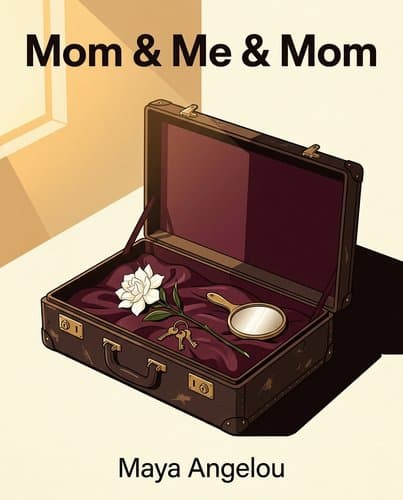
15798797_mom-me-mom
by Maya Angelou
Maya Angelou traces her journey from abandoned child to beloved daughter, revealing how her mother Vivian Baxter's fierce, unconventional love—arriving decades…
In Brief
Maya Angelou traces her journey from abandoned child to beloved daughter, revealing how her mother Vivian Baxter's fierce, unconventional love—arriving decades late—ultimately gave her not comfort, but something more powerful: the blueprint of a woman who refused to diminish herself for anyone.
Key Ideas
Charity through small daily personal acts
Charity begins with the smallest gestures: a smile for the person supporting you, a kind word when silence is easier. Vivian's lesson to thirteen-year-old Maya — 'be charitable' — wasn't about money but about the daily choice to give something of yourself even when you don't feel like it.
Persistent dignity as tactical strategy
When you're refused something you deserve, persistence executed with dignity is a strategy, not just a virtue. Vivian's streetcar job campaign — Russian novels, two weeks of racial slurs, a single lie — was a deliberate tactical operation, not passive waiting.
Detailed blessing inventory rescues from despair
If you're in despair, write down your blessings in granular physical detail: start with hearing, then sight, then what you can read. Voice teacher Wilkie's yellow-pad exercise rescued Maya when a psychiatrist couldn't — because it forced imagination of loss rather than accounting of gain.
Reputation is your most portable currency
Reputation is the most portable currency you have. Vivian's formulation: not clothes, not money, not cars — if your reputation is good, you can rebuild from anywhere. This is a practical claim, not a moral one.
Honest explanations build trust better than apologies
A parent who explains rather than apologizes can still earn trust — if the explanation is honest and specific enough to be useful. Vivian's 'I'm explaining, not apologizing' was only credible because her account of her own failures was exact and unsparing.
Physical presence affirms value more than words
When someone you love is treated badly, your presence — physical, deliberate, unhurried — communicates their value more than any argument. Vivian flying to Stockholm changed how the crew treated Maya without changing any facts about the production.
Who Should Read This
Readers who connect with first-person stories about Memoir and Resilience and want to see the world through someone else's eyes.
Mom & Me & Mom
By Maya Angelou
14 min read
Why does it matter? Because the mother who abandoned you can still be the one who liberates you.
At three years old, Maya Angelou was put on a train to Arkansas with an identification tag on her arm and no adult. Most people would call that abandonment. Angelou calls it the beginning of how she was loved. Mom & Me & Mom is the story of two mothers — the grandmother who raised her with discipline and public pride, and the biological mother who arrived late, loud, and carrying a pistol — and how both, in their radically different ways, made her. What this memoir refuses to do is let you settle into easy judgment. The woman who sent her children away was not a monster. The woman who hit her daughter in the face with a ring of keys was not a villain. What Vivian Baxter was, instead, was something harder to name — and this book holds it without flinching.
The Woman Who Explained Instead of Apologized
In a California kitchen — timeline unspecified, the children newly returned to their mother — Bailey Junior asks the question that has been accumulating for years: why did you send us away, and why didn't you come to get us? Vivian Baxter sits them down and answers without flinching. She and their father fought like wild animals, she says. The night his mother's letter arrived asking them to send the children to Arkansas, she and Bailey Senior went out together for the first time in a year and had a meal without cursing each other across the table. Sending the children away was the most peaceful thing their presence had ever produced.
Then she goes further. When Maya was two, she interrupted Vivian mid-conversation, and Vivian slapped her off the porch on reflex. Not with calculation. Not out of cruelty. The reflex of a woman who had not yet grown into the patience that motherhood required. She offers this as evidence, not confession. "I'm explaining to you, not apologizing," she tells them. The difference matters enormously. An apology asks forgiveness; an explanation asks you to understand who someone actually was.
To understand Vivian Baxter is to hold two things at once that resist being held together. She grew up in St. Louis as the designated enforcer of a family notorious for communal violence — the Bad Baxters. When a neighbor gave offense, her brothers would fan out through the offender's local bar, blocking every exit, while her uncle snapped a wooden chair in half and handed Vivian the piece she'd need. The same people, on the same evenings, gathered around their grandmother's piano to harmonize on Baptist hymns, passing around Budweiser and singing loud enough for the neighbors to wander in and join.
Vivian told her children the truth about herself rather than perform remorse she didn't feel. You can disapprove of almost every choice she made and still recognize something trustworthy in the telling. She handed them the facts of who she was and let them decide what to do with it.
Charity Isn't About Money — It's the Smallest Thing You Can Give
Vivian Baxter understood something most parents don't: that demanding love from a child who doesn't know you yet is a form of theft. So she didn't demand it. She asked for a smile.
Maya arrived in California at thirteen — tall, self-conscious, convinced her movie-star mother deserved a prettier daughter. For two weeks she answered questions in the fewest words possible and never once started a conversation on her own. Then Vivian sat her down. The speech that followed wasn't sentimental. Vivian acknowledged the obvious: she was nothing like the grandmother who had actually raised Maya. But she was paying the rent, and she had a point. Every day at school, Maya would smile at teachers she barely knew and classmates who meant nothing to her. If she could manufacture warmth for strangers, she could manage it for the woman who took her in. "Be charitable," Vivian said — then made a silly face. Maya smiled before she could stop herself. Vivian kissed her and cried. It was the first time she had seen her daughter's smile.
The naming negotiation that followed worked on the same logic. Maya couldn't call this glamorous near-stranger "Mother" — that word belonged to her grandmother in Stamps. So she offered "Lady," because the woman was beautiful and didn't look like any mother she recognized. Vivian took it as a compliment. At a family dinner shortly after, she announced the new name publicly and reframed Maya's emotional distance as a form of praise. What could have been a confrontation about rejection became, through Vivian's handling, a ceremony of mutual recognition. You can't manufacture that kind of grace. You can only notice it when you see it.
To Win a Job You Were Denied, You Have to Become Undeniable
What does a mother do when the world refuses her daughter? Vivian Baxter's answer was not comfort. It was a battle plan.
When Maya returned to San Francisco and announced she wanted to become a conductorette on the streetcars — drawn to the crisp uniforms and the small money-changing belts the women wore — Vivian told her to apply. The company wouldn't even hand her an application. Maya came home and reported the obvious: they wouldn't see her because she was Black. Vivian's response skipped past consolation entirely. She asked one question — did Maya still want the job? — and when the answer was yes, she gave her a strategy down to the logistics. Show up before the secretaries arrive. Bring money for a proper lunch at a good restaurant, because how you carry yourself matters. Bring something to read, one of those thick Russian novels Maya was working through at the time, Tolstoy or Dostoevsky. Then simply refuse to leave.
What followed was two weeks of calculated humiliation. Former classmates from Maya's high school, girls whose homework she had once helped with, now worked as secretaries in that office. They walked past her daily — laughing, contorting their faces, whispering racial slurs. By the third morning Maya wanted to stay home. She couldn't. Not because she felt strong, but because she couldn't bring herself to admit to Vivian that she wasn't as strong as her mother believed her to be. That belief, held firmly and without negotiation, functioned as a kind of architecture Maya had to grow into.
She eventually got the interview, secured the job partly through an invented credential — she claimed to have chauffeured for her grandmother in Arkansas, a woman who rarely rode in cars — and boarded her first shift at four in the morning. Vivian drove her to the beach where the streetcar barn sat, then followed the car in her own vehicle with a pistol on the seat, honking at first light before turning home. The pistol would stay in the picture for a while yet.
Power Isn't Taken — It's Given
Maya came home smiling. She had stayed out until one in the morning — hours past curfew, drawn along by a crowd of teenagers liberated by tamales and tacos and the sound of mariachi music bouncing off the walls of the Mission District. She was still smiling when she put her key in the door. Her mother hit her in the face with a ring of twenty keys before the door was fully open.
The violence was real. Maya's eyes went black, her lips swollen, blood in her mouth. But here is what Vivian said the next morning, on her knees on the kitchen floor: she had just come from Maya's empty room. She was already holding the keys when the door opened. And what flooded her wasn't anger — it was the memory of what a man had done to Maya when she was seven years old, the same childhood assault Vivian had spent years trying to outrun as a mother. The smile on her daughter's face, at one in the morning, arriving from nowhere — she struck before the thought formed.
The morning after, Bailey packed a suitcase. He was seventeen, considerably shorter than his six-foot sister, and utterly in charge. He came downstairs and told Vivian they were leaving. His exact words: "Nobody, but nobody, beats up my baby sister." Vivian, this woman who commanded her household the way a general commands a territory, reeled at the sight of Maya's face and began to beg.
What followed in the kitchen is the most psychologically complete portrait the book offers of Vivian Baxter. She sent the men away. She placed a tea cloth on the floor. Then she got down on her knees and prayed aloud for forgiveness before turning to her children and asking for theirs. Not from a chair. Not with composure. From the floor.
Bailey's observation afterward is the thing worth keeping: Vivian couldn't have done this in front of Daddy Clidell and Papa Ford — it would have dissolved the authority she held over them. She knew that, and she knelt anyway. Bailey said she didn't lose power by surrendering it to her children. She gave it to them. The distinction is everything. Power taken is a wound. Power given, deliberately, by someone who knows exactly what it costs — that's a different transaction entirely.
The Three Questions That Replaced a Lecture
Vivian Baxter arrived from Nome expecting a daughter three weeks pregnant. She got one three weeks from delivery — a teenager standing six feet tall and visibly enormous, convinced her mother was about to destroy her. Vivian looked her over and told her to run a bath. When it was ready, she climbed in and called Maya to sit with her on a stool in the steam.
What happened next was not a lecture. Vivian lit a Lucky Strike, offered Maya a Pall Mall since that's what she smoked, and asked exactly three questions. Do you know who the father is? Do you love him? Does he love you? Maya answered yes, no, no — one encounter, no attachment, nothing to salvage on either side. Vivian didn't need anything more. Her verdict came without pause: we will not ruin three lives. She said this child belonged to the family, would be welcomed by the family, and that was the end of it.
Notice what she didn't do. She didn't ask why. She didn't make Maya account for the impulse that led to a neighborhood boy and a borrowed room and sex with no kissing. The three questions weren't an interrogation — they were a triage. The only information Vivian needed was whether there was anything worth preserving between Maya and the father. There wasn't. So the question of fault became irrelevant, and Vivian simply turned toward the future.
Vivian's three questions replaced an entire genre of conversation — the kind that exists to make the person in trouble feel the full weight of their failure before anyone agrees to help them. She skipped it entirely. What she offered instead was her version of solidarity: you made a decision, here is what it produced, here is what we're going to do about it.
The birth three weeks later carried the same logic into physical form. When contractions started and the doctor failed to appear, Vivian climbed onto the delivery table herself, put Maya's leg against her shoulder, took both her hands, and timed dirty jokes to the contractions so that Maya was laughing as she bore down. She announced the baby's arrival — black hair, handsome, wonderful — with the calm authority of someone who had planned for this outcome all along. Daddy Clidell said when she got home she looked like she'd delivered twins herself.
When Maya moved out two months later with the baby, Vivian's farewell was the benediction the whole arc had been building toward: you've already been raised, you know right from wrong, you can always come home. Walking back to her room, Maya caught herself calling Vivian "Mother" — not "Lady," the careful name she'd chosen years earlier for a woman too glamorous to claim as her own. She had earned the word without noticing.
The Cost the Brother Paid That the Daughter Didn't
The same love that was enough for Maya was never quite enough for Bailey — and Angelou doesn't soften this. It is the book's most honest accounting.
Bailey was five when they were sent to Arkansas. Maya was six. By the time they came back to Vivian in California, Maya had something Bailey didn't: she had Maya. She had her brother, the person she loved most in the world, and that meant Vivian's eventual arrival in her life was additive — a discovery, a bonus. Bailey had been waiting for his mother the entire time. He showed up already hollow.
Angelou marks the wound precisely. When Bailey enlists in the merchant marine one month before graduation — snatching his papers back when Vivian reaches for them, telling her that her disappointment is, as usual, really about herself — the cruelty is calculated. He connects his suspicion that Vivian is sleeping with a family friend named Buddy directly to the fact that she once gave her children away: 'She abandoned her own children. Why wouldn't she commit adultery?' The logic is adolescent and wrong. But the emotional grammar is coherent. He is telling her that the woman she is now cannot be separated from the woman who shipped them off. Vivian's current love is permanently contaminated by her prior absence.
Years later, Maya finds him in a shoot-up house in East Oakland. She walks past two men guarding the door, sits beside her brother on a sofa, and asks him to come with her. He refuses without drama. 'You can't change me,' he tells her, 'but you can change you.' He is in charge of the room — even the doormen defer to him — and he is going nowhere.
Bailey eventually surfaces through a marriage to a woman who looked and laughed like Vivian herself. When that woman dies suddenly, he disappears back into addiction inside a week. The rescue was real. The rescue wasn't enough.
Vivian's verdict when Maya reports back is the hardest line in the book: he has never forgiven her for Arkansas, she is sorry he can't let it go, she did the best she knew to do, and she cannot undo history. No performance of guilt. Just the facts of what was and what remains.
When Gratitude Is the Only Medicine That Works
The same years that were swallowing Bailey were taking a toll on Maya too. Seven years after the Porgy and Bess tour, she found herself lying on a sofa in her mother's San Francisco house, watching Guy walk through the room, and feeling an impulse so sudden and complete it shocked her: pick him up, open the window, jump. She ordered him out of the house immediately, called a cab, and went to Langley Porter Psychiatric Clinic — an act of will that is itself remarkable, the part of her that knew what was happening moving faster than the part that wanted to act on it.
The clinic couldn't help. A receptionist explained there were no appointments available until Maya stated plainly that she was about to hurt herself and possibly someone else. That got her into a room — but the room contained a young white man in a Brooks Brothers suit, calm and confident behind his desk, and every time Maya looked up at him the tears came harder. He wasn't useless because he lacked training. He was unreachable because he was on the wrong side of every divide that had produced her grief. She thanked him, asked the receptionist to call a cab, and left without receiving anything.
What actually worked was a yellow legal pad and a ballpoint pen. Maya went to her voice teacher, a mentor named Frederick Wilkerson — Wilkie — who poured her a Scotch, let her sleep, and then, after she told him twice that she was going crazy and had thought about killing herself and Guy, sat her down at a table and gave her an instruction so simple it felt like an insult. Write down your blessings. Start with hearing. Think of every person in the world who has never heard a choir, a symphony, a baby crying. Write: I can hear. Then sight. Then reading. Then keep going.
Maya followed it. By the bottom of the first page — I can hear, I can speak, I have a son, I have a mother, I have a brother, I can dance, I can sing, I can cook, I can read, I can write — she felt, in her own words, silly. She had spent two months in Rome aching to hold her son. She could walk into the next room and do it right now.
The exercise works because it's specific in exactly this way: Wilkie didn't ask her to feel grateful in the abstract. He forced her to name it — to inhabit gratitude by imagining its exact opposite, the particular silence of someone who has never heard music, the particular dark of someone who has never seen a face. You can't fake your way through that. By the end of the page, what she called the agent of madness had retreated. Not because a professional had named it, but because a mentor with a yellow pad had handed her a structure she could actually climb.
A Horse Needs a Tail More Than One Season
Maya was in Stockholm writing the score for a film — the first time any Black woman had a screenplay produced by a major company — and the production was quietly humiliating her. The lead actress had gotten Maya banned from the set except to braid her cornrows each morning, after which the crew stood in loaded silence until Maya walked back across the lawn. When the accumulated weight of it broke through, she called her mother. She didn't use 'Lady,' the elegant name she'd chosen years earlier for a woman too glamorous to claim as a parent. She didn't say 'Mother.' She said 'Mom,' and asked for mothering — the first time, and the word itself was the whole request. Vivian was on a plane from San Francisco before the day ended.
She arrived at the Stockholm airport in high heels and a sable stole, diamonds flashing, waving a small military salute from the top of the steps — a woman absolutely in charge of her own entrance. At the bar, before anything else was discussed, she ordered Scotch for Maya, Scotch for herself, and a round for every stranger in the place. Then she delivered a folk parable: a horse that throws off its tail at summer's end because it can't be bothered is a fool. Spring will come. The flies will return. The people treating you badly now will need you later. In the meantime, she was here.
Within days of Vivian cooking fried chicken and greens for the cast in Maya's sublet apartment, the director who had expelled her from set quietly reversed course and invited her back. The actress began smiling. The actor who had threatened to abandon the production now praised Maya's writing. No salaries had changed. No grievances had been formally addressed. Maya's explanation is the sharpest insight in the chapter: her mother 'stood in the gap' — and her presence told everyone around her that this woman was worth flying across the world for. That, by itself, was the argument.
A Terrible Mother of Small Children, the Greatest Mother of an Adult
What does it mean to be forgiven by someone honest enough to tell you exactly where you failed? Not absolved — not handed a clean slate through sentiment — but looked at clearly, faults named precisely, and accepted anyway?
When Maya finally speaks the verdict aloud, her mother is in a coma and can only squeeze her hand twice in response. That's all she gets. But what Maya says is the most accurate thing anyone has said about Vivian Baxter in the entire book: she was a terrible mother to small children, and there has never been anyone greater as a mother to a young adult. Both halves are true. Neither cancels the other.
This is the shape the memoir has been building toward all along. The woman who slapped a two-year-old off a porch without thinking, who shipped her children to Arkansas when she could no longer manage them, who was absent for the years that hollowed Bailey out beyond repair — that woman is real. So is the one who sat across from her pregnant teenage daughter with a cigarette and three questions instead of a lecture. The one who flew to Stockholm in a sable coat and stood in a gap so her daughter wouldn't have to stand there alone. The one who, even dying, heard that Maya had declined an offer to teach at Exeter and called her to the bedside: go, she said, show them you spell your name W-O-M-A-N. Still refusing, at the end, to let her daughter make herself smaller.
Vivian's love was not the right love for childhood. Children needed constancy, presence, the ordinary dailiness of a parent who simply stayed — and Vivian couldn't give them that, or didn't, which amounts to the same thing from a five-year-old's point of view. But the love she could give — fierce, clear-eyed, strategic, utterly without condescension — turned out to be exactly what an adult daughter required. It was enough for Maya. It couldn't be enough for everyone.
The hand squeezes twice. That's the answer.
Maya's final thought at the hospital, standing over her mother's body, is that Vivian deserved a daughter who loved her and had a good memory. She got one. The memoir you've just read is the proof — not a eulogy that softens the hard parts, but a full accounting that holds the failure and the gift in the same sentence, the way Vivian herself always held things: without flinching, and without apology.
What It Means to Be Raised Twice
Whether that second raising was a gift or a repair for damage done depends on questions Angelou declines to answer on your behalf. What she offers instead is the speech at the bedside: terrible with small children, unmatched with adults. Both halves equally true, neither one flinching. That's not forgiveness — it's accurate witness, which is the only thing Vivian ever asked for anyway.
Notable Quotes
“Not yet, baby, you have a few hours. They will come slowly at first and they will get faster. Don't worry. I promise to get you to the hospital on time.”
“Now this large one is going to be very jovial and the little one is going to be sour as a lemon. I'll bet you fifty cents.”
“Oh welcome! We're waiting for her. Bring her in here.”
Frequently Asked Questions
- What is Mom & Me & Mom about?
- Mom & Me & Mom recounts Maya Angelou's complicated relationship with her mother, Vivian Baxter, who abandoned her as a child but later became her fiercest champion. Through their story, the book delivers practical lessons on dignity, persistence, reputation, and unconventional love, showing readers how to build resilience and self-worth even when the foundations arrive late. This memoir explores how challenging family relationships can ultimately teach profound lessons about character, trust-building, and personal transformation despite difficult beginnings.
- What are the key lessons about persistence in Mom & Me & Mom?
- The book teaches that persistence executed with dignity is a strategy, not just a virtue. Vivian Baxter's streetcar job campaign exemplifies this principle through a deliberate tactical operation involving Russian novels, two weeks of racial slurs, and a single calculated lie—not passive waiting. When you're refused something you deserve, the book teaches that combining persistence with dignity becomes a practical tool for overcoming obstacles. This transforms persistence from inspirational platitude into actionable strategy grounded in real circumstances and deliberate choice.
- What does Mom & Me & Mom teach about reputation?
- According to the book, reputation is the most portable currency you have—more valuable than clothes, money, or cars. If your reputation is good, you can rebuild from anywhere, Vivian Baxter's formulation suggests. Rather than presenting this as a moral claim, the book positions it as a practical one about how character and social standing function as tangible currency. This lesson illustrates why reputation matters more than material possessions in determining your future opportunities and resilience. Maya Angelou demonstrates through her mother's example how standing and character shape your ability to recover and thrive.
- How does Mom & Me & Mom show how parents and children can rebuild trust?
- The book demonstrates that a parent who explains rather than apologizes can still earn trust if the explanation is honest and specific enough to be useful. Vivian Baxter embodied this through her "I'm explaining, not apologizing" stance, which became credible because her account of her own failures was exact and unsparing. Additionally, the book shows that when someone you love is treated badly, your physical, deliberate, unhurried presence communicates their value more than any argument can. Maya Angelou illustrates unconventional but effective pathways to trust-building that transcend traditional apologies.
Related Book Summaries

Read the full summary of 15798797_mom-me-mom on InShort