10628_night-shift
by Stephen King
Evil doesn't lurk in castles or arrive from other worlds—in Stephen King's *Night Shift*, it hides inside factory machines, hospital wards, and the trusted…
In Brief
Evil doesn't lurk in castles or arrive from other worlds—in Stephen King's *Night Shift*, it hides inside factory machines, hospital wards, and the trusted institutions built to protect you, waiting for the precise moment your faith in them is most complete.
Key Ideas
The Protection That Never Was
King's horror isn't about monsters arriving from outside — it's about the moment when the machine, the school record, or the doctor's prognosis reveals it was never protection at all.
Systems Render Truth Utterly Unsayable
The protagonists in Night Shift are not undone by ignorance; they are undone by frameworks — academic, bureaucratic, psychiatric — that make the truth unsayable.
Real Gifts, Unresolved Moral Tension
The most unsettling stories in the collection are the ones without clean villains: Ed Hamner's gifts are real, Johnny's love is real, and King refuses to resolve the tension between care and control.
Sensory Details Ground Intangible Terror
When King gives you a sensory detail — the industrial tidiness of a folded corpse, the yellow tongue, the clicking of grey capsules — he is not going for shock. He is making the abstract horror concrete enough to believe.
The Failure No One Can Report
The deepest fear Night Shift maps is not death but the failure of the systems we built specifically so we wouldn't have to think about death — and what happens when that failure can't be reported to anyone.
Who Should Read This
Readers interested in Novels and Short Stories, looking for practical insights they can apply to their own lives.
Night Shift
By Stephen King
10 min read
Why does it matter? Because the monsters in King's stories aren't hiding under the bed — they're already inside the systems you trust to keep you safe.
Most horror asks you to fear the thing that doesn't belong — the creature, the curse, the uninvited darkness that crosses the threshold. Stephen King's Night Shift quietly dismantles that assumption. The horror here lives inside the threshold itself: inside the industrial machine that folds your laundry, inside the classroom where the wrong students keep showing up, inside the hospital room where the medicine cabinet holds one too many options. King's real argument is that evil doesn't invade ordinary life — it incubates there, patient and accidental, waiting for the right combination of ingredients to tip the familiar into the catastrophic. What makes that unbearable isn't the monsters. It's the moment when every official explanation — every inspection report, every medical chart, every rational reassurance — turns out to be a language that simply has no word for what's actually happening.
The Mangler Passes Every Safety Inspection
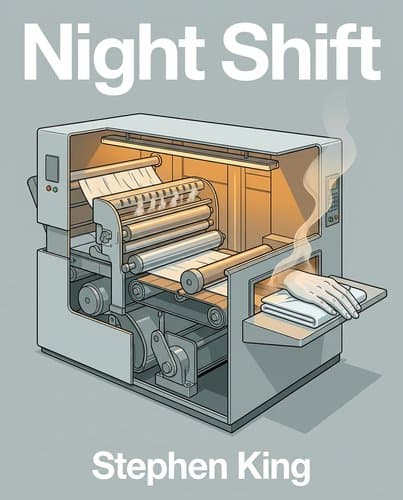
Officer Hunton arrives at the Blue Ribbon Laundry just as the ambulance is pulling away without its lights on. That detail alone tells him everything. Inside, he finds the foreman, Stanner, unable to walk him to the scene — the man simply cannot look again. So Hunton goes alone, rounds the corner past the shirt-folding unit, and sees what the Hadley-Watson Model-6 Speed Ironer and Folder did to a woman named Adelle Frawley. He is a fourteen-year veteran of highway accidents and rooftop jumpers. He turns around and vomits.
The machine is still running when he finds her. Nobody thought to shut it off. And the detail King lingers on is not the blood or the steam or the heat — though the cylinders ran at three hundred degrees and pressed at eight hundred pounds per square foot — it is the folder at the far end, dutifully doing its job. Scraps of Mrs. Frawley's clothing have been ejected and arranged with mechanical precision. The automatic folder does not know the difference between a sheet and a person. That indifference, that tidiness, is what makes the death so wrong. They carried what remained of her out in a basket.
King understands something most horror writers don't: the machine was already monstrous before anything supernatural entered it. The technical specifications read like a threat. Sixteen revolving cylinders, steam hot enough to scald flesh from bone, pressure that treats a human body as a problem of geometry. Six state inspectors will later go over every bolt and bearing and declare it perfectly safe. Death by misadventure. The safety bar was functioning. The machine passed.
And then George Stanner loses his arm to it on a quiet Monday morning, and Herb Diment runs to the fuse box and pulls every fuse in the building — the lights go out, the boiler dies — and the mangler keeps turning. It is running on something other than electricity. That is the precise moment the story crosses a line, and King earns the crossing because he spent the first half making you feel the machine's weight and heat and hunger before any demon was involved. The demon didn't make the mangler terrible. It just gave the terrible thing a will.
Rationality Is the First Thing the Monster Eats
Every framework Jim Norman reaches for is the same framework the horror exploits. He is a high school English teacher with a history of breakdown — the kind of man who has been told, in so many words, that his grip on reality is not entirely trustworthy. He knows this about himself. He describes it as a vase, glued back together: functional, presentable, but unable to hold water. So when dead boys from a 1957 murder under a Connecticut railway overpass begin appearing in his remedial literature class — not grown men in their thirties, but the same teenagers, frozen at the age they committed the crime — he has nowhere to take this information. His wife would be frightened. His department head would send him back to analysis. And the analyst would hear a man describing the literal reappearance of his brother's killers and conclude, with professional sympathy, that the trauma had finally cracked the glue.
The horror is not that no one believes Jim. It's that he can't afford to find out whether they would. The vase metaphor is a trap he built for himself, and the dead greasers walk right through it. They know it, too — Vinnie Corey grins at him through a phone-booth window after Jim has just confirmed, via a retired Connecticut cop, that 'Milford High' on the transfer transcripts does not exist. There is no Milford High School. There is a Milford Cemetery. That phone call is the hinge of the story: the moment Jim's fear converts from psychiatric symptom into confirmed fact, and the conversion changes nothing, because the confirmation is useless. He cannot bring a cemetery to a principal's disciplinary meeting. He cannot explain to his wife that the boys who murdered his brother have returned from the dead, completed high school, and enrolled in his period-seven elective. The rational tools — phone records, transfer documents, police archives — are precisely what the story uses to verify the impossible, and the verification leaves him more isolated than the doubt did.
The Dead Come Back Knowing Exactly What Broke You
The external trap is only half of what King builds into Jim's situation — the internal half is more damaging.
What does it mean that the greasers haven't aged? Vinnie Corey, Robert Lawson, David Garcia — they arrive at Harold Davis High School looking exactly as they did in 1957, teenagers in pegged jeans and leather jackets, carrying the same switchblades. If the story were only about the supernatural, this detail would just be eerie. King frames it as a clue to the story's real engine: the wound in Jim Norman never healed, which means the boys who made it never had to.
The dream sequence makes this explicit. Jim relives the ambush under the railway overpass the same way every time — not as memory, which softens and rearranges, but as event, with every sense intact. The freshly cut grass on Broad Street. The Yankees game drifting from an upstairs window. The flakes of rust on the green girders. Then the overpass metal begins to tremble as the train approaches, and he's nine years old and helpless, watching his brother Wayne get pulled into the dark. He wets himself. He runs. He survives. In the dream, none of those facts are ever different. He is, as King puts it, like a man strapped into a car going over a cliff — fully conscious, unable to steer.
That is the condition the greasers are exploiting, not the one they created. They have returned because Jim never left. He withheld the original trauma from his therapist, from Sally, from every structure that might have drained it of its power. The 1957 overpass is still running inside him, and the returned boys are its latest iteration — external projections of a loop that was already playing. They haven't aged because trauma doesn't age. It stays at the temperature of the original incident.
What makes this devastating rather than merely sad is that the greasers understand this perfectly. They don't come for Jim first. They take out Billy Stearns, then Kathy Slavin, then Chip Osway — clearing chairs, one by one, in the same class period. It's the methodical patience of something that knows it has already won. Jim's breakdown left him unable to speak the truth to anyone who might help. So when the dead come back, they come back into the silence he prepared for them.
When Every Kindness Is Also a Violation
Imagine someone who loves you well enough to know, without being told, that you take your coffee with one sugar and not two. Now imagine finding out they know because they've been reading your diary. The information is identical. The care it represents is identical. What changes is everything underneath — and that is precisely the problem King builds into Ed Hamner Jr.
Ed first approaches Elizabeth in the college library's third-floor carrels, appearing out of nowhere with an insight so precise it stops her cold: she had been vaguely wanting a strawberry double-dip cone, hadn't quite admitted it to herself, and here he is holding two of them. What follows is a sustained campaign of uncanny attentiveness. He produces a verbatim copy of her sociology final, claims photographic memory, and the exam saves her scholarship. After her boyfriend dies in a roadside accident, Ed materializes in coastal Maine — where he had no reason to be — orders exactly the seafood she would have chosen, plays music at exactly the volume and tempo she needed, and drives home at exactly the right moment. He hands her cigarettes that aren't menthol because she doesn't look like a menthol person, a judgment that turns out to be correct. He calls her Beth, a name no one uses, and she realizes with a small internal lurch that Beth is, in fact, what she has always preferred.
That last detail reframes everything before it. It's too small to fake and too intimate to stumble onto. You cannot research a person's private relationship to their own name. It suggests Ed's knowledge of Elizabeth isn't assembled from observation — it's felt, somehow, from the inside. And that's where the comfort cracks. Because if he can feel what she wants before she wants it, then every gift he's given her is also a record of intrusion. The cone, the exam answers, the right music after grief — each one is simultaneously the most loving thing a person could offer and evidence that her inner life has never been fully her own around him.
King withholds the clean verdict. Ed never harms Elizabeth. Her friend Alice, suspicious enough to hire a private detective, receives those bland white envelopes for weeks — and whatever the agency finds, we don't learn it before the story moves on. The horror isn't that Ed is a monster wearing a kind face. It's that kindness and violation can occupy the same gesture without contradiction, and that the difference between a man who knows you deeply and a man who has colonized your privacy may not be visible from inside the relationship at all. King doesn't resolve that — he just leaves you sitting with it, which is how the book earns its next move: a different kind of dependence, quieter and more chemical, measured out in grey capsules.
The Most Terrifying Act in the Book Is Also an Act of Love
Johnny is counting capsules into his palm — one, two, three, four, five, six — when a nurse glides past the open doorway of Room 312. His hand twitches. The grey gelatine capsules click together. She doesn't look in.
The story that closes Night Shift contains nothing supernatural. No demon, no possession, no creature from the dark. What it contains is a son watching his mother die badly, and deciding he won't let the process finish on its own schedule. The horror King is working with here is institutional: a medical system that removes a woman's pain by inserting a radio needle into her brain, trading the agony of abdominal cancer for total paralysis. She can no longer move her legs. She cannot scratch her own nose. She lies in a hospital bed at ninety-five pounds, telling him her midsection feels like a sawdust pile, apologizing for crying in front of him. When he asks if she'd like a cigarette, he has to hold it to her lips.
Johnny has a box of Darvon Complex in his coat pocket, taken from the medicine cabinet of her now-empty house. The dose that would kill a woman who has lost a third of her body weight is not large. He knows this. He counts six capsules and the math is straightforward.
King refuses you the comfort of clarity. Johnny pops the first capsule into his mother's mouth. She gums it until the casing dissolves, winces slightly, says it doesn't taste too bad. He gives her another. Then another. By the fourth, her tongue has gone yellow. He notices — and in the same breath considers hitting her in the stomach hard enough to make her bring them up. He could do it. It would work. The next sentence is: he could never hit his mother. That sentence is the whole story. The man administering a lethal overdose cannot bring himself to cause his mother a moment's discomfort. The tenderness and the killing aren't in conflict. They are the same impulse.
After she falls asleep, he wipes the bottle on his shirt and presses her limp fingertips around it, staging the scene to protect himself. That detail has cold calculation in it, and King leaves it there without editorial mercy. Johnny drives home and waits for the phone and wishes he had given her one more kiss. He doesn't feel different, either good or bad. That flatness is the real ending. The story doesn't tell you he was right. It doesn't tell you he was wrong. It tells you he loved her, and that this is what loving her looked like at the end, in that specific room, on that specific night, after the medical system had already done everything it was going to do.
The Safety Inspector's Report Cannot Save You
Six state inspectors disassemble the Hadley-Watson speed ironer bolt by bolt and declare it clean. The machine passes every test Maine has designed for it. That is King's argument, stated in one machine: the frameworks humans build to manage danger — safety codes, psychiatric diagnoses, hospital procedures — are precise, well-intentioned, and at the specific moment they're needed most, beside the point.
The same structure runs through every story in this collection. Jim Norman can't tell his department head that dead teenagers are occupying his classroom, because the mental health system — the very apparatus that once helped him — would hear that as relapse and recommit him. The hospital in the final story has optimized the management of dying: call buttons, johnnies, medication schedules, a cortotomy that trades pain for paralysis with surgical precision. It cannot help Johnny's mother die on any terms resembling dignity. Johnny has to do that himself, in secret, staging the scene afterward to match the narrative the institution can accept.
That final staging is King's sharpest image. Even mercy must be disguised as the system's preferred outcome. The safety inspector's report cannot save you — but you still have to file it.
What the Folder at the End of the Machine Actually Folds
What stays with you, finally, isn't the demon or the dead teenagers or the cancer. It's the folder at the end of the mangler, sorting what's left of a woman into neat piles — Johnny wiping down a pill bottle and pressing his mother's fingers around it so the paperwork will make sense — transfer records for students enrolled at a school that turns out to be a cemetery. The horror King has been building across these pages is order, continuing past the point where it should have broken down in shame. Even mercy must be disguised as the system's preferred outcome. And the darkness, it turns out, doesn't need to smash through the walls — it just needs the systems you already trust to keep running exactly as designed, on nights when what they're processing is no longer what anyone intended.
Frequently Asked Questions
- What is Night Shift about?
- Night Shift is a 1978 short story collection by Stephen King that uses blue-collar settings and ordinary people to explore how evil operates not as an external threat but embedded in everyday institutions, machines, and relationships. The stories reveal that the systems built to protect us — medical, bureaucratic, academic — are often the very structures that make horror possible. Unlike traditional monster horror, King's evil emerges from within the frameworks we depend on daily, making the collection a meditation on how protection itself can become a source of terror when those systems fail in ways that cannot be reported or explained.
- What are the key themes in Night Shift?
- The key themes explore how institutional frameworks — academic, bureaucratic, psychiatric — undid King's protagonists not through ignorance but through their inability to make truth sayable within those systems. "King's horror isn't about monsters arriving from outside — it's about the moment when the machine, the school record, or the doctor's prognosis reveals it was never protection at all." The collection emphasizes that King's protagonists face unsettling scenarios without clean villains, where gifts are real, love is real, and King refuses to resolve the tension between care and control. Sensory details ground the abstract horror in believable concrete reality.
- What is the central fear that Night Shift explores?
- Night Shift's central fear is not death itself but institutional collapse: "the failure of the systems we built specifically so we wouldn't have to think about death — and what happens when that failure can't be reported to anyone." This institutional horror operates silently, where the frameworks designed to contain danger become sources of terror instead. Unlike traditional horror focused on death itself, King's vision emphasizes what happens when protective mechanisms collapse invisibly and the truth becomes unspeakable. The stories use sensory concrete details — the industrial tidiness of a folded corpse, the yellow tongue, the clicking of grey capsules — to transform abstract institutional horror into believable, viscerally real terror.
- Is Night Shift worth reading?
- Night Shift remains essential reading for understanding how horror operates in everyday institutions rather than from external threats. The collection demonstrates that "the systems built to protect us — medical, bureaucratic, academic — are often the very structures that make horror possible and unspeakable." King's mastery lies in refusing clean resolutions; his characters aren't defeated by supernatural forces but by the inability to communicate danger within the frameworks meant to contain it. The sensory precision of King's prose — industrial details, physical descriptions — grounds abstract institutional horror in concrete, believable terror. For readers interested in psychological horror and how systems themselves can become sources of dread, Night Shift is invaluable.
Related Book Summaries


Read the full summary of 10628_night-shift on InShort