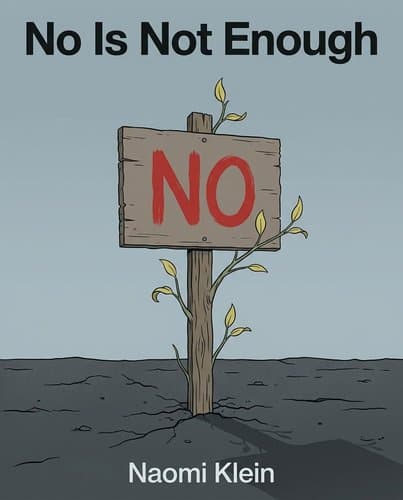
35105799_no-is-not-enough
by Naomi Klein
Trump isn't the disease—he's the symptom of fifty years of branding culture, disaster capitalism, and neoliberal ideology converging into one man.
In Brief
Trump isn't the disease—he's the symptom of fifty years of branding culture, disaster capitalism, and neoliberal ideology converging into one man. Klein reveals why resistance that only says "no" guarantees the next demagogue, and what a truly transformative alternative must demand.
Key Ideas
Scandals Confirm Trump's Impunity Brand
Trump's brand stands for impunity, not quality — so scandals confirm the brand rather than damage it. The two attacks that actually work: make him look like a puppet (threatening his 'boss' identity) or make him less rich (pressuring advertisers and commercial tenants, as the O'Reilly campaign proved).
Name the Crisis Strategy Immediately
The shock doctrine requires speed — crisis produces a window of disorientation before populations recover, and that window is when radical policy gets rammed through. Naming the playbook publicly and immediately, while the crisis is still unfolding, is the primary tool of resistance.
Climate Denial Defends Neoliberal Economics
Climate denial is not anti-science tribalism — it is a coherent ideological defense. Real climate action requires collective investment, higher corporate taxes, and regulated markets, which destroys the neoliberal project. Understanding this explains why evidence alone has never and will never change the position.
Economic Justice Plus Racial Reckoning
Symbolic diversity within an unchanged economic structure ('trickle-down identity politics') generates neither justice for marginalized communities nor solidarity with economically precarious white voters. The combination that works is economic redistribution plus genuine reckoning with racial history — not a choice between them.
Positive Vision Defeats Future Demagoguery
A resistance organized entirely around 'no' (Defeat Bush, Impeach Trump) leaves the underlying conditions intact and the political vacuum available for the next demagogue. Durable change requires a specific positive vision that is compelling enough to make the opposition's fake populism look like the pale substitute it is.
Shift from Extraction to Caretaking
The unifying frame for a cross-sectoral platform is a shift from extraction to caretaking — taking from workers, from communities, from the earth versus caring for all three. This values frame connects labor, climate, racial justice, and feminism without ranking them, and it is what both Standing Rock and the Leap Manifesto demonstrated in practice.
Who Should Read This
History readers interested in Political Figures and Democracy who want a deeper understanding of how we got here.
No Is Not Enough
By Naomi Klein
9 min read
Why does it matter? Because Trump is not an aberration — he's a conclusion.
Everyone reached for a villain — Comey, the Electoral College, third-party voters, Russia. Pick one, assign blame, and the rest of the story stays intact: normal politics temporarily disrupted, now being corrected. Naomi Klein refuses that comfort. Trump, she argues, isn't a bolt from nowhere. He's the ending that fifty years of converging trends were always writing: a culture that worshipped brand over substance, an economic doctrine that converted disaster into profit, a neoliberal consensus that hollowed out every institution that might have handled the crises it was generating. He didn't invent any of it. He just stopped pretending it needed a mask. Which makes it more disturbing, not less — because every strategy aimed at removing the man leaves the machine running. This book is about the machine. And about what it would actually take to build something capable of replacing it.
Scandal Is the Product: Why Trump's Brand Makes Him Immune to Normal Political Rules
The reason Trump scandals bounce off him isn't spin or media complicity — it's that scandal can't land on a brand built around impunity.
Trump's brand doesn't stand for luxury. His properties don't appear on top-ten accommodation lists; Mar-a-Lago racked up nearly a dozen food safety violations in January 2017. What the brand actually sells is cruder: the spectacle of being so wealthy you answer to no one. Gold curtains. Private jets on camera. "Winner" as a complete moral philosophy. In that framework, getting caught dodging taxes isn't a scandal — it's a credential. He called it "being smart." Sweatshop conditions in factories making his ties? That's what winners do to losers.
Klein traces the logic to the 1980s, when companies like Nike stopped thinking of themselves as manufacturers and became brand-builders, selling athletic identity and a sense of rebellion, outsourcing production to contractors who could be blamed and dropped when conditions became embarrassing. Trump applied the same template to politics. The disturbing part isn't that the logic is alien. It's that it isn't.
Only two things have ever actually pierced it. When the #PresidentBannon jokes framed Trump as a puppet rather than the boss, he rushed to Twitter to reassert dominance and Bannon's influence visibly crumbled. When activists targeting Bill O'Reilly went after his advertisers instead of him directly, the highest-rated Fox News host was off the air in under three weeks. Make him look controlled; make him poorer. Those are the only needles that reach him.
Crisis Is the Business Model: How Trump's Cabinet Was Built to Profit from Chaos
In 1976, New York City was functionally bankrupt. The Daily News ran a headline that said, simply: FORD TO CITY: DROP DEAD. A twenty-nine-year-old Donald Trump, still working in his father's shadow building middle-class housing in the outer boroughs, saw a chance in the city's panic. The Commodore Hotel, a midtown landmark, was losing money and might close. The city needed a buyer, any buyer. Trump partnered with Hyatt, agreed to pay $9.5 million for the property, then immediately transferred it to a city development corporation for a single dollar. The city leased it back to him at a steeply discounted tax rate for ninety-nine years. That deal, tallied by 2016, had saved Trump $360 million in taxes New York City never collected.
The deal formed him — his entire understanding of how wealth gets made: find a government in crisis, extract everything it will hand over. On September 11, 2001, with the towers still burning and downtown Manhattan in chaos, he called a radio station to announce his building was now the tallest in the area. Not a thought he kept to himself. A reflex.
This is the shock doctrine: wait for a crisis, move fast while the population is still reeling, secure concessions that would be politically impossible in calmer times. Trump staffed his administration with people who had practiced it their entire careers.
Steven Mnuchin, his Treasury secretary, purchased a failing California bank after the 2008 collapse, pulled $1.2 billion from the government to cover losses, then spent five years evicting tens of thousands of homeowners — including a ninety-year-old woman who was twenty-seven cents behind on her mortgage. Housing advocates called him the Foreclosure King. Rex Tillerson arrived at the State Department with a $180 million exit package from ExxonMobil: a company whose scientists had privately confirmed climate change was happening by 1978, then spent $30 million funding institutions to publicly deny it, while simultaneously engineering its infrastructure to handle the rising seas its press releases dismissed.
These are people whose careers were built in the gap between crisis and recovery, in the window when governments are panicked, populations are disoriented, and the usual constraints on predatory behavior have been temporarily suspended. Assembling them in a single administration isn't random. It's a skill set.
Denying Climate Change Is Ideologically Rational — If You're Trying to Save Neoliberalism
In October 2016, Klein pulled on a wetsuit at the Great Barrier Reef and found a graveyard. More than ninety percent of the reef had been hit by a mass bleaching event, triggered by just one degree of ocean warming. Nearly a quarter of it was dead. Coral skeletons draped in brown decay, the smell of decomposition soaking into her wetsuit. Her four-year-old son Toma had floated wide-eyed over the living sections that morning (five minutes of real amazement over a sea turtle and a clownfish) before she and the film crew moved to the dead zones without him. She rushed the footage out November 7, thinking it might push voters. Trump won the next day. ExxonMobil's CEO became Secretary of State.
For years, Klein had wondered why conservatives fought so hard against the plainest scientific facts — whether it was fossil fuel money buying politicians, or anti-expert tribalism serving the base. What she found, after a decade of climate reporting and This Changes Everything, was something more unsettling: conservative climate denial is coherent.
Here's what genuine climate action actually demands. Not solar panels on existing buildings. Not carbon credits traded between corporations. Real action requires public investment in new energy grids and transit systems at a scale not attempted since World War II. It requires raising taxes on corporations and the wealthy to pay for it. It requires regulations that curtail what ExxonMobil and Goldman Sachs can do with their capital. It requires "buy local" rules that directly contradict the free trade frameworks conservatives have spent decades constructing. The entire architecture of neoliberalism — market supremacy, deregulated corporations, privatized public goods, low taxes justified by trickle-down theory — gets demolished by climate science. Not chipped at. Demolished.
But this lands just as hard on the left: liberals have been selling a comfortable fiction. Keep Goldman Sachs capitalism, just add solar panels to the existing order. Conservatives understand this is false. They grasp, more clearly than the center-left does, that acknowledging the crisis is real means acknowledging that the economic order they built cannot survive responding to it. Climate denial isn't a failure to think. It's the logical conclusion of thinking very hard about what accepting the science would cost them.
Trickle-Down Identity Politics: Why Diversity at the Top Without Redistribution Doesn't Build a Movement
Was Clinton's mistake talking too much about race, gender, and sexuality, or not enough about economics? The conventional liberal post-mortem split down that line, with one camp blaming "identity politics" for alienating white working-class voters and another insisting Trump won on pure racism and misogyny. Klein's diagnosis lands somewhere more uncomfortable than either.
Between 2007 and 2010, the average wealth of white American families fell by 11 percent — a devastating blow. Black family wealth fell by 31 percent. This happened during what looked like a period of genuine symbolic progress: a Black president, two Black attorneys general, Hollywood beginning to reckon with its diversity problem, LGBTQ representation growing in corporate boardrooms. The gains were real. The inequality deepened anyway.
Klein calls this trickle-down identity politics: promote more diverse faces into leadership and trust that justice will filter down to everyone else. It works about as well in the identity sphere as it does in the economic one. Clinton's campaign backed marriage equality and transgender access to public facilities but resisted a $15 minimum wage. She championed inclusion but not redistribution. That combination asked marginalized communities to celebrate symbolic victories while their material conditions deteriorated, and offered economically precarious white voters no challenge to the system that had already failed them.
Symbolic representation without structural change produces neither justice nor coalition. Across Wisconsin, Michigan, and Pennsylvania, Clinton drew 15 to 20 percent fewer Democratic voters than Obama had in 2012 — not because she talked about race and gender, but because talking about them while defending the existing economic order offered nothing to grab onto. You can't answer rage at a failing system by promising a more diverse set of faces running that same system. That's not a problem of tone or emphasis. It's a problem of substance.
Politics Hates a Vacuum: The Cross-Sectoral Movement That Was Winning — Until It Wasn't
That vacuum had a destination. On Trump's first full day in office, union leaders representing a quarter of all unionized American workers walked out of the White House calling the visit "nothing short of incredible." That morning, Trump had signed an order withdrawing the US from the Trans-Pacific Partnership — a real concession to labor's decades of anti-trade grievances. But the man he'd put in charge of renegotiating what came next was Wilbur Ross, a billionaire who had bought a North Carolina textile mill in 2004, cut its workforce from a thousand to three hundred, and expanded production in China and Mexico. A leaked NAFTA renegotiation draft would graft the worst TPP provisions into the existing deal, not strip them out.
That scene looks different once you know what terrain Trump was stepping into. By 2001, 300,000 people were in Genoa's streets during a G8 summit — unions, environmentalists, anarchists, and church groups who had already shut down the WTO in Seattle, united by one argument: corporate trade deals were looting the public sphere worldwide.
Then September 11 happened. Bush's "with us or with the terrorists" framing panicked foundation-funded nonprofits worried about losing access and pushed key unions back into single-issue silos. The coalition collapsed almost overnight. The rage didn't go with it.
In 2009, Obama had an $800 billion stimulus, two bankrupt automakers under government control, and banks receiving trillions in public bailouts. Progressive organizations, relieved to be rid of Bush, confused access with power and applied no outside pressure. Germany used the same window to build 400,000 green jobs and reach 30 percent renewable energy. The Tea Party filled America's vacuum instead. When the economic-populist space goes unoccupied, the right moves in.
Shock Doctrine Fails When People Remember: What Argentina Taught Klein About Resistance
But shock tactics aren't inevitable — they fail where people have already seen the playbook run.
In December 2001, Argentina's president Fernando de la Rúa went on television and declared a state of siege. The country, once the IMF's model student, was in freefall. He invoked "enemies of order" and told everyone to stay home.
Argentines knew those words. In 1976, a military junta had used that exact pretext to seize power and disappear 30,000 people. While de la Rúa was still speaking, Buenos Aires's central square, the Plaza de Mayo, filled with tens of thousands banging pots and pans. He fled by helicopter. Three presidents in three weeks.
From the wreckage came 250 neighborhood assemblies across Buenos Aires, part organizing, part group therapy. At one, a housewife confessed: during the dictatorship she had dismissed disappearances with "Por algo será" — it must have been for something. Naming that failure was itself armor.
After September 11, the US had no such reckoning. The mechanism of exploitation had never been collectively named, so Bush ran the playbook largely unopposed.
The early Trump resistance showed something had shifted: four million people in the streets the day after inauguration, Islamic organizations raising $160,000 to repair vandalized Jewish cemeteries. But those alliances hadn't yet faced a security crisis. The test isn't marching when outraged; it's whether solidarity holds when told the group you're defending may have harbored the attacker.
From Extraction to Caretaking: What the 'Yes' Actually Looks Like on the Ground
In December 2016, less than a month after Trump's election, LaDonna Brave Bull Allard, official historian of the Standing Rock Sioux, was teaching visitors to chop wood. Her granddaughter came running, barely containing herself: "Grandma! The white people don't know how to chop wood! Can we teach them?" Allard laughed and said yes. The camp of ten thousand people in tents, tepees, and yurts on the frozen North Dakota plains had become, she explained, a school. Not for protest tactics. For something more basic: how to take from the land only what's needed, and return something for what's taken.
Klein arrived looking for the urgent strategic conversation she'd imagined: a summit of progressive thinkers in a university seminar room. She found it here instead — in the drumming at the sacred fire, in the seminars on decolonization, in one damning fact about the pipeline itself. It had been originally routed through majority-white Bismarck, where residents rejected it on safety grounds, then redirected to Standing Rock. The racism wasn't incidental to the fossil fuel project; it was structural to it. This is what the water protectors meant when they said the issues couldn't be separated: capitalism, white supremacy, and fossil fuel extraction weren't separate problems running on parallel tracks — they were the same project, routed through the same infrastructure. The post-election Twitter war over which cause to blame dissolved the moment you stood on that frozen ground.
That insight drove the Leap Manifesto, drafted a year before Trump's election at a two-day Toronto meeting of sixty movement leaders. The document's organizing frame emerged not from policy wonks but from the stories: workers discarded after lifetimes of service, immigrants in indefinite detention, Indigenous land poisoned by extraction. What everyone described wanting, in contrast, kept circling back to the same word: care. Care for the land, care for each other, care returned for what gets taken. From that values shift, the policy followed. Green jobs were redefined as anything useful that doesn't burn much carbon: teaching, nursing, elder care — work overwhelmingly done by women and chronically defunded. Financing was treated as a math problem: ending fossil fuel subsidies alone frees up $775 billion globally. A financial transaction tax adds $650 billion more. The money exists; what's been missing is governments willing to redirect it.
The Spell Is Already Broken — The Question Is What Fills the Silence
The ideas Klein points to — free college, care work valued as real labor, energy systems that don't require poisoning anyone's water — weren't rejected by voters. They were abandoned by the people who were supposed to fight for them, who'd learned to call that abandonment pragmatism. That consensus had no voters behind it. Candidates who said these things out loud discovered, sometimes to their own surprise, that the audience had been there the whole time. The task now isn't to wait for the right coalition or the right political window. It's to do what Allard did in that frozen North Dakota field: begin building before anyone decided it was viable, before the cameras arrived, before permission was granted. The caring majority was never a future project. It was always the actual majority — waiting for someone to name, without apology, exactly what we intend to build.
Notable Quotes
“the basic and irreversible function of an industrial economy is the making of things…It is in the factory and on the land and under the land that purchasing power originates.”
“are like roaches—you spray them and spray them and they get immune after a while.”
“and the dream of Michael Jordan, who had become a one-man Superbrand, a term first used to describe the athlete's growing empire. When their parents bought Apple computers, they were bringing home a piece of a deeply optimistic vision of the future, captured in the slogan”
Frequently Asked Questions
- What does Trump's brand stand for and what attacks against it actually work?
- Trump's brand stands for impunity, not quality — so scandals confirm the brand rather than damage it. The two attacks that actually work: make him look like a puppet (threatening his 'boss' identity) or make him less rich (pressuring advertisers and commercial tenants, as the O'Reilly campaign proved). This insight explains why traditional criticism fails and suggests what alternative strategies might succeed in challenging his political power.
- What is the shock doctrine and how can we resist it?
- The shock doctrine requires speed — crisis produces a window of disorientation before populations recover, and that window is when radical policy gets rammed through. Naming the playbook publicly and immediately, while the crisis is still unfolding, is the primary tool of resistance. Understanding this mechanism allows citizens to recognize predatory policymaking in real time and organize counter-action before legislation is enacted.
- Why has evidence alone failed to change positions on climate change?
- Climate denial is not anti-science tribalism — it is a coherent ideological defense. Real climate action requires collective investment, higher corporate taxes, and regulated markets, which destroys the neoliberal project. Understanding this explains why evidence alone has never and will never change the position. The disagreement is fundamentally about protecting economic systems and power, not about scientific facts, making this a political struggle rather than a scientific one.
- What is Klein's vision for building lasting political change?
- A resistance organized entirely around 'no' leaves the underlying conditions intact and the political vacuum available for the next demagogue. The unifying frame is a shift from extraction to caretaking — taking from workers, from communities, from the earth versus caring for all three. This frame connects labor, climate, racial justice, and feminism without ranking them, as Standing Rock and the Leap Manifesto demonstrated. Durable change requires a specific positive vision that is compelling enough to make the opposition's fake populism look like the pale substitute it is.
Related Book Summaries


Read the full summary of 35105799_no-is-not-enough on InShort