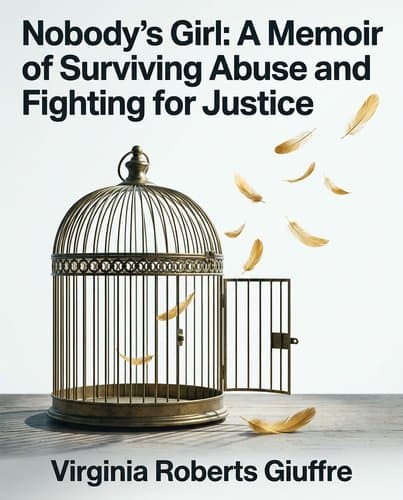
193388653_nobody-s-girl
by Virginia Roberts Giuffre
Virginia Roberts Giuffre dismantles the question 'why didn't she leave?' by exposing exactly what predators like Epstein do before force is ever needed—exploit…
In Brief
Virginia Roberts Giuffre dismantles the question 'why didn't she leave?' by exposing exactly what predators like Epstein do before force is ever needed—exploit wounds already inflicted by childhood abuse—and shows how institutions don't merely fail survivors, they actively conspire against them.
Key Ideas
Psychological wounds enable trafficking, not force
Predators who traffic children rarely use force as their primary tool — they use pre-existing psychological wounds. Understanding this dissolves the 'why didn't she leave' question entirely and reframes it as 'what had already been done to her that made leaving feel impossible.'
Epstein deal excluded victims from negotiation
The nonprosecution agreement that freed Epstein was made in secret by the DOJ without notifying victims — not by victims who accepted settlements. Judging survivors for taking civil compensation punishes the wrong people for a deal they had no part in making.
Institutions actively protect powerful abusers
Institutional systems — police departments, prosecutors, media networks, universities — don't simply fail to stop powerful abusers; they often actively protect them. The Palm Beach investigation had strong multi-victim evidence and was deliberately suppressed through smear campaigns, witness intimidation, and prosecutorial dealmaking.
Public advocacy for trauma carries severe costs
The cost of sustained public advocacy for trauma survivors is not just external — smear campaigns, legal warfare, financial exhaustion — but internal. The memoir's two suicide attempts are not aberrations; they are what decades of repeated public testimony while simultaneously carrying unprocessed trauma actually looks like.
Childhood abuse increases adult abuse vulnerability
Children who experience sexual abuse are statistically fifteen times more likely to experience domestic abuse as adults, not because of personal weakness but because early exploitation systematically destroys the internal architecture that allows a person to recognize danger and demand better — a cycle that requires explicit, sustained intervention to break.
Civil litigation replaces unavailable justice systems
Civil litigation is not the same as justice. It is the only tool the system left available. Understanding the difference — and why that gap exists — is essential to any serious conversation about accountability for powerful abusers.
Who Should Read This
Readers who connect with first-person stories about Memoir and Social Issues and want to see the world through someone else's eyes.
Nobody's Girl: A Memoir of Surviving Abuse and Fighting for Justice
By Virginia Roberts Giuffre
14 min read
Why does it matter? Because the system didn't fail Virginia Roberts Giuffre — it worked exactly as designed.
In 2021, Virginia Roberts Giuffre walked into a room at the Louvre and fell apart. Not because of what she saw — because of what she remembered. A tapestry. A color on the walls. Twenty years collapsed in an instant, and suddenly she was seventeen again, terrified, owned. The question the memoir quietly insists on is not how Jeffrey Epstein found her. It's how a girl gets so thoroughly prepared to be found — through years of abuse so normalized it registers as love, through institutions that punish children for their own suffering, through a legal system that mistakes silence for consent. This is a book about the blueprint of predation: how it's built, brick by brick, inside a child's sense of her own worth, long before anyone hands her a hundred-dollar bill.
The Abuse Didn't Start with Epstein — It Was Finished by Him
A doctor examines a young girl who has been brought in, again, for a painful urinary tract infection. Again, the nurses are baffled. When the doctor mentions that the child's hymen has been broken, her mother doesn't pause, doesn't flinch, doesn't ask a single question. She offers an explanation — the girl rides horses bareback — and that is simply the end of it. The girl herself doesn't know what a hymen is.
That moment is the architecture of what Virginia Roberts Giuffre's memoir is actually about. By the time Jeffrey Epstein's name appears in her story, Virginia had already been shaped by years of precise, methodical harm — her father's grooming, her mother's silence, the institutional cruelty of a teen rehab facility, and a trafficker named Ron Eppinger who found her on a curb in Miami at fifteen. Epstein wasn't the beginning. He was what the beginning made possible.
The grooming started with small rearrangements. Her sister was moved into the parents' bedroom. Her mother stepped back from bath time and bedtime. Her father stepped in. He called what he did "extra love." Virginia tried to dismantle the rituals — announcing she was old enough to bathe herself, that she didn't want bedtime stories anymore. The rituals ended; the abuse didn't. He threatened to take her horse, Alice, if she hid under her box spring. She crawled out.
Her mother's role wasn't passive ignorance. It was something closer to active looking away. The UTI doctor had handed her an opening, and she closed it in one sentence. Around the same time, she started whipping Virginia with thorny branches from her rosebushes and told her she might have been switched with another baby at the hospital. She may have been a mistake, the mother said.
When Virginia was placed at Growing Together, a teen rehab near West Palm Beach that charged parents fourteen thousand dollars a year per child, she did something that took real courage: she wrote down what had happened to her. She described being raped by two older boys and hoped, genuinely, that someone would do something. Staff told her the police had been informed. The boys said she'd consented. No charges. She learned then that her pain was institutional currency — useful for climbing the facility's internal hierarchy, worthless for anything else. She rebuilt every psychological wall she'd been slowly dismantling.
She ran away repeatedly. She survived on the streets near a Dunkin' Donuts under the name Rachel. And when a stranger in a limousine offered her a way out of the worst night of her life, she got in. She wasn't naive. She was a child who had learned, from everyone who was supposed to protect her, that her body was the only thing anyone wanted, and that wanting to be safe was a wish no one was going to grant.
Predators Don't Use Force. They Use Wounds.
Epstein didn't trap Virginia with force. He trapped her with a hunger to be chosen, a reflex of compliance, and the terror of losing the one person she still had left to protect.
Ghislaine Maxwell walks up to a sixteen-year-old at a spa reception desk and does something precise: she notices the anatomy book. She praises the girl's desire to learn. Within minutes she's extended an offer — a wealthy friend, a genius with money, a man who loves to help people and will pay for proper training. Come tonight after work. The address is 358 El Brillo Way, two miles away. Virginia runs to tell her father. She uses the spa's front desk phone to call back and confirm. She is not being deceived into something that looks dangerous. She is being offered the specific thing she has never had: someone who sees her as worth investing in.
That word — 'keeper' — is what actually lands. Epstein used it the first night, lying face-down on the massage table, appraising Virginia as though she weren't in the room. She'd spent years waiting to hear something like it. A decade of being sexualized by men who framed their abuse as love had trained her to read a room, disappear when required, and make no demands. She was, in his terms, easy to keep. And the part of her that had been waiting to be kept responded before the part that recognized danger could speak.
The cash sealed the transaction, but it wasn't the actual currency. Two hundred dollars pushed across a black-and-white checkerboard kitchen floor is one kind of payment. Being told you have strong hands, good instincts, and real potential is another. Virginia had grown up with neither. Both were weapons.
Then, when she showed the first signs of hesitation about becoming a full-time employee, Epstein produced a grainy photograph. Her younger brother Skydy, walking away from the camera, identifiable by his backpack and the outline of his profile. 'We know where your brother goes to school,' Epstein said, still smiling. He also mentioned that he owned the Palm Beach Police Department. The threat didn't need elaboration. Virginia had already spent years learning that abusive men operated without consequence. The photo wasn't a surprise — it was confirmation of something she'd always known. She stayed.
She wasn't locked in. She was held by a girl who'd been trained to associate love with pain, who needed to be worth keeping, and who understood that the one person she loved unconditionally could be hurt if she walked out. Epstein didn't build that cage. He just moved in.
The Worst Thing She Ever Did Was Also What Epstein Designed Her to Do
Here is the question the memoir forces you to sit with: at what point does a victim become responsible for what she does to others? Virginia's answer is unsparing. She became a recruiter for Epstein's network, and the book never lets her — or you — off the hook for it.
The mechanism Epstein used to get there was precise. Maxwell and an assistant named Kellen had already modeled the system: they'd station themselves outside New York high schools at three in the afternoon, watching for girls who looked hungry or lost, then tailor each approach to whatever that specific girl seemed to need most. The incentive structure did the rest — two hundred dollars for a first visit, four hundred if you brought a friend, and the recruiter usually avoided servicing Epstein herself. A pyramid built entirely out of other people's desperation.
When Virginia started doing it, she told herself she was the honest version. Unlike Kellen, who made the whole thing sound like fun, Virginia warned each girl about the nudity and the possibility of sexual contact. She believed this distinction mattered. She then recruited friends who had seen her apartment and wanted what looked like easy money. She is the one who explains why this makes things worse rather than better: she picked girls who said yes, which only proved how well she'd learned to spot the neediest ones. The warning didn't protect anyone. It just meant she'd found someone desperate enough not to refuse.
What Epstein had actually built, over months of nightly foot massages and birthday photographs and whispered praise, was a girl who needed his approval more than she needed her own integrity. She wasn't recruited by money or threats alone — she was recruited by the oldest wound she had: the need to be valued by the person who held her survival. His network didn't require chains because it was made of that.
Maxwell photographed Virginia naked by the pool for Epstein's birthday, arranging her hair, positioning her body, murmuring 'Perfect. Beautiful' as though speaking to herself. Virginia was about to join the wall of girls in the trophy closet. She knew it. And she had already made sure other girls were coming behind her.
The Moment She Stopped Being a Tool and Started Being a Threat
She was on her knees on the floor, begging. Not metaphorically — physically down on her knees, pleading with Jeffrey Epstein not to send her back to the man who had, days earlier, choked her into unconsciousness on his private island, laughed at her terror, and left her bleeding from her mouth and both orifices below. She'd emerged from that cabana struggling to breathe. Swallowing hurt for days. And now Epstein looked at her — this teenager on the floor — and said, with total calm: 'You'll get that sometimes.'
That sentence broke something open. Virginia had spent more than two years constructing a story that let her survive: Epstein was sick, but in his twisted way he meant well. He praised her. He called her maternal. He needed her specifically. The story was a lie she'd needed to believe, and 'You'll get that sometimes' made it impossible. He hadn't flinched. He hadn't apologized. He'd filed her near-death under acceptable losses.
What followed wasn't a dramatic escape — it was something subtler. A new instinct started firing in small, testable doses. She'd spot a girl in a bookstore, recognize the hunger that made her recruitable, and walk out without getting her number. She couldn't protect herself yet, but she could spare one stranger at a time. Agency, it turns out, doesn't arrive whole. It rehearses.
Then Epstein and Maxwell made the baby proposal — $200,000 a month, a mansion, round-the-clock nannies — and buried it under conditions that made the money irrelevant: sign over all legal rights to the child, travel wherever Epstein demanded, and confirm in writing that the two of them were not a couple. Virginia's reaction tells you exactly where she was: she could refuse on behalf of a child who didn't exist yet before she could refuse on behalf of herself. The unborn baby was easier to protect than she was. She knew it, and she says so plainly.
She used their proposal against them — agreeing in principle, then extracting the one thing she'd always been promised and never given: formal massage training, abroad. Eight weeks in Thailand. She packed every photo she owned, boarded a coach flight Epstein's credit card paid for, and cried at airport security. In Chiang Mai she met a dark-haired Australian named Robbie Giuffre at a Muay Thai gym. Ten days later they were married at a fourteenth-century Buddhist temple on a mountaintop. That evening she called Epstein's number. 'I fell in love and got married,' she told him. 'I'm never coming back.' He said 'Have a great life' and hung up — no threat, no explosion, just two seconds of indifference that told her exactly how much she'd ever mattered. They didn't speak again for five years.
The Evidence Was Always There. The System Looked Away.
The evidence against Jeffrey Epstein was never hidden. It was documented, collected, and handed to prosecutors — and prosecutors looked at it and made a choice.
When Palm Beach detectives ran surveillance on Epstein's estate starting in 2005, they didn't find murky suspicions. They found carbon-copy phone message logs tracking a steady stream of girls arriving at the mansion to 'work.' They found a note from a contact named Jean-Luc Brunel advertising a sixteen-year-old Russian girl available for 'free lessons,' the sixteen conveyed in code — 'two times eight' — as though even in writing, Epstein's associates enjoyed the game. Over thirteen months, investigators documented more than thirty victims, most of them fifteen or sixteen years old, whose stories aligned in detail after detail: the escalating demands, the cash payments, the threat that bad things would happen to anyone who talked. Detective Joseph Recarey built warrant requests on four counts of unlawful sexual activity with minors, plus warrants for two associates who had facilitated the abuse. What he had was a documented pyramid scheme built on the bodies of children.
What happened next is the whole argument. Epstein's lawyers surfaced victims' MySpace pages showing underage drug and alcohol use. The grand jury was postponed. Private investigators photographed the families of victims outside their homes. At least one girl was told explicitly: those who help him will be compensated, those who hurt him will be dealt with. In September 2007 — without notifying a single victim — US Attorney Alexander Acosta signed a secret nonprosecution agreement that shielded Epstein and his named associates from federal charges entirely. When Virginia eventually received a letter from the Justice Department informing her she was 'an identified victim of a federal offense,' she assumed it meant a trial was coming. A lawyer explained there was no trial, there never would be, and the only question left was her number. She wanted accountability. She was told to name a price.
She settled for $500,000 — chosen by looking up average home prices in her neighborhood, because she had no framework for anything else — and later discovered at least one other victim received ten times that amount. Then she agreed to let the Daily Mail pay $160,000 for the photograph of Prince Andrew's arm around her teenage shoulders. That payment became the instrument her abusers' defenders used to reframe her as a profiteer — a woman who had invented suffering and sold it. The evidence, the thirty-plus corroborating victims, the note about the sixteen-year-old, the secret agreement signed in the dark: none of that was what the powerful wanted people to look at. They wanted you looking at that check.
Surviving the Fight Is a Different War Than Surviving the Abuse
Think of going public as stepping out of a burning building — you escape the fire, but you land in the street in February, without shoes, and the people waiting there want to know why it took you so long to leave. The building was the abuse. The street is what the book calls the second war.
Virginia filed the court motion that named names — politicians, executives, foreign leaders — on December 30, 2014. Within forty-eight hours, the machinery turned. Epstein emailed Maxwell directly: offer a reward to anyone who comes forward to prove Virginia's allegations are false. He used the word 'acquaints' for 'acquaintances,' which would almost be funny if it weren't documentation of a pedophile coordinating witness incentivization from his inbox. Within six weeks, the New York Daily News ran a front-page photograph of Prince Andrew with his arm around a teenager, overlaid with the headline 'PRINCE "VIC" IN FALSE-RAPE FLAP.' The story weaponized a sealed juvenile sheriff's report from 1998 — written when Virginia was fourteen, assaulted in the back of a car while unconscious — and lifted a phrase prosecutors use when evidence is inconclusive: 'victim's lack of credibility.' That phrase, stripped of context, became the headline's engine. By the time her lawyer explained that the language was boilerplate, the story was everywhere. That's how the second war works: it doesn't need to be true, it just needs to be fast.
The ABC interview is where you see what the second war costs in full. Virginia sat for ninety minutes with anchor Amy Robach in a suite at the Ritz-Carlton on Central Park South, wept through specific incidents, named names, described the trafficking operation in detail. Then nothing aired — not a segment, not a clip. Four years later, a hot-mic recording surfaced of Robach saying she'd been told: 'Who's Jeffrey Epstein? No one knows who that is. This is a stupid story.' Epstein's lawyers and the British royal family had applied pressure; the network didn't want to lose access to the younger royals. A media giant had the evidence, chose the relationship, and buried it. If you're tracking the second war's casualties, add that to the list alongside the locked front door, the surveillance cameras, the two guns Virginia bought at a law-enforcement supply store and practiced with in the basement shooting range.
By 2022, after a decade of depositions, smear campaigns, financial desperation, and paparazzi chasing her children out of doctor's offices, Virginia was hospitalized with COVID complications in Perth. In that hospital room, the voice that had been quiet for months told her she was a burden her family would outlast. She swallowed roughly 240 painkillers. Revived with Narcan. Days after discharge she tried again. Her son Alex found her. What brought her back was a song he'd recorded himself — a spare ukulele opening, then his own voice rapping about the demons circling him: 'I don't know what I'd do without you.' That line, from her child, was what the entire decade of courtrooms and headlines and legal filings could not produce on its own. Justice and survival are not the same war, and only one of them can actually keep you alive.
Maxwell's Conviction Proves It Happened. It Doesn't Mean It's Over.
On December 29, 2021, at five in the morning Perth time, Robbie Giuffre ran circles around the bedroom shouting 'Guilty, baby!' — and that image, a husband in the dark celebrating for his wife, is probably the closest the story gets to triumph. Ghislaine Maxwell had been found guilty on five counts, including sex trafficking of a minor. The woman who once murmured 'Perfect. Beautiful' while arranging a teenager's naked body for a photograph was going to prison for a very long time.
Virginia's first public statement after the verdict ended with a warning, not a celebration: Maxwell did not act alone. Others must be held accountable. The final chapter is where that sentence earns its weight. Virginia catalogs three men she has declined to name. One she fears will physically harm her if she identifies him. Another has promised, through lawyers, to engage his resources in litigation until her family is financially destroyed. A third — a man she was forced to have sex with repeatedly — she also witnessed having sexual contact with Epstein himself. She has named all three in sworn depositions and identified them to the FBI. She simply cannot afford, in the most literal sense, to name them in a book. Her explanation is one sentence: her most important role is that of a mother.
Epstein dead, Maxwell convicted, Prince Andrew's reputation in ruins — and still a row of unnamed men living exactly the lives they lived before, their exposure blocked not by lack of evidence but by the size of their legal budgets. The accountability that exists was real and hard-won. The accountability that doesn't exist is also real.
The Shame Always Belonged to Them
Here is what forty years of fighting actually buys: not the ending the story deserved, but the one that was possible.
The thing that kept her alive wasn't a realization or a turning point. It was her son, in Section 6 of whatever ordinary Tuesday, playing ukulele and singing — earnestly, without irony — 'I don't know what I'd do without you.' That's the image that doesn't let go. Not a dramatic rescue. A kid with a small instrument who needed her here.
She's here. And her thirteen-year-old daughter, riding in the passenger seat, is singing at full volume about how Disney lied to her. Virginia grew up watching Cinderella on repeat, absorbing every lesson about what happiness looks like for a girl who waits. Her daughter has looked at the same story and decided it ends in a bad divorce. That single generational gap — one daughter groomed to accept whatever love offered itself, one who already knows better — is quiet and specific. It's the thing that tells you the work landed somewhere.
The body, though, doesn't close the ledger just because the mind decides to. Ketamine treatments for PTSD, because survival isn't clean and the nervous system keeps its own accounts regardless of how the story resolves on paper. That's the honest part. The farm outside Perth, the kangaroos at dusk — those are real. So is this.
She should have been believed the first time. That shame doesn't belong to her, and she knows it, and knowing it doesn't make it stop.
Notable Quotes
“Try to leave, and I’ll find you and kill you.”
“Come in here so we can take care of you,”
“As long as you never lie to me again, I will take you in,”
Frequently Asked Questions
- What is Nobody's Girl about?
- Nobody's Girl is Virginia Roberts Giuffre's 2025 memoir documenting her experience as a trafficking victim of Jeffrey Epstein and her decades-long fight for accountability. The book explains how predators exploit pre-existing psychological wounds, how institutional systems actively protect powerful abusers, and why civil litigation is a tool of last resort rather than genuine justice. Giuffre provides readers a clear-eyed framework for understanding survivor behavior and systemic failure, challenging common misconceptions about trafficking victims while revealing how strong multi-victim evidence was deliberately suppressed.
- How does Giuffre explain why trafficking victims don't leave?
- Giuffre argues that predators trafficking children rarely use force as their primary tool—they exploit pre-existing psychological wounds instead. This reframes the question 'why didn't she leave' entirely. Understanding that early trauma systematically destroys the internal architecture allowing people to recognize danger dissolves victim-blaming narratives. Giuffre explains that children who experience sexual abuse are statistically fifteen times more likely to experience domestic abuse as adults, not from personal weakness but from how exploitation damages their ability to protect themselves—a cycle requiring explicit, sustained intervention to break.
- Why did institutions protect Jeffrey Epstein despite evidence?
- Giuffre demonstrates that institutional systems—police departments, prosecutors, media networks, universities—don't simply fail to stop powerful abusers; they actively protect them. The Palm Beach investigation had strong multi-victim evidence but was deliberately suppressed through smear campaigns, witness intimidation, and prosecutorial dealmaking. The nonprosecution agreement freeing Epstein was made in secret by the DOJ without notifying victims. Survivors who took civil compensation are often judged for accepting settlements in a deal they had no part in making, while actual responsibility lies with institutional actors who enabled the abuse.
- What is the personal cost of fighting for justice described in the memoir?
- Giuffre describes the cost of sustained public advocacy as both external—smear campaigns, legal warfare, financial exhaustion—and internal. The memoir's two suicide attempts are not aberrations; they are what "decades of repeated public testimony while simultaneously carrying unprocessed trauma actually looks like." Survivors seeking accountability face constant re-traumatization and public scrutiny while the system fails to provide genuine justice. Giuffre clarifies that civil litigation is not the same as justice—it's the only tool the system left available, highlighting why closing this accountability gap is essential.
Related Book Summaries

Read the full summary of 193388653_nobody-s-girl on InShort