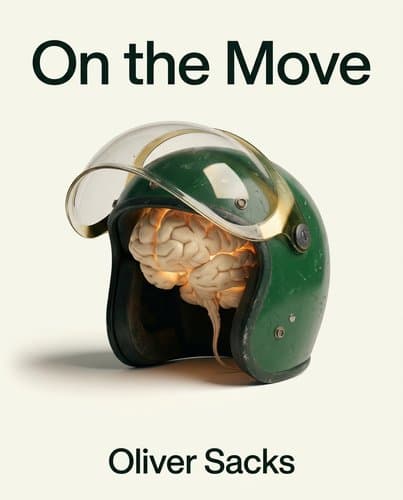
24972194_on-the-move
by Oliver Sacks
A neurologist who rode motorcycles at dangerous speeds, nearly died from drug use, and was told his most celebrated book was an embarrassment to…
In Brief
A neurologist who rode motorcycles at dangerous speeds, nearly died from drug use, and was told his most celebrated book was an embarrassment to medicine—Oliver Sacks reveals how the same restless hunger that made him reckless also made him capable of seeing his patients with unmatched clarity and love.
Key Ideas
Aim intensity rather than moderate
The same intensity that makes someone self-destructive can, if it finds the right object, make them exceptionally good at their work — the question is not how to moderate it but where to aim it
Intense hunger fuels empathetic depth
Excess and appetite are not the opposite of empathy; they can be its precondition — Sacks's capacity to go too far into his patients' inner lives grew directly from the same hunger that drove his motorbikes and his drug use
Loss reveals authentic creative voices
Some of the best creative work is produced under conditions of loss and threat rather than security — Migraine written under a death-threat deadline, Awakenings written in grief — because constraint forces the writer to rely on what they actually know rather than what they think they should say
Neurological variations expose perception's construction
The nervous system does not passively record reality; it constructs it — which means neurological 'deficits' like colorblindness or Tourette's aren't just broken versions of normal perception, they're windows into how all perception works
Know which validation actually matters
Professional legitimacy and genuine achievement can be completely decoupled: Awakenings won the Hawthornden Prize and was called a masterpiece by Auden while medical journals met it with complete silence — knowing which audience actually matters is its own form of courage
Independence permits surprising human connection
Solitude can be a long, productive relationship with work and with ideas — but Sacks's late-life opening to Billy suggests it is worth remaining available to connection even after you have organized your whole life around not needing it
Who Should Read This
Readers who connect with first-person stories about Memoir and Scientists and want to see the world through someone else's eyes.
On the Move
By Oliver Sacks
13 min read
Why does it matter? Because the life that looks like wreckage from the outside is often the one producing the most original work from the inside.
Here's the paradox at the center of Oliver Sacks's life: a man who nearly died on Norwegian mountains, flooded his brain with methamphetamine for four years, destroyed research animals through contamination and neglect, and spent decades in what he'd later call a self-imposed emotional exile — this man became the most compassionate chronicler of neurological suffering in the twentieth century. That's not despite the wreckage. The wreckage is the whole point. On the Move is Sacks's own account of how a person constitutionally incapable of doing anything by half-measures — too fast, too obsessive, too hungry, always too far — discovered that the very quality that kept nearly destroying him was the same quality that let him see his patients whole, write about broken nervous systems the way poets write about love, and arrive, finally and improbably, at something like peace.
Going Too Far Was Always the Point
The throttle on his first motorbike jammed at full speed inside Regent's Park. The brakes were too weak to stop it. So Oliver Sacks just kept going — lap after lap, clearing pedestrians with his horn, until the fuel ran out. His parents, alarmed, bought him a replacement. A faster one.
That response tells you everything. Sacks was not someone who learned caution from near-disasters; he was someone whose near-disasters kept getting funded. The jammed throttle became a 250cc Norton, which produced a red-light collision that left him parked and unconscious on a side street. The Norton became a 600cc. In California, that bike logged over 100,000 miles while its rider bulked to 260 pounds and set the state squat record at 600 pounds.
The obvious reading is that these were the dangerous hobbies of a brilliant man who needed an outlet. The more accurate reading is that they were the same thing as his medicine. The same hunger that drove him to squat 600 pounds also drove him, drunk on hard cider after failing his Oxford entrance prelims, to wander into the scholarship exam and write nonstop for two hours about a single question he found interesting — ignoring the other six entirely. He won.
Excess wasn't the opposite of his intellectual life. It was the engine of it. What you're reading in this memoir is the story of a man whose intensity never found a single channel — it flooded every direction simultaneously — and how that turned out to be, improbably, exactly what neurology needed from him.
The Wound That Shaped Everything
The defining wound of Sacks's early life arrived in a single sentence. He was eighteen, heading to Oxford, when his father asked directly about his sexuality. Sacks admitted he preferred boys — then begged his father to keep it from his mother. His father told her anyway. She came downstairs the next morning with a face Sacks had never seen before and said: you are an abomination, I wish you had never been born. Then she never mentioned it again. The subject was closed. But the words weren't — they lodged in him for decades, injecting guilt into what should have been, as he puts it, a free and joyous part of life.
What makes this more than biographical detail is what it explains. In a country that still criminalized homosexuality, Sacks dared not seek partners in London while living under his parents' roof. His trips to Amsterdam — where a stranger once found him unconscious drunk in a gutter, carried him home, and told him over coffee the next morning that there was no need to destroy himself this way, that he deserved better — were brief reprieves. His mother had wished him unborn. A stranger made him coffee.
Then there is Michael. Sacks's brother had been schizophrenic since fifteen, first treated with insulin coma therapy, later caught in the impossible arithmetic of Largactil — the tranquilizer that either suppressed his psychosis or left him shuffling, parkinsonian, feeling, as Michael described it, softly killed. Sacks watched this and did almost nothing. He could have taken Michael to a film, a concert, a restaurant. He didn't. The shame of that, he writes, is still hot sixty years later.
These two facts — the shame around his own identity, the shame around his failure toward Michael — converge on something important about the doctor Sacks would become. He would spend his career with patients whose minds had been invaded by forces they couldn't direct: encephalitis, Tourette's, drug-induced parkinsonism. His capacity to see those people as full human beings, rather than case files, came from somewhere. It came from here.
Addiction Wasn't Just Destruction — It Was Also, Uncomfortably, Productive
Can destruction and discovery live inside the same episode, fed by the same fuel? The California years force the question.
Sacks's descent into amphetamine addiction began with a specific wound: Mel, the navy man he'd shared a year of motorcycle rides and physical closeness with, moving out of their Venice apartment after a moment of sexual contact crossed whatever invisible line they'd both been pretending wasn't there. Sacks framed it simply — he turned to drugs as compensation for the loss — and then the compensation nearly killed him. Escalating from cannabis through LSD to methamphetamine by mouth and then vein, he reached doses that pushed his heart rate to dangerous heights. He knew people on Muscle Beach who died this way. He kept going.
Then comes the part that stops you cold. In a neurology teaching quiz at Einstein, his supervisor presented photomicrographs of a rare brain condition and told the room he didn't expect anyone to recognize it. Sacks blurted out the diagnosis — microglioma — and then recited every detail of all six documented cases in the medical literature. His supervisor stared. Sacks was equally baffled. He had no idea when he'd absorbed that information or how. The amphetamines had apparently turned his mind into something like a high-pressure system, compressing knowledge into strange readiness, making connections he couldn't have traced while sober. He called it 'enhancement' while acknowledging he had no adequate word for it.
The same period produced the Frank C. case — a patient whose bizarre jerking movements led, after his sudden death beneath a truck, to Sacks holding his brain two hours later and identifying the axonal damage characteristic of an ultra-rare disease. That observation became the centerpiece of an AAN exhibit that launched his academic career. He was, simultaneously, reducing himself to what he called an electrified rat and doing the neurological work of his life.
The cost was real: eighty pounds of body weight lost in three months, relationships impossible, weekends spent in states he could only describe afterward as having been 'away.' But the intensity that made the addiction catastrophic was the same intensity that kept him in the neuropathology lab at midnight, staring through a microscope at swollen axons, trying to connect three apparently unrelated conditions into a single pattern. You can't have one version of that appetite and not the other.
The Moment Excess Found Its Proper Object
The eighty patients were scattered across different wards, and most of the staff had stopped really seeing them. They'd been there for thirty or forty years — frozen, some of them, in postures they'd held since the 1920s. Not unconscious. Not absent. Just locked, in the way a door can be locked with someone pressing hard against the other side.
When Sacks arrived at Beth Abraham in 1966, he was coming off the wreckage of a research career — the lost notebook, the contaminated centrifuge, the vanished myelin sample, the lab bosses who'd finally told him, with genuine kindness, that he was a menace and should go do something where he'd cause less harm. He'd also been through the worst of the amphetamines, the eighty pounds lost, the hallucinations, the analysis that only began to work once the drugs were gone. What he had left — what he'd always had, underneath everything else — was the capacity to pay attention with an intensity that most people found unsettling.
The nurses told him something that other physicians had apparently not found interesting: these patients were still in there. Music could reach them when nothing else could. Someone who hadn't walked in decades might move naturally in response to a rhythm. Someone who couldn't speak might sing. The encephalitis had invaded the brain's movement systems and locked them, but the person inside was still there, pressing at the door.
Sacks spent eighteen months simply watching before L-dopa arrived. That restraint is the part worth pausing on. He was a man who had always wanted more — more speed, more weight, more knowledge, more sensation — and here he was, deliberately slowing down, because he understood that what he was seeing had never been seen before and might never be seen again. He took notes, made recordings, learned these people's histories from charts that went back to the epidemic years. The intensity that had destroyed his lab career was the same intensity now — just aimed at something that could hold it.
When L-dopa arrived in 1969, patients who'd been still for decades began to move — and then, almost universally, things became complicated in ways ordinary clinical medicine hadn't prepared anyone for.
For Sacks, this wasn't a failure. It was the real information. These patients — minds intact inside bodies seized by disease — showed him something that ordinary clinical medicine tended to hide: that you cannot treat a brain in isolation from the person whose brain it is, and that the person's whole life, their history, their consciousness, their will, is part of what's being treated. He had spent years feeling trapped inside his own life. He knew exactly what it looked like from the other side of a locked door.
The Books That Could Only Be Written From the Ruins
Sacks's most important books were not written despite catastrophe — they were written because of it, in conditions that left him no other option.
The story of Migraine begins with a midnight break-in. After Sacks wrote his first draft in London, his supervisor Arnold Friedman — chairman of the American Neurological Association's headache section — seized the manuscript, had it photocopied, called it trash, locked away Sacks's own patient notes, and threatened to ensure he'd never work as a neurologist again if he continued. Sacks's father advised capitulation. For months, Sacks complied. Then in the summer of 1968 he made an arrangement with the clinic janitor, slipped in after midnight, and spent three consecutive nights hand-copying his own records by lamplight. When he told Friedman he was taking a London holiday, Friedman knew. 'Are you going back to that book?' 'I have to.' 'It'll be the last thing you do.' A telegram firing him arrived a week later in England. The quivering Sacks felt then turned, suddenly, into something else — a recognition that the man blocking him was no longer on his shoulders. He set himself a deadline: finish the rewrite by September 10 or he'd have to kill himself. He finished a day early, dropped the manuscript at Faber's offices near the British Museum, then walked over and stood among the artifacts — pottery, tools, ancient manuscripts — feeling that he too had made something with a life of its own. The threat had been the fuel.
Awakenings needed a different kind of ruin. In the summer of 1972, Sacks rented a Hampstead flat and wrote each afternoon about his postencephalitic patients, then walked to his parents' house each evening and read the day's work aloud to his mother. She had delivered babies for fifty years and told medical stories all her life; her standard was simple — does it ring true? Some evenings it didn't, and she said so. Some evenings it did, and they both knew it. He writes that in some sense they wrote the case histories together that summer. Then in November his mother died of a heart attack while walking in Israel, and the hospital director simultaneously fired Sacks and evicted him, eliminating his job, his patients, his income, and his apartment in a single conversation. Sacks flew to London, sat shiva for a week, and returned to the manuscript. The later sections of the book — the ones that reach toward allegory and feel different in register from the clinical narratives — were written inside that grief, under the influence of John Donne's Devotions, in a voice Sacks says he had never found before. Medical journals received the finished book with total silence, which one editor publicly identified as one of the strangest phenomena of the year. Auden, who had read the galleys, called it a masterpiece. It won the Hawthornden Prize for imaginative literature. The profession that dismissed it would, years later, find its own patients developing the same unstable oscillations Sacks had documented — simply on a slower timetable.
The pattern is consistent enough to be a principle: the books required the losses to exist in their actual form. Exile from legitimate channels forced the midnight copying. Grief unlocked a register that clinical observation alone couldn't reach. Sacks didn't transcend his circumstances — he metabolized them, and the metabolism shows in every sentence.
On a Norwegian Mountain, He Reviewed His Life and Found It Mostly Good
He saw the sign at the bottom of the mountain — a Norwegian warning with a little cartoon of a man being tossed skyward by a bull — and dismissed it as local humor. A few hours later he rounded a boulder and found out. The animal was enormous, sitting squarely on the path, and the bull's face seemed to expand until it filled everything. He turned with exaggerated calm, as if he'd simply decided to end his walk. Then he ran. Then he was at the bottom of a cliff, his left leg twisted beneath him, the quadriceps tendon torn completely through.
What happened next is the part that stops you. Sacks dissociated from his own body so cleanly that his first thought was that someone he knew had been badly hurt — and only then understood that person was him. Rather than panic, he shifted into something like a teaching performance, narrating the injury with clinical detachment: the patella could be flipped freely, the knee dislocated backward. Then he screamed. 'This causes the patient to yell,' he added — and caught himself again. He snapped the handle off his umbrella, splinted the shaft to his leg with strips torn from his jacket, and spent eight hours levering himself down the mountain on his arms.
During those eight hours, memories unreeled — nearly all of them good. Summer afternoons. Being loved. Having given something back. He recited an Auden line to himself: 'Let your last thinks all be thanks.' He believed he might be dying and found, on inspection, that he was mostly grateful.
Two hunters found him on a ridge at dusk and got him out.
After surgery in England, the stranger experience began. His leg felt utterly alien — not paralyzed, not painful, but simply absent from his sense of himself, as if the limb had been replaced by a very convincing prop. The surgeon had no framework for what he was describing. The leg returned in stages, and then, being walked for the first time, Sacks suddenly heard Mendelssohn's Violin Concerto playing inside his mind, and the rhythm of the music restored what he later called the kinetic melody of walking. The music stopped; he stopped. The music returned; he moved.
He had spent years watching neurological injury from one side of the clinical relationship. Now, from the other side, he'd discovered something no one had adequately named: that the body's map of itself can be catastrophically erased by injury, and that recovery isn't mechanical repair but a kind of re-inhabitation. That gap became the book 'A Leg to Stand On.' The accident had handed him, at enormous cost, exactly the subject he needed.
Every Perception Is an Act of Creation
Think of the brain as a camera, and perception as photography — light comes in, image registers, reality is captured. That was more or less the model Sacks inherited from his Oxford training, and it is completely wrong. The chapter on Mr. I., the colorblind painter, is where he figures this out, and why that case matters far beyond its clinical interest.
Mr. I. was a Long Island artist, sixty-five years old, who stopped seeing color after a car accident in January 1986. Not diminished color — none. His brown dog was dark grey. Tomato juice was black. A color television was, as he described it, a hodgepodge. What stopped Sacks cold wasn't the loss itself but one particular detail: Mr. I. couldn't imagine color either. He no longer dreamed in it. The injury hadn't damaged his retinas or his color memory — he still knew that fire engines were red — but his brain had lost the machinery for constructing the experience of redness. A neurophysiologist named Semir Zeki had just mapped a single cortical area responsible for building color from raw visual data. That word — constructing — was the crack in the camera model. Perception wasn't a recording. It was a creation, assembled by specific neural mechanisms that could be selectively destroyed. When those mechanisms broke, color didn't fade. It simply ceased to be made.
The case makes the argument on its own. Mr. I.'s colorlessness revealed that what we call seeing is partly something the brain does by itself — the world doesn't arrive in full color and get faithfully transcribed. The camera model assumes the mind receives the world. What Sacks was learning, through this broken example, is that the mind makes it.
At 77, He Finally Let Someone In
December 2009. Sacks is bedridden, racked by sciatic pain so overwhelming he has started thinking about suicide — not metaphorically, but as a practical calculation. He'd lost sight in his right eye to an ocular melanoma and had his knee replaced, and the nerve pain from a crushed spinal disc has moved beyond anything morphine can touch. He cannot sit, cannot read, cannot write. He props himself up on ten volumes of the Oxford English Dictionary and composes letters standing, because the concentration crowds out the pain for a few minutes at a time.
Then Billy Hayes, the writer Sacks has been quietly falling in love with for a year, comes to say goodbye before flying to Seattle for Christmas. He tells Sacks — in the way Sacks describes him, gentle and direct — that he has conceived a deep love for him. And Sacks realizes, in the moment of being told, that he has been concealing the same thing from himself. His eyes fill with tears. Billy kisses him and leaves.
Sacks spent thirty-five years celibate after a painful encounter in his early thirties. He describes that lifetime of solitude not as a choice exactly but as a habit that hardened into a shape: self-absorbed, emotionally walled, living on sardines eaten from the tin while standing up. What Billy's declaration does — arriving in the worst physical crisis of his life — is crack that shape open. Sacks even wonders, with the neurologist's instinct he can't suppress, whether being in love was flooding his body with its own opioids, because in the final days of December the nerve pain began, genuinely, to recede.
He closes the book by calling himself a storyteller, for better and for worse. After everything — the excess, the exile, the losses metabolized into books — that's the self-definition he settles on. It doesn't feel like a declaration. It feels like someone who has finally, at seventy-seven, earned the right to say it simply.
What 'Storyteller, For Better and For Worse' Actually Means
What Sacks never fully resolved — and what makes him worth reading — is that the scientist and the novelist needed each other to function. The scientist alone would have produced case reports. The novelist alone would have produced fiction. What he actually produced required someone willing to go too far into another person's inner life and stay there, which is not a clinical skill and not a literary one but something stranger: an appetite for other people's reality that matched the appetite he brought to everything else. The books exist because the excess found, finally, something it couldn't exhaust. And then, at seventy-seven, bedridden and in pain and half-blind, he discovered he had one more place left to go too far — toward another person, toward love, toward a self-description he'd earned through sixty years of not quite fitting anywhere else. Storyteller. For better and for worse. That's not a confession. That's an arrival.
Notable Quotes
“You don't seem to have many girlfriends,”
“I answered, wishing the conversation would stop.”
“Yes, I do—but it's just a feeling—I have never 'done' anything,”
Frequently Asked Questions
- What is On the Move about?
- On the Move is Oliver Sacks's memoir tracing his life from motorcycle-riding bodybuilder to celebrated neurologist and writer. The book explores how the same obsessive intensity that drove his personal excesses—motorcycles, drugs, and physical pursuits—also powered his empathy, scientific insight, and medical breakthroughs. Sacks presents a compelling model for understanding how appetite and excess, often viewed as self-destructive, can paradoxically become the foundation of meaningful, original work and professional achievement.
- How did Oliver Sacks's personal intensity shape his professional success?
- According to On the Move, "The same intensity that makes someone self-destructive can, if it finds the right object, make them exceptionally good at their work — the question is not how to moderate it but where to aim it." Sacks demonstrates that his capacity for excess was inextricably linked to his gift for empathetic medical practice and neurological insight. Rather than restraining his intensity, he redirected it toward healing and understanding others.
- What conditions fostered Oliver Sacks's most creative work?
- In On the Move, Sacks reveals that "Some of the best creative work is produced under conditions of loss and threat rather than security." His Migraine was written under a death-threat deadline, and Awakenings emerged from grief—constraints that forced him to rely on what he actually knew rather than what he thought he should say. Sacks demonstrates that creative productivity flourishes not in comfort but in adversity, when external pressures sharpen focus and access authentic knowledge.
- How does On the Move address the relationship between solitude and human connection?
- On the Move portrays solitude as "a long, productive relationship with work and with ideas," reflecting Sacks's decades of focused, independent intellectual work. Yet the memoir's arc suggests an important complication: even after organizing his entire life around autonomy and not needing others, Sacks remained available to connection. His late-life relationship with Billy demonstrates that meaningful human connection need not diminish professional achievement—instead, it enriches an already full life.
Related Book Summaries

Read the full summary of 24972194_on-the-move on InShort