220714080_our-dollar-your-problem
by Kenneth Rogoff
The dollar's global dominance isn't inevitable—it's a fragile promise built on American credibility that U.S. fiscal recklessness is quietly eroding.
In Brief
Our Dollar, Your Problem: An Insider's View of Seven Turbulent Decades of Global Finance, and the Road Ahead (2025) examines how the U.S. dollar achieved and sustains its role as the world's reserve currency — and why that dominance is more fragile than most Americans assume.
Key Ideas
Structural contradictions trump size and growth
Every 'inevitable' challenger to the dollar — the Soviet ruble, the Japanese yen, the euro, the renminbi — looked permanent before structural contradictions undid it; pattern recognition matters more than size or growth rates when assessing the next candidate
Fiscal excess invisibly erodes dollar credibility
The dollar's dominance rests on a specific, breakable promise: low inflation and rule of law. Each act of fiscal excess or sanctions overreach chips at that promise invisibly until the chips suddenly become visible in a crisis
Delaying devaluation amplifies eventual collapse
Fixed exchange rate regimes have a structural shelf life of roughly five years in open capital markets; the very promise 'we will never devalue' encourages the dollar borrowing that guarantees eventual catastrophe — governments that delay the inevitable with political will simply make the crash worse
Reserve privilege's true benefit needs scrutiny
The 'exorbitant privilege' of issuing the world's reserve currency saves the U.S. roughly $120-600 billion annually in borrowing costs, but the military obligations required to sustain it may cost $500-900 billion more than U.S. allies pay — the net benefit deserves much more scrutiny than it receives
Costless debt consensus threatens dollar most
The greatest near-term threat to dollar dominance is not China or crypto but the bipartisan American consensus that debt is costless — a faith-based assumption about permanently low interest rates that history consistently punishes when debt levels trigger a loss of confidence
Central bank independence lacks legal protection
Central bank independence is the single most important institutional bulwark of dollar credibility — and it is not protected by law so much as by political convenience, which means it is most at risk exactly when fiscal pressures are highest
Who Should Read This
Readers interested in Macroeconomics and Economic History, looking for practical insights they can apply to their own lives.
Our Dollar, Your Problem: An Insider's View of Seven Turbulent Decades of Global Finance, and the Road Ahead
By Kenneth Rogoff
13 min read
Why does it matter? Because the dollar's dominance isn't a law of nature — it's a promise America keeps making harder to keep.
John Connally once told a room full of European finance ministers that the dollar was America's currency and their problem. He meant it as a threat. What he couldn't see — what almost nobody saw — is that it was also a description of the most unusual arrangement in monetary history: the world's reserve currency issued by a country that could, and eventually would, treat it like a domestic political toy. Kenneth Rogoff sat in enough of those rooms, across enough decades, to watch the arrangement bend without breaking — and to notice, lately, that the bending looks different. The threat was never the challenger currencies. It was the assumption, held most fiercely inside America itself, that dominance this large couldn't possibly be fragile. That assumption is now doing active damage. Every budget vote, every debt ceiling fight, every casual trillion added to the national ledger is either reinforcing a seventy-year compact with the world — or slowly dissolving it.
Every 'Inevitable' Challenger to the Dollar Was Wrong — Until It Wasn't
Paul Samuelson, arguably the most respected economist of the twentieth century, wrote in his best-selling textbook in 1961 that the Soviet economy — then growing faster than America's — would catch up to U.S. output somewhere between 1984 and 1997. This wasn't a fringe prediction from a contrarian. It was the consensus view, backed by data on Soviet steel production, space achievements, and infrastructure investment that genuinely impressed Western observers. Samuelson's timetable turned out to be wrong in every direction: the Soviet economy didn't catch up; it collapsed. By 2024, Russia's GDP was less than a tenth of America's, and the ruble is a currency the world barely notices.
Then came Japan. When Rogoff arrived at the Bank of Japan in 1991, the stock market had already fallen a third from its peak — and yet the mood remained euphoric, because everyone knew the real wealth was in land. The urban land price index had reached seven times its 1985 value, and by the numbers it was entirely plausible that Japanese companies were collectively worth as much as every American company combined. Harvard Business School professors were publishing serious arguments that Japanese corporate discipline was crushing U.S. firms industry by industry. Not cranks. The best minds of the era, looking at real data, seeing an obvious future.
What followed was two lost decades, a debt-to-GDP ratio that eventually reached 251 percent, and a currency not a single country uses as its anchor today.
The Soviet Union was going to be the rival. Then Japan. Each time, serious people armed with serious evidence looked at the numbers and reached a conclusion that felt, at the time, almost too obvious to argue with. That's the part worth sitting with. The certainty wasn't incidental to the mistake — it was the mistake. When the next challenger looks just as obvious, the feeling of obviousness is the thing to distrust most.
The Dollar Rests on a Promise — and John Connally Revealed Exactly How Fragile It Is
Rome, 1971. European finance ministers are furious, waving fistfuls of American debt at Treasury Secretary John Connally, demanding answers. Their entire post-war monetary architecture — fixed exchange rates, currency pegs, national reserves — had been built on a single guarantee: that their dollars could always be exchanged for gold. Nixon had just torn that guarantee up. Connally's response was five words: 'Our dollar, your problem.'
Rogoff argues Connally was only half right. The inflation that followed — the dollar's purchasing power steadily hollowed out through the 1970s — didn't stay Europe's problem. It became America's too. The lesson: dollar dominance was never secured by military strength or raw economic size alone. It rested on a promise. And once the promise broke, everyone felt it.
That promise has a surprisingly specific shape. Foreign governments and investors accept lower returns on U.S. Treasury bonds than they could earn anywhere else — roughly two percentage points less, by some recent estimates. At today's debt levels, that discount is worth as much as $600 billion annually to the U.S. government. The rest of the world pays a premium to hold dollars because dollars are liquid, safe, and universally accepted as collateral. The premium is real, and enormous.
But it's contingent. Foreigners pay it because they trust the United States to keep inflation low, enforce contracts reliably, and not casually expropriate assets. That's what lets the U.S. function as what one economist called 'Banker to the World' — absorbing foreign savings at low rates and deploying capital abroad in riskier, higher-returning ventures. The system works as long as the bank is trusted.
Every act of fiscal recklessness chips at that trust. Take the Iraq War: launched without a plan to pay for it, adding trillions to the debt while the underlying credibility that makes the dollar system work went unexamined. The Congressional Budget Office now projects debt-to-GDP reaching 166 percent by 2054. At some point, the premium the world pays to hold dollars stops being a gift and becomes a risk surcharge. That's the transition Connally's half-right boast pointed toward — and it may already be underway.
What Keeps a Chinese Premier Up at Night Tells You Everything About the Dollar's Future
The room at the Diaoyutai State Guesthouse felt like a film set. Rogoff and a small group of central bankers and finance ministers sat in carved wooden chairs while young women in blue silk robes served tea, kneeling beside each guest. One guest swiveled in his chair to take in the grounds and simply let go of his cup. Before it could fall, the woman beside him caught both cup and saucer in a single motion, without spilling a drop. These were Premier Zhu Rongji's personal bodyguards.
Near the end of the meeting, Rogoff asked Zhu what kept him up at night. The premier paused, then answered without hesitation: social stability. The logic was stark. As long as growth continued and ordinary people believed their lives were improving, the political and social fabric held. If growth faltered, that fabric could tear — and nothing else was doing the holding. Zhu wasn't describing an economic target. He was describing the single thread by which everything hung.
The same machine that built the foreign exchange reserves, funded the infrastructure, and turned tier-3 cities into concrete skylines was running on a logic it couldn't stop. Growth wasn't a policy choice that could be dialed up or down. It was the condition under which the whole arrangement remained viable. When Rogoff's IMF team noticed that their China forecasts kept landing suspiciously close to whatever the premier had said in his last public speech, that wasn't extraordinary statistical competence — it was a sign of how much was riding on hitting the number.
The bill arrived in 2015. Capital began fleeing China at a scale no one had seen before. A modest 1.9 percent depreciation of the renminbi spooked markets into expecting more, and the exit accelerated. To defend the currency, Beijing sold dollars and bought renminbi — the opposite of everything it had done for three decades — ultimately deploying a full trillion dollars of its four-trillion-dollar reserve pile. It was the largest currency intervention in recorded history, and it still wasn't enough on its own. The government finally stabilized things by tightening capital controls so aggressively that the prospect of the renminbi becoming a freely convertible international currency — a prerequisite for any serious challenge to the dollar — was set back by years.
That's the structural contradiction Zhu named without quite naming it. The growth imperative that built China's reserves made those reserves necessary to defend. Every challenger to the dollar has had a version of this problem: the engine of its rise eventually strains against itself. China's version is just larger, and still unresolved — and underneath it, a workforce arithmetic is quietly doing its own damage.
China's Economic Miracle Was Built on a Mechanism That Also Built a Bomb
Think of the Lewis transition as a pressure release valve. When a country has a vast population of underemployed rural workers, factories can keep expanding without wages rising, because there's always another migrant willing to work for the city rate. Inflation stays low. Exports stay cheap. The engine runs cool. China didn't discover this mechanism; it industrialized it. Every year, the government orchestrated the movement of somewhere between ten and fifteen million people out of villages and into factory towns along the eastern coast, carefully calibrated through a household registry system called hukou that controlled where workers could settle and access public services. That controlled flow of labor is why, when Rogoff's IMF team kept pestering Chinese officials about why rapid growth wasn't producing inflation, the answer was: we have an unlimited supply of cheaper labor just over that hill. The miracle was real.
The bomb was the same machine. To spread 1.4 billion people across a country, you have to build cities for them to live in. China built 145 cities with populations over a million — not as a rounding error, but as deliberate policy, each one equipped with high-speed rail connections, gleaming apartment towers, and the basic infrastructure of modern life. The construction sector swelled until it accounted for somewhere between 25 and 29 percent of China's entire economy. The problem is that population doesn't spread evenly across cities no matter how well you plan them. Talent and opportunity concentrate at the top, and the young follow. You can build a tier-3 city in Henan province to the same specifications as Shanghai, but the young people will leave for Shanghai anyway. By the time Rogoff and his co-author Yuanchen Yang published their 2020 paper on peak China housing, tier-3 cities had more floor space per capita than France or Germany — countries roughly four times richer — and local governments were quietly drowning in off-balance-sheet debt they'd accumulated by selling land to fund the construction that justified the land sales in the first place.
Evergrande's 2021 implosion didn't come out of nowhere; it was the moment the valve finally gave. The engine that suppressed wages and powered the export miracle had, over thirty years, also filled a continent-sized country with buildings no one particularly wanted to live in. The U.S. spent decades squandering its own advantages through fiscal recklessness. China spent the same decades building, with genuine brilliance, a growth machine that was quietly constructing its own ceiling.
The Countries That 'Fixed' Their Exchange Rates Learned the Hard Way That Math Always Wins
Picture the Swedish Riksbank in November 1992, raising its benchmark lending rate to 500 percent. Not 5 percent. Five hundred. The bank's governors had convinced themselves that if they held firm long enough, the speculators betting against the krona would run out of patience and retreat. They held for thirty days. What broke wasn't the speculators — it was the Swedish banking system, whose borrowing costs had been driven so far above their loan income that banks began failing and mortgages started defaulting across the country. Keynes had a line for this: markets can stay irrational longer than you can stay solvent. The Riksbank surrendered, having proved the point at ruinous cost.
The Swedish case reveals something that took years of crises across Thailand, Indonesia, Russia, and Brazil to fully articulate: the trap isn't corruption or weakness. It's structural, and it's sprung by the promise itself.
To make a currency peg credible, a government must convince everyone — investors, banks, corporations — that it will never, ever devalue. The stronger that promise, the more comfortable domestic firms feel borrowing in dollars, because why pay for a hedge when the exchange rate is guaranteed? Dollar debt piles up across the private sector. Then one day the peg starts to look shaky — perhaps because inflation has drifted higher than in the anchor country, or a current account deficit has grown past 7 percent of GDP, as Thailand allowed to happen. Speculators sense it. They test the central bank. Now the government faces an impossible choice: defend the peg by driving up interest rates until the banking system collapses, or abandon it and watch every dollar-denominated loan in the country suddenly cost twice as much in local currency. Either path leads through catastrophe. The promise of stability is precisely what loaded the gun.
Rogoff and his co-author Maurice Obstfeld turned this insight into a blunt empirical claim in 1995: in countries with meaningfully open capital markets, rigidly fixed exchange rates almost always collapse within five years. They used this framework to flag Thailand's baht specifically — it had hit the five-year mark and fit the pattern. The 1997 crash came two years later, wiping out a decade of gains in months.
You might object: surely a government with full reserves and tight fiscal discipline is safe? Sweden had reserves. The defense failed anyway, because the cost of defense — interest rates so high that banks were collapsing and homeowners defaulting — was destroying something more valuable than the exchange rate itself. The math doesn't require a corrupt government. It only requires an ironclad promise and an economy full of entities that believed it.
The Privilege of Running the World's Currency Costs More Than Most Americans Realize
What if the 'exorbitant privilege' of running the world's reserve currency barely covers its costs?
France spends 2 percent of GDP on defense. The U.S. spends 3.7 percent. That gap — $500 to $900 billion annually — is roughly equal to the entire estimated value of dollar privilege. The two things are not unrelated. Dollar hegemony requires a stable global system; a stable global system requires someone to pay for it. The U.S. carries that bill. To return to the defense burden Washington shouldered at the end of the Cold War, around 6.8 percent of GDP, it would need to spend roughly $900 billion more annually than it does today. Germany and Italy sit at about 1.5 percent. They're getting the order at a significant discount. The privilege is real — as we established earlier, the world's appetite for Treasuries saves Washington somewhere between $120 billion and $600 billion a year in borrowing costs. But the duty that makes the privilege possible costs roughly the same amount.
There's a second cost, stranger and more structural. The U.S. acts as banker to the world: it takes in foreign savings as low-yield bonds and deploys capital abroad in higher-returning stocks and direct investments. In normal times, that spread is tidy. But consider what happened in 2008. When Lehman collapsed and the global economy seized, the U.S. equity portfolio — the risky side of the ledger — cratered by roughly 40 percent. Meanwhile, the safe-harbor side worked exactly as designed: terrified investors piled into Treasuries, driving yields down and dollar demand up. The U.S. absorbed the loss on its foreign holdings at precisely the moment it was most needed as a backstop for everyone else's panic. That's not a market inefficiency. That's the insurance premium. The arrangement genuinely benefits the world. Whether it benefits America by enough to justify the cost is, it turns out, an open question no one has cleanly resolved.
The Biggest Threat to the Dollar Isn't China — It's America's Own Fiscal Complacency
The greatest threat to the dollar isn't Beijing or Brussels or Bitcoin. It's a bipartisan American consensus, running bone-deep through both parties, that debt is free.
To understand how that consensus cashes out, start with a specific bet that three Treasury Secretaries made and lost. When long-term rates sat near historic lows in 2016, thirty-year Treasuries were available at roughly 2.25 percent. Rogoff urged the Treasury to lock them in — to do what any prudent homeowner does, take the fixed-rate mortgage before variable rates rise. Jack Lew declined. Steve Mnuchin declined. Janet Yellen declined. The reasoning had a surface logic: short-term rates were even lower, and the overwhelming consensus held that rates would stay depressed for years, maybe forever. Why pay a premium for duration when duration seemed pointless? When rates surged past 5 percent in 2023, the answer became brutally clear: the United States had financed trillions in short-term debt like a hedge fund gambling on cheap rollover costs, and now every refinancing came at dramatically higher prices. One investor called it the biggest blunder in Treasury history. The taxpayers absorbed it in silence, because almost no one had explained the bet being made on their behalf.
What made the bet feel reasonable was a decade of economists talking themselves — and policymakers, and eventually the public — into believing that low rates were the new permanent reality, the way doctors once convinced themselves that ulcers were caused by stress. The left concluded it could expand government programs without raising taxes. The right concluded it could cut taxes without touching spending. Dick Cheney's old line that Reagan proved deficits don't matter migrated from conservative provocation to received bipartisan wisdom. When I argued at a London conference in 2016 that no one would be talking about secular stagnation within nine years, the reaction ranged from polite dismissal to open hostility. I was obviously an austerity crank — the kind of person who sees debt monsters under every bed. It didn't feel great. It also turned out to be right.
Seven centuries of real interest rate data make the uncomfortable case: the decade of near-zero rates was the anomaly, not the baseline. The post-2008 plunge was a historical shock, and historical shocks fade. With U.S. debt projected toward 166 percent of GDP by mid-century, and a single percentage point of higher rates adding $300 billion annually to the deficit, assuming this resolves painlessly is not a policy position. It's a prayer.
The dollar probably survives. What's genuinely uncertain is the price of the adjustment — and that price is being set right now, in decisions about how much debt to issue, how long to make it, and whether the next crisis finds the U.S. with room to respond or already pinned against the wall. Picture a homeowner who took only adjustable-rate mortgages his whole life because fixed rates always seemed like a waste, and then turned sixty-five with rates at 8 percent. History doesn't punish recklessness on a fixed schedule. But it does collect.
The Question the Dollar Can't Answer Forever
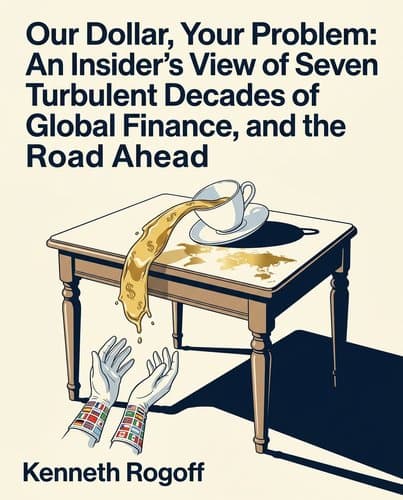
Rogoff ends on an image worth sitting with: a bodyguard who's fast enough to catch the cup before it hits the floor, but not fast enough to stop the trembling hand that tipped it. The dollar has outlasted every rival not because America kept its promises with unusual consistency, but because its rivals kept breaking theirs first. That margin is narrower than it looks, and it isn't guaranteed to persist. The real uncertainty isn't whether China or the euro or some digital alternative eventually displaces the dollar — it's whether the U.S. squanders the advantage through choices that feel painless right now and arrive as catastrophe later. Fiscal drift, eroded central bank independence, the quiet assumption that dominance is self-renewing — these aren't abstract risks. They're the same pattern that preceded every monetary transition this book describes. The dollar probably survives. The question is what's left of it when it does, and who pays for the gap. History doesn't punish recklessness on a fixed schedule. But it does collect.
Notable Quotes
“The markets can stay irrational longer than you can stay solvent.”
“Climate is systemic risk, climate is systemic risk,”
“Jerome Powell, by refusing to take climate risk as a systemic crisis, you are putting us at risk of an economic disaster. Climate change will heighten the risk of a banking crisis. Because of your negligence, the American people will have to take a 15 percent loss of GDP,”
Frequently Asked Questions
- What is Our Dollar, Your Problem about?
- Kenneth Rogoff examines how the U.S. dollar became and maintains its role as the world's reserve currency, and why that dominance is more fragile than most Americans believe. Drawing on seven decades of financial history, the book identifies institutional commitments, fiscal risks, and geopolitical costs affecting dollar supremacy through the century. Rogoff shows how previous challengers—the Soviet ruble, Japanese yen, euro, and renminbi—looked permanent before structural contradictions destroyed them. The dollar's dominance rests on a specific, breakable promise: low inflation and rule of law. Each act of fiscal excess or sanctions overreach invisibly chips at this promise until crises expose the damage.
- What are the key threats to dollar dominance according to Rogoff?
- The greatest near-term threat to dollar dominance is not China or cryptocurrency but the bipartisan American consensus that debt is costless. This faith-based assumption about permanently low interest rates consistently fails when history reassesses it. Fixed exchange rate regimes structurally collapse within roughly five years in open capital markets. Rogoff notes that the very promise 'we will never devalue' encourages the dollar borrowing that guarantees eventual catastrophe. Central bank independence is the single most important institutional safeguard of dollar credibility, yet it lacks legal protection and remains most vulnerable when fiscal pressures peak. Political convenience remains its only defense.
- What can we learn from previous challenges to the U.S. dollar?
- Every supposedly inevitable challenger to dollar dominance eventually collapsed—the Soviet ruble, Japanese yen, euro, and renminbi all appeared permanent before structural contradictions undid them. Pattern recognition matters more than size or growth rates when assessing future challengers. These historical lessons demonstrate that seeming permanence masks hidden vulnerabilities. The dollar faces similar structural risks rooted in its foundational promise of maintaining low inflation and rule of law. Each instance of fiscal excess or sanctions overreach erodes this promise invisibly until crises suddenly expose the damage. Understanding why past challengers failed illuminates vulnerabilities threatening current dollar dominance and should inform policymaking about reserve currency sustainability.
- What are the costs and benefits of the dollar's reserve currency status?
- The exorbitant privilege of issuing the world's reserve currency saves the U.S. roughly $120-600 billion annually in borrowing costs. However, the military obligations required to sustain it cost $500-900 billion more annually than U.S. allies pay. Rogoff argues this net benefit deserves much more scrutiny than it receives. The true cost-benefit analysis of reserve currency status remains largely unexplored in American policy. Understanding whether military expenses justify the borrowing savings is critical for evaluating long-term fiscal sustainability. This calculus becomes more urgent as geopolitical competition intensifies and mounting debt obligations strain budgets worldwide.
Related Book Summaries

Read the full summary of 220714080_our-dollar-your-problem on InShort