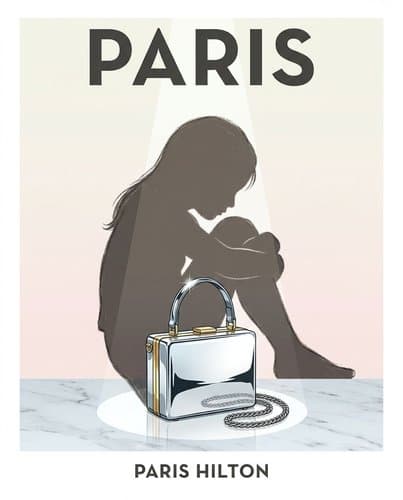
61812425_paris
by Paris Hilton
Behind the blonde persona was a survival strategy built in solitary confinement—Paris Hilton dismantles the glamorous armor she wore for decades to expose the…
In Brief
Behind the blonde persona was a survival strategy built in solitary confinement—Paris Hilton dismantles the glamorous armor she wore for decades to expose the abuse, silence, and self-authorship that made her both a prisoner and an architect of her own existence.
Key Ideas
Girls mask ADHD as personality traits
ADHD in girls is systematically underdiagnosed because girls mask better — the restless daydreamer performing obedience gets missed while the disruptive boy gets treated. If ADHD is being considered for a child, ask specifically about the female presentation: relentless social performance, 'trying harder to fit in,' and compensating creativity are symptoms, not personality traits.
Grooming's binary protects the abuser
Grooming offers a false binary: 'stupid victim who was deceived' vs. 'irresistible siren who changed someone's mind.' Paris names this explicitly and shows that both options protect the abuser. Recognizing the binary — and refusing to choose — is the cognitive move that breaks the manufactured silence.
Cult-based methodology hides in residential programs
Before placing any child in a residential treatment program, research its therapeutic lineage. Programs tracing back to CEDU, Synanon, or 'emotional growth boarding school' methodology are rebranded cult techniques, not clinical treatment. The $50 billion industry has no federal oversight; state-level regulation is the only check, and it is weak.
Self-authorship defends against imposed reality
'Your reality is totally up for grabs; if you don't create your own life, someone else will create something based on their own agenda and project that on you.' Paris Hilton developed this philosophy in a solitary confinement cell. It is the most durable strategic insight in the book: self-authorship is not vanity, it is defense.
Silence enables harm to future victims
Silence about abuse does not neutralize damage — it compounds it. Paris estimates that her years of silence about Provo made her complicit in harm to subsequent victims who entered the same institution. The compound interest stops when disclosure begins, not when the person feels ready.
Forgiveness returns damage to the abusers
Forgiveness can be offered before an apology arrives, and before one ever will. Paris explicitly names what she wanted her parents to say, notes they have not said it, and extends forgiveness anyway. This is not the same as acceptance or resolution — it is a unilateral act that returns the damage to the people who caused it.
Who Should Read This
Readers who connect with first-person stories about Memoir and Mental Health and want to see the world through someone else's eyes.
Paris
By Paris Hilton
10 min read
Why does it matter? Because everything you think you know about Paris Hilton is exactly what she built to keep you from knowing anything.
You already have a picture of her. Everyone does — the catchphrase, the sex tape, the pink velour tracksuit, the Chihuahua in a handbag. That picture isn't wrong, exactly. It just isn't the whole story. It's the story she built to replace the whole story, which is darker, stranger, and considerably less photogenic. She engineered the dumb-blonde persona in a solitary confinement cell at sixteen, in near-total dark, with nothing but her own mind for raw material. She made it impenetrable. She wore it for twenty years. And this book is the accounting of what that cost — what she surrendered to keep it intact, and what she quietly built inside the armor the whole time, waiting for the day she finally decided to take it off.
She Stayed Silent for Twenty-Five Years Because the Alternative Was Worse
A schoolteacher called a fourteen-year-old girl every night, and one night, her parents were out. He said come outside. She climbed down the drainpipe, slid into the passenger seat of his idling SUV, and he kissed her. When her parents' headlights swept the windshield, he jammed the car into gear, fishtailed down the driveway, sped through Bel Air, and while she held on to the seat, laughing nervously, he kept repeating: "My life is over. Why did you make me do this?"
Paris Hilton called this her first kiss for the next twenty-five years.
Not because she forgot what happened. Because there were two available stories and she chose the one where she was a person, not a casualty. The teacher had already named her the irresistible one — she'd been voted "Finest Girl" in her yearbook, and he'd spent months telling her she was mature and sensational, far beyond the boys her age. The other story (the one where a grown man called a child every night to ask if her parents were home) required her to accept the word "pedophile," which required accepting the word "victim," which required believing that everything he'd praised in her had actually been a weapon he was using against her. That she had been garbage all along, just waiting to be thrown away.
Nobody chooses that story about themselves. Not Paris, who was shipped to her grandmother's in Palm Springs after the incident while the teacher, as far as she knows, faced no consequences.
The exile was the second instruction in what turned out to be a curriculum. Her parents had already taught her the foundational rule: if you don't talk about a thing, it's not a problem. Silence was the family operating system, inherited and unexamined. The teacher's "it's our secret" slotted directly into it. A year later, at a stranger's apartment, a man kept pushing a spiked wine cooler on her until she took one sip — and woke hours later in an empty room she didn't recognize, barely able to stand, with no memory of what had happened to her body. The math repeated: nowhere to take it, no words that fit, no version of the story that kept her whole.
By the time the world knew who Paris Hilton was, silence was a structural feature, not a choice. The wounds came first. The armor came after.
A Furniture Salesman Turned Parental Desperation Into a $50 Billion Industry
You don't send your kid to a place like this because you're cruel — you send her because silence as a family strategy stopped working. A psychiatrist handed you a royal-blue brochure showing tennis courts and horse riding, briefed you that your teenager would lie and manipulate to come home, and told you the only way to save her life was to hold firm no matter what she said. The con required your love. It ran on it.
Mel Wasserman wasn't a therapist. He was a Palm Springs furniture salesman who became a disciple of Charles Dederich, the founder of Synanon, a violent cult that used verbal abuse, sleep deprivation, forced abortions, and physical brutality as "treatment." In 1964, he spotted some teenagers on a street corner, invited them to spaghetti dinner, and never really let them leave. He moved to a compound in the San Bernardino Mountains, rebranded the cult methodology as an "emotional growth boarding school," hired a copywriter to produce a brochure featuring tennis courts and students on horseback, offered therapists financial kickbacks to send families his way, and invented an acronym for the school's name ("SEE yourself as you are and DO something about it") because the actual origin, Charles E. Dederich University, pointed too clearly at a banned cult.
Working-class parents mortgaged their homes; the celebrity client list (Michael Douglas, Barbara Walters, Roseanne Barr) came in with deeper ones. Alaska alone spent $31 million in Medicaid funds sending 511 children to programs like CEDU between 1999 and 2005. The industry Wasserman built now generates $50 billion a year.
Paris Hilton arrived at CEDU not as a client but as inventory. What the brochure called "emotional growth curriculum" was, in practice, a circle of chairs with paper towels pre-distributed around the perimeter, soft rock playing at punishing volume, and children trained to dismantle whoever was selected that night — drilling into documented vulnerabilities from their intake files — until the target confessed something real or invented, whatever it took to make the abuse stop. Kids screamed until tiny blood vessels burst under the skin of their faces. Paris watched them spew confessions she later realized they had fabricated.
The con depended on distance. By the time Paris managed a fifteen-minute monitored phone call home, her mother was already fluent in CEDU vocabulary, telling her to "work the program." CEDU hadn't just locked Paris up. It had gotten to her parents first.
The Paris Hilton Brand Was First Sketched in a Solitary Confinement Cell
The brand wasn't built on privilege and good timing. It was designed in a freezing cinder-block cell at seventeen, while Paris Hilton was locked in solitary confinement with blood on the walls and a bucket in the corner.
The working theory most people carry is that Paris Hilton is what happens when a beautiful girl from a famous family gets a reality television show at exactly the right cultural moment. The actual origin story is more disturbing.
At Provo Canyon School, solitary confinement was called "Obs." The cell was hexagonal, roughly the size of a public bathroom stall, kept between 55 and 60 degrees. They took your underwear when they put you in so you couldn't use it to kill yourself. The walls had dried blood and feces on them. A bucket, a drain, a small wired-glass window that let in a thin strip of light. They had stripped her name, her clothes, her freedom to hum a song or scratch a word on paper.
What they couldn't reach was her mind.
Inside Obs, she built something: not a fantasy, but a working blueprint for a future self. She chose specific playlists. She thought through the exact citrus note she wanted in a perfume she didn't yet own. She decided how a corset should be boned. Instead of the bruised face and numbered sweats, she specified: lush lashes, a spray tan, glitter at the cheekbones. Each detail was the deliberate inverse of something Provo had done to her.
She finds the framework for this later in Magritte's painting of a pipe — the image is not the pipe, but it has its own undeniable reality, and whoever controls the image controls what's real. She applied that directly: the baby voice that made interviewers hear ditzy while she was running numbers in her head, the deliberate performance of a woman too famous to be taken seriously, which is to say too famous to be looked at closely. Provo had tried to replace her with a numbered unit, 127, and she'd learned what it felt like from the inside. The only defense against someone else's story is building your own first. The brand wasn't an accident of celebrity. It was a survival strategy, made specific enough in the dark that she could execute it the moment the door opened.
The Culture Did to Her at Nineteen What Provo Did to Her at Sixteen
She was on the other side of the world when her manager called. A thirty-seven-second clip of her, naked, was moving through the internet. Her first instinct was that someone had faked it. Then she made the connection to a video she'd made years earlier with a boyfriend she trusted, and she called him.
He told her it was too late. The clip was already out. He said he had every right to sell something that belonged to him — something worth real money.
If she had chosen this, the lighting would have been better. She would have had a stylist. The camera angles would have been flattering. She would never have dedicated the finished product to victims of 9/11. And — most importantly — she would have owned it, publicly and loudly, and never apologized to anyone. The argument lands because it's true, and because she had to make it. That's the machinery: she was violated, and then required to prove her innocence to people who had already purchased the footage for the price of a restaurant dinner.
Meanwhile, Nicky was getting up before their parents every morning at the Waldorf Towers, running the hotel hallways, turning all the newspapers face-down. Her teenage brothers could barely look at Paris.
Provo had used her documented secrets against her in group sessions. The culture used her private footage on newsstands, talk shows, and late-night stages. The people running the operation changed. The logic did not.
The Armor and the Cage Were Always the Same Object
Seoul, three in the morning. Paris Hilton is on a hotel bed, peeling false lashes from her eyes while a documentary director named Alexandra Dean holds a camera on her in silence. The footage was meant to capture the exhaustion of a global brand empire: the private jets and packed arenas and fragrance launches that had made her one of the wealthiest self-made women in entertainment. Instead, what pours out is: "I don't even know who I am sometimes. I created this brand and this persona and this character, and I've been stuck with it ever since."
The brand had worked. That's what makes the Seoul room so clarifying. The specific vision she built in solitary confinement — lush lashes, glitter at the cheekbones, a baby voice deployed like a second skin — generated nearly three billion dollars in fragrance revenue alone, a DJ residency at Amnesia in Ibiza, a million dollars a gig. The armor was impenetrable because she'd engineered it that way: you can't humiliate someone who controls every angle of her own image. You can't reach someone who's never fully there.
What the armor also did was keep her out of her own life. The tabloids called her a sex symbol; she had no word for what she actually was, which was someone for whom sex had been made terrifying by abuse, and for whom the word "asexual" simply didn't exist yet (not as a matter of orientation, but as a name for what happens when the connection between body and self gets severed early and never repaired). The Carl's Jr. ads and the music videos, all that performed desire, were her attempt to reclaim something taken from her. The performance was real. The access was not. She called herself the Kissing Bandit and told no one.
The nightmares were always waiting. Not metaphorically. Every night she tried to sleep in her own bed, the images came back: hushed voices in a stairwell, footsteps down a hall, hands grabbing the back of her neck. For twenty years, she woke screaming in hotels on every continent, sleeping better in cars and makeup chairs than in any bed. What it cost her in those first months back in Los Angeles was specific and constant: she couldn't set her foot on the floor in the dark. She knew, in the part of her brain that doesn't respond to reason, that a hand would grab her ankle. She would sit knees-to-chest, talking herself down — not real, it's over, you're safe — until morning. It never quite worked.
The armor held. The nightmares stayed. She filled the calendar.
She Forgave Without Receiving What She Asked For
Forgiveness given before it's asked for is not the same as forgiveness withheld indefinitely. Paris Hilton understood the difference, even if her parents never got there.
She names it exactly: what she wanted wasn't "I'm sorry you had such a hard time" (which locates the pain in her experience) but "I'm sorry we made a terrible mistake," which locates it in the decision. Her parents managed the first. Not the second. She says so without theatrics: they're just not there yet, maybe they never will be, and that's okay.
So she apologizes to them. Unprompted. For the cruelty of disappearing — for making them live not knowing whether their daughter was alive. She names the psychological torture on their side too. She means it. The apology doesn't cancel what happened to her; it exists alongside it.
The image the book won't release is her parents behind a cracked door, watching two hired men drag their daughter screaming into the dark. They don't move. They had their reasons — this was the plan, the program, the thing that was supposed to save her. Knowing the reasons makes it harder, not easier.
Twenty years later, her mother covers her face with her hands on camera when Paris finally tells her what happened inside those walls. A few days pass. Then a text arrives: a link to an article about Provo Canyon survivors. No explanation, just: I'm following you now.
Paris calls her mother's willingness to talk about it publicly astonishing courage. She's not wrong. It's also not the apology she asked for. She had already decided that was okay.
The Room She Wasn't Scared of Anymore
When she testified before the Senate in 2021, advocates built a life-size replica of a solitary confinement cell in the rotunda. Same dimensions, same cinder block. She stepped inside, and she cried.
Not because the room still had power over her. Because it didn't.
That's the ending the book earns — not the apology she asked for and didn't receive, not the footage scrubbed from the internet, not the nightmares going quiet for good. Just a woman standing inside a replica of the worst place she's ever been, finding out it has become something she can walk out of. What she does with that — the testimony, the advocacy, the runway entrance she chose to close her own documentary — is what living looks like when survival stops being a full-time job. You can call it transformation. She'd probably call it choosing, finally, who she is when nobody's watching.
Notable Quotes
“Don't try to lock it,”
“There wouldn't be much point.”
“I braced my hands on the toilet seat, breathing, waiting until I saw her eye at the crack in the stall door.”
Frequently Asked Questions
- What is Paris Hilton's memoir 'Paris' about?
- This memoir traces Paris Hilton's survival of institutional abuse at a teenage treatment facility and her journey constructing and then dismantling a public persona. The book exposes three major systems: the unregulated residential treatment industry, the mechanics of grooming, and the underdiagnosis of ADHD in girls. By sharing her personal narrative, Paris equips readers to recognize these systems in their own lives and reclaim their own stories. The memoir combines personal account with systemic critique, showing how her decades of carefully constructed persona actually protected her while simultaneously preventing her from being her authentic self.
- What does 'Paris' reveal about ADHD diagnosis in girls?
- Paris reveals that ADHD in girls is systematically underdiagnosed because girls mask their symptoms better than boys. The restless daydreamer performing obedience gets missed while the disruptive boy receives treatment. If ADHD is being considered for a child, ask specifically about female presentation: relentless social performance, 'trying harder to fit in,' and compensating creativity are symptoms, not personality traits. This diagnostic gap has profound consequences, as undiagnosed ADHD leaves girls struggling without support, often developing harmful coping mechanisms instead of receiving proper treatment and understanding.
- How does 'Paris' address the topic of grooming and abuse?
- Paris explicitly rejects the false binary that grooming narratives create: 'stupid victim who was deceived' vs. 'irresistible siren who changed someone's mind.' Both options protect the abuser by placing responsibility on the victim. Recognizing this binary and refusing to choose it is the cognitive move that breaks manufactured silence around abuse. Paris demonstrates that this framework is not about blame, but about naming how abusers use language and narrative to isolate victims and prevent disclosure. Understanding this pattern is crucial for recognizing grooming when it happens and speaking about it.
- What does 'Paris' expose about the residential treatment industry?
- Before placing any child in a residential treatment program, research its therapeutic lineage. Programs tracing back to CEDU, Synanon, or 'emotional growth boarding school' methodology are rebranded cult techniques, not clinical treatment. The $50 billion industry has no federal oversight; state-level regulation is the only check, and it is weak. Paris's experience at Provo exposes how these facilities can cause serious harm while operating largely unmonitored. Her call for transparency and accountability reflects the broader need for systemic change in an industry that lacks sufficient safeguards to protect vulnerable teenagers.
Related Book Summaries

Read the full summary of 61812425_paris on InShort