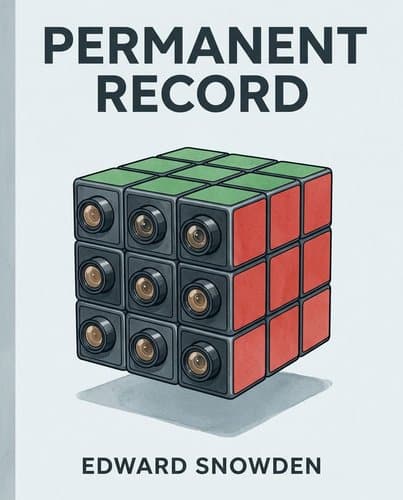
46223297_permanent-record
by Edward Snowden
Metadata—who you called, when, from where, and with whom—reconstructs your entire life without reading a single message, and Snowden reveals how every branch…
In Brief
Metadata—who you called, when, from where, and with whom—reconstructs your entire life without reading a single message, and Snowden reveals how every branch of the US government deliberately conspired to make this surveillance legally unchallengeable by the very citizens it was built to watch.
Key Ideas
Encryption beats deletion's false protection
Deletion is a user-interface fiction: when you delete a file, only the directory entry changes — the data remains on disk until overwritten. The only meaningful protection against surveillance is encryption; trusting platforms to delete your data is trusting them with a key they can hand to anyone who asks.
Metadata reconstructs your complete life
Metadata (who you called, when, for how long, from where, to whom) is more invasive than the content of your communications and carries weaker legal protection. It reconstructs your full life — relationships, movements, beliefs, health — without reading a single message.
Nothing-to-hide logic enables mass control
'Nothing to hide' reasoning is structurally self-defeating: it doesn't protect you, it surrenders everyone's privacy simultaneously, because every person alive has something in their past that could be prosecuted under some law currently on the books — and mass surveillance hands that retroactive weapon to whoever holds power.
Classification defeats legal surveillance challenges
Secret surveillance programs are designed to be legally unchallengeable: you cannot sue to expose them because you cannot prove surveillance without the government first confirming the program exists, and the government will classify that confirmation. The legal system's integrity depends on cases being arguable; mass surveillance removes the argument.
Government branches coordinated surveillance conspiracy
All three branches of the US government — Congress, the judiciary, and the executive — coordinated to enable and protect mass surveillance after 9/11. This was not individual failure or overreach; it was a deliberate, concurrent constitutional breach requiring active cooperation from institutions designed to check each other.
Engineers shoulder surveillance's moral burden
Technical knowledge of broken systems creates moral obligations that ignorance avoids. The engineers who build surveillance infrastructure have disproportionate access relative to their formal authority and therefore bear a special responsibility — they are the only ones who fully understand what they've built.
Who Should Read This
Readers interested in Memoir and Geopolitics, looking for practical insights they can apply to their own lives.
Permanent Record
By Edward Snowden
11 min read
Why does it matter? Because the man who built the infrastructure of mass surveillance is the only one who can explain exactly how it works — and why it cannot be reformed from within.
Most people come to this book expecting one of two things: a spy thriller, or a civics lecture. The spy thriller crowd wants the chase — NSA contractor goes rogue, steals secrets, runs. The civics crowd wants the verdict: hero or traitor, depending on which news channel last had their attention. Both framings miss what the book actually is: the origin story of a kid who fell in love with computers at age seven because, for the first time in his life, something gave him honest answers. Snowden spent the next two decades building the infrastructure of American surveillance — not as a spy, but as an engineer tracing systems to their root causes. The book asks what happens when you apply that exact discipline to the system you've spent your career serving. The answer took seven years to arrive at and cost him everything he couldn't pack into a carry-on.
He Loved Computers Because They Were the Only Thing in His Life That Was Fair
The government lab was dim when Lon Snowden led his seven-year-old son inside: standard beige walls, the kind of institutional quiet that makes children whisper. Then the screens came into focus, rows of monitors casting a steady green glow, all showing the same color, the same kind of data. Eddie's first thought was that someone had left a lot of televisions tuned to the same channel.
His father had brought him here to diagnose a broken Nintendo. Eddie had taken it apart to fix it himself, lost a screw to the family dog, and failed spectacularly. While Lon went off to repair the console, he left the boy alone at a keyboard with a Post-it note full of characters Eddie couldn't quite parse. There were quotation marks he didn't know how to type, a Shift key he had to discover through trial, a QWERTY layout nobody had explained. He pecked away with stubby fingers for a long time.
When he finally hit Enter, the screen asked: WHAT IS YOUR NAME?
He typed his answer. The screen replied: HELLO, EDDIE!
What hit him wasn't the novelty. It was the fairness. He had entered something specific; the machine had returned something specific. No mood, no favoritism, no arbitrary reversal. At school, identical answers earned different grades depending on who asked and who answered. At home, rules shifted with adult stress levels. But here: input produced output, every time, for everyone. A computer would wait as long as necessary for the right input, then respond instantly and identically to anyone who provided it. He had never encountered anything that consistent.
Snowden's later choices — what he leaked, why, at what cost — look like political decisions, but their roots are here, in a kid who found in machines the one domain where the rules were real. When he eventually discovered that the systems he'd devoted his career to were being used to betray exactly that principle, it registered as something more than a policy disagreement. It felt like a personal violation.
He Didn't Discover the Surveillance State — He Helped Build It, One Compartmentalized Job at a Time
Whistleblowers are usually imagined as outsiders who stumble across a secret. Snowden was the opposite: a specialist who built the machine one compartmentalized assignment at a time, each role so narrowly defined that the full architecture was invisible until it wasn't.
The clearest example is a program called EPICSHELTER. At the NSA's Pacific Technical Center in Japan, Snowden inherited a genuine engineering problem: spoke sites around the Pacific were losing intelligence data because bandwidth constraints prevented them from transmitting full backups to headquarters. His fix used a technique called deduplication — scanning every file fragment across every facility, identifying what was already stored at NSA headquarters at Fort Meade, and transmitting only the genuinely new material. Backup volumes dropped from a torrent to a trickle. The system worked. The NSA adopted it, expanded it globally, and quietly renamed it.
What Snowden had optimized, without framing it this way at the time, was the agency's capacity to store everything, indefinitely. Before EPICSHELTER, bandwidth was the practical ceiling on how much the NSA could archive. After it, the ceiling was gone. The agency's stated aspiration — to retain collected communications not for days or weeks but for years, eventually for decades, eventually forever — had just become technically feasible. He'd solved a logistics problem. He had also, without knowing it, removed the last real constraint on mass surveillance.
That pattern held across his entire career. Each job handed him a specific problem and the access needed to fix it: digitizing CIA European station networks in Geneva, engineering the intelligence cloud that gave every agent universal data access regardless of location, building the global backup that ensured no collected record could ever be lost. No single role showed him the whole system. That's not an accident of bureaucratic structure; it's a feature. Compartmentalization works by controlling what you can know, not just what you can do. You can't object to a purpose you haven't been permitted to see.
The view came in Hawaii, in a tunnel under a pineapple field built over the ruins of a Pearl Harbor-era aircraft factory. From a single terminal, he had practical access to the communications of roughly 320 million Americans. Every job he'd held had been a gear in the same machine; Hawaii was the first time he could see the machine as a whole. The geography carries a specific irony: the surveillance apparatus justified by Pearl Harbor was being run from directly beneath it.
His diagnosis, at the end of seven years: the system worked exactly as designed. That was the problem.
The Government Made Mass Surveillance Legal by Redefining the Word 'Collected'
Imagine a bank that quietly moves your savings into its own vault, then argues it hasn't "taken" anything because it hasn't spent the money yet. The transfer is just storage. Possession doesn't occur until withdrawal. Under this logic, the bank could hold your funds for decades, draw on them whenever convenient, and never have committed a crime.
The NSA constructed almost exactly this argument. When Snowden, doing routine sysadmin work in Japan, encountered the classified Inspector General report on the agency's post-9/11 surveillance expansion, the first thing he noticed was what it wasn't: a redaction of the public version. The document released to citizens wasn't a censored version of the truth. It was a separate document that bore almost no relation to the classified original. The classified version showed the NSA had quietly pivoted from targeted collection to bulk collection, sweeping up everyone's communications under a program called STELLARWIND, and had justified this legally by redefining ordinary English words.
Specifically: "acquire" and "obtain." The government's position was that data entering NSA databases wasn't legally "obtained" until an analyst queried it. The capture itself, the automatic wholesale harvesting of phone records and internet traffic, was merely storage. No one had technically obtained anything, so no warrant was required. Data could sit in those databases indefinitely; the moment a future administration found you inconvenient, they could retrieve everything you'd ever communicated, without having ever, in the legal sense, searched you. The Fourth Amendment protects against unreasonable search and seizure. The NSA's position was that neither had occurred. The Constitution hadn't been repealed — just the verbs had been redefined.
The construction was airtight in one further way: it couldn't be challenged. When the ACLU sued, they hit a closed loop. To have standing, they needed to prove their clients had been surveilled. But the surveillance was classified. And classified information, the government argued, couldn't be established through press reports — only through official government confirmation. The program could never be challenged without first being admitted, and it would never be admitted. The Supreme Court, in 2013, accepted this reasoning and dismissed the case 5-4 without examining whether any of it was constitutional. The executive created the program in secret, the legislature looked away, and the judiciary declined to look at all. Every branch had arrived at the same answer: this question would remain unasked.
'Nothing to Hide' Is the Most Dangerous Belief About Privacy You Can Hold
What would happen if every law were actually enforced?
Not selectively, as laws are now, but all of them — every misdemeanor, every ordinance, every statute buried in state code since a more prudish era and never repealed. Maryland still makes adultery a criminal offense, punishable by a ten-dollar fine. North Carolina bans bingo games longer than five hours. Most people have smoked something they shouldn't have, jaywalked, downloaded something they didn't pay for, or attended a meeting that would look suspicious to someone determined to be suspicious. The laws are everywhere; enforcement is selective; and that selectivity is what makes civil life possible.
Mass surveillance eliminates that selectivity. Not today, necessarily. But permanently. Every communication stored is a future weapon. Imagine a file on your desktop: the complete record of everything that could ruin you. The one-night stand your partner doesn't know about. The teenage abortion you told no one. The protest you attended, the petition you signed, the search you ran at 2 a.m. when you were frightened about your health or your finances or your politics. Everyone has one. Mass surveillance means the government holds a copy of yours, and can open it the moment you become inconvenient.
"I have nothing to hide" sounds like a position. It isn't. It's a surrender. The nothing-to-hide argument makes the same mistake as saying you don't care about free speech because you never plan to say anything controversial: it treats a structural protection like a personal preference. Privacy isn't a preference for secrecy — it's the entire zone beyond the state's reach, the negative space that makes every other freedom real. Americans don't have a "right" to free speech in some positive sense; they have it because the government is forbidden from restricting it. Privacy is the same structure, an enforced absence of state power, and once it's gone, it's gone for everyone. Your choice to surrender it doesn't just expose you. It shrinks the space in which your neighbor, your child, the next generation of dissidents, get to exist.
The Case Against Mass Surveillance Wasn't Legal or Philosophical — It Was a Toddler in a Diaper
A man in Indonesia is at his computer, his toddler squirming in his lap, smacking the keys. The kid keeps giggling. Snowden has headphones on, and through them he can hear every giggle — the father's microphone is transmitting to an analyst in Hawaii, and the father has no idea. Then the child looks into the camera. Snowden feels the boy looking directly at him. He closes the session. He gets up and walks out.
The father's offense was sending a job application to a university in Iran. Tenuous enough for the NSA to flag him, sieve his digital life from internet traffic, and assemble it into folders: résumé, texts, browser history, a geo-fence tracking his movements. Snowden was reviewing those folders using XKEYSCORE (type any address and it retrieves years of emails, search queries, and live screen activity, letter by letter as they were typed) when he found the video.
Constitutional arguments describe a system. The Fourth Amendment analysis, the redefined verbs, the closed legal loops: all of it stays at the level of structure. The sound of that giggle is what the legal argument never reaches — a specific child, on the other side of a camera, whose father sent a résumé to the wrong address. The surveillance didn't care that the suspicion was too thin for Snowden to reconstruct later. It collected anyway. It assembled anyway. It put an analyst at one end of a wire and a father at the other.
Snowden held his breath without realizing it. He knew how packets become searchable records, how a microphone becomes a filing cabinet. None of it prevented the shock. There's a difference between knowing a system can reach inside someone's home and hearing a child laugh in your headphones because it did.
He Smuggled NSA Secrets Past Armed Guards in a Rubik's Cube — and the Math Forced Him to Go Public
He walks out of the Tunnel — the NSA facility under the pineapple field — every night with SD cards the size of a pinkie nail, some in his sock, one inside a pried-off square of a Rubik's Cube snapped back into place. He banters with the guards, solves the cube one-handed mid-conversation, and watches them smile. He's been at this for months: distributing cubes to colleagues, coaching whoever took to them, making the object so ordinary a guard's eyes would slide right past it. By the time the cards held the NSA's secrets, the cube was already invisible.
What worked: getting the documents out. What couldn't work: keeping his name off them.
He was right about his communications. A laptop running an operating system that forgot everything at shutdown, borrowed Wi-Fi accessed through a hardware ID swapped to look like a different device, encryption keys too long for any computer to crack in any human timescale. What he couldn't hide was the documents themselves. Every classified file carries embedded metadata: invisible tags recording which user accessed it, when, from where. Strip the metadata and you protect yourself. But stripping modifies the file, and a modified file is one an investigator can dismiss as tampered. The disclosure would be judged by whether the documents were exactly as the NSA had kept them.
Then he learned about single-user watermarking: techniques that encoded a specific analyst's identity into documents through patterns of microdots in logos or shifts buried in timestamp coding. Some markers might survive any scrubbing he knew how to do, and there were surely methods he didn't. The same technical architecture he'd spent his career building — the one that made every document traceable, recoverable, attributable — was closing around him.
Any investigator checking which employees had accessed everything he planned to disclose would find a list with one name on it. Not a risk to manage. A certainty to accept.
What the technology forced as a practical matter, Snowden converted into a commitment: he would come forward and let his name stand behind what he'd done. The technical trap had become the moral decision.
The Person Who Paid the Highest Price Never Agreed to Be Part of This Act of Principle
Sandra, Snowden's mother, hooks her laptop to the flatscreen on June 9. A YouTube video loads — there he is, Ed, real and alive, thinner than Lindsay remembers but sounding like himself again, the confident version before this last difficult year wore him down. She stands in silence. Her phone begins to explode.
Lindsay was somewhere else, and had been for ten days.
Lindsay Mills had been constructing cover stories: telling NSA special agents that she'd left Hawaii because her grandmother needed heart surgery, not because she needed her best friend on the mainland. She'd watched government SUVs stake out her driveway, refused agents who wanted to copy her computers without a warrant, and deduced from a foreign phone number on her missed-calls list that Ed was in Hong Kong. She had done all of this without being told anything.
That's the detail the book insists you sit with. Snowden spent years planning a disclosure he believed the public needed. He thought through document selection, journalist partnerships, and the legal architecture that would trap him regardless. He did not tell the person who shared his life. The closest preparation he managed was engineering his mother's visit to Hawaii so that the two women who loved him most would have each other when everything broke.
What followed for Lindsay was bureaucratically thorough. FBI agents read her private messages back to her demanding explanations (private communications, stripped of relationship context, look like code). A friend, Eileen, who knew what evasive driving looked like, drove her through San Diego, had her drain her life savings in cash before the government could freeze her accounts, and blew a hairdryer in the upstairs hallway so any listening devices couldn't capture their whispers. Agents followed her through the Macy's women's department. The FBI field office had a betting pool on when media would find her.
In early July, on the lanai of their emptied house, she burned his photographs and clothes in a trash can. Then she wrote in her diary that volcanoes are only destructive in the short term — ash becomes minerals, lava cools into new land. She was describing a decision to stay. She was also still in the middle of damage she hadn't agreed to absorb.
The book doesn't resolve this. The surveillance state needed exposing. A specific person paid for that exposure without ever being asked. Both things are true, and Snowden is disciplined enough not to pretend they cancel each other out.
The Diagnostic Habit That Got Him There — and What It Asks of Everyone Who Now Knows
Snowden's diagnosis of the surveillance state runs on the same instinct that made him good at building it: trace every failure back to its root, refuse to accept that something works correctly simply because it hasn't visibly broken yet. That instinct is not specialized knowledge. You don't need a security clearance to apply it. What it costs you, once applied, is the comfort of plausible ignorance. The engineers who built these systems carry a specific obligation — they hold the key that explains the lock. But you've now read the diagnosis. The gap between knowing a machine is broken and doing nothing about it has a name, and it isn't neutrality. Snowden lost his country, the life Lindsay had built around him, and any uncomplicated version of home. The question the book leaves sitting in the room is quieter than that: what exactly have the rest of us lost by choosing not to?
Notable Quotes
“According to the report, it was the government's position that the NSA could collect whatever communications records it wanted to, without having to get a warrant, because it could only be said to have acquired or obtained them, in the legal sense, if and when the agency”
“them from its database. This lexical sophistry was particularly galling to me, as I was well aware that the agency's goal was to be able to retain as much data as it could for as long as it could—for perpetuity. If communications records would only be considered definitively”
“once they were used, they could remain”
Frequently Asked Questions
- What is Permanent Record about?
- Permanent Record is Edward Snowden's firsthand account of how the US intelligence community built a system of mass surveillance. The book explains how metadata reconstructs entire lives, why the legal system cannot challenge secret programs, and what happens when all three branches of government coordinate to undermine constitutional checks. Snowden argues that understanding this surveillance infrastructure created an obligation to expose it. The work documents both the technical mechanisms of mass surveillance and the institutional failures that enabled it to flourish after 9/11.
- What are the key takeaways from Permanent Record?
- Permanent Record identifies six critical insights about mass surveillance. Deletion is a user-interface fiction—data remains on disk until overwritten, making encryption the only meaningful protection. Metadata is more invasive than message content and reconstructs your entire life. "Nothing to hide" reasoning is self-defeating because it surrenders everyone's privacy simultaneously and gives power over retroactive prosecution. Secret surveillance programs are legally unchallengeable due to classification barriers preventing lawsuits. All three government branches coordinated to enable mass surveillance after 9/11. Finally, engineers building surveillance systems bear special moral responsibility due to their unique access and understanding.
- Why did Edward Snowden feel obligated to expose mass surveillance?
- Snowden believes that understanding how mass surveillance works creates a moral obligation to expose it. As he explains: "Technical knowledge of broken systems creates moral obligations that ignorance avoids. The engineers who build surveillance infrastructure have disproportionate access relative to their formal authority and therefore bear a special responsibility — they are the only ones who fully understand what they've built." For Snowden, this knowledge demanded action. He recognized that exposure was necessary to challenge a system where all three government branches coordinated to undermine constitutional checks, making ordinary legal and political remedies impossible.
- What does Permanent Record explain about metadata and surveillance?
- Permanent Record reveals that metadata—who you called, when, for how long, from where, and to whom—is more invasive than message content and carries weaker legal protection. This information reconstructs your complete life, including relationships, movements, beliefs, and health, without reading a single message. The book demonstrates why "nothing to hide" reasoning is self-defeating: it surrenders everyone's privacy simultaneously. Since every person has something in their past prosecutable under current laws, mass surveillance hands retroactive weapons to whoever holds power. Snowden shows how legal and technical vulnerabilities combine, leaving citizens defenseless against systemic abuse.
Related Book Summaries


Read the full summary of 46223297_permanent-record on InShort