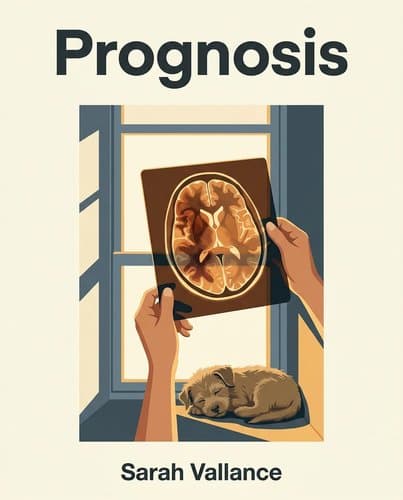
43497893_prognosis
by Sarah Vallance
After a traumatic brain injury, Sarah Vallance rebuilt her career and identity using the very mind medicine said was broken — hiding her wound so convincingly…
In Brief
After a traumatic brain injury, Sarah Vallance rebuilt her career and identity using the very mind medicine said was broken — hiding her wound so convincingly that even those who loved her refused to believe it existed, leaving her brilliantly recovered and profoundly alone.
Key Ideas
Ask about neuroplasticity beyond initial prognosis
When a doctor delivers a prognosis after TBI, ask specifically about neuroplasticity — the brain's capacity to build new pathways around damaged tissue. Sarah's neurologist never mentioned it; she learned about it from a stranger in a park six months post-injury. A prognosis documents what the damage is; it doesn't determine what recovery becomes possible.
Self-designed intensive practice outperforms formal therapy
The most effective cognitive rehabilitation Sarah found was self-designed: five hours daily of copying text by hand, reading aloud to catch word errors, rehearsing conversations with specific scripts. The formal system offered her stuffed-toy fabric-cutting. If formal rehabilitation offers little, self-directed intensive practice targeting the specific deficit may still work.
Undetected deficits surface years after injury
TBI symptoms and losses can surface or be discovered years or decades after the injury — not as new damage, but as abilities that were gone from the start and never tested. If you've had a head injury, periodically check capacities you haven't recently used: music reading, complex spatial tasks, emotional regulation under stress.
One safe disclosure breaks isolation cycle
Concealment of a hidden disability is often a rational survival calculation, not just avoidance — but it compounds isolation. The more successfully you hide, the less support you can access, and the fewer people can name you as next of kin when it matters. Even one safe disclosure, to one person, changes the math.
Strategic silence protects under cognitive stress
'No one is ever thought to be a fool by keeping quiet.' Sarah's operating principle in high-stakes professional settings while managing cognitive deficits. The practical translation: when you're uncertain about your ability to perform under scrutiny, brevity and careful listening buy more time than rambling explanations.
Structure scaffolds recovery better than empathy
The practical scaffolding of daily routine may matter more in TBI recovery than emotional support. Laura's locked study door, hourly snacks, and mind-mapping technique contributed more to finishing Sarah's PhD than any formal intervention. If you're supporting someone with a brain injury, concrete behavioral structure — not just empathy — is the lever.
Who Should Read This
Readers who connect with first-person stories about Memoir and Neuroscience and want to see the world through someone else's eyes.
Prognosis
By Sarah Vallance
9 min read
Why does it matter? Because a prognosis is not a ceiling — and someone had to prove it without anyone knowing she was trying.
A neurologist's prognosis has the finality of a verdict. When Sarah Vallance's arrived — by phone, no ceremony, IQ of eighty, consider working in a park — it was meant to close the file on her. She hid it instead. For two decades she concealed a traumatic brain injury so completely that the people who loved her most refused to believe it existed, even when she said so directly. That's the trap built into recovering from an invisible wound: the performance that gives you back your career, your relationships, your life is the same performance that leaves you entirely alone inside the damage. Prognosis is about what it actually costs to disprove a medical verdict, and why a stranger in a park and a tick-covered puppy appeared in no treatment plan anyone ever wrote for her.
The Neurologist Had the Wrong Prognosis for the Right Reasons
In January 1995, a psychologist named Toby sets a collection of colored wooden shapes on his desk and asks Sarah Vallance, 31, to find the yellow circle. She cannot. She insists there isn't one. He points to it. She buries her face in her hands and sobs.
Three days earlier, she was the youngest person ever appointed to New South Wales's senior executive service, a director in the Premier's Department, one-third through a doctorate in public administration. Then a horse named Mac bolted across a sheep farm in rural New South Wales, jumped two fences, and stopped dead. She went over his head. She'd later try to describe the sound her skull made hitting the rock: one part crack, one part slosh, one part thump.
The next morning she found her reading lamp inside the refrigerator and her toaster in the freezer, caked in frost. She didn't connect either to the fall. She drove herself to work.
After Toby's assessment, the neurologist calls. The psychometric results put her IQ equivalent at 80. She won't return to white-collar work. He suggests, with the detached helpfulness of someone who has already moved on, that outdoor work might suit her. Parks. Something like that. Her PhD is over. In a few sentences, he closes out her career and, with it, the youngest-ever appointee to New South Wales's senior executive service.
It's hard, reading this, not to believe him. She couldn't find a yellow circle. The brain scan showed bruising. Two centimeters to the right, she would have died. The neurologist isn't speculating; he's reading evidence. What makes this a book rather than an ending is a distinction neither of them can see in 1995: the gap between what damage exists and what a person can still do with what remains. He was right about the first part. Twenty years later, an MRI would confirm significant shrinkage in exactly the motor and cognitive regions he described. The damage was real. The extrapolation — that damage is destiny — was where he got it wrong.
What Actually Rebuilt Her Brain Had Nothing to Do With Any Treatment Plan
What rebuilt Sarah Vallance's brain was copying academic articles by hand into spiral-bound notebooks, reading every sentence aloud, and a dog with better instincts than her neurologist.
About two months after the accident, she sat down in her sealed study — it smelled; her cat had been using the carpet as a protest toilet while she was at the office — and opened a file on her computer titled "Methodology." She didn't know what the word meant. She burst into tears and retreated to the sofa.
She went back the next day. Her method was brutal in its simplicity: five hours a day, seven days a week, she copied academic journal articles verbatim, by hand, into notebooks. She'd forgotten how to type, so handwriting was all she had. Her dysphasia meant rogue words appeared in her sentences, words that had no business being there. Reading everything aloud let her catch them before they slipped through. She recorded every unfamiliar word each day and reviewed the list each night. By the next morning, she could recognize the words but not remember what they meant. Every morning, she started over.
It took her a full week to transcribe one brief journal article. A page a day. Before the accident she had read two books on a good day.
Her brain was running a relay race while missing two runners — damaged cells dead, healthy neurons scrambling to cover their routes. MRI scans show injured brains work dramatically harder than healthy ones even on basic tasks. The daily grinding was forcing those backup pathways to form. She didn't know any of this. She just refused to stop.
The pivot came from her dog. Six months in, George — who had strong opinions about attractive strangers — threw himself into a woman's lap in the park and refused to leave. Sarah sat down beside them. The woman mentioned she'd just finished a master's thesis on traumatic brain injury, specifically on how the brain heals itself after damage. Sarah asked whether it actually could. "It can," the woman said, "and often does. You'd be surprised."
That was the entire exchange. Sarah never saw her again. But the neurologist had told her she would never return to white-collar work, and here was someone who had spent two years studying the evidence saying the opposite. It had already been working. The proof was on her desk: notebook after notebook, filled in her own handwriting, one page a week.
The Only Witnesses Who Accepted Her Without Conditions Were the Ones Who Couldn't Speak
When Sarah was discharged from the neurologist's care with a disability pension and a suggestion to try parks work, the two most reliable presences in her days were a dingo-colored stray named George and a black-and-white rescue named Bess. George woke her at seven, selected the park, herded her home when he'd decided they were done, and nudged her toward the stairs at nine each night. Bess planted herself against Sarah's side on the sofa and stayed there. Neither of them could tell anyone what they saw. Neither required her to seem fine, or to get better on any schedule, or to close her mouth while she sat there losing hours to a hole in the plaster.
Everyone else in her life needed something. The social worker needed her to attend rehabilitation. Her mother needed her to be functioning enough not to require intervention. She kept her distance from former colleagues, who needed her to still be the person she had been. George and Bess needed feeding and walking. In exchange, they offered a complete absence of assessment.
When Sarah was at her lowest, she didn't find a reason to live so much as she backed into one. She considered the alternative and found a practical snag: the same cognitive damage that had ended her career made the plan too unreliable to execute. So she made a deal with herself — she would stay alive for the remainder of George's and Bess's natural lives. After that, she had decided, she would have discharged her obligations.
The deal wasn't supposed to be a foundation. It was a ceiling: permission to leave, deferred. Not to recovery, not to hope — just to showing up for two animals who showed up for her each morning without being asked. It became, instead, a floor.
The Concealment That Gave Her a Fellowship Also Left Her With No One to Name in an Emergency
What does it take to decide that something true about yourself is too dangerous to share?
Sarah was openly gay in a country where homosexuality was illegal — she never hid it, considered it professionally irresponsible to hide it. The brain injury she had disclosed to fewer than five people in her entire life.
The gap between those two positions was a calculation. She had read the literature: brain injury survivors read as intellectually impaired, volatile, untrustworthy — not someone you put in charge of things. She had also observed the evidence in her own career: a relocation agent in Singapore was ferrying her through apartment viewings in a gold Mercedes, as the newly appointed regional head of human resources for an international bank. That career, that apartment, everything before them — all of it rested on nobody having pressed her at the right moment. She said so explicitly: if she had been honest about her injury, none of it would have existed. The concealment was the foundation of the life, not the price she paid to get there.
The payoff was real. So was the bill, and it arrived through a routine question from a receptionist at a local surgery outside Sydney: next of kin. Sarah had returned to Australia in her early fifties, to a beach house she barely recognized, after years in Singapore and Hong Kong. She stood at the counter and couldn't answer. Her brother was estranged. Her mother she'd seen five times in twelve years. The nearest eligible candidate was a cousin eleven hours' drive away, encountered once in two decades. What she could inventory at fifty-one: three dogs, two cats, and an ex-girlfriend in Hong Kong who had stopped loving her back.
The armor had performed exactly as designed — a Harkness Fellowship (which funds exceptional professionals to spend a year studying in the United States), a career, a relationship, the apartment in Singapore. But the same concealment that made people trust her also made it impossible for them to see what was actually wrong. When she finally told her partner Giulia about the injury, Giulia dismissed it immediately: look at you, you're fine, whatever problems you had are past. She wasn't being cruel. She was responding to the only Sarah she had ever been allowed to see.
Brain Damage Is Patient — It Delivers Its Losses on Its Own Schedule
In a Singapore apartment, Sarah unpacks a box of papers and finds the score to Beethoven's Spring Sonata — the last piece she performed at the Conservatorium High School before everything else happened. She opens it at the table. Nothing registers. She can identify the treble clef, and that's where it ends.
She retrieves her violin from the wardrobe, where it has traveled with her through every move since Sydney. Her fingers land on the fingerboard and stick, rigid. She knows the open first string produces a G. Beyond that: nothing. The notes on the page have become a foreign alphabet: she cannot locate a G on the score or assign any sound to any symbol.
The condition has a name: musical alexia. Brain injury can erase the ability to read and produce music the same way it erases language. She had lost this in 1995, in the weeks after the fall, and simply never discovered the gap because she never went looking. For twenty years the violin sat in its case and the loss sat with it, undisturbed.
A broken bone announces itself. Brain damage has patience. It waits for you to open the right box. Some losses showed up immediately — the toaster in the freezer, the yellow circle she couldn't find on a psychologist's desk. Others took years. She had rebuilt a career, earned a doctorate, moved continents, and believed she understood the full inventory of what was gone. She didn't. There was the father she failed to help die. The dog she killed to keep a girlfriend. The damage had its own list.
She Chose Not to Schedule Her Next Brain Scan. That Was Its Own Kind of Answer.
Sarah had downloaded the paperwork for a clinic in Zurich and given herself a deadline: dead by Christmas. Three weeks later, she carried a feral puppy named Scout (roughly the weight of a mango, covered in sixty ticks, burning with babesiosis, a tick-borne fever) home from a Hong Kong road embankment and put her to bed on a stuffed reindeer. She had not planned to keep her. She told Giulia she would find Scout a home once Scout recovered. She had zero intention of doing this.
What changed the arithmetic wasn't sentiment. It was math. Puppies live ten or eleven years. If Scout was going to survive, Sarah would need to also. She hadn't decided to stay alive — she had accidentally acquired an obligation that made dying inconvenient. The Dignitas papers had felt like control: a peaceful death, champagne, fondue in Zurich, before dementia could take what remained. Scout didn't cancel the fear. She just rearranged the schedule.
The book lands here, on a reprieve accepted on its own terms. A year or so later, Louise, a psycho-geriatrician who specializes in dementia, holds Sarah's MRI slides up to the kitchen window in chronological order and delivers the clearest verdict anyone has ever given: every loss, the music she can no longer read, the words that hijack sentences, the serial memory failures, traces back to exactly where her skull met a rock. The changes are slow and bear the fingerprint of injury, not neurodegeneration. Louise reads brain scans of people with dementia all day; she knows the difference. But she's also precise about what this does and doesn't settle: no prognosis, no guarantees — just an injury and its specific, stable consequences.
What Sarah does with that verdict is the point. Her neurologist had already recommended another MRI in four years. After Louise reviews the slides, Sarah decides to skip it. Seven years of waiting for the worst had consumed the life she was trying to protect. Louise frames it simply: if the next scan shows more atrophy, what will you do? There is no answer that requires knowing.
She left the appointment unscheduled. Scout still needed someone there in the morning. That wasn't certainty, but it was specific, and it was enough.
The Last Thing She Chose Not to Know
The question the book never quite asks out loud is the one it leaves you holding: how many of us are waiting for a prognosis before we agree to live? Sarah didn't get certainty — she got Louise, a psycho-geriatrician holding slides up to kitchen window light, and a puppy the size of a mango who required tick treatment and someone still present for the next decade. That was enough. Not proof. Not a clean scan. Just enough. The next MRI appointment went unscheduled. The fear didn't leave. She just stopped requiring it to.
Notable Quotes
“We're going to do some simple tests,”
“Let's try some basic numeracy tests anyway.”
“Toby says, reaching under his desk and pulling out a large plastic cylinder full of wooden shapes in primary colors. He empties the cylinder on his desk.”
Frequently Asked Questions
- What is Prognosis about?
- Prognosis is Sarah Vallance's memoir about recovering from a traumatic brain injury that physicians declared permanent. Through self-directed rehabilitation, Vallance rebuilt her career, relationships, and identity while exploring neuroplasticity—the brain's capacity to create new pathways around damaged tissue. The book reveals practical recovery strategies based on routine, repetition, and structure, and examines the psychological and social costs of concealing hidden disabilities. Vallance demonstrates that recovery extends beyond initial medical prognoses through deliberate, personalized rehabilitation, offering concrete hope and actionable strategies for patients and supporters alike.
- What does Prognosis teach about neuroplasticity and recovery?
- Sarah Vallance argues that neuroplasticity—the brain's capacity to build new pathways around damaged tissue—fundamentally changes what recovery is possible after traumatic brain injury. She discovered that her neurologist never mentioned neuroplasticity in her prognosis; she learned about it from a stranger six months after her injury. Vallance emphasizes that "a prognosis documents what the damage is; it doesn't determine what recovery becomes possible." Understanding neuroplasticity shifts patient expectations from permanent limitation to potential restoration through deliberate rehabilitation and neural reorganization.
- What self-directed rehabilitation strategies does Prognosis recommend?
- Sarah Vallance's most effective cognitive rehabilitation was entirely self-designed, not provided by the formal medical system. Her intensive practice regimen included five hours daily of copying text by hand, reading aloud to catch word errors, and rehearsing conversations with specific scripts. In contrast, formal rehabilitation offered minimal practical intervention. Vallance emphasizes that "if formal rehabilitation offers little, self-directed intensive practice targeting the specific deficit may still work." Her experience demonstrates that highly focused, repetitive practice tailored to individual cognitive deficits can achieve recovery where standardized interventions fail.
- What does Prognosis say about disclosing hidden disability?
- Vallance argues that concealing a hidden disability is often a rational survival strategy rather than mere avoidance, yet concealment has significant costs. "The more successfully you hide, the less support you can access, and the fewer people can name you as next of kin when it matters." She advocates for strategic disclosure, noting that even one safe disclosure to one trusted person fundamentally changes access to support. This selective transparency allows individuals to maintain professional boundaries while building a minimal safety net, breaking the isolation that complete concealment creates.
Related Book Summaries
Read the full summary of 43497893_prognosis on InShort