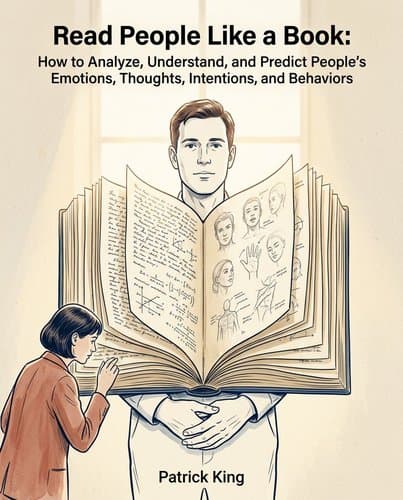
56199402_read-people-like-a-book
by Patrick King
Every outburst, defense mechanism, and nervous gesture follows a hidden logic—once you learn to read clusters of behavior instead of isolated signals, other…
In Brief
Read People Like a Book: How to Analyze, Understand, and Predict People's Emotions, Thoughts, Intentions, and Behaviors (2020) explains the layered logic behind human behavior — motivation, ego defense, biological wiring, and personality.
Key Ideas
Match advice to Maslow hierarchy level
When someone reacts with disproportionate intensity, identify which Maslow level they're currently operating from — someone in survival mode cannot engage advice aimed at self-actualization, no matter how good the advice is
Defense mechanisms reveal underlying fears
Read the specific ego-defense mechanism to diagnose what a person fears: denial means they cannot accept the reality; projection means they cannot accept a part of themselves; rationalization means they cannot accept failure — the mechanism names the wound
Read gesture clusters, not individual signals
Stop reading individual gestures and start reading clusters — neck-touching alone means almost nothing; neck-touching paired with body-angling, pursed lips, and ventilating reads as a unified defensive state that is very hard to fake across all channels simultaneously
Establish behavioral baseline before assessing truth
Before you try to assess whether someone is lying, ask them about something you already know to be true — without a behavioral baseline for that specific person, no individual tell is meaningful enough to act on
Test first impressions with indirect questions
Treat your first impression as a hypothesis, then test it with a question that bypasses defenses — 'what animal best describes you?' reveals more about a person's self-concept in thirty seconds than a direct question reveals in thirty minutes, precisely because it feels like play
Who Should Read This
Curious readers interested in Behavioral Psychology and Social Psychology and the science of how the mind actually works.
Read People Like a Book: How to Analyze, Understand, and Predict People’s Emotions, Thoughts, Intentions, and Behaviors
By Patrick King
12 min read
Why does it matter? Because the people around you are more legible than you've been taught to believe.
Most people consider themselves decent judges of character. Research politely disagrees. Confidence in reading others has almost no relationship to actual accuracy — the person trusting their gut most is often missing the most. The gap isn't talent. It's framework.
Human behavior isn't random or mysterious — it follows a layered logic of unconscious drives, ego protection, biological wiring, and stable personality. Once you know which layer is running at a given moment, other people stop being confusing and start being readable. The framework builds layer by layer: from the unconscious drives people can't see in themselves, through the body signals they can't fully suppress, all the way to the specific questions that pull honest answers past a person's defenses.
People Aren't Irrational — They're Following Rules You Haven't Learned Yet
Why do people who seem perfectly reasonable in one moment turn baffling in the next, and why does the same behavior from two different people feel completely different? Most of us assume the answer is personality, or mood, or that people are just unpredictable. The short answer is simpler: you're watching the output without seeing the input. Every behavior is already solving something. Find what it's solving, and the action stops being mysterious.
Consider a counselor at a women's shelter. Two women arrive in the same week. The first came in hours ago, bruised and afraid, her children beside her. The second has been there three months, safe, stable, starting to breathe again. Same counselor, same training, same genuine care for both. But she doesn't approach them the same way. She knows the first woman is operating from the base of the pyramid, where physical safety is the only thing that registers. A workbook on forgiving your abuser or building self-love would be noise at best, insulting at worst. The second woman's survival is secured. What she's starving for is connection, someone to make her feel less alone. Handing her a legal resources list would miss her entirely.
The counselor isn't reading these women's personalities. She's reading their need level. That framework is Abraham Maslow's hierarchy of needs: not a self-improvement ladder, but a live diagnostic.
There's a more useful frame than personality or mood: active drives — running processes that determine what someone is reaching for right now. Maslow is the most immediately useful of these, but it's one piece of a larger set that Patrick King builds his opening chapter around.
King's reframe runs like this. Before it, other people's behavior feels personal, aimed at you, shaped by mood, random. After, it becomes traceable. The person who keeps arguing past the point of obvious defeat isn't being irrational; their ego's defense system is running, protecting them from a reality they can't yet face. The colleague who goes cold after minor criticism isn't oversensitive; they're somewhere on the hierarchy where belonging feels threatened. The same behavior from two people can have completely different machinery underneath it.
People are not choosing behavior at random. They're solving for something — a threat to the ego, an unmet need for safety or connection, a perception of pain they're trying to escape. The practical question stops being "why are they doing this to me?" and becomes "which drive is running right now?" That single reframe is what the rest of the book is built on.
The Ego Doesn't Protect You — It Protects the Story You Tell About Yourself
Fred had spent his whole life organized around one fixed point: his idol. Bedroom walls covered in posters. Closet full of replica outfits. An identity built so thoroughly on admiration that when the man at the center of it all went on trial for a serious crime, Fred showed up outside the courthouse with a protest sign. The evidence mounted. The verdict came — guilty. Compelling documentation followed. Fred's response didn't change. The victims were jealous, he said. Looking for spotlight. The whole thing was a conspiracy by people who resented someone great.
You might read Fred as stubborn, or delusional, or simply dishonest. But none of those fit. Fred wasn't arguing a position he'd chosen to defend. He was protecting something he couldn't afford to lose: the story of himself as someone whose judgment could be trusted, whose admiration was always deserved. Accepting the verdict would have indicted that story entirely. The ego, facing that threat, simply refused. Not as a deliberate choice. Automatically, the way a knee jerks when tapped.
The mechanism has a name — ego defense — and its defining feature is that it runs without the person's awareness. The person using it doesn't experience themselves as lying. They experience themselves as seeing clearly. The mechanism running in Fred is denial, the bluntest of the set. Denial doesn't spin reality into something more flattering; it refuses to register the threatening reality at all. Other mechanisms are subtler. Rationalization acknowledges that something went wrong, then immediately assigns the blame elsewhere: the boss always hated me, the coach was biased, the timing was unfair. The sour grapes fable captures this precisely: the fox who can't reach the grapes decides they must have been sour anyway, still hungry, ego intact, problem made invisible. Projection goes further still: the cheating husband who can't face his own behavior redirects that unacceptable feeling outward, becoming convinced his bewildered partner is the one hiding something. What he accuses her of is the label he secretly gives himself.
Once you see this pattern, defensive behavior stops looking like stubbornness and starts looking like a map. Each mechanism points toward a specific fear the person cannot face directly. Denial points to a reality too threatening to register. Rationalization points to a failure the ego won't own. Projection points to a trait the person finds intolerable in themselves. Jung called this territory the shadow: everything a person has pushed out of consciousness because owning it feels impossible. The behavior is predictable — not because people are weak, but because the ego runs the same plays every time. You're not watching someone choose to be difficult. You're watching a system doing exactly what it was built to do.
Your Body Is Arguing With Your Words — and Your Body Is Winning
The defenses the ego runs are invisible — but the body broadcasting that something is being suppressed is not.
Imagine you get a phone call from a friend who insists everything is fine. Their words are perfectly neutral. But something makes you ask again — and again they insist. How did you know to keep asking? You weren't watching their face. You couldn't see their hands.
In 2020, Wim Pouw at Radboud University ran an experiment that answers it. He had six people make a simple, sustained "aaaa" while moving their arms in different ways. A separate group of thirty listeners heard only the audio, with all visual information stripped away. Those listeners could correctly identify what kind of gesture the speaker had been making, where in space the movement happened, and how fast it moved. From sound alone.
The explanation isn't mystical. When you make a gesture, muscles engage across your whole body, including those that produce sound. Different arm movements create different patterns of tension in connective tissue, which subtly shifts pitch, volume, and speed. The voice is not a separate channel — it is the body. And because it's the body, it carries the same involuntary information that the limbic brain pushes through every other physical system.
But knowing that the body broadcasts emotional state still leaves the harder problem: what are you actually watching for? The answer is clusters, not tells. Ex-FBI agent Joe Navarro, who spent a career reading people under pressure, is emphatic: a single gesture proves nothing. Arms folded across the chest could mean defensiveness, or cold air conditioning. A hand moving toward the throat could signal stress or just an itch. A gesture becomes meaningful when it groups with others pointing in the same direction.
Consider deception. The limbic brain is running two conflicting programs: what's actually felt, and what the person is trying to project. That internal conflict shows up as effortful self-control: closed posture, restricted movement, deliberate containment. Navarro calls these "pacifying behaviors," small self-soothing gestures the body makes to bleed off stress it can't otherwise release. A woman touching the suprasternal notch, the small hollow at the base of the throat. A man pulling his collar open as though the tension itself is generating heat. Someone slowly wiping their palms down their thighs. Each one alone gets dismissed. All three in five minutes, from someone who doesn't normally do any of them, tells a different story.
The practical shift this creates: stop hunting for the single gesture that cracks the case. That's how you end up misreading someone's anxiety as guilt. Watch instead for a unified theme running across face, voice, posture, and hands simultaneously. When everything points the same direction, you're reading the limbic system, not the performance.
The Lie-Detection Tells Everyone Knows Are Almost Completely Useless
Reading clusters in real time raises an obvious question: can you use them to catch a liar?
The tells everyone learns to watch for are nearly useless. Shifty eyes, nose-touching, looking up and to the right. Not marginally unreliable. Nearly useless.
A 2006 study in the Forensic Examiner found that age, education, gender, and confidence in one's lie-detection abilities were all statistically irrelevant to actual performance. A companion paper that same year found that psychologists and judges, professionally trained to read behavior, performed at chance level alongside everyone else. The most damning number: only 50 people in 20,000 catch liars more than 80% of the time.
The reason tells fail is structural. A gesture only means something relative to a baseline. Arms crossed could signal defensiveness or cold air conditioning. Touching the face could be stress or an itch. A practiced liar who knows the same tell-watching framework you do simply won't do those things. You're trying to catch someone with access to the same field guide.
What actually works is increasing the cognitive load on the liar until their fabricated story becomes too heavy to carry. Truth-telling requires only memory. Fabrication requires running four programs at once: building the story, keeping it consistent, managing your visible affect, and tracking what the other person already knows. The liar is carrying a far heavier load.
The technique that takes advantage of this: ask someone to recount a story you already know to be true before asking about the thing in question. That first account gives you a baseline: how they tell stories when nothing is at stake. Then compare. When you introduce the suspect narrative, watch for the voice going flat. Liars frequently narrate fabricated events in a detached, objective tone, because they cannot simultaneously construct a story and perform genuine emotion about it. The feeling they're suppressing leaks into their body instead, which is why clusters of neck-touching, collar-ventilating, and posture-angling become visible precisely when the voice sounds calmest.
Then drop a small incorrect detail mid-story and watch what happens. A truth-teller corrects you. A liar — already juggling too much — may accept it without flinching. Each new variable is another weight on a structure that's already straining.
The clusters from the previous section still apply, but with one condition: they only mean something against a baseline you've established yourself. The signal isn't in any single gesture. It's in the gap between the two stories.
More Observation Won't Make You a Better Judge — But Better Questions Will
All of those techniques (baselines, cognitive load, the deliberately wrong detail) are interrogation tools. They tell you how to interrogate once you're already looking. The harder skill is trusting what sent you looking.
Mara walked into the second interview already knowing something was wrong. The first round had left her with a feeling she couldn't name: not about the role, not about the commute, just about the person across the desk and the way the room felt. She'd gone home telling herself it was nerves.
But she went back. This time she started asking specific questions about the previous person in the job. The answers were evasive. The story shifted slightly each time she pushed. Body language went sideways. The interviewer touched his collar, leaned back, broke the rhythm of what had been a smooth presentation. She dug through her network afterward. What she found: the previous employee had been let go after filing a sexual harassment complaint against someone who would have been her direct manager.
Her gut had flagged it. Her questions found it.
That's the structure: gut instinct opens the investigation. It doesn't close it.
Here's where the research cuts against intuition's usual image. John Gottman, a psychologist who studies couples, claims he can predict with 95% accuracy whether two people will still be together fifteen years from now, from a single observation. That's already startling. But the part that should stop you: his accuracy drops to 90% when he spends more time watching. More data made him worse. The first impression wasn't just sticky; it was optimal.
Gut instinct isn't always right. Nalini Ambady, who coined the term "thin slicing" for detecting patterns from minimal information, found that emotional state degrades it. People who are sad lean toward slower deliberate processing and lose accuracy. And gut instinct left unchecked is confirmation bias with a faster engine: you'll notice only the evidence that proves what you already felt.
The productive move: let gut instinct flag the problem, then use deliberate analysis to investigate. Don't override the bad feeling. Don't act on it unexamined. Follow it into specific questions designed to surface concrete information.
That's where indirect questions come in. Asking someone "what animal best describes you?" sounds like small talk. It works because of the distance. People are far more comfortable describing traits in a wolf or a bear than describing those same traits in themselves, so they answer honestly without noticing they've done it. Someone who immediately says "bear" rather than shark — fierce, protective, not to be messed with — has just told you something precise about how they balance danger and warmth in their own self-concept. You couldn't have gotten that from a direct question. The indirection is load-bearing.
The right question isn't the one that demands an answer. It's the one the person answers without realizing they're being asked.
What You Owe the People You Can Now Read
The temptation, once you have these tools, is to use them for leverage — to spot the defense mechanism and feel ahead of the person running it. Resist that. Fred's refusal to believe the verdict, the colleague who deflects every piece of feedback, the hand that moves toward the throat at exactly the wrong moment — these aren't tells to exploit. They're glimpses of someone protecting something they cannot afford to lose. The machinery you've learned to read is the machinery of being human under pressure.
Accurate reading and compassionate reading, it turns out, require each other. You cannot see someone clearly while you're judging them, and you can't extend genuine grace to someone you don't understand. That double requirement is the actual gift of the framework.
Notable Quotes
“The boss has always had it in for me. And who trained me? Him! It's all his fault one way or another.”
“Nobody I admire this way would ever be guilty of this,”
“It's all just a conspiracy put together by the people who resent him for whatever reason.”
Frequently Asked Questions
- How do ego-defense mechanisms reveal what people fear?
- To diagnose what a person fears, read their ego-defense mechanism. According to the text, denial means they cannot accept the reality; projection means they cannot accept a part of themselves; rationalization means they cannot accept failure. The mechanism names the wound. By identifying which defense mechanism someone uses, you understand their fundamental fear. This enables you to predict their behavior and emotional responses more accurately. Rather than viewing these defenses as obstacles to understanding, treat them as diagnostic tools revealing what the person cannot psychologically accept.
- Why is reading behavioral clusters more reliable than individual gestures?
- Stop reading individual gestures and start reading clusters. Neck-touching alone means almost nothing; however, neck-touching paired with body-angling, pursed lips, and ventilating reads as a unified defensive state that is very hard to fake across all channels simultaneously. Reading clusters rather than single tells dramatically increases your accuracy because people can control one behavior but struggle to maintain consistency across multiple communication channels. This cluster approach transforms people-reading from pure guesswork into a reliable, learnable skill that you can develop systematically over time.
- What's the first step before assessing whether someone is lying?
- Before you try to assess whether someone is lying, ask them about something you already know to be true. Without a behavioral baseline for that specific person, no individual tell is meaningful enough to act on. This baseline allows you to observe their normal behavioral patterns—their typical facial expressions, speech patterns, and body language. Only by establishing this reference point can you reliably detect deviations that might indicate deception or discomfort. Attempting lie detection without a baseline is essentially guesswork with no factual foundation.
- How should you test your first impression of someone?
- Treat your first impression as a hypothesis, then test it with a question that bypasses defenses—'what animal best describes you?' reveals more about a person's self-concept in thirty seconds than a direct question reveals in thirty minutes, precisely because it feels like play. This indirect approach works because people naturally lower their psychological defenses when they perceive an interaction as playful or experimental rather than interrogative. By reframing your inquiry as a game or thought experiment, you access more authentic self-perception and honest insights into how people genuinely see themselves.
Related Book Summaries



Read the full summary of 56199402_read-people-like-a-book on InShort