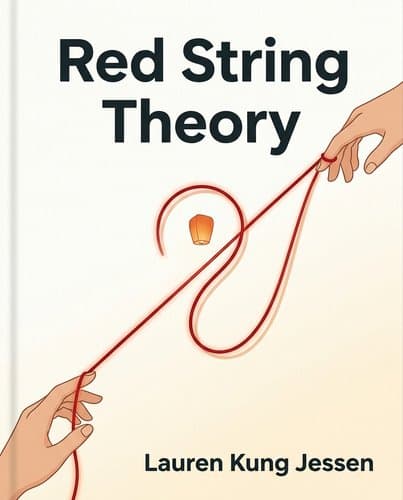
145624991_red-string-theory
by Lauren Kung Jessen
Fate sets the table, but you still have to sit down. This romantic novel explores how two people with opposing worldviews—one a believer in destiny, one a…
In Brief
Fate sets the table, but you still have to sit down. This romantic novel explores how two people with opposing worldviews—one a believer in destiny, one a skeptic—discover that love lives in the charged space between what's written in the stars and what you're brave enough to choose.
Key Ideas
Fate Requires Your Active Participation
The red string mythology isn't about passivity — it's about staying open long enough for the right person to appear, then having the courage to follow through. Fate sets the table; you still have to sit down.
The Language Incompatible People Create Together
When two people have genuinely incompatible worldviews, the relationship isn't built by one converting the other — it's built in the specific language they invent together. Jack's 'fated meteor' is that language.
Objects Speak What Words Cannot
Cultural objects — a recipe, a snow globe, a lantern — often carry emotional weight that direct conversation can't. Pay attention to what the people you love make, collect, and keep.
The Experiment Itself Is the Declaration
Testing fate doesn't necessarily cheapen it. The act of deliberately creating conditions for connection — even if imperfect — is itself a form of commitment. The experiment is the declaration.
Where Instinct Meets Deliberate Choice
The zhuā zhōu insight: the 'sweet spot' of a meaningful life sits at the overlap of what you're drawn to instinctively and what you consciously decide to pursue. Neither alone is enough.
Who Should Read This
Readers interested in Novels and Relationships, looking for practical insights they can apply to their own lives.
Red String Theory
By Lauren Kung Jessen
8 min read
Why does it matter? Because the red string only works if someone decides to follow it.
Somewhere out there, according to an ancient Chinese belief, a red thread already runs from your finger to the finger of the person you're meant to love. Invisible, unbreakable, indifferent to distance. If the thread already exists, why does following it feel less like destiny and more like a choice you have to keep making? That tension is exactly where Lauren Kung Jessen plants her story. An artist who needs to prove herself. An engineer who trusts equations over intuition. A lantern drifting through Manhattan that both of them chased anyway. Red String Theory isn't really a debate between fate and free will — it's a love story that lives in the charged space between them, arguing quietly that the thread only pulls taut when someone decides to reach.
The Fantasy Is Real Until Someone Has to Prove It
Imagine someone has already tied a red thread around your ankle. You can't see it, and you won't feel it until the right person walks by and the line goes taut. All the bad timing, the wrong turns, the relationships that almost worked — none of it was failure. It was just slack in the string. This is the promise at the center of Chinese mythology's Red Thread of Fate, and it's the reason Rooney, the mixed-race artist at the heart of Lauren Kung Jessen's novel, has organized her romantic life around it. The myth holds that an invisible cord connects two destined people across time and distance, regardless of circumstance. It doesn't ask you to be impressive or ready. It only asks you to follow the thread.
That kind of belief is hard to argue someone out of because it works as emotional architecture. When you're alone and uncertain, the idea that connection is already written removes a particular kind of dread. You're not behind. You're not broken. You're just not there yet.
The novel tests this comfort almost immediately. On the night of a Lantern Festival party, Rooney watches a paper lantern drift away into the Manhattan dark — somewhere above the noise of the street, orange light going smaller — and on instinct, chases it. A stranger is doing the same. That stranger is Jack, a NASA engineer whose thinking runs toward probability and empirical proof, the kind of person who hears "fate" and mentally appends "statistically unlikely." The two of them spend the night wandering the city under the convenient cover of anonymity, and somewhere in that shared chase, something catches. Rooney isn't naive for following the lantern; she's using a framework that keeps her available — available to follow an impulse, to stay curious about a stranger, to treat an accidental encounter as worth pursuing rather than dismissing as coincidence. The red string doesn't find her a partner. It keeps her from talking herself out of one.
A NASA Engineer and an Artist Walk Into a Lantern Festival — and Neither Will Budge
The central friction here isn't really about whether fate exists. It's about what happens when a skeptic decides to participate in it anyway — and whether participation changes the thing itself. Jack doesn't simply doubt Rooney's belief in the red thread; he responds to it the way a NASA engineer responds to any untested hypothesis. He designs experiments. He constructs a series of encounters he calls 'Red String Theory,' staging fate-adjacent moments to see if the connection between them holds up under controlled conditions. It's either the most romantic gesture in the book or the most corrosive one, depending on how you look at it — because the question it quietly raises is whether manufactured coincidence still counts as a sign.
That's where the two protagonists' epistemologies actually collide. For Jack, something is true when it can be replicated, measured, tested. His world at NASA runs on that logic — you don't launch a spacecraft on a hunch. For Rooney, the red thread works precisely because it can't be engineered. Its power is in the surrender: you follow it without knowing where it goes, you treat accidental encounters as meaningful, you stay open to what you didn't plan. The moment Jack starts building the conditions for fate, he's doing something that, by Rooney's own framework, should disqualify the result. If you set the stage, is what happens on it still real?
But Rooney carries her own contradiction, and it's the most interesting piece of mental furniture in the book. Her fierce drive to earn success entirely on her own terms sits in quiet tension with the mythology she lives by. The red thread promises that her best future is already tied to someone else — it's a beautifully passive image, a cord the lunar matchmaker Yuè Lǎo has already fastened to her ankle before she had any say in it. Rooney, who needs to claim her place as an artist without anyone else's help, doesn't fit that picture easily. She wants the fated partner and the independently won career, which means she's holding two stories about agency that don't fully square: one in which the universe arranges things for her, and one in which she arranges them herself. That second story keeps pulling against the first every time she gets close to letting the thread lead.
What You Can't Say Out Loud, You Cook
When two people can't say what they mean, they make things instead.
Jack makes his grandfather's red bean ice cream in two stages, and the sequence is more deliberate than it looks. Half the paste goes into a blender with the custard base and disappears entirely into the mixture — you'd never know it was there as a distinct thing, only as depth, a low earthen sweetness underneath the cream. The other half goes in near the end of churning, folded in with the ice cream already nearly set, so it stays in pieces. When you eat a spoonful, you get both: the smooth flavor running through everything and the occasional chunk that wants to announce itself. The recipe calls this a feature, not a compromise.
Jack is a man whose working language is empirical — he builds experiments, runs probabilities, measures outcomes. Sentiment doesn't have much room in that framework. But the ice cream he makes with his Gōng Gong, his maternal grandfather, every Sunday isn't really about ice cream. The ritual of it — the overnight soak, the hour and a half of simmering, the slow custard tempered by hand so the eggs don't scramble — encodes something about what he learned from that relationship and where his precision and warmth actually come from. The same care that makes him a good engineer makes him a good grandson. Food is where those two things can coexist without needing to be explained.
Wren's tea eggs work the same way, except the metaphor runs in the opposite direction. You start with a whole, sealed egg and deliberately damage it — tapping with a spoon or rolling it gently across a counter until a web of cracks spreads across the shell. Then you submerge it for up to twenty-four hours in a brine built on Lapsang Souchong, a tea so aggressively smoky it earns the comparison to Wren herself: robust, distinct, not everyone's first instinct. The cracks are the point. The marinade seeps through the fractures, and what comes out after a full day in the refrigerator isn't the egg you started with — it's stained through, layered with flavor it couldn't have developed intact. You had to let the outside in.
Can You Test Fate Without Destroying the Magic?
Jack builds what he calls Red String Theory — a deliberate series of fate-adjacent encounters, staged to see whether the connection he feels with Rooney holds up under something resembling scientific scrutiny. He's a NASA engineer; his instinct, when confronted with a variable he can't quantify, is to construct a test. So he does. He manufactures the kind of serendipitous moments that Rooney's mythology says the universe produces on its own, then watches to see what happens between them.
But the section worth sitting with isn't Jack's logic — it's Rooney's experience. She's organized her romantic life around a framework that asks her to stay open, to follow impulses she didn't plan, to trust that the thread is already tied and she just has to follow it. That framework only works if the moments feel unengineered — if the coincidences arrive without an architect. The second Jack starts building the stage, he's stepped into the role of Yuè Lǎo, the lunar matchmaker in the myth, the figure who ties the string in the first place. He hasn't disproved fate. He's impersonated it.
What makes this a real problem — not a criticism of Jack, but a philosophical knot the novel refuses to untangle — is that Rooney can't easily tell the difference. Does she suspect the encounters? Maybe. Does the feeling arrive anyway? Yes. And that's the thing: the warmth that shows up during a manufactured coincidence is the same warmth that shows up during a real one. The heart doesn't have a very good instrument for distinguishing serendipity from a setup.
The novel's wish — the one Rooney and Jack write on their lantern and release into the New York night — lands on the only honest answer available: "May fate bring us close enough to choose." Not fate instead of choice. Not choice instead of fate. The string gets you to the door. Someone still has to knock.
The Wish Written by the Skeptic Changes Everything
Jack is the one holding the pen. When Rooney and Jack prepare their lantern on the rooftop of her mother's Manhattan apartment building — cream paper, eco-friendly material Jack sourced specifically for this night — he pulls out what the novel calls his Discipline Pen, the instrument of the engineer, and offers it to Rooney to write their shared wish.
The wish they settle on is seven words: 'May fate bring us close enough to choose.' That sentence is doing something careful. It doesn't ask fate to deliver a person, packaged and certain, to the door. It doesn't ask for the strength to find someone without any help from the universe. It asks fate and choice to work in sequence — fate narrows the distance, and then the human being does something with that proximity. Jack, who spent the novel constructing controlled experiments to see if connection could survive scrutiny, didn't arrive at a conversion. He arrived at an expansion. His framework got bigger.
You can hear it in how he talks about Rooney on that same rooftop, looking out over the Hudson. When she asks about comets, he corrects her gently — comets are rare, that blinking light is a satellite — but then pivots without apology into metaphor. He tells her she was a meteor in his life, that she entered his atmosphere without warning and he couldn't have predicted the impact. A NASA engineer reaching for the language of wonder rather than data, and the reach is entirely voluntary. He hasn't abandoned the scientific framework. He's learned it can coexist with something else.
Jessen makes the same argument in her author's note through zhuā zhōu, a Chinese first-birthday ceremony. Objects are spread before the child — a book, a coin, a piece of food — and whatever the baby instinctively grabs is said to map their future. The ritual marks the moment a child first reaches toward the world, before they know enough to choose strategically. Jessen herself grabbed a pencil and a piece of candy, and became a writer with a culinary background. Her point isn't that the ritual proved prophetic. It's that the sweet spot sits somewhere between two explanations: that fate pre-wired the grab, or that knowing about the grab quietly shaped every choice that followed. Both can be true. The ritual doesn't cancel agency; it inaugurates it.
The lantern climbs until the wish written on its side is too small to read. What Rooney notices, watching it go, is that she doesn't need to know where it lands. That's the change. For someone who has spent years trying to track the thread, to locate its other end, to confirm the myth is real — the willingness to release without knowing is the thing. Jack counts down like he's running a launch sequence, because for him, this is a mission. On three, they let go. The lantern finds its own way up.
The Thread Was Always in Your Hand
Jack counts down like there's a control room listening. Three, two, one — and a paper lantern carrying seven words climbs into the dark above the Hudson, past the point where you could read them even if you tried. That's the image worth keeping. Not a man converted to magic, but a man trained to calculate odds who decided, with full knowledge of the odds, to let something go anyway. The red string is real — but it doesn't do the work for you. It was about staying open long enough to recognize what was already in front of you, and then having the nerve to reach. You don't get to choose whether the thread exists. You only get to choose what you do when it goes taut. That's not a small thing. That's the whole thing.
Notable Quotes
“Think we’ll see a comet?”
“Oh. What about a shooting star? Let’s find one of those.”
“Maybe if we look closely. Or if we’re lucky enough to catch it streaking by. The odds aren’t good,”
Frequently Asked Questions
- What is Red String Theory about?
- Red String Theory (2024) explores the tension between fate and free will through the lens of Chinese red-string mythology. It traces how two people with opposing worldviews build a relationship on their own terms, offering insights into how cultural objects, shared language, and deliberate acts of connection shape love. The work examines how the choice to pursue someone is itself a form of destiny, challenging the notion that fate means passivity. Instead, it reveals how fate and conscious decision-making work together to create meaningful relationships.
- What does Red String Theory say about fate and free will?
- Red String Theory reframes fate as an active process rather than passive resignation. The work explains that "Fate sets the table; you still have to sit down." The red string mythology isn't about helplessness—it's about staying open long enough for the right person to appear, then having the courage to follow through. The text argues that testing fate doesn't cheapen it; the deliberate act of creating conditions for connection is itself a form of commitment. The experiment becomes the declaration of devotion.
- How do people with opposing worldviews build relationships according to Red String Theory?
- When two people have genuinely incompatible worldviews, the relationship isn't built by one converting the other—"it's built in the specific language they invent together." Red String Theory uses Jack's 'fated meteor' as an example of this shared language: the unique communication system that emerges when fundamentally different perspectives meet. Rather than finding common ground through compromise, couples create their own dialect, symbols, and references that only make sense within their relationship. This invented language becomes the foundation of their connection.
- What is the zhuā zhōu concept in Red String Theory?
- The zhuā zhōu concept represents "the 'sweet spot' of a meaningful life [that] sits at the overlap of what you're drawn to instinctively and what you consciously decide to pursue." Neither impulse alone is sufficient for fulfillment; true meaning emerges at their intersection. Red String Theory also emphasizes that cultural objects—a recipe, a snow globe, a lantern—carry emotional weight that direct conversation cannot convey. Paying attention to what people you love make, collect, and keep reveals their values and deepens connection in ways words alone cannot.
Related Book Summaries
Read the full summary of 145624991_red-string-theory on InShort