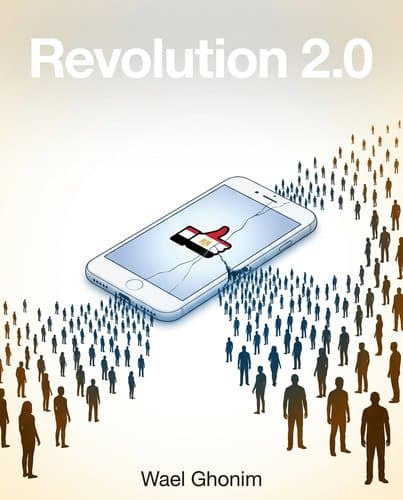
12265209_revolution-2-0
by Wael Ghonim
A Google marketing executive secretly built the Facebook page that toppled Hosni Mubarak—not through revolutionary ideology, but by applying product adoption…
In Brief
A Google marketing executive secretly built the Facebook page that toppled Hosni Mubarak—not through revolutionary ideology, but by applying product adoption logic: lower the cost of the first small action, design for the unconvinced middle, and let social proof do the rest.
Key Ideas
Small commitments unlock bolder collective action
Fear of acting alone is more powerful than fear of punishment — lower the perceived cost of the first small commitment (liking a post, holding a sign), and bolder action follows as social proof accumulates
Persuade the unconvinced middle, not converts
Design your message for the unconvinced middle, not the already-converted: Ghonim used colloquial dialect, avoided activist jargon, and spoke in the first person as an ordinary citizen precisely because radicals didn't need persuading — the passive majority did
Anonymity protects movements and enables participation
Anonymity is a strategic choice, not a limitation: by removing his ego and identity from the Kullena Khaled Said page, Ghonim made the movement harder to target and easier for anyone to identify with
Leaderless movements need invisible coordinating architecture
A 'leaderless' movement still requires coordination — the honest lesson from January 25 is that decentralized energy needs invisible architecture (shared documents, agreed routes, clear demands) to become effective action rather than scattered noise
Suppression becomes advertisement for movement significance
Cutting off a movement's communication infrastructure at its peak can backfire catastrophically: the Egyptian regime's internet blackout on January 28 signaled to millions of apolitical citizens that something historic was happening — suppression became the loudest possible advertisement
Emotional truth persuades faster than arguments
Emotional truth travels faster than argument: Isra's crayon drawing and Ghonim's televised breakdown each moved more people than any policy document — in a high-fear environment, shared grief and vulnerability are more persuasive than rational appeals
Who Should Read This
History readers interested in Democracy and Geopolitics who want a deeper understanding of how we got here.
Revolution 2.0
By Wael Ghonim
11 min read
Why does it matter? Because the assumptions you have about how revolutions start are backwards.
Here's what everyone gets wrong about the Egyptian revolution: it didn't need a Lenin. It needed someone who understood why people click "add to cart" but abandon checkout. Wael Ghonim was a Google marketing executive in Dubai — cautious, genuinely afraid — who looked at a 30-year dictatorship and saw not a political problem but a conversion problem. Too many Egyptians wanted change and not enough believed anyone else did. His solution wasn't a manifesto. It was a Facebook page engineered to lower the perceived cost of dissent one tiny commitment at a time, until courage became contagious at scale. What follows is the story of how that worked — mechanically, psychologically, and at terrible personal cost — and why it suggests something unsettling about where power actually lives now.
The Regime's Real Weapon Wasn't Violence — It Was the Belief That You Were Alone
It's midnight in Cairo, and Wael Ghonim is blindfolded with his own shirt, his own belt cinched around his head to keep the fabric in place. The driver is taking side streets deliberately — not to avoid traffic, but to scramble any mental map Ghonim might be building. He cannot see the next blow coming. That's the point. The guards grip his handcuffed arms, and somewhere in the darkness between each kick and each curse, he finds himself praying not for escape but for something stranger: that a friend named Najeeb in Dubai will think to change a password before the interrogation gets serious.
The physical abuse in that car was real, but almost beside the point. Egypt's State Security had spent decades perfecting a more efficient instrument than pain. Under the emergency law in continuous effect since 1967, any Egyptian could be held for six months without a warrant, without an attorney, without explanation. The apparatus kept exhaustive dossiers on anyone with public influence — not just opposition politicians but charity workers, university lecturers, prominent businessmen. Private recordings of people's infidelities sat in filing cabinets at headquarters, ready to be deployed if someone needed persuading. Officers were warned not to tap their own wives' phones, since it tended to cause domestic problems.
This infrastructure didn't need to be used constantly to work. It just needed to be known. Fear spread through the culture like a dye — visible in everyday proverbs: walk close to the wall, mind your own business, whoever keeps quiet stays safe. The message was the same in every variation: you are being watched, and no one is coming to help you. That belief — not the detention cells, not the slaps, but the isolation it manufactured — was how three decades of rule sustained itself. When everyone assumes they're the only one who objects, the regime never needs to arrest everyone. It only needs to arrest enough people that the rest conclude they're alone.
Ghonim, lying in that car, knew exactly what the beating was designed to accomplish. He made a conscious decision to perform terror — to tremble on cue, to accelerate the process. So he let his hands go slack against the seat, forced his breath into shallow, ragged pulls, gave them the fear they were looking for. But even as he calculated, the real fear was moving in. That gap between the performance and the genuine thing is where authoritarianism lives.
A Sales Funnel Is a Strange Blueprint for a Revolution — Until It Works
Ghonim understood something most activists miss: courage is a product, and products need a sales funnel. Before you can get someone to storm a public square, you have to get them to click a link. Then like a post. Then change a profile picture. Each step is smaller than the last, and that's the whole point.
When he built the 'We Are All Khaled Said' page in the summer of 2010, he mapped out four explicit stages borrowed from marketing school: join and read, interact with a like or comment, run a small campaign yourself, then take to the street. Most political organizers think only about that last stage and wonder why nobody shows up. Ghonim thought about how to move someone from stage one to stage four without ever asking them to skip a step — because each step does something a street protest can't: it makes the next act of defiance feel like a natural continuation rather than a leap.
The photograph campaign is the clearest proof it worked. Ghonim asked members to hold up handwritten signs reading 'We Are All Khaled Said' and post the photos. Stage three. It's nothing — a picture taken in a bedroom or a kitchen, sent to an admin nobody has ever met. But when the photos came back, something shifted. Then a pregnant woman sent an ultrasound image captioned with the news that she'd named her unborn child Khaled, and that he would remember. These weren't arguments. They were proof — visible, shareable proof — that you were not the only one. And once you believed that, the street was suddenly a shorter distance away.
The language he chose carried the same logic. He could have used formal written Arabic, the register of newspapers and political speeches. Instead he wrote in colloquial Egyptian dialect, the register young people actually think in, and he stripped out words like 'nizaam' — activist shorthand for 'regime' — that signal to ordinary readers that this page is for the already-converted. The goal was always the great middle: people who felt something was wrong but had no political identity, who'd never been to a protest, whose parents would tell them to stay home. You don't reach them by sounding like an activist. You reach them by sounding like their neighbor.
The Enemy of Every Revolution Is Abbas — and There Are 80 Million of Him
Think of it as a coordination problem, not a courage problem.
Abbas is at a café, water pipe in hand, entirely convinced that nothing will ever change — and mildly hostile to anyone who acts as though it might. He doesn't march against the movement. He's just certain it's pointless, and that certainty is contagious. Ghonim's diagnosis was blunt: Egypt's problem isn't that the police are brutal. It's that there are 80 million Abbases. Half a million people waking up would be enough to change everything — but every Abbas who stays home makes it easier for the next one to stay home too.
The Silent Stand was a machine for breaking that loop. Participants wore black and stood roughly arm's width apart along the waterfront, backs to the street, facing the sea — silent, motionless, unchantable. The security apparatus couldn't ban mourning; there were no signs to confiscate, no slogans to cite under the emergency law. But the real mechanism was photographic. After the first stand, images flooded back to the page: a man on a crutch holding his position for half an hour, a family with an infant in arms, one protester who waded into the water and stood among the waves. These weren't arguments for change. They were evidence that people had shown up and were not in handcuffs.
When the next person saw those photos, the calculation shifted. The perceived cost of standing there dropped. Someone had already done it and come home.
Social proof is fear-reduction technology.
The page was aggregating hundreds of images from ten cities at once — doing for courage what a wire service does for news, just faster and with no editor deciding what counted. Abbas doesn't change his mind when you argue with him. He changes it when he sees his neighbor in the photograph.
The Knife-Edge Between Anonymous and Exposed: What Ghonim Had to Lose
What does it actually cost to stop being anonymous? Not legally, not abstractly — but in the specific, domestic, late-night sense of the word?
Ghonim coordinated the January 25 revolution from a hotel room in Dubai, firing anonymous emails to field activists in Cairo who didn't know his real name. He was debating march routes with Ahmed Maher of the April 6 Youth Movement — Maher literally addressed him as 'Khaled,' the dead man whose name the page bore — while simultaneously writing a Google Doc accessed by 50,000 people that specified which neighborhoods to start in, what layers to wear in case the protest became an overnight sit-in, and how to treat tear gas exposure. He was, in every operational sense, running a revolution at remove, wrapped in anonymity like armor.
Then he bought a ticket to Cairo, and the armor came off.
His wife Ilka had spent years watching his activism consume their household, and when he packed his bag on the night of January 22, she called it what it was: selfish. He had two young children, a dream job at Google, and was about to fly into a city where his name was already on a security watch list. Before he left, she pressed a green charity wristband into his hand — something they'd picked up at a cancer fundraiser — and asked him to wear it so he'd think of her and the children whenever he looked at it. He kissed the kids while they slept and walked out.
On the plane he drafted an unsent message: 'I am now being arrested at Cairo Airport.' That's the knife-edge — not the grand revolutionary gesture, but the technical preparation for your own disappearance, written in an airplane seat at 4 a.m. while your kids are asleep in Dubai.
The farewell message he posted to the page the night before January 25 carries the same weight. He told a million strangers he had no idea whether he'd be home, in a cell, or in the ground by the next evening — and asked their forgiveness in advance for any harm he'd caused them. The revolution wasn't leaderless because no one was leading. It was leaderless by design, because the person leading it understood exactly what leaders cost.
'From Today Onward, You Are Called 41'
The officer's voice came fast and hard: 'From today onward you will forget this name. Here you are called 41.' Wael Ghonim, blindfolded, hands cuffed, repeated it back. 'What's your name, kid?' '41.' He shivered as he said it.
This is the moment the revolution stops being a triumph. Everything before it — the million-person Facebook event, the protesters standing down water cannons, the Tank Man moment on a Cairo side street — runs on momentum and solidarity and the intoxicating proof that you are not alone. Then the car stops, the building door opens, and the state does the one thing it has always known how to do: it takes you away from the crowd and reduces you to a number.
Three officers took turns interrogating Ghonim about his Google job, his American wife, his dinner that night with two colleagues from the company's San Francisco office. To them, each detail was a piece of the puzzle proving CIA recruitment. The idea that a successful professional with a good salary and a comfortable life in Dubai would build a Facebook page out of moral outrage — not foreign funding, not a hidden political agenda, just genuine rage at a photograph of a beaten man — was literally unthinkable to them.
Ghonim spent eleven days in that cell. He measured time by the five daily prayers. He ate fuul and halva on a wool blanket on the floor. A guard made him stand up and sit down, stand up and sit down, until the lesson was absorbed. Physical bruises fade; what lingers, Ghonim says, are scars on dignity — the kind that outlast the body's recovery.
Outside, Tahrir Square was becoming a battlefield and then a city-within-a-city. Inside, Ghonim dreamed of freedom and woke each time reaching to pull his hands apart, only to find them still cuffed. The revolution he helped ignite was peaking without him, which is either the point or the tragedy — probably both. He'd built something deliberately larger than himself, leaderless by design. It worked exactly as intended. And he sat blindfolded in the dark, reduced to a number, paying the price that leaderlessness cannot distribute equally.
The Regime's Fatal Mistake Was Trying to Silence a Movement That Silence Had Already Built
The regime's decision to cut every phone network and internet connection in Egypt on the morning of January 28 was designed to paralyze a movement that ran on digital coordination. It did the opposite. For the millions of Egyptians who had been watching from a careful distance — not yet convinced, not yet willing to risk it — the sudden silence was the loudest possible signal. Governments don't black out entire countries when they're winning. Every person who picked up their phone to find nothing understood immediately that something irreversible was in motion, and many of them walked out their front door to go see it.
The scene that captures this best happened inside a mosque in Nasr City during Friday prayers. A pro-regime imam had built his entire sermon around discouraging protest, warning about foreign conspiracies and hidden agendas. Near the end, reaching for a rhetorical climax, he asked the congregation: 'Who is going to benefit from all this?' He expected silence. Instead, a single voice answered: 'Egypt.' He tried again — 'For whose sake is this happening?' — and this time a dozen voices came back: 'Egypt.' Then the whole room. The imam finished his sermon and sat down. When the prayer ended, the crowd walked out together and merged with streams from every other mosque in the neighborhood, a few dozen people becoming a few hundred becoming a crowd that spilled past the intersection and kept going.
The regime couldn't model this: by January 28, the movement no longer needed the internet to spread its logic. Ghonim had spent six months building a distributed understanding of why this mattered and proof that other people felt it too. The shutdown arrived too late to cut the signal, because the signal had already become the people themselves.
The Breakdown That Did More Than Any Post: Why Anonymity Had to End
The moment that ended Hosni Mubarak's thirty-year rule wasn't a march or a slogan. It was a man on live television watching photographs of dead strangers and losing the ability to speak.
Ghonim had been released from eleven days of blindfolded detention and brought to a TV studio still carrying the psychological residue of his captors' careful kindness — a condition his activist friends recognized and worried about. He went on air anyway, exhausted and imperfectly calibrated. When the show's director cued a slideshow of protesters who hadn't survived, Ghonim found himself looking at Ahmed Ehab: a young Egyptian killed two months after his wedding, who had wanted the same things Ghonim wanted and paid the price Ghonim had nearly paid. He couldn't hold it. He apologized to the parents of every martyr, said it wasn't their fault or ours, then walked off the set mid-broadcast. In the studio hallway he kicked the furniture and shouted the same word over and over.
By the next morning, 1,200 messages had piled up in his personal inbox. People who had been watching from the careful middle — not protesters, not regime loyalists, just Egyptians waiting to see who else was in the room — wrote to say they were heading to Tahrir.
Here's what makes this strange: Ghonim had spent six months ensuring the movement couldn't be reduced to a single face. Anonymity was the architecture. No figurehead meant no target, no personality cult replacing the actual grievance. The page worked precisely because its administrator was nobody. Then the single most galvanizing moment of the entire uprising was his very public, identified, unguarded collapse.
The book never fully resolves this. Ghonim doesn't try to. What he gives you instead is the sequence: the breakdown on February 8, the crowds at Tahrir on February 9, Vice President Omar Soliman's thirty-second statement on February 11 announcing that Mubarak had stepped down and the military would manage the country's affairs. Eighteen days. The thing everyone had said was impossible.
What a leaderless revolution leaves behind is the question the book ends on without quite asking it. The tools that built the movement — anonymity, distributed trust, the refusal to be anyone's symbol — are different tools than the ones needed to govern what comes next. Ghonim knew this. He posted a vow that the moment Egyptians achieved their dream, he would walk away from political life entirely. He meant it as integrity. It also meant the revolution's most effective architect had designed himself out of whatever followed.
The Snowflake That Didn't Feel Responsible
Ghonim's avalanche metaphor is generous to everyone involved, including himself. No single snowflake responsible for the slide — it's a beautiful way to describe what happened, and it's also, quietly, a way to describe what didn't happen after. When Mubarak fell, the military council stepped in. The Muslim Brotherhood won the elections. Ghonim himself left Egyptian public life. The same design that made the movement impossible to decapitate made it impossible to steer. You can build something that spreads because it belongs to everyone, or you can build something that holds because someone is accountable for it. In January 2011, those turned out to be different things. What the book actually teaches you is that lowering the cost of the first act is a solvable engineering problem, and Ghonim solved it. What comes after the square empties is a different kind of problem entirely, and it doesn't yield to a Facebook page, a Google Doc, or a man weeping on television. Those tools were perfect for the thing they were built for. The question is whether you know, before you begin, what you're actually building toward.
Notable Quotes
“Aren’t the police supposed to be good? Don’t they protect the people?”
“Yes, but some policemen in Egypt are bad,”
“My name is Khaled, and I’m coming to the world in three months. I will never forget Khaled Said and I will demand justice for his case.”
Frequently Asked Questions
- What is Revolution 2.0 about?
- Revolution 2.0 is Wael Ghonim's first-person account of how he used social media marketing principles to help ignite Egypt's 2011 uprising against Hosni Mubarak. The book demonstrates how anonymous online organizing, emotional messaging aimed at the unconvinced majority, and decentralized coordination can overcome fear and mobilize mass civic action. Ghonim, a Google executive, led the Kullena Khaled Said Facebook page that became central to the movement. The work offers practical lessons for anyone studying digital activism, online organizing, or social change in high-fear environments.
- How did anonymity help Wael Ghonim's activism in the Egyptian revolution?
- Anonymity was a strategic choice, not a limitation in Ghonim's approach. By removing his ego and identity from the Kullena Khaled Said page, Ghonim made the movement harder for authorities to target and easier for ordinary citizens to identify with and join. This allowed the page to represent collective will rather than personal ambition, expanding its appeal across demographic groups and dispersing vulnerability across a decentralized network. The strategic use of anonymity strengthened rather than weakened the movement's reach and resilience, demonstrating that identity removal can be a powerful organizing tactic.
- What role does emotional messaging play in Revolution 2.0's approach to activism?
- Emotional truth travels faster than argument in high-fear environments. Isra's crayon drawing and Ghonim's televised breakdown each moved more people than any policy document. Ghonim designed messaging for the unconvinced middle, not already-converted radicals, using colloquial dialect, avoiding activist jargon, and speaking as an ordinary citizen. This emphasis on shared grief and vulnerability proved more persuasive than rational appeals. The book shows that emotional resonance—rather than ideological purity—can overcome apathy and mobilize masses when fear dominates the social landscape and citizens feel isolated in their convictions.
- What does Revolution 2.0 reveal about decentralized movements and leadership?
- A 'leaderless' movement still requires coordination—decentralized energy needs invisible architecture (shared documents, agreed routes, clear demands) to become effective action rather than scattered noise. While Ghonim championed anonymity and distributed decision-making, the book's honest lesson acknowledges successful movements require structural coordination beneath their leaderless appearance. Additionally, cutting off communication infrastructure at a movement's peak can backfire catastrophically; Egypt's internet blackout signaled to millions of apolitical citizens that something historic was happening, making suppression the loudest possible advertisement for the cause.
Related Book Summaries


Read the full summary of 12265209_revolution-2-0 on InShort