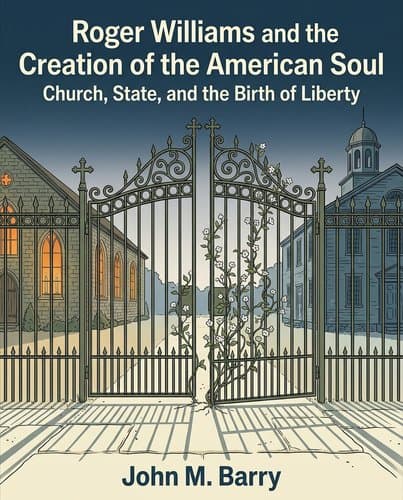
11797348_roger-williams-and-the-creation-of-the-american-so
by John M. Barry
The separation of church and state wasn't born in Enlightenment philosophy—it was forged by Roger Williams's radical conviction that forced worship corrupts…
In Brief
Roger Williams and the Creation of the American Soul: Church, State, and the Birth of Liberty (2012) traces how one Puritan minister's theological convictions laid the foundation for America's separation of church and state. John M.
Key Ideas
Religious Freedom Protects Faith From State
Religious freedom in America was not invented to protect the state from religion — it was built to protect religion from state corruption. Understanding this reverses how most people read the First Amendment.
Religious Faith Demands Church-State Separation
Williams's wall of separation between church and state was derived from his deepest religious conviction: that forced worship 'stinks in God's nostrils' and that any government fallible enough to flip between Catholicism and Protestantism in a single lifetime is too fallible to be trusted with eternal souls.
Breakthroughs From Unfinished Intellectual Arguments
The synthesis of Coke's legal individualism ('no man may be punished for his thoughts') and Bacon's empirical skepticism produced something neither man pursued to its logical end. Great intellectual breakthroughs often happen at the intersection of people who never finished their own arguments.
Conscience Coexists With Civil Authority
Liberty of conscience is not the same as the absence of civil authority. Williams's 'Ship of State' letter makes the distinction explicit: no one should be forced to attend the ship's prayers, but everyone must obey the ship's course — conscience ends where civil peace begins.
Principles Prove Themselves Without Champions
The real test of a principle is whether it survives without its champion. Rhode Island's defense of Quakers it despised, under existential economic pressure, after Williams had been voted out of office, is the moment his 'lively experiment' became something durable rather than personal.
Founding Vision Was Conditional Warning
The 'City upon a Hill' in Winthrop's original sermon was not triumphalist — it was a warning. If the colonists failed their covenant with God, they would become a 'byword' for shame globally. The same founding text later used to justify American exceptionalism was originally a statement of terrifying conditional responsibility.
Who Should Read This
History readers interested in World History and Democracy who want a deeper understanding of how we got here.
Roger Williams and the Creation of the American Soul: Church, State, and the Birth of Liberty
By John M. Barry
14 min read
Why does it matter? Because the wall between church and state wasn't built by secularists — it was built by the most devout man in the room.
Here's a striking assumption most people carry about the First Amendment: it exists to keep religion out of government. To protect the secular from the sacred. The wall between church and state, in this reading, is a restraining order — civilization protecting itself from zealotry.
Wrong. The man who built that wall was possibly the most devout person in colonial America. Roger Williams didn't want the state out of religion to protect politics from God. He wanted it out because the state would corrupt God — because forcing a magistrate's crude hand into sacred territory was, in his view, a trespass against the holy. He fled into a blizzard with nothing but dried corn paste to protect that conviction. What John Barry reconstructs is not the founding of a secular principle, but the founding of something stranger and more radical: the idea that the soul is too important to leave in the government's hands.
It means the First Amendment's most radical idea came not from skeptics but from a believer — and that changes whose side the wall was really on.
The Man Who Refused the Best Job in the New World
Picture the scene: a colony on the edge of extinction, February 1631, Boston harbor locked in dangerous ice. The ship Lyon has just completed a winter Atlantic crossing — the worst possible time to make the passage — and its arrival has saved the Massachusetts Bay settlement from starvation. Governor John Winthrop is so overwhelmed with relief that when he records the moment in his journal, he mentions the young minister who stepped off the gangplank before he mentions his own wife, who was on the same vessel.
That minister was Roger Williams, already celebrated in England for his scholarship and piety, and the colony's leaders moved quickly. The Boston church's lead theologian was heading back to England, leaving the most prestigious religious post in English America vacant. The offer they extended to Williams — a man still in his twenties — was an invitation to help design a civilization from its foundations. He would be partner to Winthrop's great experiment, the famous city upon a hill.
He turned it down flat. His explanation was five words: he could not serve an unseparated people.
Williams refused because the Boston church still maintained formal ties to the Church of England, which he believed had rotted through. To stand at that pulpit and lead worship through a tainted institution was not a compromise he could make — not because he was defiant, but because the integrity of a congregation's relationship with God required clean hands. Forcing worship through corrupt channels, he believed, was an offense against the very God you were trying to honor. The colony had offered him the pinnacle of his profession. He walked away because accepting it would have been a sin.
Williams didn't arrive at this conviction alone. He'd spent years in rooms where it was being tested at the highest levels — and the man who first put the tools in his hands was not a theologian but a lawyer.
Before Williams, There Was Coke — And a King Who Tried to Strike Him
A Sunday afternoon, somewhere around 1615. The king of England is standing over the most powerful judge in the country with his fist raised, ready to strike. Coke is on his hands and knees. He stays there until the king's fury passes — then gets up the next morning and issues a new ruling declaring that no man may be punished for his thoughts.
A teenage boy named Roger Williams was in those rooms, taking shorthand notes.
Coke had plucked Williams from obscurity after spotting him recording speeches in shorthand — a newly fashionable technology that Coke, who had learned law before its rediscovery, immediately recognized as useful. Something beyond the skill caught his eye: the boy's intensity, his hunger. Coke would eventually call him a son. Williams would later describe Coke as the 'man of honor, and wisdom, and piety' whose memory he carried for decades after Coke's death — a striking detail given that Williams mentioned his actual father only once in thousands of pages of surviving writing, and only in dismissal.
What Williams absorbed from Coke was a specific and explosive idea: that the law is not the king's tool but his constraint. When James I claimed he could decide any court case himself because he possessed reason just as well as any judge, Coke replied that legal judgment required a different kind of knowledge — built from centuries of precedent, custom, and hard-won experience — and that without it, kings could make the law as full of holes as a fisherman's net. The law, Coke told the king, protected even the sovereign himself. James called this treason. Coke didn't flinch.
Eleven of twelve judges eventually knelt and promised obedience when James demanded it. Coke alone refused, saying only that he would do what was 'fit for a Judge to do.' The confrontation was physical but the stakes were constitutional. He was eventually dismissed from the bench. Francis Bacon, the king's philosophical architect, who believed royal power should expand rather than contract, orchestrated the removal.
But the idea survived the man. Williams had watched Coke use the mechanics of common law as weapons against a state that claimed authority over the conscience itself. That the law could shield the individual from sovereign power wasn't just English legal history to Williams. It was the skeleton he would eventually give to an entirely new kind of colony.
The World Williams Fled: When the Wrong Opinion Got Your Ears Sawed Off
The English state under Charles I and Archbishop Laud wasn't persecuting people for their opinions in some metaphorical sense. It was doing it physically, systematically, and with bureaucratic thoroughness. Consider what happened to Alexander Leighton, a minister who published a pamphlet calling bishops satanic. The High Commission had him held for fifteen weeks in an open cell at Newgate — exposed to winter rain and snow — then sentenced him to a £10,000 fine and life in prison. But first came the preliminary punishment: thirty-six lashes across his bare back with a heavy cord, two hours locked in the pillory, a branding iron pressed to his face spelling out 'SS' for Sower of Sedition, his nose split open, and then his ears removed — not surgically, but sawed off in a drawn-out, bloody procedure. When the sentence was read aloud, Archbishop Laud reportedly took off his cap and thanked God. This was not a lapse in an otherwise tolerant system. This was the system working as designed.
The logic behind it was actually coherent, which makes it more frightening. Laud genuinely believed that religious nonconformity and political instability were the same threat wearing different clothes. A church that fractured would pull the state down with it, since only the church could teach the conscience, and only conscience made law binding. Force people to conform outwardly, silence the dissenting preachers, and the kingdom holds. The problem was that Puritans believed the mirror image of this with equal fervor: that a corrupt church endangered the whole nation's covenant with God, and that compromising with it meant complicity in England's destruction. Both sides thought they were fighting for civilization's survival. That's the pressure cooker Williams was standing inside.
By the time Parliament dissolved in chaos in 1629 — soldiers hammering on locked doors while members physically pinned the Speaker into his chair to block the king's men from forcing an adjournment before resolutions could be read — the question of religious conformity and the question of civil liberty had fused into a single crisis. Members declared it a capital offense to introduce 'innovation of religion' in the same breath they declared it a capital offense to cooperate with the king's illegal taxes. Williams had been in those rooms, carrying letters for Puritan families, watching it happen. What he took from it shaped everything he would do next.
Williams Synthesized Two Rivals Who Never Finished Their Own Arguments
Think of intellectual inheritance like plumbing. Coke built the pipes — the legal principle that the individual stands behind a wall the state cannot breach, that no authority can reach into a man's mind and punish what it finds there. Bacon built the pressure — the insistence that received authority must yield to observed evidence, that 'truth is the daughter of time, not of authority.' Williams connected the two systems. What he let run through them was something neither man had been willing to pressurize.
Coke's legal individualism stopped short of the obvious question. He protected the layman's body from the ecclesiastical courts, declared that thought is free, established that the king himself lives under the law — and then quietly left religion alone, content to remain a High Church Anglican with no interest in where his own logic pointed. Bacon went further in method but not in application: his Novum Organum, published in 1620, the same year the Mayflower sailed, argued that received wisdom had to yield to direct observation, but Bacon himself spent his career as the king's ideological architect, arguing for expanded royal prerogative. He showed Williams how to think. He didn't show him where to aim.
Williams aimed at the place both men had circled without entering. If no state can punish a thought, why can it compel a prayer? If received authority must yield to evidence, what evidence exists that any magistrate can reliably identify God's will? He had watched Coke go to the Tower rather than yield a legal principle. He had absorbed Bacon's insistence on following evidence past comfortable conclusions. The synthesis was almost mechanical once you held both traditions in your hands: the individual conscience is the one territory where neither law nor reason can establish a reliable sovereign — and therefore no sovereign should try.
Neither Coke nor Bacon finished their own arguments. Williams did.
The Wall of Separation Was a Religious Idea Before It Was a Legal One
Williams's wall of separation was not a concession to secular thinking. It was the most radically religious idea he ever had.
The phrase that Jefferson would later borrow and Madison would build into constitutional doctrine first appeared in a pamphlet Williams wrote in London in 1644. The image he reached for was a garden — the true church, pure and Edenic — surrounded by what he called the wilderness of the world. When a gap gets opened in the hedge between them, he wrote, God eventually tears down the entire wall and lets the wilderness swallow the garden whole. He wasn't worried about priests meddling in politics. He was terrified of politicians poisoning prayer.
Every other major voice in that era — the Puritans of Massachusetts, the Archbishop of Canterbury, the Westminster Assembly convened in London to redesign English Christianity — shared the same premise: the state must be a 'nursing father' to the church, guiding the population toward godliness and punishing deviation from it. They believed God rewarded obedient societies with harvests and military victory, and punished corrupt ones with plague and conquest. Religion and government couldn't be separated because God himself had fused them.
Williams looked at the same history and drew the opposite conclusion. Catholic kingdoms were winning their wars against Protestant ones. Islamic empires — which his contemporaries called 'Turkish' — were among the most prosperous societies on earth. If God materially rewarded the godly, none of this should be happening. Williams didn't just notice the anomaly; he wrote it into his arguments directly, deploying it as counter-evidence against the nursing-father theory every time his opponents cited divine providence to justify state religion. The argument was empirical: worldly success comes alike to all, regardless of theology, and proves nothing about whose prayers God is answering.
But it was his logic about magistrates that cut deepest. English rulers had cycled between Catholicism and Protestantism three times within living memory, each time claiming divine mandate for the new position. If fallible, power-hungry, demonstrably inconsistent men were going to sit in judgment over which form of worship God required — if the purity of the church depended on the goodwill of those particular gardeners — then the garden was already lost. Forced worship, Williams wrote, was a spiritual violation so total it dwarfed any physical harm the state could inflict. The soul was the most intimate thing a person possessed, and commanding it was the ultimate trespass.
The wall he demanded wasn't a legal compromise or a pluralist accommodation. It was an act of theological protection. He wanted the government's hands off the church for the same reason you'd want a butcher's hands off a surgeon's instruments.
He Won the Argument in London While His Enemies Erased His Colony From the Map
What does it mean to win an argument while your enemies are physically erasing the thing you argued for?
When Williams arrived in London in the summer of 1643, he had no legal standing, no powerful patron yet, and two well-connected Massachusetts agents — Thomas Weld and Hugh Peter — already embedded in the parliamentary circles he needed to penetrate. His answer was a book. The manuscript he had drafted on the voyage over was disguised as a linguistic guide: a dictionary of Narragansett vocabulary. But every page of A Key into the Language of America made a subversive argument about human equality, pointing out that the English not long ago had lived like the people they now called savages, and suggesting in verse that heaven might welcome 'Indians wild' while shutting its doors on 'proud' Christians. This was pointed provocation aimed at the one wound Massachusetts couldn't hide: despite founding charters full of rhetoric about spreading the gospel, the colonies hadn't converted a single Indian. Williams's book made him a celebrity in London at exactly the moment it made the Bay Colony an embarrassment in Parliament.
Then Weld made his move. While Williams was outside London hunting for fuel during a coal shortage, Weld collected nine signatures on what he called a Narragansett patent — a rival claim that would hand Massachusetts control over Rhode Island. He gathered the names one at a time, and he selected a Sunday as the official date, which no committee would ever have convened. The patent lacked proper seals, a majority vote, and every procedural requirement that would make it binding. But it gave Massachusetts a claim it could attempt to enforce three thousand miles from any English court.
Williams spent months in lobbies, taverns, and parliamentary antechambers wearing at the Committee on Foreign Plantations with logic, evidence, and sheer persistence. He had the critical backing of Henry Vane, one of Parliament's most powerful members. On March 14, 1644, the committee issued a legitimate charter — properly voted, sealed, and enrolled. Its language authorized fully democratic self-government by majority consent. More remarkably, it contained almost no mention of God and no religious oversight whatsoever, a document of soul liberty written by the most religiously serious man in the room.
While Williams was winning that argument in London, Massachusetts had been settling the question on the ground. Soldiers had marched through Providence, besieged Samuel Gorton's settlement, hauled his followers to Boston in chains, and displaced Rhode Island families with Bay Colony settlers. Back in New England, the charter was a piece of paper against an army. Williams had secured the legal idea. Whether it would survive contact with the people who wanted it dead was another matter entirely.
Parliament Burned His Book at Smithfield — Where He Grew Up Watching Heretics Burn
The public hangman arrived at Smithfield in the late summer of 1644 carrying as many copies of The Bloudy Tenent as he could gather, and he burned them all. This was the neighborhood where Williams had grown up, the same grounds where generations of English heretics had been executed by fire. Parliament had just staged, in the place most associated with burning people for wrong beliefs, a ceremony demonstrating exactly the tyranny Williams's book argued against.
The burning backfired in the way suppressions tend to when the suppressed idea is already airborne. The book had sold fast enough to require a second printing within three weeks of publication — faster than the outrage could organize itself. What Parliament torched at Smithfield was mostly paper. The argument had already moved into other minds. A Scottish Presbyterian monitoring English religious politics with professional alarm noted with dismay that Williams 'had drawn a great number after him.' Then he watched Henry Vane — a heavyweight in the parliamentary coalition, an ally he had counted on — begin arguing at dinner tables for complete liberty of conscience, for every sect, without exception. Vane's biographers trace this directly to Williams. Between 1644 and 1649, sixty pamphlets addressed Williams by name; over a hundred and twenty others quoted him.
Lazarus Seaman, preaching to Parliament just weeks after the burning, named the problem his allies had created: 'The shell is sometimes throwne into the fire, when the kernell is eaten as a sweet morsel.' He meant it as a warning. He was also writing the epitaph of the burning itself. Suppression had become advertisement. The attempt to extinguish the argument proved, in plain public view, precisely the claim it was trying to destroy.
The Freest Place in the World Was Also Its Messiest — and That's the Point
Samuel Gorton was not a subtle presence. Winthrop called him 'not fit to live upon the face of the earth,' which is the kind of description that tells you something. Gorton had already been expelled from two other colonies before arriving in Providence in 1641, and Williams knew what was coming — but the same principles that had made Williams a refugee made it nearly impossible to turn away someone claiming conscience as his reason for being there. Gorton was charismatic enough to pull most of the town toward him within months. His argument was that any government lacking a direct royal charter had no legitimate authority at all — which in Providence, governed by nothing more than five elected arbitrators, meant no authority existed. When one of those arbitrators issued a routine judgment against a Gorton ally over a debt, his followers blocked enforcement with their fists. Both sides then showed up in a field carrying weapons. Williams had to run in physically and put himself between them.
The scene captures something real about what Providence was. Its founding compact was the most radical document in colonial North America — written by the most devout man in the region, yet containing no mention of God, establishing authority not from divine mandate but from the consent of the governed. No central meeting house was built for half a century. The houses ran in a single line rather than circling a common. The arrangement was almost a diagram of the idea: each person standing separately before whatever they believed in.
But ideas don't police their own application. The people drawn to the freest place in the world included those who intended to take freedom past the point where any shared life remained possible. Williams's answer, eventually hammered out in a letter that has been reprinted for centuries, was the image of a ship: passengers of every religion aboard, none compelled to pray, none barred from their own worship — but all required to follow the captain's orders, pay their fare, and not preach that no captain was necessary. Conscience was sovereign over the soul. Civil obligation was sovereign over everything else.
He had to write that letter because his experiment kept proving his point the hard way. The freest place in the world was also the messiest. Those two things were not accidents. They were the same thing.
The Proof Wasn't Williams. It Was Rhode Island Without Him.
The proof that an idea has become real is the moment it survives without its author. In 1657, Williams charged his closest allies with treason over a procedural dispute — including Gregory Dexter, the man who had risked prison to print The Bloudy Tenent, now facing charges from the colony that book had created. Providence voters removed Williams from office entirely and ordered him to hand over the physical charter. For the first time since founding the colony, he held no post, attended no meeting, signed nothing. The experiment would have to run without him.
The United Colonies chose this moment to move. Massachusetts, Plymouth, Connecticut, and New Haven together wrote to the new Rhode Island president demanding the colony expel its Quakers. The letter came paired with an offer of full military alliance and the threat of a total trade embargo. For a colony dependent on Boston merchants for nearly everything, the trade threat was existential. And the carrot was real — membership would mean the colony that had been called a sewer full of scum would finally be accepted as an equal partner.
The government that answered wasn't Williams. It was Benedict Arnold (not the revolutionary-era traitor — this Benedict Arnold was Rhode Island's president) and every other officer of the plantation, signing a single letter. They began with careful diplomacy, acknowledging the concern, even conceding that Quaker doctrine threatened civil order. Then they drew the line. Rhode Island would pass laws against disruptive conduct, they said. But they possessed no law 'whereby to punish for only declaring by words their mindes and understandings concerning the things and ways of God' — and they did not intend to make one. They cited their charter's foundational principle and threatened to refer the matter directly to Cromwell rather than yield.
Williams himself despised Quaker theology. When he debated three Quakers publicly in 1672, he canoed twenty miles at age sixty-nine to argue for nearly ten hours. The audience called him 'Old man! Old man!' and shouted him down. He fought them with every word he had. He just refused to fight them with anything else. Massachusetts hanged four Quakers on Boston Common and had to be stopped by a royal order. Rhode Island, under the same pressure, built the distinction that became a constitutional inheritance: what you believe is yours; what you do in the world is negotiable. The colony had learned that from a man who was no longer in the room.
The Argument We're Still Living Inside
Here is what makes the Rhode Island moment so quietly devastating: the men who refused Massachusetts weren't true believers in Quaker doctrine — they thought it was wrong. They defended it anyway, without Williams in the room, under real economic threat, because the principle had become separable from the man who invented it. That's when you know an idea has actually landed.
But Winthrop's instinct didn't die either. Every American argument about school prayer, about whether bakers must make wedding cakes, about what a mayor can say from a public podium — these aren't new fights. They are the same fight, wearing different clothes. Williams won the constitutional text. Winthrop won the cultural reflex. And you live inside both of them, probably on different sides depending on the issue and the year. That tension isn't a failure to resolve the founding argument. It may be the founding argument, still unresolved in the way it always was.
Notable Quotes
“one uniforme order of discipline in the churches”
“to consider how farr the Magistrates”
“for the preservation of that uniformity”
Frequently Asked Questions
- What is Roger Williams and the Creation of the American Soul about?
- The book traces how Roger Williams, a Puritan minister, laid the foundation for America's separation of church and state through his theological convictions. John M. Barry demonstrates that Williams built the wall between church and state not to limit religion but to protect it from government corruption. The work reveals how Williams's ideas fundamentally reversed conventional understanding of the First Amendment, showing the true origins of American religious liberty rooted in his belief that forced worship "stinks in God's nostrils" and corrupts eternal souls.
- How did Roger Williams view the relationship between religious freedom and government authority?
- Williams saw religious freedom and government authority as separate domains rather than opposing forces. In his "Ship of State" letter, he explicitly distinguished liberty of conscience from civil authority. According to the text, "no one should be forced to attend the ship's prayers, but everyone must obey the ship's course — conscience ends where civil peace begins." This means Williams defended both genuine religious liberty and the legitimate power of the state to maintain order, rejecting both theocracy and anarchism as solutions.
- What were the intellectual roots of Roger Williams's ideas about church and state?
- Williams synthesized legal and philosophical traditions from two major thinkers. Edward Coke contributed legal individualism with the principle that "no man may be punished for his thoughts," while Francis Bacon provided empirical skepticism. The "synthesis of Coke's legal individualism and Bacon's empirical skepticism produced something neither man pursued to its logical end." The combination of these intellectual streams—individual conscience protection and skepticism toward absolute authority—created the philosophical foundation for Williams's revolutionary approach to religious liberty and limited government.
- Was the 'City upon a Hill' originally about American exceptionalism?
- No, according to Barry's analysis. John Winthrop's original 1630 sermon presented the "City upon a Hill" not as triumphant exceptionalism but as a warning. Winthrop emphasized that if the colonists failed their covenant with God, they would become a "byword" for shame globally. The founding text was originally a statement of "terrifying conditional responsibility," not a promise of American superiority. This concept was later fundamentally reinterpreted to justify American exceptionalism, distorting Winthrop's original meaning.
Related Book Summaries
Read the full summary of 11797348_roger-williams-and-the-creation-of-the-american-so on InShort