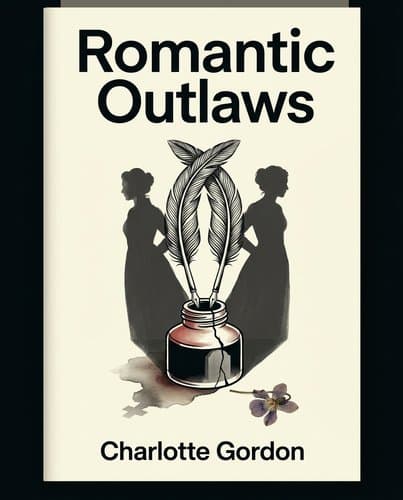
22294061_romantic-outlaws
by Charlotte Gordon
Mary Wollstonecraft and Mary Shelley lived a century apart but paid identical prices for their radical ideas—social exile, lost children, and legacies hijacked…
In Brief
Mary Wollstonecraft and Mary Shelley lived a century apart but paid identical prices for their radical ideas—social exile, lost children, and legacies hijacked by the men who loved them. Gordon's dual biography reveals how *Frankenstein* and *A Vindication* were not just arguments for freedom, but survival acts by women who had no other inheritance left to claim.
Key Ideas
Intellectual courage demands private personal sacrifice
The cost of living by radical ideas is rarely paid in public debate — it's paid in private devastation: lost children, social exile, and betrayal by the people closest to you. Both women's stories show that intellectual courage and personal suffering are not separate tracks but the same road.
Institutional erasure masquerades as honoring intention
Institutional erasure rarely looks like outright censorship. It looks like a well-meaning husband publishing his dead wife's private letters, or a son's family omitting 'Frankenstein' from his mother's gravestone — small acts by people who thought they were honoring her.
Frankenstein argues abandonment breeds creature violence
Frankenstein is not primarily a horror story. It is an argument: that the creature's violence is a direct consequence of the creator's abandonment. Read it as Mary Shelley's reckoning with her own origin — born from a mother who died giving birth to her, raised by a father who loved ideas more than people — and the novel becomes something else entirely.
Self-effacement preserves legacy at personal cost
Self-effacement can be a survival strategy rather than defeat. Mary Shelley hid her editorial labor to keep Percy's poetry alive in a century that would have buried it alongside his atheism. The question the book leaves open: what did that strategy cost her own work, and who gets to decide when survival becomes compromise?
Women's freedom won through existence and refusal
The argument for women's intellectual freedom was not won by argument alone. Wollstonecraft and Shelley won it by existing — by writing books, surviving scandal, and refusing to disappear — and then losing control of their own legacies to the people who claimed to love them most.
Who Should Read This
Readers interested in Memoir and Literary Fiction, looking for practical insights they can apply to their own lives.
Romantic Outlaws
By Charlotte Gordon
12 min read
Why does it matter? Because the women who invented modern feminism were erased by the men who claimed to love them.
Imagine a small girl in a London churchyard, tracing letters carved in stone with her fingertip. Not her name — her mother's. The woman in the ground died ten days after giving birth to her, killed by a doctor who forgot to wash his hands. So the daughter learned to read from the gravestone, inheriting a revolution she never got to witness. That inheritance — Mary Wollstonecraft to Mary Shelley, across the unbridgeable fact of death — is what this book is actually about. Not the famous ideas, not the famous novel, but the cost: the stillborn children, the suicide attempts, the men who preached liberation and practiced abandonment. Two women who didn't win anything easily, and whose books survived precisely because everything else was taken.
A Girl Raised on a Gravestone: The Inheritance That Started Everything
On August 30, 1797, a physician was called to a London home to help a woman who couldn't deliver the afterbirth. He performed the procedure and left. He hadn't washed his hands. Ten days later, Mary Wollstonecraft — author of the most radical feminist argument of her century — was dead of puerperal fever. Her newborn daughter survived, too small and weak for anyone to expect it.
That daughter, Mary Godwin, grew up knowing exactly how her mother had died. She also grew up knowing, from the time she could walk, where her mother was buried. Her father, the philosopher William Godwin, took her to St. Pancras churchyard almost daily. He taught her to read there, guiding her small fingers across the letters carved into the headstone: MARY WOLLSTONECRAFT GODWIN. Nearly the same as her own name. One dead, one alive — a distinction that felt, to the child, disturbingly provisional.
Charlotte Gordon's dual biography opens on this image: a little girl tracing her mother's name in stone, learning language and loss at the same moment. It sounds like something from a gothic novel, which is appropriate, because this little girl would grow up to write one. The daughter didn't just inherit the mother's grief. She inherited her project. Wollstonecraft had spent her career drafting education manuals for daughters who didn't yet exist, writing toward a generation of women who might live free — and one of those daughters turned out to be her own. Shelley spent her life reading her mother's books until she knew them by memory, trying to become what Wollstonecraft had theorized was possible. A Vindication of the Rights of Woman and Frankenstein aren't two separate achievements. They're one argument, written across two generations, begun in ink and finished in stone.
The Walls Were Real: What It Actually Meant to Be a Woman in 1780
The legal situation for women in late eighteenth-century England wasn't a set of inconveniences. It was a cage with very specific dimensions. Wives owned nothing — not their clothes, not their children, not their bodies. A husband could beat his wife, lock her indoors, sell her earnings, all within the law. Children were his property by default. Divorce required a private act of Parliament, and of the 132 granted before 1800, every single plaintiff was male. England gave legal protection to chimpanzees in 1824 — a full twenty years before it bothered to limit violence against wives.
Wollstonecraft understood this not as an abstraction but as furniture — the actual structure of the house she grew up in. As a teenager, she stationed herself outside her mother's bedroom every night, waiting for her drunken father to come home so she could block the doorway. She knew exactly what happened when he got through. What she couldn't have anticipated was her mother's response: Elizabeth blamed Mary for provoking him. The logic is almost impressive in its cruelty — a woman so ground down by a system that offered her no exit that she turned on the only person trying to help her. Mary kept showing up anyway. Night after night, the same door, the same drunk footsteps on the stairs.
That education in powerlessness is what made Wollstonecraft's later choices legible. When her sister Eliza's marriage collapsed into what was almost certainly sexual coercion, Wollstonecraft didn't hesitate long. She planned the escape like a military operation — a safe house in Hackney, decoy coaches, false names. In the carriage, Eliza's terror took a physical form: she chewed her wedding ring until it came apart in pieces. The baby had to be left behind, legally the husband's possession. The child died of neglect within the year.
This is the pressure both women lived under — not metaphorical constraint but consequences measured in dead children and shattered rings. The walls were real, and both of them would spend the rest of their lives bleeding from the impact.
The Romantic Myth Starts Here — and So Does the Wreckage
What did the great Romantic elopement actually look like from the inside? Not the version in the poetry — the version with the donkey.
Mary Godwin was sixteen when Percy Shelley burst into her father's house on a July night with a pistol in one hand and a bottle of laudanum in the other, shouting that he couldn't live without her and that if she didn't run away with him he would shoot himself. Her stepmother was screaming. Her father wasn't home. Mary stood there with tears running down her face, pleading with this man to put the gun down. He eventually left, then immediately swallowed an enormous dose of the laudanum anyway. The Godwins rushed to his lodgings and found a doctor already tending to him. This is the elopement — not moonlight and carriage wheels, but a poisoning and a medical emergency, with a sixteen-year-old girl serving as crisis negotiator.
They ran away two weeks later, crossing the Channel in a fishing boat during a thunderstorm. Shelley was ecstatic; Mary spent most of the crossing crouched in the bottom of the boat, gripping his knees, soaked and terrified. In France, they bought a donkey to carry their luggage. The donkey collapsed. They traded it for a mule. Shelley twisted his ankle and couldn't walk, so Mary and her stepsister Jane trudged behind the mule through a countryside that Napoleon's wars had stripped to bare dirt. The food was sour milk and dry bread that had to be softened in water. When they finally reached what Shelley had promised would be the free, noble Switzerland of Godwin's novels, they found tidy businesspeople and clean streets and absolutely nothing to do, and turned around and went home.
Back in London, Mary's first child — born premature the following February — survived for thirteen days. She wrote in her journal afterward that she kept dreaming the baby had come back to life, that it had only been cold and they had warmed it by the fire, and then she would wake up. Shelley, meanwhile, was reportedly frightened of catching a fever from Mary's breast milk, and spent his evenings downstairs with Jane, relishing the effect his ghost stories had on her. He was composing his first mature poem. She was recording, in blurred entries, that she was waking up and finding no baby.
The Romantic myth asks you to look at this period from a great distance, where the squalor softens into atmosphere and the grief becomes someone else's. Up close, it's a woman managing everything — the creditors, the moves, the pregnancy, the death, the jealousy — while the man wrote the poems that would make them both famous.
The Summer That Made Frankenstein — and Why Mary Lied About It
On the night of June 16, 1816, Byron threw a book of ghost stories into the fire and issued a challenge: everyone at the Villa Diodati would write something better. He was thinking of himself and Shelley. He barely registered the two women in the room.
The setting had been building pressure for weeks. A volcanic eruption in Indonesia the previous year had pushed enough ash into the upper atmosphere to strangle summer across the northern hemisphere — red snow in Italy, frozen grain from Moscow to New York, a near-whiteout blizzard that had almost stopped the group's Alpine crossing in May. By June they were trapped inside the villa day after day, the lake invisible behind curtains of sleet, tempers shortening. Byron had arrived in a custom-built replica of Napoleon's war carriage, because of course he had, and now he had nothing to do but torment Polidori, the doctor he'd hired as a travelling companion, and avoid Claire Clairmont, Mary's stepsister, who had engineered her own invitation to the villa after a brief affair with Byron. The novel that came out of this claustrophobic pressure cooker is usually framed as a horror story. It's more accurate to call it a reckoning.
Mary began writing almost immediately after the ghost story challenge. That's the detail her later account buried. In 1831, preparing a new edition of Frankenstein, she described a long creative drought broken only by a sudden, unbidden nightmare — the pale student, the half-assembled body, the horrible stirring of unintended life. It's a beautiful story. It also contradicts every contemporary source. Shelley's preface to the first edition mentions no struggle. Polidori, who catalogued Mary's daily activities with the thoroughness of a man deeply infatuated, recorded no difficulty on her part at all. If she'd been paralyzed, he would have noticed and noted it.
Gordon argues that Mary's dream narrative was a survival strategy, not a memory. By 1831, the fact that a woman had written Frankenstein had already damaged its sales and reinforced her social exile. Admitting she had designed the book — had deliberately constructed a story about a creator destroyed by his creation's hunger for a father, drawing on her own rejection by Godwin and her grief over a dead baby — would have marked her as calculating. In the early nineteenth century, a calculating female intellect was, by social definition, monstrous. So she performed the only acceptable version of female genius: the passive vessel, the dream that arrived without invitation.
But the book she actually wrote gives her away. Victor Frankenstein doesn't just build a creature and lose control of it. He abandons it in horror the moment it opens its eyes — and the creature, alone and furious, murders everyone Frankenstein loves in return. That's not a nightmare. That's an argument. Mary had spent her life watching men build things — philosophies, poems, revolutions, love affairs — and walk away from the wreckage they left behind. She turned that pattern into literature, and it survived everything: the bad reviews, the enforced anonymity, the drab Bath autumn ahead of her. The monster outlasted the summer that made him.
Wollstonecraft Threw Down the Gauntlet in Twenty-Eight Days — Then Paid for It Forever
The irony in Wollstonecraft's story is that her husband killed her reputation using the exact weapon she'd forged herself — radical honesty, nothing held back, the private and the political collapsed into one.
She had written A Vindication of the Rights of Men in twenty-eight days, faster than any other respondent to Edmund Burke's defense of aristocracy and tradition. Halfway through, she'd nearly quit — turned up at her publisher Joseph Johnson's house convinced she was unequal to the task, citing her lack of formal education, her fragile health. Johnson told her to stop: he'd simply destroy what she'd already sent him. She didn't need to continue. That threat to her pride sent her straight back to her desk. The first edition sold out in three weeks. When she attached her name to the second, reviewers who'd praised the anonymous text turned on her — Horace Walpole called her a hyena in petticoats, satirists mocked her unmarried status, and critics suddenly found the same arguments incoherent that they'd previously admired. She'd known this would happen and did it anyway, because the whole philosophy she was building demanded exactly that: hold nothing back, let reason and passion speak together, refuse the polite disguise.
Godwin had first encountered her at a dinner party in 1791, where she'd dominated the conversation and he'd sat in resentful silence in his unfashionable black coat, finding her brash and her writing poorly organized. He would eventually fall in love with her, then outlive her — and then, eight weeks after her death in 1797, publish a memoir revealing her suicide attempts, her out-of-wedlock daughter, her obsession with the married painter Fuseli, her sexual history with Gilbert Imlay. He meant it as a tribute, proof of her magnificent, feeling nature. What it produced was The Anti-Jacobin Review indexing her name under "Prostitution." The reputation that had survived Burke's ridicule and Walpole's contempt didn't survive her husband's love.
The philosopher disappeared; a cautionary tale took her place. For the next century and a half, women advocating for female equality actively avoided citing Wollstonecraft, afraid her notoriety would contaminate their cause — her passion interred, her reason footnoted, the combination she'd spent her career defending turned into the precise terms of her burial.
Dead Children, Shared Silence: What the Marriage Actually Cost
On September 24, 1818, Mary made a ten-hour journey across northern Italy with a baby who was dying. Clara had been ill for weeks — high fever, dysentery, the limp and unfocused eyes of a child losing her fight with dehydration. The trip was Shelley's idea, organized around a social fiction he'd told Byron to smooth over Claire's claim to her daughter. Mary packed the house on her twenty-first birthday while Maria Gisborne held Clara; she arrived in Este to find Shelley waiting with a poem about how much he loved her. Then, after another four hours of travel the following month, while Clara convulsed in her arms, Mary sat in an inn hallway and waited for Shelley to come back with a doctor. He was still running when the baby stopped breathing.
She recorded the death in a notebook that already contained Fanny Imlay's suicide and Harriet Shelley's drowning. The notebook had become something like a ledger of women and children who hadn't survived the Romantic experiment. Shelley buried Clara on the Lido without a marker. Byron suggested the location. There was no ceremony.
What happened next is the argument at the center of everything Gordon wants you to see. Mary went silent — not metaphorically, but genuinely impenetrable, returning Shelley's overtures with something colder than anger. Shelley, unable to reach her, turned his grief into poetry and then turned his poetry into a rebuttal. While Mary was upstairs in their Livorno villa researching medieval Italian heretics and writing a novella about a daughter whose father loved and destroyed her, Shelley was composing Prometheus Unbound — a poem that takes the same mythological figure Mary had used as Frankenstein's subtitle and insists on the opposite conclusion. Mary's Prometheus creates something he can't control, and everyone he loves dies. Shelley's Prometheus uses human intelligence to save the world. Gordon calls this their 'marital debate,' carried out in literature because direct conversation had become impossible.
The creature in Frankenstein isn't a monster in the way the film versions teach you. He's articulate, capable of love, and desperate for a father who won't look at him. Abandon what you made, the novel argues, and it will come back for everyone you love. That's not a warning about science. It's a warning Mary had been drafting her entire life — about Godwin withdrawing after she ran away with Shelley, about Shelley requiring her presence in Venice while their daughter burned with fever. Prometheus Unbound says she was wrong and human genius will prevail. She wrote it first, and she was the one holding the body.
The Books Were the Only Inheritance That Couldn't Be Taken
A relay race run entirely underground. The baton passes in secret by people who can't be seen passing it. What matters is that it keeps moving.
Mary's final act of literary creation wasn't a novel. It was a persona. When Edward Moxon paid her to edit Shelley's collected works in 1838, she faced the same problem her mother's posthumous reputation had posed to her since childhood: brilliant men, left to their own instincts, destroy the women they love by revealing them too fully. Godwin had published every sordid and magnificent detail of Wollstonecraft's life eight weeks after her death, thinking he was honoring her. The result was a century of women afraid to mention her name. Mary had learned that lesson at St. Pancras churchyard, tracing the letters on a headstone.
So she did the opposite. Shelley's papers were chaos — poems crammed between boat doodles, stanzas spread across three different envelopes, lines that had to be assembled from wherever they'd landed. She sewed it all into order, then wrote a preface describing herself as nothing more than a transcriptionist for a spirit too pure for this world. She turned the atheist radical who'd been denied his own children by a court citing his immorality into something Eton chaplains would eulogize. Not once did she mention the months of reconstruction. Her editorial labor, at least as substantial as his penciled revisions to Frankenstein, vanished into the work itself.
This looks like self-erasure. It was closer to camouflage. The books survived the Victorian gatekeepers because she made them palatable. Shelley got read. And Wollstonecraft — buried under Godwin's loving demolition job for a hundred years — eventually got recovered too, because Frankenstein was still circulating, and Frankenstein kept pointing back to its author, who kept pointing back to her mother. The baton moved. You can call Mary's invisibility capitulation, or you can call it what it actually was: the same thing her mother did with A Vindication, written in twenty-eight days under a pen name because a woman's name on the cover would have stopped people from reading the argument. Both of them hid the labor. Both of them kept the books alive — and alive was enough.
What Survives the Erasure
Jane Shelley waited at the churchyard gates past midnight, two coffins beside her in the carriage, the vicar having extracted his condition: darkness, no witnesses, no fuss. Three generations went into that ground together — Wollstonecraft, Godwin, Mary — and the stone above them said nothing about Frankenstein. Someone had decided that was for the best.
Here's what they couldn't bury: the arguments. Wollstonecraft predicted, with some precision, that men would keep calling women irrational right up until they ran out of reasons to — and that the irrationality charge was doing work, not describing anything true. Mary predicted, in the form of a monster, that the thing you abandon doesn't disappear; it comes back shaped by your abandonment. Both predictions are still running. Frankenstein is still making the case Mary couldn't make openly — that the creature is a product of neglect, not nature, which in 1818 was a more radical claim about human society than anyone wanted to discuss at dinner. The Vindication is still making people uncomfortable in exactly the ways Wollstonecraft said it would: not because the argument is radical anymore, but because it hasn't finished being necessary. The women who wrote them got the midnight burial. The books got everything else.
Notable Quotes
“A revolution in female manners,”
“I here throw down my gauntlet,”
“the absurdity of many of her conclusions”
Frequently Asked Questions
- What is Romantic Outlaws about?
- Romantic Outlaws tells the parallel lives of Mary Wollstonecraft and her daughter Mary Shelley, tracing how each paid for her radical ideas in private loss, social exile, and erased legacy. The book traces how institutional erasure works—not through outright censorship but through small acts by people who thought they were honoring the women—and reveals what Frankenstein really says about its author's origins. Gordon demonstrates how the argument for women's intellectual freedom was won not by argument alone, but by these women existing, writing, surviving scandal, and refusing to disappear.
- What does Romantic Outlaws reveal about Frankenstein?
- Frankenstein is not primarily a horror story but an argument: the creature's violence is a direct consequence of the creator's abandonment. When read as Mary Shelley's reckoning with her own origin—born from a mother who died giving birth to her, raised by a father who loved ideas more than people—the novel becomes something else entirely. It shifts from psychological horror to a window into the personal traumas and losses that shaped one of literature's most influential writers and her imaginative inheritance.
- How does Romantic Outlaws explain institutional erasure?
- Institutional erasure rarely looks like outright censorship; it appears as small, well-intentioned acts by those who love you. The book demonstrates that legacies get erased not through deliberate destruction but through decisions made by loved ones—publishing private letters, omitting work from gravestones, or controlling what gets remembered. These protective gestures, meant to honor, paradoxically remove women's intellectual contributions from public view. The pattern repeated across both Wollstonecraft's and Shelley's lives, showing how institutional erasure often happens because someone loved them enough to censor their legacy.
- What are the key takeaways from Romantic Outlaws?
- The cost of radical ideas is paid not in public debate but in private devastation: lost children, social exile, and betrayal by those closest to you. Institutional erasure often comes from well-meaning loved ones rather than outright censorship. Frankenstein functions as Mary Shelley's reckoning with her own psychological origins—born from a mother who died giving birth, raised by a father who prioritized ideas over people. The book also explores how self-effacement became Mary Shelley's survival strategy, raising the question: what did that strategy cost her own work's legacy?
Related Book Summaries

Read the full summary of 22294061_romantic-outlaws on InShort