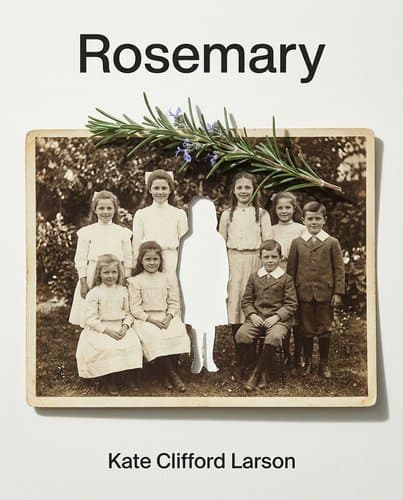
23719479_rosemary
by Kate Clifford Larson
Rosemary Kennedy's lobotomy—ordered secretly by her father in 1941—didn't end her influence on America; it ignited it. Trace how one family's desperate…
In Brief
Rosemary Kennedy's lobotomy—ordered secretly by her father in 1941—didn't end her influence on America; it ignited it. Trace how one family's desperate concealment of disability quietly drove the arc of civil rights legislation, the Special Olympics, and a political dynasty built on buried shame.
Key Ideas
Institutional structures harm vulnerable patients systematically
Medical hierarchies and financial incentives shape outcomes for patients who have no power — Rosemary's disability traces directly to a nurse unwilling to act without a doctor present and a doctor whose fee depended on arriving in time; understanding this makes visible how institutional structures, not individual malice, produce irreversible harm
Concealing disability prevents necessary specialized care
Concealing a family member's disability from institutions and caregivers doesn't protect the person — it prevents them from receiving specialized support; the Kennedys' pattern of understating Rosemary's condition to every school she attended ensured she was perpetually misplaced rather than genuinely helped
Environment, not capacity, determines flourishing outcomes
People with intellectual disabilities can flourish with the right environment — Rosemary's documented progress at Belmont House under Montessori methods shows that the question was never her capacity but whether the system around her was designed for her; this is as true now as it was in 1939
Proximity to harm catalyzes disability policy
Legislative change on disability often lags behind private guilt by decades — Kennedy disability policy was catalyzed not by enlightened principle but by a family's reckoning with what they had destroyed; understanding this helps explain why rights movements require proximity to harm, not distance from it
Erasure from family creates lasting ripples
The erasure of a family member's existence — from correspondence, from stories told to younger siblings, from public record — causes collateral damage that ripples through everyone left behind; Eunice's decades of advocacy and Teddy's lifelong terror both began the day Rosemary disappeared from family letters
Who Should Read This
Readers interested in Memoir and Social Issues, looking for practical insights they can apply to their own lives.
Rosemary
By Kate Clifford Larson
12 min read
Why does it matter? Because the Kennedy family's most consequential legacy was the one they spent decades trying to bury.
Most people assume the Kennedy family's decades of disability advocacy — the Special Olympics, the landmark mental health legislation, the research institutions — came from somewhere noble. Compassion, maybe. Catholic obligation. The natural instinct of a powerful family to use its power for good. What actually happened is harder to sit with. There was a woman named Rosemary, the third Kennedy child, who was damaged at birth by a nurse following protocol, hidden through childhood by parents following ambition, and then destroyed at twenty-three by an experimental surgery her father ordered without telling her mother, her siblings, or her — a father following ambition of a different kind. After that, she was erased — from letters, from photographs, from the family story — for twenty years. Everything the Kennedys eventually built around disability rights traces back to her. Not to their generosity. To what they did to her, and what it cost them when they finally had to look at what they'd done.
A $125 Fee and Two Hours That Changed Everything
On the evening of September 13, 1918, a nurse stood in a bedroom at 83 Beals Street in Brookline, Massachusetts, pressing a newborn's crowning head back into the birth canal. She held it there for two hours.
Rosemary Kennedy's obstetrician, Dr. Frederick Good, had been summoned when Rose Kennedy's labor began, but Boston was in the grip of the Spanish flu — more than five thousand cases in the city alone by mid-September, hospitals overwhelmed, funeral processions moving through the streets daily. Good was delayed, attending to the sick. And so the nurse, trained in obstetrical delivery, chose not to deliver the baby herself. Her professional manual made the stakes of that choice grimly clear: if the mother died in the doctor's absence, the nurse could "hardly excuse herself." The hierarchy she worked inside was unambiguous. The physician delivered; the nurse waited.
But the baby was already coming. Telling Rose to press her legs together failed. So the nurse physically held the baby back. Obstructing a baby's passage through the birth canal cuts off oxygen — the kind of deprivation that causes exactly the cognitive disabilities Rosemary would carry for the rest of her life.
Dr. Good's fee for prenatal care and delivery was $125. Missing the birth meant losing it. That the delay happened — and that a nurse chose institutional loyalty over the safety of a crowning infant — is not in dispute.
When Good finally arrived that evening, he delivered a baby who appeared healthy. The Boston Globe announced "a dainty girl" added to the Kennedy nursery. Flowers arrived. The child was named Rose Marie, called Rosie, later Rosemary. Her mother remembered her as sweet and quiet, crying less than her brothers had.
What the announcement could not say, what no one yet understood, was that Rosemary's life had already been shaped — not by fate, but by a professional hierarchy, a financial incentive, and two hours of a nurse's hands.
Love and Ambition Are Not the Same Thing
The Kennedy family loved Rosemary. That love just wasn't enough to protect her from them.
Rose built an elaborate system to manage her children's development — index cards tracking vaccinations and developmental milestones, scheduled dinner conversations about historical figures, compulsory sports with losses analyzed afterward. The point of the system was excellence. Her children would be prepared, polished, and competitive. That framework made perfect sense for nine children. For Rosemary, it was a trap. Every index card that logged a sibling's progress implicitly recorded her falling further behind. The family's love and the family's culture were working in opposite directions, and the culture was stronger.
Joe's version of the same problem came with more heat. When Gloria Swanson — his mistress at the time, one of the most famous film stars in the world — overheard him on the phone one afternoon, she could tell he was agitated, negotiating with some doctor about Rosemary, apparently offering to buy the hospital a new ambulance in exchange for treatment. When the call ended badly, Swanson suggested her own physician, a California doctor who used therapeutic diets. Joe's eyes went cold. He told her he'd already taken Rosemary to the best specialists in the East and he wasn't interested in some three-dollar doctor recommending vegetables. When Swanson pushed, he erupted: 'Do you understand me? Do you understand me?' She never raised the subject again. Eddie Moore, Joe's closest aide, later told her it was 'a very sore subject with the boss,' then tapped the side of his head to indicate something was wrong with Rosemary.
Joe was desperate enough to offer an ambulance to a hospital. But the desperation was always aimed at a cure, a fix, a return to normal. The possibility that Rosemary simply could not be normal, and that this was something to be lived with rather than solved, was not available to him. The Kennedy operating principle was that obstacles yielded to sufficient effort and resources. A daughter who contradicted that principle wasn't just a family difficulty; she was a refutation of everything Joe had built.
Rosemary seems to have understood this, at some level, without being able to name it. In a letter she wrote to her father after a visit in the fall of 1934, she was sixteen years old and already several schools deep into a childhood of managed failure. The letter is full of misspellings and gaps, the handwriting of a much younger child. But the emotional content is precise: 'I would do anything to make you so happy. I hate to Disappoint you in anyway.' The letter is the record of someone who spent her whole life trying to earn approval from a man whose love was real and whose standards she could never reach — and who knew it.
The One Time Everything Worked
In the winter of 1939, a nun named Mother Isabel sat down to write a letter to Rose Kennedy that must have read like a dispatch from a parallel universe.
Rosemary, she reported, had come to her one afternoon and asked to be told her own faults — because, Rosemary explained, faults spoil people. Mother Isabel found the moment striking enough to record carefully. She had watched the girl think something through, reach a conclusion about herself, and ask for help improving.
That was the person living inside Belmont House, the Assumption Sisters' country school in Hertfordshire, under a Montessori method that organized her days around tasks she could actually complete: supervising children in the garden, reading to them at a stated hour, setting out the china and silver for mid-morning lunch, putting everything away again afterward. Structure that made her the capable one, the one others depended on. Joe Kennedy, who visited regularly, wrote to Rose that Rosemary loved being the boss there — that she was happy, looked better than she ever had, and wasn't lonely in the slightest.
The section of Rosemary's life that makes everything afterward almost unbearable to read. She had been failing through schools since early childhood, each placement a version of the same problem: environments built for children who learned differently, moved faster, didn't need what she needed. Belmont House was different in every specific way that mattered. The nuns knew her limitations and built her days around her capabilities. She flourished in ways her family could measure — tasks completed, rages diminished, the self-awareness that surprised even a trained educator.
Then the war ended it. Germany's advance forced the family home, and Rosemary was extracted from the one place that had worked. Joe, writing from London with what sounds like genuine relief that she was safe, noted almost casually that she could return to England 'when things settle down here under any regime.' The diplomatic pouch that had been forwarding her letters — protecting the family from the embarrassment of her childlike handwriting — stopped arriving. The daily companion who had walked with her and guided her through each hour was gone. What replaced it was Hyannis Port in the summer of 1940, eight competitive siblings, and a family culture that measured everything.
She had been built up carefully over nearly two years. What came next took considerably less time to pull down.
Joe Kennedy Made This Decision Alone
Joe Kennedy made this decision alone, in November 1941, in secret, against the explicit objections of his wife and daughter and over the public warnings of the American medical establishment — and he did it to protect his sons' political careers.
Three months earlier, the Journal of the American Medical Association had published a warning that scientific understanding of the frontal lobes was 'admittedly meager' and the operation 'experimental.' Saint Elizabeths Hospital, one of the country's foremost psychiatric institutions, had already refused to let Freeman and Watts perform lobotomies on its patients, on the grounds that neither patients nor desperate families could truly consent to such a risk. Joe knew enough about the procedure to seek out its leading practitioners. He cannot have been unaware of the objections.
Kick Kennedy, working as a journalist in Washington that fall, investigated the procedure for her mother. Her source — a reporter who had spent months observing patients at Saint Elizabeths — told her that people who underwent the surgery stopped worrying, yes, but they were also simply gone as people. Kick went straight back to Rose: this was nothing they wanted done to Rosemary. Rose agreed. Joe proceeded without telling either of them.
What he was primarily focused on, the record suggests, was Rosemary's threat to the family's image. She had been sneaking out of her school at night. There could be a pregnancy, a scandal, publicity at the exact moment Joe was mapping out futures for Jack and his other sons. Nurse Luella Hennessey recalled his attitude plainly: it would be better to close the case.
So Rosemary was admitted to George Washington University Hospital. She was strapped to a table, her head shaved, holes bored into her skull near her temples. The surgery required her to be fully conscious — only local anesthesia — so the doctors could monitor each cut's effect on her mind. Dr. Freeman asked her to sing, to count, to recite what she knew. Through the first cut, the second, the third, she complied. With the fourth cut she became incoherent. She stopped talking.
She emerged unable to walk or speak. One arm would never fully function again. The vocabulary she had spent years building shrank to a handful of words. The nurse present in the operating room left nursing entirely afterward and spent the rest of her life haunted by what she had witnessed. Freeman and Watts's own published data, released the following year, quietly recorded a nine percent mortality rate among their patients while claiming sixty-three percent satisfactory outcomes — and Rosemary's result went into the footnotes.
She was twenty-three years old. She had no legal right to refuse. Under the laws of the time, a father's decision superseded a daughter's entirely. Joe Kennedy didn't break the law. He just used it.
The Erasure Was Systematic, Not Accidental
The architecture of the erasure is visible in the paper trail. Rose's December 1941 family letter, written from a hotel room during the sale of the Bronxville house, named every Kennedy child but one. For the next two decades, Rosemary does not appear in Rose's family correspondence at all — not once, across hundreds of letters. Joe's mentions of her between 1942 and 1944 were brief and vague, addressed only to Joe Jr., Jack, and Kick: 'looks very good,' 'getting along quite happily.' After the summer of 1944, she disappears from his letters entirely. The children were given separate cover stories calibrated by age — thirteen-year-old Jean heard that Rosemary had become a teacher's assistant in the Midwest; nine-year-old Teddy got nothing official and drew his own conclusion: 'I had better do what Dad wanted or the same thing could happen to me.' The silence itself became the message.
When Joe transferred Rosemary from Craig House to Saint Coletta in Wisconsin in 1949, Archbishop Cushing told him directly that the Massachusetts facility 'would be impossible to avoid public attention' and that Jefferson, Wisconsin 'will solve your personal problems.' Joe later wrote to Sister Anastasia at Saint Coletta that the arrangement had been 'a major factor in the ability of all the Kennedys to go about their life's work.' The bureaucratic calm of that sentence is its own kind of record. He is describing a brain-damaged twenty-eight-year-old woman, his daughter, as a logistical obstacle that has been routed around.
The cost distributed itself unevenly through the family. Eunice collapsed after Rosemary disappeared — photographs from 1942 and 1943 show her gaunt and hollow, and she left Sacred Heart college before Christmas. Rose followed her to California to attend classes together.
But no image captures the long arithmetic of the erasure better than what happened when Rose finally visited Rosemary at the family's pool in Hyannis Port, decades later. The nuns encouraged Rosemary to join her mother in the water. Rosemary sat in a chair instead and stared straight ahead, motionless, like someone who had learned very early that compliance leads nowhere good. Rose whispered across the water: 'Oh, Rosie, what did we do to you?' The answer was in the question. She already knew.
Disability Rights in America Was Built on Guilt, Not Enlightenment
The Kennedy disability legislation was built on guilt — not on principle, not on enlightenment, and not on anything the family would have chosen to acknowledge if the evidence hadn't kept surviving.
Before Jack Kennedy made a secret visit to Jefferson, Wisconsin in 1958 to see Rosemary for the first time since her institutionalization, he had refused to co-sponsor the mental-retardation legislation that disability advocates were pressing him to support. Elizabeth Boggs, a leading voice for parents of disabled children, was blunt about what that refusal revealed: Jack didn't need to tell the public about his sister to back the bill. He just didn't. Then he saw Rosemary — what had become of her, what the family's decisions had done — and came back a different senator. He co-sponsored the legislation within the year. The cause hadn't changed. The private reckoning had.
What followed is staggering once you trace the legislation back. Eunice redirected the Kennedy Foundation from Catholic charity to disability research. She appointed doctors, commissioned studies, and by 1963 had engineered the creation of the National Institute of Child Health and Human Development, the President's Panel on Mental Retardation, and the signing of two landmark bills that built the infrastructure for community-based care. Camp Shriver in a Maryland backyard in 1961 became the Special Olympics by 1968 — a thousand athletes at Soldier Field, now four million in two hundred countries. All of it traceable upstream to a brain-damaged woman in Wisconsin whom the family had spent two decades erasing from correspondence.
Eunice never disguised what powered this. When someone asked her, near the end of her life, what had driven her so relentlessly through decades of advocacy, she answered with one word: anger. Not compassion — anger. In a 2007 speech she was even more precise: she said she had been lucky to witness her mother and her sister treated with 'the most unbearable rejection,' that adversity gave her purpose while love gave her confidence, and that Rosemary's influence — more than any single individual — had shaped everything her brother Jack became as a president. She added that not one author among thousands had understood what it really meant to be a sibling of someone with an intellectual disability.
She had a point. What she was describing was a family trying to legislate its way out of what it had done. The NICHD and the Special Olympics are real achievements, genuinely real. But their origin is a woman who sat in a chair at a pool's edge and stared straight ahead while her mother waded in the water and whispered her name.
What Rosemary Couldn't Say
Eunice called it anger. That one word is the closest anyone in that family ever got to an honest accounting. Every institution America built in Rosemary's name — the Special Olympics, the NICHD, the federal legislation — was built by people who owed her a debt she had no language to collect, for a wrong she could never name. The surgery took that from her too. Sit with what it means that the rights movement serving millions of people like Rosemary was not born from enlightenment — it was born from a chair pulled back from the water's edge, and a woman who stared straight ahead, and said nothing.
Notable Quotes
“rattling of the instruments, the noise of the suction apparatus, and the menacing spark of the electro-cautery.”
“additional trouble caused by the operation passes almost unnoticed.”
“Apprehension becomes a little more marked when the holes are drilled,”
Frequently Asked Questions
- What is Rosemary by Kate Clifford Larson about?
- Rosemary reconstructs the hidden life of Rosemary Kennedy, whose intellectual disability was concealed by her family and whose fate was sealed by a lobotomy her father ordered without her consent. Drawing on letters and archives, author Kate Clifford Larson traces how this one family's shame about disability quietly shaped American history—from JFK's presidency to the creation of the Special Olympics. The book reveals broader truths about institutional power, medical harm, and civil rights, showing how Rosemary's personal tragedy became a catalyst for understanding disability advocacy and the lasting impact of medical decisions made without patient autonomy.
- How do institutional structures contribute to medical harm?
- Medical hierarchies and financial incentives systematically shape outcomes for patients without power. In Rosemary Kennedy's case, "a nurse unwilling to act without a doctor present and a doctor whose fee depended on arriving in time" produced irreversible harm. These institutional arrangements—rather than individual malice—demonstrate how systems, not personalities, drive patient outcomes. The same structural incentives persist today: doctors' financial interests, bureaucratic hierarchies, and unequal power relationships continue to shape medical decisions. This helps explain why institutional redesign, not moral appeals alone, is necessary to prevent similar harms among vulnerable populations who cannot advocate for themselves.
- Why is concealing a family member's disability harmful?
- "Concealing a family member's disability from institutions and caregivers doesn't protect the person — it prevents them from receiving specialized support." The Kennedys exemplified this: "the Kennedys' pattern of understating Rosemary's condition to every school she attended ensured she was perpetually misplaced rather than genuinely helped." Born from shame and a desire to protect family reputation, this secrecy paradoxically worsened Rosemary's situation. Instead of receiving appropriate education and care designed for her specific needs, she remained in unsuitable environments. The book demonstrates how family secrecy around disability, however well-intentioned, ultimately denies disabled people access to the support systems they need.
- How did Rosemary Kennedy's story influence disability rights policy?
- "Legislative change on disability often lags behind private guilt by decades." Kennedy disability policy, including the Special Olympics, "was catalyzed not by enlightened principle but by a family's reckoning with what they had destroyed." This insight helps explain why "rights movements require proximity to harm, not distance from it." The family's personal tragedy motivated their advocacy in ways abstract principles could not. Moreover, "Eunice's decades of advocacy and Teddy's lifelong terror both began the day Rosemary disappeared from family letters"—showing how erasure and concealment created the emotional impetus driving decades of disability policy change.
Related Book Summaries

Read the full summary of 23719479_rosemary on InShort