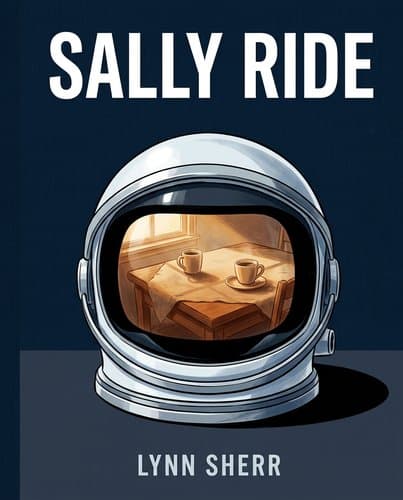
18775337_sally-ride
by Lynn Sherr
Sally Ride broke barriers by mastering strategic invisibility—but Lynn Sherr reveals how the same compartmentalization that made her America's first woman in…
In Brief
Sally Ride broke barriers by mastering strategic invisibility—but Lynn Sherr reveals how the same compartmentalization that made her America's first woman in space also cost her the life she privately lived, exposing the hidden price pioneers pay to survive their own trailblazing.
Key Ideas
Survival strategies calcify beyond their necessity
Compartmentalization is a survival strategy, not a character flaw — but survival strategies built for one environment can calcify into habits that outlast the danger they were designed for
Pioneering success demands sacrificing intimate relationships
The traits that open doors for pioneers — emotional control, opacity, the ability to act without attribution — are often the same traits that make intimate life costly. Recognizing this duality is more useful than celebrating one side of it
Closeting impacts generations, not just individuals
Silence is never just a personal choice when you're a first: Ride's closeting affected Tam's visibility, her friends' ability to know her, and potentially a generation of LGBTQ+ youth who might have seen themselves in her. The cost of strategic concealment is always shared
Greatest impact often follows initial achievement
You can do your most important work after your most famous achievement — Ride's post-NASA career in science education and policy may have shaped more lives than her spaceflight did
Institutional barriers are deliberate, never inevitable
When an institution tells you to wait — for equity, for inclusion, for recognition — there is usually a document somewhere with someone's handwriting on it proving the delay was deliberate, not inevitable
Who Should Read This
Readers interested in Scientists and Memoir, looking for practical insights they can apply to their own lives.
Sally Ride
By Lynn Sherr
13 min read
Why does it matter? Because the most public pioneers are often the most private people — and the armor that gets you to the frontier can become the prison you live in once you arrive.
Lynn Sherr spent thirty years thinking she knew Sally Ride. Then she read the obituary. Two revelations, back to back: a secret relationship of twenty-seven years, and a cancer diagnosis Ride had kept hidden for seventeen months while still running a company and inspiring millions of children. Not hidden from strangers — hidden from her closest friends. The woman who shattered the astronaut corps' glass ceiling in 1983 had spent her entire public life building a second, invisible one around herself. This book is Sherr's attempt to understand how that happens — how the same discipline that gets you strapped into a rocket at thirty-two, pulse steady at fifty-six, can quietly become the wall that keeps everyone out. The answer turns out to be less about secrets than about survival, and what it costs when the armor you needed to break through never quite comes off.
The First Word Was 'No': How Sally Ride Was Built for Secrecy Before She Ever Reached NASA
Molly Tyson watched her college girlfriend keep a five-year secret with what looked, from the inside, like no effort at all. They shared a house at Stanford decorated with supernovae posters and a bust of Julius Caesar. They dropped pronouns when writing home, said 'I went to the flea market' when they meant 'we.' Molly felt 'very burdened by this secret,' increasingly desperate to bust loose from what she called their bunker. Sally appeared to find the whole arrangement simply unremarkable. No visible distress. Jokes in stressful situations. The compartment sealed, the lock unexamined.
What Molly couldn't have known was that Sally arrived at Stanford already fully trained for exactly this. The training was generational. Joyce Ride — sardonic, one-word-answer Joyce — told her daughters' biographer with complete evenness that she had been 'not a terribly affectionate mother.' Not as an apology. Just as fact. Her own parents had never shown affection to each other or to her, so the pattern passed forward with the quiet efficiency of inherited furniture. Bear Ride, Sally's younger sister, described the family's emotional register with a phrase their grandmother had coined: 'tight lipped.' A long line of intuitive introverts whose real conversations were internal. Nobody in the Ride household said 'I love you.' It wasn't coldness — visitors remembered a genuinely happy house — it was a different operating system, one where closeness expressed itself through proximity and shared silence rather than declaration. Bear eventually lived openly as a lesbian. She and Sally never discussed it. Two sisters who shared an orientation, a household, and apparently a code of silence so deep it didn't require enforcement.
Sally absorbed this so completely that when she tried, at nineteen, to write honestly about her feelings for her first serious boyfriend, she needed to apologize before she began. 'Being serious is very hard for me,' she wrote him. 'I'm not used to analyzing my feelings and emotions, much less trying to communicate them.' She wasn't performing modesty. She was describing an actual gap — a place where most people carry their interior life, Sally carried physics problems and batting averages.
The armor wasn't forged under the pressure of fame. It came standard.
LBJ Scrawled 'Let's Stop This Now' — and They Did, for Twenty-Five Years
Women weren't kept out of the early space program by drift or inertia. There was a specific moment, a specific hand, and ink you can still read. In March 1962, pilots Jerrie Cobb and Jane Hart — members of a group of female aviators who had passed the same punishing medical screenings as the Mercury astronauts — took their case directly to Vice President Lyndon Johnson. He heard them out, sent them home, then picked up a letter his own staff had drafted expressing cautious support for allowing women to fly. He didn't sign it. He scrawled 'Let's stop this now!' across the signature line in inch-high letters and had it filed. That document is the only known written proof that women were deliberately kept on the ground — not by accident, not by custom hardening into policy, but by a decision someone made and recorded. Four months later, when Cobb and Hart carried the same argument before a congressional subcommittee, John Glenn — still gilded from his triumphal orbital flight — explained that women's absence from the cockpit was simply how American society organized itself: men flew, men fought, men built. The subcommittee thanked the women and asked them to be patient. NASA would get a man to the Moon first, and then perhaps they'd get around to it. The same sentence women had been hearing about every door they'd ever knocked on.
Twenty-five more years would pass before the locks changed — years that required a new shuttle program, a new astronaut category with no military test-pilot requirement, and a deliberate nationwide recruiting campaign. They were also years that taught any woman watching what public exposure could cost. When Billie Jean King was outed in 1981, she lost every corporate sponsorship within hours. The specific content of the exposure didn't matter; what mattered was that it handed enemies a weapon. For a woman in Sally Ride's position, the calculation wasn't paranoid — it was obvious. The armor had to cover more than just flying.
Sally's application in 1977 didn't land in an indifferent bureaucracy. It landed at the exact threshold that two decades of active political suppression had created — and that she, without knowing any of that history, had just barely arrived in time to cross.
A Pulse of 56: The Quality That Made Her First Also Made Her Unreachable
Minutes before the launch of STS-7, Sally Ride lay strapped into Challenger's cockpit at an angle that put the Florida sky in her peripheral vision and several hundred tons of rocket fuel directly beneath her. She checked her own pulse: fifty-six beats per minute. Very mellow. She held onto her pencil.
That number — lower than most people's resting rate — is the whole story in miniature. The same trait that made NASA's selection committee, reviewing 8,000 applications, point at Sally and say her also made her, in the end, unreachable even to herself. Bob Crippen chose her as his flight engineer because she stayed calm during simulator malfunctions; George Abbey defended her to JSC's director by citing her technical mastery of the robot arm and her 'ability to work well with others.' What both men were really describing was an emotional architecture that processed pressure somewhere invisible and output only competence. In a cockpit, this is the thing you most want.
You can watch it working in the preflight press conferences, where reporters tried every angle to get something quotable out of the first American woman heading to space. One asked whether she wept when things went wrong in training. Sally closed her eyes, smiled slowly, then turned to the pilot beside her and asked why nobody ever put that question to him. Commander Crippen, playing along, offered to do the weeping himself. The room laughed. The reporter got nothing. She had, as she put it, a switch marked 'Oblivious,' and she knew exactly when to throw it.
The cost didn't show up until after the landing. Back on Earth, she told a friend she had 'wanted to describe' the flight — 'but to friends' — and that the relentless press cycle had 'spoiled it, demystified, devalued, depersonalized' the whole experience before she could hold onto it. The same controlled presentation that protected her in the cockpit was now consuming the private event itself. She eventually sought out a therapist, recording in a notebook that the constant public performance was 'draining' and that she had a 'hermit side' fighting to stay whole. The pulse of 56 was not serenity. It was a very efficient machine, and the machine didn't distinguish between what needed suppressing and what needed to be felt. What the therapist's notebook captured privately, the next chapter of her life would play out in public — the same switch, the same cost, just with the whole country watching.
She Left No Fingerprints: How Sally Ride Changed History by Staying Invisible
The clearest proof came in the basement of Washington's Old Executive Office Building, about two weeks into the Rogers Commission investigation of the Challenger disaster. Sally had been slipped a single sheet of paper — three columns of data showing how the rubber O-rings that sealed the shuttle's rocket joints lost their resilience in cold temperatures. The morning of the January 28, 1986 launch had been exceptionally frigid, icicles fringing the tower. The data made the connection unmistakable. It also made the source dangerously exposed: whoever had passed that paper to a commission member could be fired for it. Sally understood both facts simultaneously. She said nothing to her colleagues, waited, and then on a quiet Friday evening fell into step beside General Don Kutyna — a two-star Air Force officer she had privately noted was a 'boyish, avid worker' who kept chocolate in his briefcase — in the corridor. Without a word, she reached into her notebook and handed him the sheet, sealed in plastic.
Kutyna grasped the problem immediately: the information had to surface without a trail leading back through either of them. So he planted the concept — cold weather, rubber seals — into the mind of Richard Feynman, the Nobel physicist on the commission, with whom he'd struck up a friendship. Feynman, never knowing where the idea originated, ran with it in his own spectacular fashion: at the next public session, he clamped a sample of O-ring rubber, dunked it in a glass of ice water, and showed the world live on television that the material lost its snap in the cold. The evening news ran the clip. The physical cause of the Challenger explosion had been demonstrated with a hardware-store clamp and a glass of ice water. Sally watched it and told a reporter she thought it was 'pretty cool.' Her name was nowhere near the match she had struck.
This wasn't the only time the instinct showed up. Years earlier, during the 1983 mission, NASA had famously fumbled the question of menstruation in space — engineers had packed a hundred tampons for a six-day flight, then asked Sally, on the record, if that was 'the right number.' She deflected the question so calmly, so pleasantly, that the absurdity landed on them rather than her. No confrontation, no manifesto. Just a slight redirection, and the room moved on. The same reflex: let the question answer itself, stay out of the frame.
What's worth sitting with is the precision of it. Sally didn't leak to a journalist, didn't confront management, didn't grandstand at a hearing. She passed one piece of paper to one person who could use it without attribution, then disappeared from the chain of custody entirely. The same instinct that had kept her personal life sealed for decades — the practiced reflex of letting nothing out unless she controlled where it landed — had just ensured that the true cause of seven deaths reached the American public. The compartment that looked, from the outside, like self-protection was also a mechanism for doing things that more visible people simply couldn't do. Invisibility, in her hands, was leverage.
The Gorilla at the Table: What Sally's Silence Actually Cost
Tam had a phrase for it. At social gatherings where she and Sally were both present, she felt like a gorilla at the table — a massive, obvious presence that everyone carefully looked past. She knew what she was. She knew what they were. The people around the table knew too: inside Sally Ride Science, employees considered the relationship an open secret, something they discussed among themselves but never in front of the couple. A colleague named Karen Flammer watched Sally and Tam move through meetings with unmistakable tenderness — Sally would jump in to make sure Tam got credit for her contributions; Tam would read Sally's exhaustion and find a way to close the session. Anyone paying attention could see a partnership. Nobody said the word. Tam couldn't even be acknowledged as a partner in the company they had built together.
The strangest evidence of how far this went is what happened with Susan Okie, a friend since high school. When Okie asked Sally directly about her earlier relationship with Molly Tyson, Sally said flatly that it had never happened. Not 'I'd rather not discuss it.' A denial. Years later, Okie still described it as a wound — the sense of being kept outside by someone she'd known since childhood, of discovering there was a locked room she'd never been invited to enter. 'She was like a locked box,' Okie said. The compartment that had protected Sally from hostile institutions, that had allowed her to pass one crucial piece of paper to one general in one corridor — deployed on a friend, it just felt like a lie.
Sally's ability to live comfortably inside this arrangement owed everything to the same architecture that had served her in cockpits and commission hallways. She was, Tam observed, radically present in individual moments — fully there when talking to you, unconcerned with what the room might be thinking, untroubled by what she wasn't saying. She wasn't suppressing discomfort. She had restructured the whole question so it didn't arise. That's why deceiving Okie wasn't experienced as deception — it didn't register as a cost at all. Tam, without that particular gift, absorbed what Sally could simply set down.
Tam doesn't frame it as resentment. She lists what she gave up with clear-eyed precision: a doctoral program she loved, the chance to be publicly claimed, an open home. She stayed because what she had with Sally was worth the rest. But she also nearly left, once, when the emotional distance accumulated past a certain threshold. The gorilla metaphor isn't metaphor for Tam. It's a memory of actual meals, in actual rooms, where she sat next to Sally and remained invisible, by mutual agreement, to everyone at the table.
'I'm Not Sure You Really Know That': What Sally Said When She Finally Ran Out of Time
Tam sat next to the hospital bed they'd moved into the bedroom so Sally could watch the sunsets. At some point — neither of them could say exactly when — the lock gave way.
The clearest signal wasn't a speech. It was arithmetic. Years earlier, Tam had asked Sally whether their relationship was permanent. Sally, entirely in earnest, said she couldn't see more than five years ahead — so they agreed to five years, and would revisit. They renewed, wordlessly, every five years for over two decades. Then, in those final weeks, Sally looked at Tam and said she wished she had twenty-seven more years with her. Tam absorbed this quietly and noted what had changed: 'It wasn't five anymore. We'd moved to a new unit.' The woman who had once capped her emotional horizon at five years had, at the end, let herself want a lifetime.
The softening happened in sequence with the illness, as if each thing the cancer took — her weight, her strength, her ability to walk downstairs for morning tea — freed something else. She cried every day. She had never cried in front of people. She told Tam, plainly, that Tam had been as much her rock as she had been Tam's, and that she wasn't sure Tam had ever known that. This, from a woman who had once denied a twenty-year relationship to a childhood friend without flinching. The compartments weren't being defended anymore. There was nothing left to protect them from.
When Tam told her she needed to figure out what to say at the celebration of life — who am I to you, publicly, after all this time — Sally's answer was simply: decide for yourself. Whatever you say is fine. And then, a few hours later, she added something she had never said in twenty-seven years together: being open about them might be hard on NASA and the astronaut corps, but she was okay with that. Whatever Tam thought was right was right.
Tam wrote the obituary, named herself as Sally's partner of twenty-seven years, and that line became the headline the world ran.
She told her mother she loved her for the first time in her life. Joyce said it back. Bear, who was there, called it enormous — fifteen minutes that exceeded everything that had come before. The armor didn't shatter. It dissolved, slowly, in the exact order things were taken from her, until what was left was just Sally: holding Tam's hand, watching the Pacific go dark, finally out of time and finally, at last, with nothing left to withhold.
The Sally Ride Impact Site: Why the Controlled Crash Is the Right Memorial
On December 17, 2012, two lunar satellites the size of washing machines crashed into the Moon's North Pole at a mile per second. NASA named the impact site after Sally Ride. Her sister Bear found it genuinely cool. A few observers noted the irony before moving on: the memorial for a woman defined by daring precision and strategic reticence was a controlled crash.
That's the right monument. The question worth asking about Sally Ride's legacy isn't whether she broke a barrier — she did, emphatically, in 1983. It's whether she stopped there. She didn't. At science festivals run by Sally Ride Science, the company she built with Tam O'Shaughnessy starting in 2001, you'd find kids like Genesis Santos, twelve years old, from East Los Angeles, who showed up expecting a field trip and left having pointed a satellite camera at a crater of her choosing. Santos told an interviewer she'd never thought of the Moon as somewhere you could actually go. After that day, she did. Multiply that afternoon by two million students across thirteen years — through festivals, teacher academies, and Moon camera projects — and you get a second act that dwarfed the first.
Ride knew exactly what she was doing with her celebrity. Astronaut Pam Melroy put it precisely at a tribute event: Ride's most important gift wasn't being first — it was being extraordinarily good, because every woman who followed her inherited the reputation she built. You don't argue with that. You build on it.
The controlled crash is the right memorial because that's what her whole life was: daring, precise, and productive on impact.
What the Armor Was For
Here is what you're left with: a woman who held her pulse at 56 on the launchpad and spent the next thirty years holding everything else just as steady — and then, only when the cancer had taken enough of her, finally let herself say twenty-seven more years. Not five. Not provisional. The real number. You have to wonder whether the armor was ever load-bearing — whether at some point the fear that built it had simply outlasted anything it needed to protect against. Sherr can't tell you. Sally never looked back long enough to say. But you know something now that Sally never quite let herself know: the woman capable of wanting twenty-seven years was always in there, behind the pulse of 56, behind the sealed compartments, behind the controlled everything. She just ran out of time before she ran out of reasons to hide her. So you look for her instead — which is, maybe, exactly what she would have wanted you to do.
Notable Quotes
“What am I going to do without you?”
“I’m not sure you really know that. You’ve helped me over the years as much as I’ve helped you.”
“I wish I had another twenty-seven years with you,”
Frequently Asked Questions
- What is Sally Ride by Lynn Sherr about?
- Lynn Sherr's biography "Sally Ride (June)" tells the story of America's first woman in space, tracing her groundbreaking scientific achievements and the profound personal costs of her life lived in strategic concealment. The book explores how Sally Ride's fierce commitment to privacy shaped her relationships and legacy, examining the tension between the compartmentalization that enabled her to break barriers and the isolation it created. Beyond her historic spaceflight, the biography highlights her decades of transformative work in science education after leaving NASA, showing how her post-career achievements may have impacted more lives than her famous achievement in space itself.
- What is the role of compartmentalization in Sally Ride's life?
- Sally Ride used compartmentalization as a survival strategy to navigate her male-dominated environment and achieve unprecedented access. Lynn Sherr's biography illustrates the core tension: "Compartmentalization is a survival strategy, not a character flaw — but survival strategies built for one environment can calcify into habits that outlast the danger they were designed for." The book reveals how this protective mechanism enabled her success but created lasting emotional costs in intimate relationships and personal connections. Readers discover that while compartmentalization was necessary for her career achievements, it became an entrenched pattern with profound relational consequences that extended far beyond her time at NASA.
- What was Sally Ride's impact on science education?
- Sally Ride's post-NASA career in science education may have shaped more lives than her historic spaceflight itself, according to Lynn Sherr's biography. After leaving NASA, Ride dedicated decades to science education and policy work, transitioning from being famous for her achievement to doing her most important work. The book emphasizes that "You can do your most important work after your most famous achievement — Ride's post-NASA career in science education and policy may have shaped more lives than her spaceflight did." This aspect of her legacy highlights how pioneers can make lasting contributions beyond their most visible accomplishments, fundamentally transforming science education and inspiring new generations to pursue scientific careers.
- What are the personal costs of privacy and silence for Sally Ride?
- Sally Ride's fierce commitment to privacy came with profound personal costs extending far beyond her own life, as Lynn Sherr's biography reveals. The book explores how her strategic concealment affected her intimate relationships and the lived experiences of those closest to her. A key insight states: "Silence is never just a personal choice when you're a first: Ride's closeting affected Tam's visibility, her friends' ability to know her, and potentially a generation of LGBTQ+ youth who might have seen themselves in her. The cost of strategic concealment is always shared." This underscores that Ride's privacy choices had ripple effects, shaping relationships while potentially limiting representation and visibility available to others who might have benefited from her public acknowledgment.
Related Book Summaries
Read the full summary of 18775337_sally-ride on InShort