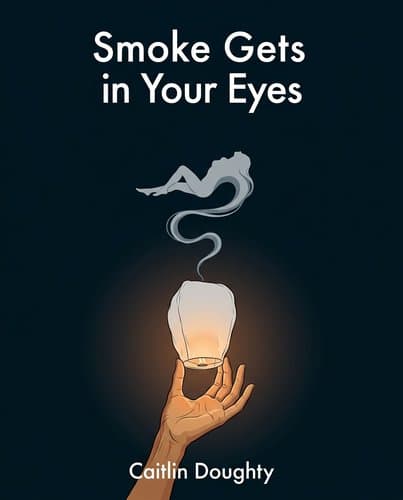
20663702_smoke-gets-in-your-eyes
by Caitlin Doughty
Behind America's sanitized funeral industry lies a deliberate system designed to keep you terrified of death—and paying for it. Mortician Caitlin Doughty…
In Brief
Smoke Gets in Your Eyes (Sept) follows a young crematory worker's firsthand education in death care to expose how the modern funeral industry profits by separating people from their dead.
Key Ideas
Sheltering from death ensures our helplessness
Avoidance amplifies fear: the modern system that removes death from daily life doesn't protect us—it ensures that when death arrives, we face it without any framework, exactly as eight-year-old Doughty did at the mall
Funeral industry profits from invented necessity
The funeral industry's most profitable products—embalming, sealed caskets, concrete vaults—are roughly 150 years old and were invented for marketing reasons, not grief. You are not legally required to use most of them.
Cheap alternatives still remove family presence
'Direct cremation' is not the death-positive alternative it appears to be. Removing the family from the body cheaply is still removing the family from the body. Price and presence are separate choices.
Witnessing death rituals enables healthy grieving
Letting families touch, wash, or witness the cremation of their dead is not traumatic—it's the closest secular equivalent to grief rituals that every other culture has maintained. The industry profits from convincing you otherwise.
We learn to fear decomposition
Decomposition is not shameful. The body's dissolution is a biological process that every other culture has found ways to integrate. Our horror at it is learned, not innate—and it can be unlearned.
Systemic change exceeds informational solutions
Even experts cave to the system under personal grief. Knowing what's wrong with the funeral industry and acting differently when your grandmother dies are not the same thing—which means the work of changing our relationship with death is cultural, not just informational.
Who Should Read This
Readers who connect with first-person stories about Memoir and Cultural Studies and want to see the world through someone else's eyes.
Smoke Gets in Your Eyes
By Caitlin Doughty
13 min read
Why does it matter? Because the avoidance you've been sold as comfort is making the fear worse.
You already know, on some level, that the sealed room and the euphemism and the mahogany casket aren't there for the dead. They're there for you. The entire American apparatus of dying—the $900 chemical injections, the Astroturf draped over the open grave so you don't have to watch the dirt go in, the cookie smell piped through the arrangement room to soften the transaction—has been engineered not to ease grief but to manufacture distance. And distance, it turns out, is the primary ingredient in dread. Caitlin Doughty spent six years inside that apparatus, pulling warm skulls from cremation chambers and shaving dead men's faces, and what she found was the opposite of what you'd expect: that touching death directly, smelling it, holding it in your rubber-gloved hands, is not traumatizing. It's just true.
The Skull in Your Hands Tells You More Than Any Funeral Ever Will
Imagine holding a warm skull in your hands. Not a Halloween prop—a real one, still radiating heat from the cremation chamber, smooth and dusty against industrial rubber gloves. That's where Caitlin Doughty found herself on her first day as a crematory operator at Westwind Cremation & Burial in Oakland, California. She was twenty-three, had never shaved a person in her life, and had spent the morning razor-scraping stubble from the face of a dead accountant named Byron. A few hours later, she was raking his glowing bones out of a furnace when she spotted his skull sitting intact among the embers. She picked it up. She turned it. And then it crumbled—completely, irreversibly—the shards sifting through her fingers into the collection container below.
That moment is what this book is actually about. The person is gone. What remains is matter. The face she had carefully shaved that morning, the eyes she had tried and failed to close, the mouth frozen open in a silent grimace—none of it survived. Byron the accountant, the husband, the man his family needed to see one final time under rose-tinted lights, had become something else entirely.
We avoid knowing this. The anthropologist Ernest Becker argued that fear of death is the hidden engine behind nearly everything humans do—why we build monuments, raise children, start wars, and scroll mindlessly at three in the morning when sleep won't come. Think of the hospital room designed so that the dying happen behind a closed door, out of sight; the refrigerated drawer; the legal placard restricting access to the room where bodies are prepared. The machinery of avoidance hums so efficiently that most people reach middle age without ever having seen a corpse.
Doughty's argument, made not through philosophy but through a pink plastic razor and a crumbling skull, is that this distance doesn't protect us. It just makes the fear louder in the dark. Byron's bones shifted through her fingers. That was the whole lesson.
A Sound You Can't Unhear: How Modern Childhood Leaves Us Defenseless Against Death
It's Halloween night at a mall in Kaneohe, Hawai'i, and eight-year-old Caitlin Doughty has just won $75 in a costume contest by shuffling down the runway in a broken tiara and fake blood, groaning in a zombie monotone about vengeance from beyond the grave. She is, for a moment, the champion of death. Then she watches a toddler climb the second-floor balcony railing near the escalator and tip over the edge, falling thirty feet onto a laminate counter below. The sound — a single flat thud — would replay in her mind for years, the way a song you hate gets stuck on a loop. She spent that night awake until dawn, blankets pulled to her chin, struck for the first time by the certainty that she was going to die, that everyone was going to die, and that no one around her seemed remotely equipped to talk about it.
What followed was a private attempt to manage what no one had taught her to manage. She developed a constellation of rituals: circling the perimeter of her house three times before feeding the dog, landing only on dead leaves and never live ones, and — most strangely — ducking her head into her shirt collar and drooling, having decided that failing to do so would signal to whatever governed the universe that she didn't want her life badly enough. The logic was irrational but felt airtight. She was eight. She had no other tools.
Doughty's experience is something more specific than ordinary childhood fear. By some accounts, children at the Jamestown settlement watched roughly 440 of every 500 original colonists die within three years. They carried small coffins through the streets as pallbearers. They sang jump-rope rhymes about how many years they had left to live. Death was a neighbor, not a secret — which meant it could be absorbed rather than ambushed by. Doughty had been kept safely away from it, so when it arrived without warning in a mall food court, her mind had nothing to hold onto. The rituals weren't pathology in isolation; they were the panicked invention of a kid whose culture had stripped away every other option for making sense of what she'd seen. The tools she needed already existed — she just had no idea where to look. She'd find them, eventually, at a place called Westwind.
The Body Refuses to Be Dignified—and That's the Point
The funeral industry sells you the idea that hiding a body's dissolution is a form of respect. The opposite is closer to true: every tool designed to make a corpse look
The American Funeral Was Invented by Civil War Ambulance Chasers—and It Shows
The American funeral as you know it is roughly 150 years old, invented not by clergy or grieving families but by entrepreneurs chasing money on Civil War battlefields.
When soldiers died in the summer heat of Mississippi or Virginia, their bodies decomposed faster than trains could carry them home. Railroads started refusing to transport corpses unless they were sealed in expensive iron caskets, which most families couldn't afford. Into that gap stepped a new kind of opportunist. Men followed the armies from battle to battle, setting up canvas tents with a plank of wood across two barrels as a work surface. They injected chemical mixtures into the arteries of the freshly dead and charged the families whatever the grief would bear. Dr. Thomas Holmes, still celebrated by the funeral industry as a founding father, claimed to have preserved more than four thousand soldiers this way, at a hundred dollars each. To advertise his results, he propped up the preserved bodies of unidentified dead men outside his tent like store mannequins. The competitive environment was ruthless enough that embalmers burned down each other's tents and placed newspaper ads boasting that their embalmed clients, unlike competitors', would never turn black in the casket.
After the war, the undertakers who had learned the trade didn't disappear. They worked to transform a wartime convenience into a permanent cultural institution. The key move was making the embalmed corpse seem like evidence of professional expertise, something a layperson couldn't produce at home. One early embalmer wrote in the 1880s that the process made the public marvel at something mysterious and incomprehensible, and that marvel translated into respect for the practitioner. Before this, the local undertaker was a coffin-seller who might also pull teeth and shoe horses. Embalming was what elevated him to something resembling a specialist, and the funeral industry has been protecting that status ever since.
The result is a procedure that even its own practitioners treat with a kind of detached absurdity. At Westwind, Doughty watches Bruce work through the body of Cliff, a veteran who died alone, and the experience strips away any remaining mythology. The pink-dyed formaldehyde coursing through the arteries, the trocar punched through the abdomen to rupture organs and vacuum out the contents while Bruce chats cheerfully about his plan to corner the market on funeral doves — this is what's inside the dignified casket. Americans didn't inherit this from antiquity. They inherited it from a man propping corpses outside a tent in a war zone. The tradition is young enough that it could be different.
Giving Families the Button Back: What Real Grief Looks Like
What happened at the Huang cremation was exactly the kind of thing the modern funeral industry has spent a century trying to prevent.
The first time Doughty witnessed a Witness Cremation at Westwind, she was wearing a cherry-red dress. The Huang family, roughly thirty people strong, were already filling the crematory before she had time to change. An older woman spotted her and barked with disapproval—red is the color of celebration in Chinese mourning tradition, and Doughty had shown up to a funeral in a party hat. She shuffled to the back of the room, mortified, and watched what happened next.
Everyone dropped to their knees. Elderly women, adult sons, people she couldn't tell apart from hired professional mourners—all of them on the floor, wailing, beating their palms against the concrete as the casket slid toward the machine. A man with a video camera moved through the crowd waving his hands upward, silently demanding more anguish, and the mourners obliged with louder, more torn cries. The noise of human grief and roaring furnace mixed into something eerie and ancient. Then Mike, Westwind's manager, gestured to Mr. Huang's son. The son stepped forward and pushed the button that started the flames.
Doughty had expected to feel like a professional managing a process. Instead she felt like an intruder who had wandered into something real. That button—a mundane ignition switch on an industrial machine—had become a handoff, the last physical act a son could perform for his father. Later, Mike told her simply: you have to let them push the button. They love the button. What he understood, and what the modern funeral industry has largely engineered away, is that doing something with the body—touching it, washing it, sending it off yourself—is not trauma inflicted on mourners. It's the mechanism by which mourning actually works.
The alternative is Doughty's friend Mara, standing at a grave covered in Astroturf, waiting for a burial that never happened while she watched. The casket sat above ground as the family was ushered away, and only once they had left did the backhoes arrive. The industry called that sparing her. What it actually did was strand her grief with nowhere to go—no physical act to anchor the loss, no moment where her body understood what her mind already knew.
Proximity to the dead, Doughty came to believe, isn't what prolongs grief. Distance is. The Huang family walked out of that crematory having done something. Mara walked away having been protected from doing anything at all.
The Direct-Cremation Trap: Cheaper Isn't the Same as Healthier
What if the alternative to an overpriced traditional funeral is just a cheaper way to avoid death altogether? That question sits at the heart of Doughty's uneasy reckoning with direct cremation—the option she once admired, operated daily, and eventually came to see as a different species of the same disease.
The clearest evidence is a nine-year-old named Ashley. Her parents, after she died in a hospital, left her body there, drove home, and typed a credit card number into Bayside Cremation's website—Westwind's internet-only sister operation, designed so that no human being ever had to speak to another human being. They waited two weeks for a box to arrive in the mail. When the transaction stalled, it was because they had tried to charge Ashley's cremation to a Sears department store card. The detail is almost too perfect. Sears. Not grief, not ritual, not the gathering of people who loved her—a retail account, the same one you'd use for a refrigerator or a lawnmower. Ashley had been processed into a line item before anyone had the chance to understand what had been lost.
Jessica Mitford made this possible, or at least made it respectable. Her 1963 bestseller exposing the funeral industry as a carnival of exploitation was genuinely important—she was right that embalming is oversold, that families get pressured into caskets they don't need, that grief is a market. But the flaw Mitford never addressed was identified by someone with a specific vantage point: Doughty operated the very cremation machine that reduced Mitford's own body to ash in 1996. The book improved America's relationship with the price point, not with death. By telling readers that finding cheaper alternatives was the sophisticated move, Mitford gave cultural permission to keep not looking. Direct cremation didn't bring death closer. It outsourced the avoidance to a website and a postal carrier. The body still disappears; you just pay less for the trick.
That would be easy to leave as cultural criticism—smug, abstract, somebody else's problem. But Doughty doesn't leave it there. She had a grandmother too.
The Professional Who Caves: What Happened to Doughty's Own Grandmother
Think of someone who has spent years training themselves to run into burning buildings — and then picture them frozen outside their own house on fire.
When Doughty's grandmother Tutu died, Doughty was the family's designated expert. She had spent years watching the funeral industry use wires, glue, and incorrect lipstick colors to stage a performance for grieving families. She had written and spoken publicly about how those techniques sever the living from any honest encounter with loss. She had promised herself, professionally and personally, that when death came close it would come differently.
Then a Hawaii funeral director told her mother that keeping Tutu's body at home beyond two hours violated state law. It was false. Doughty knew it was false. But she said nothing, and Tutu went to the funeral home.
At the viewing, Doughty saw immediately what had been done. The mouth she had last seen slack and peaceful in her mother's photograph had been pulled into a tight grimace using wire threaded through the gums. Bright red lipstick covered lips that Tutu had never painted that color in ninety-two years of life. Doughty recognized every technique; she had used most of them herself. The woman in the casket looked like the industry's idea of a deceased grandmother, not like her grandmother.
What followed made the moment worse. Tutu's Samoan caretaker, Valerie — who had bathed and dressed her, taken her on outings, stayed with her as her mind dissolved — walked to the casket carrying a small child and let the child kiss Tutu's face, again and again, weeping openly and touching her cheek with bare hands. The woman who had never read a word about death psychology or natural burial was more present with the body than Doughty could manage to be.
The system doesn't fail only the uninformed. That's the actual measure of how deep it runs. Doughty had every piece of knowledge required to resist — and at the moment it mattered, the legal bluff, the industry's framing, the path of least resistance inside raw grief proved stronger than the knowledge. Avoidance doesn't feel like cowardice when you're inside it. It feels like the only available mercy. That's what makes it so durable, and so costly: you only discover what it took from you afterward, standing at a casket, looking at lips painted the wrong color.
The Stillness That Waits When You Stop Running From It
The wheel came off Doughty's Volkswagen at seventy-five miles per hour on the I-10 freeway — not metaphorically but literally: bolts snapping, the assembly spinning free of the axle, bare metal grinding against asphalt in a rooster tail of sparks as the car fishtailed across four lanes of Sunday traffic near Palm Springs. What she expected to feel was the particular terror of losing all control over the vehicle that contains your body. What she actually felt was a slow, gathered quiet. A voice said something like ah, here we go, and the Moonlight Sonata started playing at half speed in her head. Her hands worked the wheel but her mind was somewhere else entirely, calm in a way that surprised her even as it was happening.
Four years of pulling bodies out of furnaces, lifting cold hands, labeling cardboard containers, watching families dissolve over what remained of someone they loved — all of it had been, without her consciously planning it, a kind of immunization. Not against death, but against the terror of losing physical control that underlies so much of what humans spend their lives running from. The car eventually slammed into a dirt embankment on the shoulder, facing oncoming traffic, and she was fine. The moment that should have been the worst of her life turned out to be proof that her work had changed something real in her.
A few months later, alone in a California coastal town called Cambria, she walked a mile uphill through fog to a cemetery established in 1870. She stepped over the chain at the entrance and sat down between two graves — one belonging to Howard J. Flannery, who died in 1963, and one marked only with the words A Soaring Spirit, A Peaceful Heart. She sat there until the fog lifted and a sky full of stars appeared. The silence was total: no wind, no crickets, nothing. She had expected, she realized, to need the gothic props — the tolling bell, the weeping willow, the figure in black — that culture offers as substitutes for the stillness itself. Without them, there was just the moon and the old stones and the fact of all the lives that had already ended. It was not frightening. It was, she decided, what you get on the other side of the running: not peace as an absence of feeling, but peace as a presence you can finally sit in. Somewhere in those four years of work — washing bodies, sealing shrouds, learning to touch the dead with care rather than dread — she had stopped needing the theater. The silence had become enough.
What the Silence in the Cemetery Is Actually Offering You
The discomfort you feel right now — reading about wires threaded through gums, about rendered fat flowing out of a cremation chamber, about a son pushing a button that starts the flames — that feeling isn't a malfunction. It's the sensation of something true you haven't finished thinking about yet. Doughty didn't find stillness by achieving distance from all of this. She found it by going closer, closer, closer, until the thing she'd been circling since a Halloween night in a mall finally had a shape she could put her hands on. There's a moment elsewhere in the book that makes this concrete: the Ghusl washing, hands on a stranger's cooling body, which turns out to feel less like confrontation than like care. That's the trade the book is actually offering — not comfort through looking away, but the specific calm that becomes possible only when you stop. The cemetery in Cambria was quiet not because death is peaceful in some greeting-card sense, but because she had finally stopped running long enough to notice that the thing chasing her had always been her own reflection.
Notable Quotes
“Hey, I don’t need your judgment here, Byron,”
“red in tooth and claw,”
“Death makes me very angry. It doesn’t make sense to me.”
Frequently Asked Questions
- What is Smoke Gets in Your Eyes about?
- "Smoke Gets in Your Eyes" follows a young crematory worker's firsthand education in death care to expose how the modern funeral industry profits by separating people from their dead. Drawing on mortuary science and cultural history, the book demonstrates that most industry practices are recent inventions rather than necessities, and that direct engagement with death reduces fear rather than causing it. Doughty's account reveals how practices like embalming and sealed caskets were invented roughly 150 years ago primarily for marketing and profit, not for legitimate death care needs.
- Why does the funeral industry use practices like embalming and sealed caskets?
- "The funeral industry's most profitable products—embalming, sealed caskets, concrete vaults—are roughly 150 years old and were invented for marketing reasons, not grief." You are not legally required to use most of them. The industry invented these practices to maximize profits by creating perceived necessity rather than actual need. By separating families from direct contact with their dead and marketing expensive services as essential, funeral companies built a highly profitable system based on marketing rather than genuine grief care. Understanding these practices as inventions helps families reclaim agency over their death rituals.
- Is direct cremation really a death-positive alternative?
- While direct cremation seems progressive, it may not be the solution it appears to be. The book argues that "Removing the family from the body cheaply is still removing the family from the body. Price and presence are separate choices." True death-positive practice involves allowing families to touch, wash, or witness the cremation of their loved ones. Doughty describes this as "the closest secular equivalent to grief rituals that every other culture has maintained." Family involvement in these processes is not traumatic but rather healing, and the industry profits by convincing people otherwise.
- What does the book say about our fear of decomposition?
- Doughty argues that "Decomposition is not shameful. The body's dissolution is a biological process that every other culture has found ways to integrate." Our horror at decomposition "is learned, not innate—and it can be unlearned." This perspective suggests that by changing cultural attitudes and practices around death, we can transform our relationship with our own mortality. The book also acknowledges that even experts struggle to practice differently when personally grieving. Therefore, "Knowing what's wrong with the funeral industry and acting differently when your grandmother dies are not the same thing"—changing our death culture requires systemic cultural shifts.
Related Book Summaries
Read the full summary of 20663702_smoke-gets-in-your-eyes on InShort