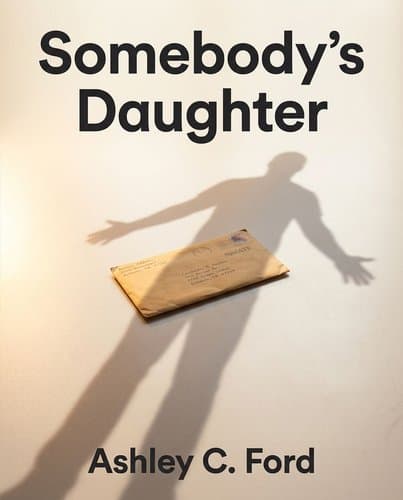
54860610_somebody-s-daughter
by Ashley C. Ford
Ashley Ford built her father from prison letters and longing — then had to hold that love alongside the truth of what he did to another woman.
In Brief
Ashley Ford built her father from prison letters and longing — then had to hold that love alongside the truth of what he did to another woman. A memoir about the walls childhood forces us to build, and the freedom that only comes from telling the full, impossible truth.
Key Ideas
Self-protection eventually prevents true intimacy
The inner life you build to survive — the self that hides its 'badness' from the adults who might punish it — is the same self that makes full intimacy impossible later. Protection and isolation are two names for the same wall.
Protective warnings can silence vital truths
Protective love and silencing love can travel through the same person, in the same breath. The warning system meant to keep you safe may be the exact force that keeps you quiet when it matters most.
Finding language that names your truth
Rape is not sex. Ashley Ford had to find this distinction in a library, from books with white girls on their covers, because no adult in her life said it plainly. If you are carrying the wrong kind of guilt, ask whether someone gave you the right categories to work with.
Real contradictions need not resolve cleanly
You can hold someone's love for you and their capacity to harm others in the same hand. That contradiction is not a problem to resolve — it is a truth to carry. Demanding a clean story is a way of refusing the real one.
Speaking truth is the worthiest act
Telling your truth is not a betrayal of the people in it. Ashley's father told her: 'Don't worry about nobody's feelings, especially not mine. You gotta be tough to tell your truth, but it's the only thing worth doing next to loving somebody.' That is the permission this book gives.
Who Should Read This
Readers who connect with first-person stories about Memoir and Family and want to see the world through someone else's eyes.
Somebody's Daughter
By Ashley C. Ford
10 min read
Why does it matter? Because the father you've imagined is always safer than the one who exists.
The call comes after nine, which is wrong — her mother is almost always asleep by nine. A daughter stands in a kitchen she has decorated carefully, pasta going cold on the counter, and hears four words that crack her open: Your dad is getting out. She doesn't cry right away. She eats a bite of cold linguine first. Then she cries, and what comes out of her is something she can't name yet. She has spent her whole life loving a father who only exists in letters, in her grandmother's stories, in the architecture of his handwriting on envelopes she would grab from the mailbox before anyone else could. Somebody's Daughter is about what happens when you finally meet the man you built from imagination, and learn that the man is a rapist, and that loving him anyway might be the most honest thing she has ever done.
My Mother Didn't Know I Could Do Bad Things and Still Have the Sun
A four-year-old Ashley Ford sees a television commercial warn that cigarettes will kill you. Her mother's pack is sitting in a black purse a few feet away. Her mother is in the bathroom. Ashley doesn't wait — she opens the box, dumps every cigarette into the kitchen trash, some ripped in half, and considers herself helpful.
That night, hands drag her out of sleep and into the kitchen. Ashley had already learned to distinguish between two people who shared her mother's body: there was Mama, who watched rainy-day movies with her children draped across her, and Mother, who rose from somewhere inside Mama to do what Mama wouldn't. Mother pointed at the cigarettes sitting on top of the trash. Ashley went to sleep sore.
What happened next is the thing worth watching. She didn't confess, didn't seek comfort, didn't transfer blame. She'd already absorbed that honesty was a trap. She carried the fact of her own badness silently and alone. The next day, she performed silence so completely that her mother praised her: "You're being such a good girl today." That night, she stayed awake until her mother fell asleep, leaned over the headboard, pulled back a curtain, and watched a sunrise by herself for the first time. The sky went from soft rose to blood orange above the clouds. She whispered to her shadow until the light hurt her eyes, then closed them and held the image inside.
"My mother didn't know I could do bad things and still have the sun."
You might read that as a four-year-old's small defiance — a child discovering she can have secret pleasures. But Ford is describing something structural. What looks like a resourceful kid managing an unpredictable parent was actually the construction of a self that existed entirely outside anyone else's knowledge or permission. The sunrise wasn't a reward for patience. It was proof that her interior life — the wanting, the deciding, the surviving — could outlast punishment, outlast the Mother, outlast the performance of goodness she now understood she'd have to keep up indefinitely. She was four, and she was already building the place she'd live in for the next twenty years.
The Same Love That Tried to Protect You Can Teach You to Stay Silent
How do you tell a parent you were hurt when that same parent taught you your account might not hold?
After Ashley's cousin is abused by her stepfather (believed by no one), her mother responds with what looks like vigilance: sex education delivered in a fury, interrogations after every visit away from home, demanding to know whether anyone had touched Ashley, her face already furious, as if a confession were overdue. Ashley reads this accurately, if not the way her mother intended. The anger doesn't register as protection. It registers as accusation. She absorbs the lesson: what happens to her body will be hers to prove away, with the right voice, the right face, the right body language. Her mother has promised to kill any abuser.
Then comes New Year's Eve. A family friend finds Ashley alone in the dark living room. She trusts him: he gives dollar bills to children, speaks to kids like adults. When he asks if she loves him, she considers: he's like family, and family, her mother always says, is all they have. She nods. At midnight, he forces his tongue into her mouth, his hands clamped on either side of her head, her skull against the cold patio glass. Her eyes are open. His are shut.
She runs to her mother immediately. Her mother sends her to bed.
She almost goes back. Then the man reappears in the doorway, winks, says Happy New Year. Ashley climbs the stairs on her hands and feet — a child's posture, not an adult's — and decides to stay silent. The reason she gives herself: he was like family, and all they had was each other. Her mother's own words, repeated as protection. Now locking the door.
She Left Something Important in That Shed, and It Was Too Cold to Go Back for It
Bradley's assault, in the shed behind the house, didn't just hurt Ashley Ford — it split her. Afterward, on the shed floor, each attempt to re-enter her own body brought a sharp, cold pain. She walked back to the house but stopped halfway and looked at the shed. Something important was still inside it. Too cold to go back for. One part of her crossed the threshold. The other didn't.
What complicated the years that followed was that she still wanted Brett, a boy she'd been seeing. Clearly, physically, on her own terms. In the movies she watched with her mother, women who'd been assaulted stopped wanting sex entirely. Ashley did not, and that gap convinced her something was wrong with her: she was the wrong kind of victim responding the wrong way.
No adult closed this gap. Not her mother, not her teachers. These were the same people who had covered the mechanics and morals of sex in exhaustive, furious detail but apparently never thought to say the one thing that would have helped: rape is not sex. Ashley found it out herself, in the teen section of the Allen County Library, from paperback novels with white girls on the covers, because she had nowhere else to take her questions. Those books drew a line her entire community had left undrawn, a distinction so basic you'd think any adult could have offered it. What happened in the shed and what she wanted with Brett were different categories of act. Neither one had anything to say about the other.
She brought that distinction to Brett's bedroom. He was gentle — the way a musician is careful with anything he loves. She walked away with something specific and irreversible: she had wanted this and chosen it. It was hers. The shed had made its claim on her. The claim didn't hold.
The girl she'd left behind in the cold didn't come home all at once. But Ashley walked home from Brett's and felt her own feet on the ground. Present. Hers.
He Raped Two Women — Said Like Any Other Piece of Gossip, Mid-Argument, in a Food Court
They are standing in the Panda Express line at Glenbrook Mall — the longest line in the food court, which Ashley considers a tax worth paying — when her grandmother decides to confess. The shopping trip has gone mostly silent. Ashley refused, for once, to share whatever was hurting her. Her grandmother took that personally. Now, mid-argument, she tells Ashley she needs to be nicer to her mother, because she doesn't even know why her father is in prison.
Ashley takes the shot she has. Why?
"He raped two women."
Her grandmother says it the way she says everything about Other People: quickly, flatly, without ceremony. Ashley has watched her use the same tone on strangers whose clothes fell short of her standards, on family members she deemed sloppy. The information arrives in that same register. Ashley's feet go still. She masks her face. She does not cry, does not speak, does not eat. She has learned, from years of her grandmother's warnings about what Other People might say, that showing too much emotion gets you labeled. She performs steadiness all the way home.
Then she calls Brett and walks to his house on autopilot, crossing streets without looking. She puts a bright smile on for his mother in the kitchen. She holds it until they're alone in the den, and then she dissolves. Brett pulls her into his lap, rocks her, and says he's sorry over and over. He doesn't let her go.
What the delivery cost her was scaffolding. The information arrived as gossip, not as a conversation. There was no frame for what it meant to be the daughter of a man who had done that.
Because Ashley had already decided what her father was. This same grandmother had given her the portrait years earlier: a young man who carried baby Ashley from room to room to show her off, leaving her with one sock and dried milk in her neck rolls, so loved by her mother that when he was taken away she sat weeping on a grandmother's doorstep, pregnant, pulling at a skirt. That man wrote letters across the years of his incarceration calling Ashley brilliant, his favorite, the most beautiful. She hadn't believed the letters exactly. But she had believed in being loved by someone who believed them. That arrangement had been enough.
Now she had to hold it alongside: he raped two women.
The letters didn't stop being real. The love in them didn't retroactively disappear. What changed was the weight she had to carry them with.
You Cannot Be Fully Loved When You Have Only Ever Shown the World Half of Yourself
Brett left two months after coming out, quietly, without ceremony. The floor went out.
The depression that followed was the bill coming due on twenty years of self-concealment.
Ashley's friends tried. They showed up with food, with presence, with all the love they had, and still couldn't reach the floor of her grief. They were working with only a fraction of her: they didn't know about the shed, didn't know Brett had been the only person who had seen her at her worst — curled in his lap, soaking his shirt with tears — and stayed anyway. He was the only living witness to her whole self. When he left, the self that had only ever existed inside his knowledge went with him. She lost thirty pounds in three months. She stopped attending class. She stopped listening to music, which, for someone who had used sound her entire life as a way to feel less alone, registered as an alarm. You play movies for background noise when silence feels like being buried.
Recovery came from a Kodak digital camera her grandmother gave her for Christmas. Back in her Muncie house, isolated from her four roommates, she set the self-timer and posed. At first in outfits she no longer wore outside. Eventually, nude. When she uploaded the images and looked closely, she saw something that contradicted everything Brett's departure had confirmed about her body — clear skin, stretch marks that appeared deliberately placed, a stomach that looked warm and worth touching. She was obsessed. She played with light, wrote on her skin, edited tints and shadows. Over the following semester, she fell in love with what she saw.
The act of looking was the thing. For twenty years, she'd needed someone else's eyes to confirm she was real, worthy, survivable. The camera gave her back to herself. Not through anyone else's assessment. Through her own, sustained and deliberate, over and over until she believed it. She had been working with only a part of herself. The photographs were her first attempt at the whole.
Not Even When We're Burning Alive
She pressed her cheek to the center of his chest. Ford's memoir refuses the structure most readers bring to it — the confrontation, the verdict, the silence that tells you where things stand. The end she arrives at isn't resolution. It's a beginning. She told you exactly what that would look like years before she got there.
When Ashley was young and living with her grandmother in Missouri, the old woman led her past the far edge of the property to where the grass grew long and uncut. She dug until she found what she was after: a dense knot of garden snakes moving slowly through each other in what looked like deliberate closeness. Her grandmother poured lighter fluid into the hole and dropped a match. The snakes didn't scatter. They held tighter as they burned, pressing in even as the scales came apart. Ashley started to cry. Her grandmother, still watching without flinching, offered what she clearly considered an explanation: creatures like these don't let go when they're on fire. We don't give up on our people, she said. Not even then.
Ashley was five, maybe six. The lesson arrived before she had full use of it. But it had a long time to work.
By the time her father walked out of prison (after twenty-six years inside, after she spent years not knowing what he'd done, then knowing, then deciding to show up anyway), the reunion took place at her aunt's house in Indiana. Ashley asked her mother to be there, which was its own act of courage: her mother hadn't seen the man in twenty-five years. When the garage door opened, Ashley stood up without quite knowing why. She wanted to be the first person he saw. She was.
He crossed the room silently and put his arms around her. She pressed her cheek to his chest and used the breathing method she had returned to throughout her life when feeling got unbearable — four counts in, hold for seven, release in eight. Her aunt began crying and calling out praise. Her uncle took close to a hundred photographs in quick succession and sent them all at once: more images of Ashley and her father together than in all of her previous life, delivered in under a minute.
She doesn't forgive him for what he did to women she never knew. She is direct about this — that absolution isn't hers to give. But she is equally clear that he is part of her, and she doesn't want to turn from that. What she says when they finally stand face to face is the simplest thing available. Hi, Daddy. First tear. Cheek to chest. Breathe in, hold, release.
This was her father and she was his daughter. That, she says, is a good place to start.
Ford never promises arrival — only the choice to keep going. The snakes held on as they burned. So does she.
What "A Good Place to Start" Actually Means
The reunion didn't fix anything. Her father walked out of prison and she was there, and none of the decades between them collapsed, and nobody was absolved of anything. What happened instead was simpler and harder: she chose to be present to what was actually true rather than the story she'd needed it to be. That's what Ford is really after, not a lesson about forgiveness but a question about waiting. She spent a life doing exactly that. The ending, when it came, wasn't an ending. It was just a door she'd finally stopped standing outside of. She kept the letters.
Notable Quotes
“I said in a faux posh voice. It was meant to keep things as jovial as the moment could stand. Usually, she would respond with her own equally posh voice,”
“then we'd both giggle and tell each other something silly, or gossip, or ask the question we'd called to ask. This time my mother said,”
“Your dad is getting out of prison.”
Frequently Asked Questions
- What is Somebody's Daughter about?
- Somebody's Daughter is Ashley C. Ford's memoir about growing up with a father in prison and reconciling an imagined parent with a man convicted of rape. The book examines how childhood survival strategies limit adult intimacy, explores how contradictory truths can coexist, and investigates what it takes to tell an honest story about the people who formed you. Ford weaves personal narrative with insights about trauma, identity, and the complex bonds between parents and children shaped by incarceration and the search for authentic truth.
- What does the book reveal about survival and adult intimacy?
- The inner life you build to survive — the self that hides its 'badness' from the adults who might punish it — is the same self that makes full intimacy impossible later. Protection and isolation are two names for the same wall. Ford traces how the defensive mechanisms children develop to navigate unsafe environments become obstacles to vulnerability in adulthood. By naming this pattern, she offers readers a framework for recognizing how early protection can later prevent the authentic intimacy we seek in relationships.
- How does Somebody's Daughter address contradictions in people we love?
- You can hold someone's love for you and their capacity to harm others in the same hand. That contradiction is not a problem to resolve — it is a truth to carry. Ford demonstrates that refusing to simplify complex family relationships allows for honest reckoning. Rather than demanding clean narratives where people are wholly good or bad, she insists real stories contain competing truths. This framework enables readers to understand their own relationships with flawed people they love.
- What permission does the book give about telling your truth?
- Telling your truth is not a betrayal of the people in it. Ashley's father told her: 'Don't worry about nobody's feelings, especially not mine. You gotta be tough to tell your truth, but it's the only thing worth doing next to loving somebody.' Ford frames honest storytelling as both an act of courage and integrity. This paternal wisdom anchors the memoir's core message: that authentic narratives about our families and ourselves, though difficult, ultimately serve love better than protective silence.
Related Book Summaries


Read the full summary of 54860610_somebody-s-daughter on InShort