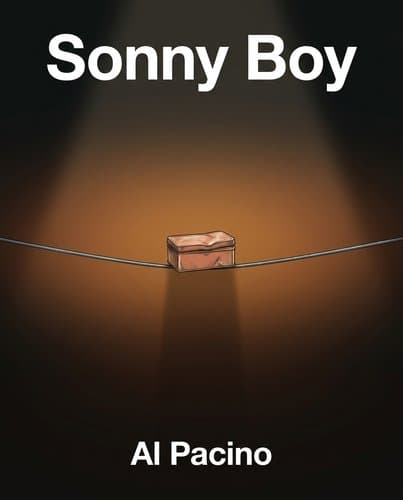
209499400_sonny-boy
by Al Pacino
A boy from the South Bronx who found salvation in acting at thirteen spent the next six decades chasing that transcendence—and losing everything else.
In Brief
A boy from the South Bronx who found salvation in acting at thirteen spent the next six decades chasing that transcendence—and losing everything else. Pacino's memoir is a brutal, tender reckoning with how the thing that saves you can quietly become the thing that costs you everyone you love.
Key Ideas
Apparent Arrogance Protects Artistic Integrity
The behavior others read as ego or arrogance often has a different source: Pacino's 'difficulty' — refusing roles, holding out on scripts, fighting directors over details — was consistently an attempt to protect the transcendence he'd found in the craft from being cheapened by commercial logic. Identifying what you're actually protecting, rather than how you appear to others, changes every negotiation you have.
Survival Tools Can Become Constraints
Survival is not the same as thriving — and the thing that saves you can quietly destroy you by other means. Pacino's mother kept him from the needle; the fame she never lived to see nearly took him through alcohol and pills. The same protective instinct that works at ten can become the cage that traps you at forty.
Breakthrough Comes Through Openness to Accident
The best work often comes from staying open to accident. 'Attica' wasn't scripted — it was whispered in Pacino's ear thirty seconds before the scene. Michael Corleone's slow deadening emerged from a 'garden planting' strategy that nearly got him fired. The preparation matters, but the breakthrough usually arrives through the gap the preparation leaves open.
Philosophy Cannot Replace Financial Literacy
Financial illiteracy is its own kind of ideology. Pacino's indifference to money was philosophically consistent — he had decided at nineteen that fame and fortune were irrelevant to the work. But philosophy doesn't pay for sixteen cars you don't own. The same worldview that kept him artistically incorruptible left him with $90,000 after decades of iconic films.
True Worth Transcends External Validation
An Oscar, a Tony, a standing ovation — these are what Pacino calls 'Father's Day cards': small necessary pockets of applause to help you get through a lifetime, not evidence that the lifetime was worth it. Worth has to come from somewhere that external validation can't reach or destroy.
Who Should Read This
Readers who connect with first-person stories about Memoir and Artistic Expression and want to see the world through someone else's eyes.
Sonny Boy
By Al Pacino
11 min read
Why does it matter? Because the man you think was being difficult was actually trying to protect the only thing that ever made him whole.
The easy story is this: Al Pacino became famous, became difficult, became a recluse who turned down Han Solo and skipped the Oscars and drank through some of the greatest films ever made. A star behaving like a star. Except the memoir doesn't support that story. What it actually describes is a sixteen-month-old boy who got quietly handed off while his parents fell apart — a rupture so early he couldn't name it until he was twenty-eight and sitting across from a therapist. And then, somewhere around thirteen, in a school auditorium, he felt briefly whole. Not famous. Not successful. Whole. Everything afterward — the drinking, the sabotage, the box of cash he asked to sniff before declining — was a man trying to protect that one feeling from being managed, marketed, and quietly killed by people who confused it with a career.
Three Friends Who Didn't Make It Out
Picture Pacino at ten or eleven, sitting in his grandparents' bathtub on Bryant Avenue in the South Bronx, five stories above an alleyway where his friends are howling his name into the night — 'Sonnnn-ayyyyyyyy!' — summoning him to whatever the late shift had in store. He wanted to go. These boys were everything. But his mother said no. It was late. Tomorrow was a school day. The answer was no.
He hated her for it.
Then he's fifty-two, standing at the vanity with shaving cream on his face, trying to figure out who to thank for the Oscar he's about to accept, and it hits him: she's the reason he's still here. Not his talent, not his drive, not some special exemption from the physics of the neighborhood. Just a window his mother refused to open.
The three boys howling in that alley — Cliffy, Bruce, Petey — all died from heroin. That's not a statistic. Pacino watched it happen in increments. Petey's trajectory announced itself early: deep in a stretch of wasteland called the Dutchies, a prank sent everyone scattering, and Petey fell on something jagged that sliced through his wrist all the way to the nerves. The doctors stitched it badly. His hand never moved right again. He'd catch a ball, pull off his glove, switch it to the other hand to throw. Poverty made literal, in one clumsy fall.
The moral weight of the whole book rests on that bathtub scene. Survival wasn't the reward for being the talented one, the driven one, the one who wanted it more. It was the reward for having a mother stubborn enough to make him stay inside. He knows this, and it costs him any certainty that he deserved what came next.
The Moment He Decided Fame Was Irrelevant
Here is the claim: Pacino had already decided, at nineteen, that fame was beside the point — and that decision came before he had any reason to be modest about his chances.
The evidence lives in one night at the Actors Gallery in Manhattan, doing Strindberg's 'Creditors' for a handful of people who may or may not have been paying attention. Nothing about the circumstances announced themselves as significant. And then something happened that he couldn't have manufactured: the words left his mouth and they were Strindberg's, but they felt like his own. Not performed — more like the words had always lived in him and the text had just given them an address. He describes the sensation as lifting off the ground. Afterward, he walked. Not anywhere specific — just walked, the way you do when something has reorganized itself inside you and sitting still seems beside the point. The South Bronx, the hunger, the gap between where he'd come from and where actors were supposed to come from: all of it became briefly irrelevant. What landed in its place was something he could only articulate in negatives: eat or don't eat, make money or don't, become famous or don't. None of it meant anything anymore. The craft had its own weather system, and once he'd stepped inside it, external rewards looked like postcards of a place you'd already been.
Charlie Laughton — his teacher, effectively his surrogate father — sharpened this into a philosophy. One sentence did it: life is on the wire, he told Pacino. Everything else is just waiting. It was the Flying Wallendas' answer, apparently, when someone asked why they went back up after the pyramid collapsed and people died.
Pacino received that story like a man who already knew the punchline. It confirmed what the Strindberg night had shown him — that the only living he could do was in the act of risking something real.
The paradox the book is quietly building toward, though Pacino doesn't announce it: the transcendence he found in obscurity was exactly what success would put under pressure. You can't lift off from the ground if the ground keeps moving up to meet you.
The Man Who Was Almost Fired from The Godfather Felt Relieved About It
He's lying in a gutter on White Plains Road in the Bronx, looking up at the sky, ankle twisted so badly he can't move. The crew of The Godfather has crowded around him, asking whether bones are broken, whether he can walk. And what Pacino feels — his word — is relief. A miracle, even. The thought that passed through him was something like: I don't have to do this anymore.
To understand why a man would lie in a gutter hoping his injury would liberate him from one of the most coveted roles in cinema history, you have to understand what the preceding weeks actually felt like. Paramount didn't want him. They wanted Nicholson, Redford, Beatty — men who announced themselves. The studio saw Pacino's Michael Corleone as a bad bet, and the rumor of his imminent firing had spread so thoroughly through the production that crew members went stiff when he walked onto set — the particular silence of people waiting for someone to be proved right about you.
His strategy — play Michael as an enigma, start closed and opaque so the eventual explosion would mean something — looked, in the early rushes, like nothing. Just a small dark-haired guy being unremarkable. That's what the studio saw. That's what nearly got him fired.
When Francis Ford Coppola finally told him he wasn't cutting it, he moved up the shooting schedule for the Italian restaurant scene, where Michael's transformation from outsider to killer gets its first real landing. Pacino shot it days after the ankle incident, medicated on cortisone, half-hobbled, in a state that blurred the line between the character's rigid containment and the actor's physical limitation. The studio reversed course almost immediately.
The relief he felt lying on White Plains Road wasn't cowardice. It was the same nervous system that had lifted off during that Strindberg night in a near-empty theater: a body telling him the stakes were real. He brought that man — desperate, cornered, hoping for escape — directly into Michael Corleone's stillness. The character who looks like nothing, right up until he doesn't. It's the most autobiographical performance he never planned to give.
A Script Isn't Fixed by Money — No Matter What's in the Tin Box
A producer called him into a New York office, poured him a drink, and when the pleasantries ran out, reached into a desk drawer and produced a locked metal container. Inside, he said, was a million dollars in cash — Pacino's if he'd agree to reprise Michael Corleone in the sequel. Pacino asked if he could pick it up. Sniff it. He wanted to know what a million dollars felt like in his hands. The producer smiled. And then Pacino passed, because whether the box held a million dollars or packets of sugar was genuinely beside the point. Money is an abstraction, and you can't build a performance out of abstraction.
What he needed was a script worth inhabiting. When the studio finally stopped escalating the offer and sent Coppola instead, Coppola cut straight to it: stop raising the number, just fix the story. So Pacino and his teacher Charlie Laughton flew to San Francisco, checked into the Fairmont Hotel, and spent six days and nights in Room 617 doing what Pacino called the work of moving men — not writing, but carrying the furniture that was already there into its proper arrangement, finding the missing connective tissue in Michael's arc. When they finally walked out, Charlie looked up at the room number like a man marking a historic address.
The last piece was Lee Strasberg, cast as Michael's rival Hyman Roth. Strasberg had been, alongside Charlie and producer Marty Bregman, one of the surrogate fathers who'd shaped Pacino's entire sense of what the craft demanded. Putting that relationship on screen — the protégé opposite the patriarch, the full psychological weight of inherited authority made visible — wasn't clever meta-casting. It was something closer to confession. What Pacino actually felt, acting opposite his own teacher, was the thing no number on a check could have manufactured: the scene was already written inside him before he spoke a word.
'Attica' Was Not in the Script — and That Was the Whole Point
Burtt Harris — assistant director on 'Dog Day Afternoon,' a man who'd spent years reading crowds and knew what streets carried — leaned in close as Pacino was walking out to face the people gathered around the bank and whispered two words: 'Say Attica.' Pacino didn't understand at first. 'What do you mean?' Attica was the upstate New York prison where, just months earlier, a revolt had been crushed with such ferocity that forty-three people died. Harris knew what that name carried. Pacino walked out, looked at the crowd, and said it — 'Remember Attica?' — and the people went, in his own description, fucking crazy. Standing there watching it happen, he understood something: that's what film can be. Not planned, not rehearsed, not protected. Open.
Except that none of this was the version Pacino had arrived on set to give. The night before a reshoot, he'd been alone in a borrowed apartment — Candice Bergen's, as it happened — with half a gallon of wine, pacing for hours, trying to locate his character. He'd seen early footage of himself and recognized nothing: playing nobody, he thought. What he found, somewhere after midnight, was an energy he described as antsy and agitated, a live-wire quality that was less a decision than a discovery. His castmates whispered the next morning about whether he was having a breakdown. He wasn't. He'd just found the frequency.
The prepared actor who paced all night created the conditions for the unprepared instant when a name whispered in his ear became the soul of a scene. Pacino's best work wasn't built despite the accidental. It was built to receive it.
The Sardi's Premiere and the One Person Who Got It
The night of the Scarface premiere, Pacino walked from a Broadway stage — he was mid-run in American Buffalo — straight into the after-party at Sardi's. Whoever assembled the guest list had imagined a triumph. What they got was a room of sophisticated New Yorkers sitting in what Pacino describes as full zombie mode, the life drained clean out of them. Then Liza Minnelli materialized at his elbow. She hadn't even seen the film — she was there for the occasion — and she looked at the crowd and asked him flatly: what the hell did you do to these people? Then Eddie Murphy cut through the room with that enormous smile of his and wrapped Pacino in a hug, saying it was fantastic. Pacino notes, with the clarity of hindsight, that Murphy might have been the only person in the building who actually understood what the film was.
What Murphy recognized was that Tony Montana was a parable about the American Dream's internal logic: take everything, pay for everything. The hip-hop generation got it. The civilians watching it in Times Square theaters got it. The Sardi's crowd couldn't see past the spectacle to the point.
Pacino had been protecting that point months earlier when he spent forty-five minutes in a standoff with Brian De Palma and producer Marty Bregman over where to shoot Tony Montana's climactic restaurant monologue. The studio wanted to move it to a cheap nightclub to save two hundred thousand dollars. Pacino refused — the tuxedo, the setting, the contrast between the ornate room and the man slowly losing his grip on it were the scene's actual content. You cut that and you cut the point. It cost him his reputation for being easy to work with. What he was protecting was the same thing Murphy saw in that room at Sardi's, and the zombie crowd couldn't.
The Oscar Arrived on the Same Night It Was Put Away
What does winning an Oscar actually feel like? Probably not what you'd imagine. Pacino walked out of the Dorothy Chandler Pavilion in 1993 with the Best Actor statuette for 'Scent of a Woman,' his twenty-fifth year in the business, and before the night was over, Marty Bregman had him on a private jet back to New York. They were shooting 'Carlito's Way' the next morning. The Oscar came with him, in a bag, on the plane.
Bregman fell asleep. The plane went quiet. Pacino sat there holding the statue, trying to locate what he was supposed to feel. What arrived wasn't triumph. He came to think of it the way you might think of a Father's Day card: not the thing itself but evidence that someone noticed — a small acknowledgment to carry in your pocket for the long stretches when no acknowledgment comes. A pocket of applause, he called it. Enough to get through a lifetime.
The morning was already waiting. That's the actual shape of the story — not the ceremony but the plane, not the validation but the work continuing anyway. Twenty-five years from a kid in the South Bronx to a man with an Oscar in a bag, and the most honest thing Bregman could offer him was the same thing the craft had always offered: another role, another set, another morning where you show up and see what you can find. The award confirmed something, but it didn't change the terms. The wire was still the wire. You still had to get back on it.
The Eyebrow That Said Everything
In a Beverly Hills rental house in 2011, Pacino sat at a table going over his finances — something he rarely did — while one of his accountant's deputies tidied up the paperwork. Pacino had just returned from a family trip to Europe: London, Denmark, a Gulfstream 550, an entire floor of the Dorchester Hotel. He'd spent a fortune and expected to feel broke. Instead the numbers looked healthy, which struck him as remarkable. He said it out loud — something like, wow, I've got a lot of money. And the minion's right eyebrow lifted, just slightly, just for a second, before settling back into place. Pacino describes what happened next in three words: time stopped. He knew. Not the details — not the Ponzi scheme, not the scope of the theft — just the fact of it, the way you know a sound is wrong before you can name what's broken.
The resulting inquiry confirmed it. A forensic accountant the lawyers found — a man named Shelby Goldgrab, which is either the best or worst name in the history of financial crime — sat Pacino down and told him he needed to get out immediately. His business manager wasn't just stealing; he was doing it with the casual confidence of a man who'd decided his client would never look. Goldgrab's parting line was: I don't want to see you selling pencils in front of Carnegie Hall. He wasn't laughing when he said it.
Fifty million dollars, gone. But here's what the book makes quietly clear: a man who checked out of money at nineteen — who decided the only real currency was what happened when you were standing on the wire — is not well-positioned to notice when it's evaporating. The same quality that kept the craft pure left everything else unguarded. The eyebrow said everything. He just hadn't been watching.
There Was Nothing There — and He's Still Working
The most honest thing Pacino reports from the edge of death is that there was nothing there. During the early months of the pandemic, with a home nurse running fluids into his arm to fight the dehydration of a COVID fever, he lost his pulse. He came back to find six paramedics in his living room dressed in what looked like astronaut suits, an ambulance idling outside. His account of what happened in the interval is not a tunnel, not a light, not the faces of people he'd loved. Just: gone. He'd been somewhere that had no coordinates, and then he was back on his couch.
He finds some company in Einstein's note about Spinoza's God — not a God who tracks individual fates but one present in the orderly structure of everything that exists, the laws themselves rather than the lawgiver. When Einstein was close to the end, he reportedly told a friend, 'See you in the continuum.' Pacino holds onto that. Not because he finds it persuasive, exactly, but because a continuum is at least a shape he can picture, and the peace of those blank seconds was genuine.
What the book won't do is resolve this into wisdom. A man who built his entire life on the premise that the only real living happens in the act of risking something — who decided at nineteen that the high-wire was the point and everything else was just waiting — cannot square that with oblivion as the punchline. So he doesn't try. At eighty-four, eyes damaged by a corneal condition that leaves him temporarily blind every morning, he's working on King Lear. Not as a capstone. As a lifeline. For a certain kind of person, he says, these fires are what hold extinction off. He came back from nowhere and went straight to work. That's not a resolution. It's the whole argument.
What the Eighty-Four-Year-Old Is Still Reaching For
Here is what stays with you, finally: not the Oscars, not the Godfather, not the fifty million dollars that disappeared while he wasn't watching. It's the image of an eighty-four-year-old man, eyes that go dark every morning before they clear, sitting with King Lear — not as a monument to himself but as the only medicine that works. The poet Bukowski's gravestone reads 'Don't try.' Pacino's version would have to read something like the opposite: the trying is the only country he ever actually lived in. The South Bronx boy whose mother kept the window shut, who lifted off the ground in a nearly empty theater and spent sixty years refusing to land — he didn't survive by winning. He survived by needing the wire more than he feared the fall. An eighty-four-year-old man and King Lear. That's the whole story.
Notable Quotes
“It’s not me! It’s Petey’s blood!”
“Look out, there’s a Boony there!”
“Because life’s on the wire. The rest is just waiting.”
Frequently Asked Questions
- What is Sonny Boy about?
- Al Pacino's 2024 memoir *Sonny Boy* traces his journey from the South Bronx to Hollywood stardom, exploring how the transcendence he discovered in acting at thirteen became both his life's compass and his greatest source of destruction. The book examines addiction, financial ruin, and broken relationships—revealing what artistic integrity actually costs and what external success cannot provide. Pacino offers an unvarnished account of the gap between internal artistic fulfillment and external validation, showing how the thing that saves you can quietly destroy you by different means.
- Why did Al Pacino refuse roles and fight with directors?
- Pacino's reputation for difficulty—refusing roles, fighting directors over details—wasn't driven by ego, but by a consistent attempt to protect the transcendence he'd discovered in acting from being cheapened by commercial logic. Identifying what you're actually protecting, rather than how you appear to others, fundamentally changes every negotiation. His seeming arrogance was philosophically consistent: a deliberate refusal to compromise artistic integrity for financial gain, even when it meant walking away from major opportunities or clashing with powerful figures in the industry.
- What does Sonny Boy reveal about fame and fulfillment?
- The book demonstrates that survival is not the same as thriving—and the thing that saves you can quietly destroy you by other means. Pacino's mother kept him from addiction as a child; the fame she never lived to see nearly took him through alcohol and pills as an adult. The same protective instinct that works at ten can become the cage that traps you at forty. Pacino calls Oscars, Tonys, and standing ovations "Father's Day cards": small necessary pockets of applause to help you through a lifetime, not evidence the lifetime was worth it. Worth must come from somewhere external validation cannot reach.
- How does Pacino describe the role of preparation in creating great work?
- The best work often comes from staying open to accident, not rigid adherence to preparation. "Attica" wasn't scripted—it was whispered in Pacino's ear thirty seconds before the scene. Michael Corleone's slow deadening emerged from a "garden planting" strategy that nearly got him fired. Pacino argues the preparation matters fundamentally, but the breakthrough usually arrives through the gap the preparation leaves open. This philosophy reframes the creative process: meticulous technique creates the conditions for discovery, but the discovery itself requires remaining responsive to spontaneous opportunity and accident during performance.
Related Book Summaries
Read the full summary of 209499400_sonny-boy on InShort