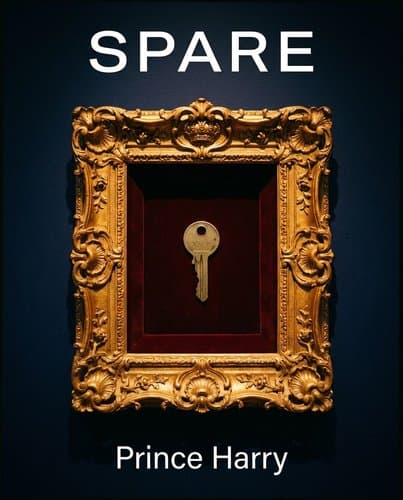
62296528_spare
by Prince Harry
Raised as a role, not a person, Harry traces how twelve years of deferred grief quietly dismantled him—surfacing as panic attacks and an inability to leave…
In Brief
Raised as a role, not a person, Harry traces how twelve years of deferred grief quietly dismantled him—surfacing as panic attacks and an inability to leave damaging situations. His reckoning exposes how an institution erases you without malice, simply by handing you an identity you never chose.
Key Ideas
Unprocessed Childhood Grief Erupts Sideways
Deferred grief doesn't wait — it surfaces sideways, as panic attacks, rage, or an inability to leave situations that are damaging you. Harry's collapse had almost nothing to do with the press or the Palace and almost everything to do with a twelve-year-old who chose protective fiction over grief at Balmoral. Naming that changed the equation.
Natural Roles Enable Institutional Self-Erasure
An institution doesn't need active malice to erase you — it just needs you to accept a role that forecloses selfhood. The trap is that the role feels natural because you were raised inside it. The Spare framing wasn't cruel; Harry absorbed it without resentment. That's exactly what made it effective.
Systemic Critique and Personal Betrayal Coexist
Systemic blame and personal betrayal are both true, and choosing between them is emotionally dishonest. The hardest accountability in this memoir is not Harry's critique of the Palace — it's the moment he describes William's collar-grab, and the moment he admits Charles leaked his private memo. Those weren't policies. Those were people.
Dignified Refusal Replaces Forgiveness and Closure
'Here you go' — the book's final address to the world — is not resolution. It is the refusal to keep explaining yourself to people who have already decided not to listen. That is a different, harder kind of peace than forgiveness or closure, and it is the only one the evidence actually supports.
Who Should Read This
Readers who connect with first-person stories about Memoir and Political Figures and want to see the world through someone else's eyes.
Spare
By Prince Harry & J.R. Moehringer
10 min read
Why does it matter? Because the Royal scandal isn't the gossip — it's what happened when a man decided to exist.
You come in expecting confessions: feuds rendered in precise detail, the palace's quiet machinery exposed. All of that is here. But the book's real charge arrives in a patch of daffodils at Frogmore, the Windsor estate, four months into Harry's exile, when he confronts his father and brother and asks why he left. William's reply is six words: I honestly don't know. Charles's expression confirms it. Harry stares at them — the familiar scowl, the alarming baldness, the fading resemblance to their mother — and arrives somewhere colder than betrayal: maybe they really don't. Not refusal. Genuine absence. Spare is Harry's answer to those six words, every chapter a layer of evidence that he exists as a person, not a position, and that arriving at that truth cost him the only home he'd ever known.
The Word 'Spare' Was Never Just a Label — It Was an Operating System
Imagine being handed a job description on the day you're born — not aspirational, just structural. You're the redundancy. The backup system. The organ donor, if the primary unit fails. Nobody explains this cruelly; it's simply stated as fact, the way weather is stated, and you absorb it the way a child absorbs accent.
That is the operating condition of Harry's entire life. Charles allegedly said it aloud within minutes of Harry's birth: "Wonderful! Now you've given me an Heir and a Spare — my work is done." Harry reports this without rage, without bitterness. He frames it as a joke, "presumably." What makes it devastating is not that Harry was wounded by it but that he wasn't. It landed as definition rather than insult — the way a second child born into a clear hierarchy absorbs its terms before he has vocabulary to dispute them.
The Balmoral nursery makes this concrete. The royal family's summer castle in Scotland has fifty bedrooms, but Willy and Harry shared one, divided. Willy's half: double bed, a window overlooking the courtyard and a bronze stag, mirrored cupboard doors. Harry's half: smaller, plainer, no such amenities. Harry notes this without complaint, then adds the sentence that contains the whole book: he never once asked why.
That non-question is the evidence. Not the smaller room — the absence of curiosity about it. When a child doesn't ask why he got the lesser half, it means the distribution already made sense to him. The hierarchy had installed itself below the level of protest.
He keeps pulling at the same thread. Every breakdown and exile that follows is this system doing exactly what it was built to do.
The Lie That Kept Him Functional Kept Him Broken for Years
Late in the night at Balmoral, Pa comes to Harry's bedroom in a white dressing-gown. He sits on the edge of the bed, puts a hand on Harry's knee, and delivers the news in stages — a car crash, a head injury, a hospital. Harry waits for the part that comes next: that she is fine, that they will go to her. Pa never delivers that part. He says his mother didn't survive, then stands up and leaves.
Harry does not cry. Not once. Not that morning, not during the funeral procession through London, not when he sees the mountains of flowers outside Kensington Palace. He stands politely while strangers weep around him, mutters thanks for coming, and feels guilty. Why are they crying when he can't? The absence of tears isn't numbness. It's a decision the psyche made before Harry was consulted.
Within hours, Harry constructs an alternative explanation: Diana staged the crash. She had been hounded by photographers, trapped in a life she couldn't survive. The accident was her exit. In his mind, she is already somewhere in Europe (a Paris flat, or tucked into the Alps), building a new life until it's safe to contact her sons. This is not a passing fantasy. Harry sustains it for years. Each morning he tells himself this might be the day she reappears. He dreams nightly of bumping into her on a street corner, recognizing her through a blond wig and sunglasses. When Willy says she is gone, Harry fires back: she would never die either, she would never do that to them. Willy concedes it's a fair point.
Spare is Harry demanding that the Palace stop lying, dismantling royal fictions in public. The same man maintained his own private fiction for nearly a decade. It wasn't weakness. It was engineering. The belief that Diana was hiding kept his grief suspended where it couldn't overwhelm him. It kept him functional. It also kept him frozen, unable to mourn, unable to access the interior life that would eventually become the subject of his memoir.
The one break comes at Althorp, Diana's burial island, when the coffin descends and Harry's body convulses. He weeps into his hands. Then immediately reframes what just happened. He tells himself he wasn't crying because he believed she was actually in that hole. He was crying at the abstract thought of it. The lie closes back over the wound within seconds.
That is the operating system this entire book runs on. The panic attacks, the volcanic rage at the tabloids, the inability to remain in Britain without deteriorating — all of it traces back to that suspended grief. Before Afghanistan, before Meghan, before the Nazi costume scandal, a twelve-year-old boy made a deal with himself in the dim of that Balmoral bedroom: he would not believe this until he had proof. The proof never came. The grief never processed. Everything else in the memoir is what that unprocessed weight looks like when it finally starts moving. The institution was waiting.
The Institution Didn't Need to Destroy Meghan — It Just Needed Her to Disappear
The institution doesn't need enemies to destroy a person. It needs a schedule. In Harry, it had found the right man: someone trained, from childhood, to carry grief without putting it down.
What the British press and the royal establishment did to Meghan wasn't coordinated malice. It was a system running its standard operating procedure on someone who wouldn't cooperate with it. The procedure is simple: when a new royal arrival generates too much brightness, you wait for the press to file it down, and you do not intervene. You advise patience. You suggest she not read the papers. You protect the relationship with editors whose goodwill you'll need next week.
The racist coverage escalates. The Daily Mail runs a headline connecting Meghan to a Los Angeles neighborhood she never lived in, citing its weekly crime statistics as though proximity to a zip code were character evidence. A Mail essayist predicts that Meghan's "rich and exotic DNA" will "thicken" the Windsors' "watery, thin blue blood." Each time Harry brings this to Charles, the response is the same: "Don't read it, darling boy." Not a phone call to an editor. Just the trained aristocratic response to discomfort, which is to advise not feeling it.
By late 2018, Meghan told Harry she wanted to stop breathing — not "I want to die" but something more bureaucratic and exhausted: she wanted to stop existing, to disappear, because her disappearance was the only exit the system had left open. She was pregnant. That night they had a Sentebale charity engagement at the Royal Albert Hall — Harry was a patron, the tickets were sold, the schedule was fixed. Harry was afraid to leave her alone. So Meghan applied dark lipstick over her bloodshot eyes, and they went.
They held hands through a Cirque du Soleil performance while she wept silently in the royal box.
That image is the argument made visible. The institution hadn't ordered anyone to bring Meghan to this point. It had simply continued its normal operations (the press cycle, the Palace silence, the engagement calendar) and this was the result. The system doesn't need malice. It needs only to keep running, and for the new arrival to eventually stop making noise.
Meghan never stopped making noise.
He Called His Kills 'Chess Pieces' — Then Asked Himself One Devastating Question
All of this came after Afghanistan. Harry went twice — before Meghan, before the exile — and what he found out there about himself is what stops the book from being just a wound dressed for public inspection.
Late 2012, Camp Bastion. A red phone rings and Harry and his pilot sprint to their Apache, run through preflight checks in eight minutes, lift into the Afghan dark. The targeting system locks onto eight heat signatures moving in Taliban formation. Harry calls for clearance to fire. Control stalls. The targets split, climb onto motorbikes, scatter. By the time clearance arrives, one bike remains. He fires the 30-mm cannon. One man down. One runs into a building.
Back at base, he scans himself for distress. Traumatized? No. Sad? No. He reports his kill count across two tours — twenty-five — with something more uncomfortable than pride: accounting. He wouldn't look away from the number. The Apache's nose camera recorded every engagement with a timestamp, and Harry leans into this as moral seriousness: you don't get to pretend you weren't there. He describes the targets as chess pieces removed from a board (Bads eliminated before they could kill Goods) and acknowledges, in the same breath, that this framing was learned, that he recognized it as "problematic." He uses it anyway, because thinking of them as people would make the Apache's cannon impossible to fire.
That would be the whole story, if a mate hadn't asked one question later.
Harry had just described the motorbike chases — Taliban commanders fleeing between villages at 50 kilometers per hour, Harry guiding Hellfire missiles onto their rear wheels with a precision he compares to throwing pub darts. His mate asked: did it factor in, even a particle, that these men were on motorbikes? The chosen vehicle of the photographers who had hunted Harry his entire adult life. The kind that chased a Mercedes into a Paris tunnel in 1997.
Harry's answer: "I couldn't say."
Not a denial. Not a confession. An acknowledgment that he couldn't see the bottom of his own motivations. The book spends pages establishing Harry as the hunted party — tabloids as persecutors, press as complicit in his mother's death. That framing isn't false. But "I couldn't say" refuses to leave it clean. It raises the possibility that grief and rage, accumulated across decades, found an outlet that felt like justified warfare and may have been something more tangled. Harry doesn't resolve it. He doesn't ask the reader to forgive it or condemn it. He reports it, and refusing to tidy it up is what separates this from a grievance memoir.
He came back from Bastion carrying a number he wouldn't look away from and a question he couldn't answer. What waited back in Britain had less integrity than either.
The Palace Made a Convenient Villain — But William's Hands Were Right There
Back from Afghanistan, the wounds Harry catalogues are domestic. How much of what destroyed him and Meghan was truly institutional, and how much was simply William?
Harry reads it all as systemic. The courtiers he nicknames the Bee, the Fly, and the Wasp (his own household staff); the Palace's policy of strategic silence while Meghan received death threats: all of it real, documented, and damning. But twice, the abstraction collapses into something far more specific.
The first time is at Nott Cott, the small cottage Harry shared with Meghan in Kensington Palace grounds. William arrives claiming he wants to help, then immediately calls Meghan "difficult," "abrasive," someone who "alienated half the staff." These are tabloid talking points Harry has heard before, and he says so. That refusal to simply agree is what detonates William.
Within minutes they're shouting. William stands; Harry sits on the sofa. Harry goes to the kitchen, fills two glasses of water. William follows, still shouting, then moves fast: grabs Harry by the collar, rips a necklace from his neck, and throws him down. Harry lands on the dogs' water bowl, which cracks under his back. He lies there a moment, then tells William to get out.
What happens next is worth sitting with. Harry calls his therapist from the kitchen floor — torn shirt, broken necklace, bowl shards underneath him — and tells her he's proud of himself for not hitting back. He's doing the emotional work while his older brother walks out the front door.
He keeps the secret, too. William asks him not to tell Meghan; Harry agrees. He only breaks it when she sees the scrapes days later and asks what happened.
The second collapse is subtler but more corrosive. Harry sends Charles a carefully worded letter, marked Private and Confidential, outlining their plan to step back. It contains one detail not found anywhere else: that they'd offered to surrender their Sussex titles. Within days, that detail is in The Sun. Harry's accounting of who could have seen the letter leaves almost no candidates.
The hands that ripped the necklace belonged to a specific brother. The leak came from a specific father. The institution made those choices easy. It didn't make them inevitable.
The Book Exists Because William Said 'I Honestly Don't Know Why You Left'
A hummingbird gets into the house. Harry scoops it from the ceiling with Archie's fishing net, its legs barely thicker than thread, wings flat against its sides, then carries it outside and sets it on a sun-warmed wall. It lies motionless. He urges it: come on, you're free. Against expectation, it moves. He says goodbye to it, which matters because it's the only farewell in the book Harry delivers while watching something he loves actually leave.
The book exists because of a single exchange at Frogmore, a few hours after Prince Philip's funeral. Harry tried to explain why he and Meghan fled Britain. William said he honestly didn't know. Charles's expression confirmed it. Harry stared at them and thought: maybe they really don't. And then the worse thought — if they didn't know why he'd left, they may never have known him at all. Maybe he hadn't known himself either.
He couldn't explain it that afternoon in the burial ground. It would take too long, and they weren't listening. So he wrote it down: everything he'd been trying to say to Pa, to Willy, to anyone. The memoir is that explanation — four hundred pages answering a question that took three seconds to ask.
A friend tells Harry the hummingbird is a resurrection bird. The Aztecs believed them reincarnated warriors. Harry lets this hover without claiming it. He doesn't announce the bird is Diana or himself. He just describes what it felt like to hold something fragile in cupped hands, urge it toward flight, and then watch it go.
That is the honest ending: a man handed a role before he could choose one, who spent forty years learning he was more than the role, and who finally found the only words left. Permission. Let go, and see if it flies.
What It Costs to Say 'Here You Go' to the World
The hummingbird lay motionless on the wall after Harry released it, body no heavier than a coin, wings flat against its sides, and he said goodbye, my friend. Not goodbye, Diana. Not goodbye, Willy. A friend: something chosen, under no obligation to stay. When it lifted and disappeared, he said what no palace statement ever had. My mother. Not a title. Just the plainest possible name for the thing he'd spent forty years circling.
Grief is the operating system. But the book isn't about the Palace or the tabloids. It's about what it costs to become a person when being born the spare (backup, the one who exists to make the other one possible) was installed in you before you had language to question it. Harry found something like flight. Whether "goodbye, my friend" is an ending, or simply the first sentence he has ever been free to mean — that question is now yours.
Frequently Asked Questions
- What is Spare about?
- Spare is Prince Harry's memoir about growing up as the royal family's second son and the psychological impact of inherited identity. The book examines how being cast in a supporting role — the "spare" — shaped his sense of self, and traces the emotional collapse that eventually forced him to choose personal authenticity over institutional duty. Rather than a traditional tell-all, Spare offers a framework for understanding how institutions can erase individual autonomy without active malice, simply by embedding us in roles that feel natural because we were raised inside them.
- What are the key takeaways from Spare?
- Spare reveals that unprocessed grief surfaces as panic, rage, or entrapment sideways, not immediately. Harry traces his collapse to a twelve-year-old's protective fiction at Balmoral, not media persecution. The memoir shows how institutions erase selfhood simply by accepting a constraining role; Harry absorbed the "Spare framing" without resentment, making it devastatingly effective. Spare refuses false choices between systemic blame and personal betrayal — both are true. The book ends not with resolution but refusal: "Here you go" is the decision to stop explaining yourself to those who've decided not to listen.
- Is Spare worth reading?
- Spare is worth reading for anyone seeking to understand how inherited roles shape identity and limit autonomy. Beyond royal gossip, the memoir offers psychological insight into intergenerational trauma and the difference between institutional systems and personal relationships. Harry's unflinching examination of his own protective mechanisms — the fictional narratives he constructed to survive — makes the book genuinely introspective rather than purely accusatory. The most valuable contribution is its final stance: a refusal to perform reconciliation or seek validation from those committed to misunderstanding.
- How does Prince Harry explain his mental health struggles in Spare?
- Harry attributes his mental health collapse not to media pressure or institutional conspiracy, but to unprocessed grief from his mother's death when he was twelve. At Balmoral, he chose protective fiction — a story that allowed him to function — over naming his loss. That deferred grief resurfaces decades later as panic attacks, rage, and inability to leave damaging situations. Naming the original wound changed the equation. The book's insight: systemic harm is real, but the immediate driver of his crisis was emotional avoidance, not external persecution.
Related Book Summaries
Read the full summary of 62296528_spare on InShort