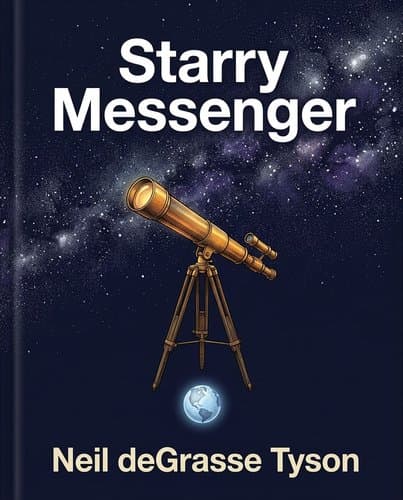
59808487_starry-messenger
by Neil deGrasse Tyson
The universe doesn't care about your politics, your tribe, or your ego—and that indifference is liberating. Tyson shows how viewing Earth from a cosmic…
In Brief
Starry Messenger (Sept) applies the cosmic perspective — the detached, evidence-first view from outside human tribalism — to politics, religion, war, and mortality. Astrophysicist Neil deGrasse Tyson shows how replacing motivated reasoning with scientific thinking resolves culture-war contradictions and gives readers a portable framework for distinguishing what is true from what they want to be true.
Key Ideas
Question Belief's Evidence vs. Desire
Test every strong belief with one question: am I confident because the evidence supports this, or because I want it to be true? That single question is the entire scientific method compressed into a daily habit.
Independent Replication Over Intuitive Appeal
When a heterodox scientific claim reaches you, ask whether it has earned consistency across independent observations by researchers with no shared interest in the same result — not whether the conclusion feels right.
Apply Alien Perspective to Tribal Conflict
When a culture-war argument feels urgent and tribal, deliberately apply the space-alien frame: what would an observer with no prior commitments find inconsistent or hypocritical in this position, including your own?
Mortality Enables Genuine Value in Giving
The finitude of your life is not a condition to manage — it is the source of value in everything you give away, including time. Real flowers are worth giving precisely because they die.
Cosmic Rarity Demands Serious Life
Your specific existence is cosmically improbable (you are one of at least 10³⁰ viable human genomes that could have been drawn — and most will never be). That rarity is an argument for taking your brief time seriously, not for finding it meaningless.
Scientific Literacy Sustains Institutional Trust
Public scientific literacy is not cosmetic. When the people who vote and the people they vote for cannot distinguish pre-consensus research from established findings, the institutions that channel evidence into governance become unreliable — and the self-correcting system loses its downstream effect.
Who Should Read This
Science-curious readers interested in Scientists and Cognitive Psychology who want to go beyond the headlines.
Starry Messenger
By Neil deGrasse Tyson
9 min read
Why does it matter? Because the arguments you're most convinced about may be the ones least worth having.
You probably believe the culture war is a uniquely modern disaster: algorithmic, terminal, a product of this particular broken moment. You're wrong by about four hundred years. In 1610, Galileo pointed a freshly built telescope at the sky and discovered that people will fight ferociously to protect what they want to be true from what actually is. The Earth orbited the Sun regardless. Nobody asked it for its opinion. The method Galileo used to find that out — test your assumptions, follow the evidence, stay suspicious of your own conclusions — has been available ever since. We've built institutions around it and largely refused to apply it to anything that matters to us personally. Starry Messenger is Neil deGrasse Tyson's guided tour of that refusal, and what it costs us.
We Have a 400-Year-Old Cure for the Epistemic Crisis — and We Keep Refusing to Take It
Jupiter had moons. The Moon had mountains. The Sun had spots. Galileo published his findings in Sidereus Nuncius (Latin for Starry Messenger, the title Tyson borrows for this book), and the universe it described contradicted everything his contemporaries assumed was true, everything they hoped was true, and everything they dared claim was true. The three phrases get worse as they go. Assumption shades into preference, preference into insistence. Galileo wasn't just reporting data. He was diagnosing a habit.
We treat the current epistemic collapse — the misinformation spiral, the warring tribes that can't agree on yesterday's headlines — as something historically new. Tyson opens by arguing it isn't. The mechanism is identical: people act on what they believe to be true, or what they wish were true, with no concern for what's actually true. Galileo's contemporaries didn't reject his findings because the evidence was weak. They rejected them because the evidence was threatening. It removed Earth from the center of all motion. It implied that human senses, unaided and unchecked, were unreliable guides to how nature works.
Tyson extracts two lessons from that 1610 book. First: our unassisted senses cannot reveal fundamental truths about nature. Instruments aren't optional; they're the whole point. Second: Earth is not the center of the universe. Neither lesson is merely astronomical. Together they deliver a methodology and a warning. The methodology: extend your perception through tools that can't be flattered, bribed, or frightened into confirming your preferences. The warning: your intuitive sense of centrality, that the universe arranges itself around your needs and your tribe's conclusions, is not evidence. It's bias wearing the clothes of certainty.
Four hundred years later, the clothes are different. The bias is the same. Tyson named this book after Galileo's for a reason: it's the same dispatch, sent from the same altitude, addressed to people still insisting the world revolves around them.
Science Isn't a Body of Facts — It's a System Designed to Stop You from Lying to Yourself
Science is a procedure: a set of rules engineered to stop you from believing what you want to believe when the evidence points somewhere else. Treating it as a curated archive of verified facts misses everything that makes it work.
Tyson distills the procedure to one sentence: do whatever it takes to avoid convincing yourself that something false is true, or that something true is false. Every tool science has built — every controlled experiment, every peer review, every replication requirement — exists to enforce that one rule against a brain that constantly works to undermine it. Your brain does not want objective truth. It wants confirmation. Science is the mechanism built to beat it.
What makes this more than a modern management principle is its age. The anti-bias ethic at the core of scientific method wasn't invented by Isaac Newton or Francis Bacon or the European Enlightenment. It was articulated in the eleventh century by an Iraqi scholar named Ibn al-Haytham, born in 965 AD. Working in Basra in what is now Iraq, he instructed that a researcher must "suspect himself as he performs his critical examination, so that he may avoid falling into either prejudice or leniency." That sentence is roughly 600 years older than the Royal Society of London (founded in 1660), 600 years older than Galileo's telescopes, 600 years older than the founding of Harvard. The timeline quietly dismantles the comfortable assumption that rigorous, self-critical inquiry is a European invention delivered to the rest of the world.
Five centuries later, Leonardo da Vinci arrived at the same place from a different direction: "The greatest deception men suffer is from their own opinion." When an insight keeps surfacing independently across cultures and eras, it's evidence that the problem it addresses is a permanent feature of human cognition, not a local historical accident.
The procedure that emerged has one property separating it from every other truth-finding system humans use: it eats its own errors. Publish wrong results, and colleagues checking your work will expose them. Fake your data, and the researchers who build on your findings will find out. No external authority polices this — the structure does it automatically. That has nothing to do with scientists being unusually honest people, and everything to do with what the rules reward and punish. Which is why applying science only to conclusions you already prefer doesn't leave you with a better epistemic system. It leaves you with none.
Scientific Culture Rewards Rebels, Not Conformists — Which Is Exactly Why the Consensus Matters
Why would anyone trust a consensus produced by a group of people who spend their careers together, cite each other's work, and depend on the same funding bodies? The suspicion that scientific consensus is just sophisticated groupthink is reasonable on its face. The answer sits in the incentive structure.
Fame in science doesn't go to the researcher who confirms what everyone already believes. It goes to the one who overturns it. Tyson is direct: the fastest path to a distinguished career is to contradict prevailing research and supply consistent experimental evidence. That means every major claim in a field carries a professional target on its back. Conferences aren't ceremonies of collective agreement. Tyson describes them as open season on anyone presenting ideas, no protection for seniority. The junior researcher attacking a senior scientist's life work isn't being impolite. They're doing exactly what the culture rewards.
Fraud works the same way. There is no law against publishing wrong results. The penalty is purely structural: if your colleagues cannot replicate your findings, every future claim you make becomes suspect. Fabricate data, and the researchers building on your work will eventually find out — after which your career doesn't end by committee decision, but because the system stops working for you. Nobody polices this externally. The rules do it themselves.
So when a scientific consensus does form, when researchers working independently, using different instruments, across different institutions, keep arriving at the same conclusion, it has survived a gauntlet built by people whose careers rewarded tearing it down. The consensus on climate change, or evolution, or the age of the universe, isn't scientists nodding in agreement over conference dinners. It's the residue of years of failed attacks.
Abraham Lincoln signed the National Academy of Sciences into law in 1863 — "a year when he clearly had more pressing matters at hand," as Tyson notes. The understatement sharpens the point: building an institution to pressure-test scientific claims was considered essential enough to do in the middle of a civil war.
From High Enough Up, the Culture Wars Disappear
Here is a thought experiment. You are looking at a classroom map of the world: countries coded in different colors, borders crisp, territories labeled. Pull back until the map is the size of a postage stamp. The colors blur. The lines disappear. What remains is ocean and land.
That is roughly what Earth looks like from orbital altitude, which is why the experience has a name. Astronauts who circle the planet call it the overview effect, a shift that arrives when you're high enough to see human civilization from outside its own frame. National borders do not appear from orbit because they were never inscribed in the terrain. They exist in maps and treaties, maintained by armies. Religions cannot be spotted from 250 miles up because they live in minds, not topography. The political arguments consuming every news cycle shrink, from that altitude, into the noise of a species rearranging furniture in a small room and calling it history.
Tyson's recurring thought experiment takes it further: imagine an extraterrestrial observer arriving on Earth with no exposure to human culture. No tribal loyalties. No inherited categories. The visitor couldn't tell a Democrat from a Republican, a Muslim from a Christian, a nationalist from an immigrant. They would see a single species — genetically near-identical across all its surface variation — subdividing itself into factions and warring over those factions with evident intensity. The alien would not be puzzled by conflict. They would be puzzled by the premise: the conviction that these divisions mark something deep in the structure of reality rather than something constructed at the surface of one small planet.
That's the move. The culture wars are not fake. People disagree about real things, and the disagreements carry real consequences. The problem is the frame that makes the conflicts feel cosmically ordained, as though your tribe is defending some fundamental feature of the universe against an existential threat. That frame was built at ground level, by brains shaped through evolution to prioritize in-group survival over accuracy. Those instincts served well on the savanna. They don't reliably track what's at stake in any modern dispute.
Science replaces the classroom map. Not by dissolving genuine disagreements, but by providing the altitude from which tribalism becomes visible. Visible things can be questioned.
You Are One of 10³⁰ Possible Humans — Which Means Your Brief, Improbable Life Has No Substitute
In the summer of 1859, in Yellow Springs, Ohio, an educator named Horace Mann stood before the graduating class of Antioch College, the school he had spent a decade building, and delivered what would be his final commencement address. He was sixty-three and ailing; he would die before the summer ended. The sentence he gave them has outlasted everything else he said that day: "Be ashamed to die until you have won some victory for humanity."
That is not a sentence a healthy man writes from comfort. It arrives from the particular clarity of someone who knows their time is running out, when the question of what to do with your remaining days stops being abstract and becomes the only question.
Tyson closes the book with Mann's sentence, and it lands differently once you've absorbed the statistic that precedes it.
The human genome can generate at least 10³⁰ viable configurations, a number the phrase "million trillion trillion" barely gestures at. All 100 billion people who have ever lived represent less than 0.00000000000000001 percent of everyone who could ever exist. Most people who could be born will never be conceived. The specific genome that assembled into you (that particular arrangement of perceptions, preferences, voice, and face) will not recur. Not in a thousand years. Not in a million. Practically speaking, never.
Two foundations emerge for why this matters, and they pull in different directions. The first: you are a singular identity in a solution space so vast that "replacement" is not even a coherent concept. The second is that finitude creates meaning. Plastic flowers require no care, never die, and gather dust. Real flowers die within a week, which is precisely why they work as gifts. Remove the death and you remove the attention.
These claims are related but call for different responses. Scarcity of time is a consolation available to every life equally. Cosmic improbability of your specific configuration is not a consolation at all. It is a demand. Mann's question — have you won some victory for humanity? — is the demand made explicit, by a man who was running out of time to answer it himself.
The Cosmic Perspective Isn't Detachment — It's the Heaviest Obligation You'll Ever Feel
The cosmic perspective is supposed to deliver you to serenity — stand back far enough and human struggles lose their claim on you. Tyson spends the entire book arguing the opposite. The wider you see, the heavier the obligation gets.
His stated preference for burial over cremation makes this concrete. A cremated body releases its stored energy as infrared photons traveling into space, warming nothing and feeding no one. Tyson finds this waste. He wants the worms, the microbes, the fungal root networks beneath the soil — the whole biosphere that spent billions of years assembling the chemistry that became him — to have it back. The molecules he gathered by consuming living things during his life would return to them, continuing a cycle that predates humanity by four billion years. This isn't resignation. It's accountability extended as far as the physical world will allow.
That logic runs through everything the book argues. Science's self-correcting culture, the overview effect, the astronomical improbability of any specific human configuration — none of this points toward detachment. It points toward engagement. The scale that makes you feel small also makes your participation irreplaceable. No one else has been assembled in your specific arrangement to do what you could do, and no one will be.
The sentence Mann gave his students knowing he would be dead before the year ended lands here with full weight: "Be ashamed to die until you have won some victory for humanity." The cosmic view delivers you back to Earth with a question you cannot dismiss. You arrived against stupendous odds, you will be here briefly, and the universe has provided nothing to substitute for you. That is not a reason for serenity. That is the heaviest obligation.
What Galileo's Telescope Still Requires of You
Galileo's telescope in 1610 settled nothing about what people wanted to believe — it only clarified, with pitiless precision, what was there. The universe offered no comfort then and has not revised its position since. Four centuries of effort have produced a method for living honestly inside that indifference: instruments over intuition, evidence over tribal convenience, findings that survive every attempt to break them.
None of that releases you from the weight of being here. You are a configuration of atoms with a one-in-10³⁰ chance of existing, carrying a genome that will not recur, alive during a brief window when that question still has an open answer. Be ashamed to die until you have won some victory for humanity. That is the heaviest obligation the evidence will ever place on you.
Notable Quotes
“He should also suspect himself as he performs his critical examination of it, so that he may avoid falling into either prejudice or leniency.”
“The greatest deception men suffer is from their own opinion.”
“Take nobody's word for it.”
Frequently Asked Questions
- What is Starry Messenger about?
- Starry Messenger applies the cosmic perspective—the detached, evidence-first view from outside human tribalism—to politics, religion, war, and mortality. Neil deGrasse Tyson demonstrates how replacing motivated reasoning with scientific thinking resolves culture-war contradictions. The book provides readers with a portable framework for distinguishing what is true from what they want to be true. This framework centers on a single daily habit: testing strong beliefs by asking whether your confidence stems from evidence or from wanting something to be true. By engaging with the cosmic perspective, readers develop intellectual tools for navigating divisive contemporary issues.
- How do you evaluate a heterodox scientific claim?
- When a heterodox scientific claim reaches you, the key is to ask whether it has earned consistency across independent observations by researchers with no shared interest in the same result—not whether the conclusion feels right. This method prioritizes reproducibility over intuitive appeal. By focusing on whether independent, unconnected researchers have reached similar conclusions, you can distinguish genuine scientific findings from wishful thinking. Rather than accepting a claim because it aligns with your beliefs, examine whether it has survived independent verification. This evidence-centered approach strengthens your ability to navigate controversial scientific topics while protecting against pseudoscience and tribal consensus traps.
- How does the cosmic perspective help with culture-war debates?
- When a culture-war argument feels urgent and tribal, apply what Tyson calls the 'space-alien frame': ask 'what would an observer with no prior commitments find inconsistent or hypocritical in this position, including your own?' This simple question removes emotional investment and tribal allegiance. By imagining an external observer with no stake in your group's conclusions, you gain clarity about what follows from evidence versus what you want to believe. The space-alien frame transforms polarized debates into opportunities for intellectual honesty. Rather than defending a position because your tribe holds it, you examine it critically and dispassionately, exposing contradictions and motivated reasoning on all sides.
- What does Starry Messenger teach about mortality and meaning?
- Starry Messenger reframes mortality as a source of meaning rather than a problem. Tyson argues: 'The finitude of your life is not a condition to manage — it is the source of value in everything you give away, including time,' and 'Real flowers are worth giving precisely because they die.' Your cosmic rarity also generates meaning: you are one of at least 10³⁰ viable human genomes that could have been drawn, and most will never be. Rather than finding this improbability meaningless, Tyson contends that rarity is an argument for taking your brief time seriously, transforming how you value relationships and moments.
Related Book Summaries

Read the full summary of 59808487_starry-messenger on InShort