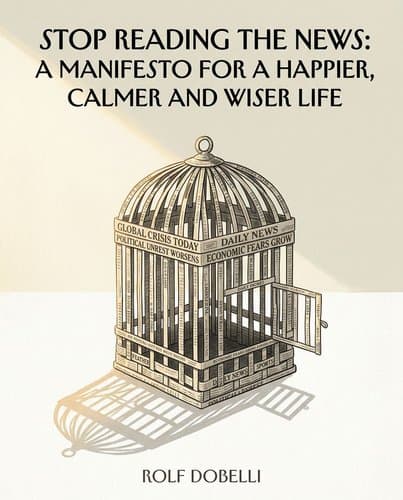
48581422_stop-reading-the-news
by Rolf Dobelli
The news industry sells you the illusion of being informed while systematically hijacking your attention—the one resource you can never recover.
In Brief
The news industry sells you the illusion of being informed while systematically hijacking your attention—the one resource you can never recover. Dobelli makes the case for radical abstinence: quit entirely, replace it with books, and watch your thinking grow sharper, calmer, and genuinely wiser.
Key Ideas
News rarely changes material decisions
Run Dobelli's core test on yourself right now: of the roughly 20,000 news items you consumed this year, name one that materially improved a real decision you made. If you can't name two, you've already proven his central argument on yourself.
Moderation with news is impossible
Don't attempt moderation — you can't judge whether a headline is worth reading without reading it, which means partial engagement collapses back into full consumption. Cold turkey is mechanically necessary, not just philosophically preferred.
Read books twice for mastery
Replace news time with books inside your circle of competence. When you find one that delivers new insight on every other page, read it twice immediately — Dobelli's estimate is that the second reading is ten times more valuable than the first.
Friends confirm news isn't essential
Handle the social anxiety of 'missing news' by asking friends at gatherings: 'Has anything important happened this week?' The modal answer, in Dobelli's experience, is 'not really' — which is both reassurance and data about news's claimed indispensability.
Donate money, not attention platforms
If you genuinely care about humanitarian crises, donate money to established aid organizations — not attention to news platforms. Your attention enriches the platform (sold to advertisers, used to profile you); your money can fund a hundred wells while your 'presence' funds zero.
Research track records, skip news
For democratic participation, research candidates' track records rather than their promises, and only vote on referendums when you can articulate the opposing position as clearly as your own. The Founding Fathers built democratic theory without a single news feed.
Specialize deep, cut general news
Identify the two or three specialist publications genuinely relevant to your work and life, go deep in those, and cut everything else — the general news that feels important but demonstrably has no effect on your actual decisions or your actual world.
Who Should Read This
People working on personal growth in Happiness and Focus, especially those tired of generic motivational advice.
Stop Reading the News: A Manifesto for a Happier, Calmer and Wiser Life
By Rolf Dobelli
10 min read
Why does it matter? Because the news habit you've been calling 'staying informed' is actively preventing you from understanding anything.
Here's a test. Cast your mind back over the past month of news consumed: headlines scrolled, bulletins half-absorbed, articles clicked and abandoned. Name one item that materially changed a decision you made. Not something vaguely interesting. A specific piece of information that improved something real in your life. Take your time.
Still nothing? That's not a memory problem — it's the entire argument. Rolf Dobelli spent decades as a devoted news addict, convinced the habit made him sharper, better calibrated, more alive to the world. Then he started asking that question honestly and came up almost empty. What followed wasn't a modest screen-time reduction. It was a systematic dismantling of everything the news claims to offer, with a finding at the center that should make any rational person uncomfortable: understanding precisely how news is harming you provides exactly zero protection from it.
You've Read 20,000 News Items This Year. Name One That Changed a Decision.
In April 2013, Rolf Dobelli walked into the Guardian's London offices expecting to pitch his latest book to fifty staff journalists. Editor-in-chief Alan Rusbridger had other plans. He'd just read a piece on Dobelli's website arguing against news, and he wanted that talk instead, delivered to a room full of people whose careers depended on news being important. Dobelli held the floor for twenty minutes and closed with a blunt verdict: what these journalists produced every day amounted, in the end, to entertainment. The room went silent. Rusbridger narrowed his eyes, told the room to run Dobelli's arguments that day, then walked out without a word. Four hours later the anti-news piece was live on the Guardian's website. It became one of the most-read newspaper articles of that year. An anti-news manifesto, going viral as news.
That paradox points at something real. Here's the test: you've consumed roughly 20,000 news items in the past year, about sixty a day at a conservative count. Name one that helped you make a better decision. Not a decision you could have made anyway on general knowledge, but one that genuinely required that specific item. When Dobelli asks this of his friends, most come up with nothing. A few manage two examples. Two from 20,000 is a hit rate below 0.01%. His own decade without news yielded a single candidate: in 2010, he drove to the airport to find his flight had been cancelled by an Icelandic volcanic eruption, a fact he learned only upon arriving.
The obvious fix is to be more selective — read only what matters. It collapses immediately. To judge whether a headline is worth your time, you have to read it, which means you're already consuming it. Selection requires consumption. You end up sampling the whole buffet just to find the one dish worth eating.
Worse still: the items journalists miss are often exactly what you'd want to know. On November 11, 1993, the world's first internet browser, Mosaic, launched. Dobelli considers it possibly the most significant invention of the twentieth century after the atomic bomb and antibiotics. It didn't make German TV news. That evening's lead stories: party funding reform, an Israeli prime minister shaking hands with Bill Clinton, the Pope fracturing his shoulder. The relationship between newsworthiness and actual relevance runs in reverse: the louder the fanfare, the smaller the event's real consequence. That turns out to be the milder charge. News doesn't just miss what matters — it actively warps your sense of which risks are real.
The news feels like duty. The duty has no payoff. And the thing you traded it for might have been worth knowing.
Your Sense of Risk Is Systematically Inverted — and Knowing This Won't Help
News doesn't give you a distorted picture of risk. It gives you an inverted one — and knowing this won't straighten it out.
The mechanism is easy to see once it's named. When a bridge collapses, news cameras chase the car: the driver's story, their feelings, where they were going. The car is irrelevant. Any car, or a gust of wind, could have triggered the collapse. What matters is the bridge: its structural design, whether other bridges built to the same specifications are still standing. That information might prevent future deaths. The driver's biography will get you through the commute. News picks the driver.
Scale this across a year and you get a mental map where terrorism ranks above chronic stress, shark attacks above antibiotic-resistant bacteria, plane crashes above the slow accumulation of government debt. The vivid and photogenic reliably beats the statistical and systemic.
The alarming part: knowing this doesn't fix it. Paul Slovic gave horse-race bettors at the University of Oregon progressively larger data sets about the horses, then measured both their predictive accuracy and their confidence. More information had precisely zero effect on how well they picked winners. It had a massive effect on how certain they felt. Data didn't sharpen judgment; it eroded the caution and skepticism that judgment depends on. Careful predictions hardened into sure things.
The real cost of a daily news diet isn't misinformation. It's inflated confidence in the misinformation. When Dobelli raises this with people who say "I'm aware of the bias, I can compensate," his answer is blunt. In 2008, banks ran quantitative risk models, employed dedicated analysts, and had every financial incentive to get this right. They still mispriced risk catastrophically. If that level of incentive can't fix calibration, conscious reflection won't either.
News Doesn't Just Waste Time: It Physically Restructures the Brain You Need to Think With
Imagine a fitness regime that made you stronger in one specific way while quietly weakening something else. You'd want to know the trade-off before committing. The brain works the same way: resources allocated to one function come at the cost of others. News consumption is making that trade on your behalf, without your informed consent.
Eleanor Maguire at University College London spent years scanning the brains of London taxi drivers. Earning a license requires memorizing 25,000 streets and hundreds of landmarks, a process that takes three to four years. After licensing, MRI scans showed measurably more neurons in the hippocampus. The brain had literally grown new tissue for the job. The cost: when asked to recognize new geometric shapes, the taxi drivers scored worse than bus drivers who drove fixed routes and memorized nothing. The brain reallocated resources toward what it was asked to do, and paid for it elsewhere.
Dobelli's application is direct. Every hour spent skimming headlines and clicking from one story to the next trains the brain in rapid, shallow processing. Those circuits strengthen. The circuits for sustained concentration (following a long argument, reading a book, thinking a problem through) weaken from disuse. He observes the result in heavy news consumers who once read voraciously: after a few pages they get restless, their attention dissipates. He's precise about the cause: not age, not busyness. The physical architecture has changed.
What's being eroded is the ability to sit with a difficult idea long enough to understand it — the same capacity you'd need to notice the erosion happening. You lose your diagnostic instrument in the process of losing it.
A second mechanism makes it worse. Roy Baumeister showed that willpower depletes through genuine physiological expenditure. Media platforms engineer every handoff (the autoplay, the infinite scroll) to be marginally easier to continue than to stop. Your capacity for resistance doesn't improve with practice. You spend willpower losing a battle designed to be unwinnable, then sit down to do actual work already depleted. That's why news-heavy days feel unproductive even setting aside the lost hours.
Dobelli's recovery estimate: roughly a year without news before the brain regains its capacity for sustained reading. He offers it not as encouragement but as a timeline — long enough that most people hear the number and quietly decide the odds are already against them. That resignation, it turns out, is exactly what the next harm counts on.
The Most Insidious Harm: News Trains You to Feel Helpless in the Areas Where You Have the Most Control
Two groups of rats sat in identical boxes. Both received mild electric shocks — annoying, not painful. Both had a wheel. The difference: Martin Seligman and Steven Maier had wired only one wheel to the shock mechanism; the other spun freely, changing nothing. Same input, same duration, same intensity. Only agency differed.
The group with the functioning wheel carried on normally. The helpless group shifted: passive, withdrawn, uninterested in pleasure, frightened of novelty.
Now consider what arrives each morning. Bomb detonations in cities you'll never visit. Famines across continents you can't reach. A celebrity's leaked texts. A politician's tweet. These stories range from catastrophic to trivial, but they share exactly one property: you can do nothing about any of them. News is, by design, a daily sequence of electric shocks with no wheel attached.
You might think: fine, I feel bad about things I can't control, but my actual life (work, relationships, neighborhood) stays intact. The research says otherwise. Learned helplessness doesn't stay quarantined to the domain where it's acquired. The passive rats weren't passive only about shocks; the effect bled into their whole behavioral profile. Dobelli says it plainly: people conditioned by absorbing uncontrollable events become passive at work and at home, precisely where a turned wheel actually does something.
The harm accumulates without announcing itself. You won't notice becoming more passive in your own life because passivity doesn't feel like passivity. It feels like procrastination, hesitation, a vague sense that effort is probably futile. The shocks keep arriving. The wheel keeps being disconnected. And gradually, the part of you that would have reached for it elsewhere — in a difficult conversation, a stalled project, a problem worth fixing — stops reaching.
The Two Arguments That Keep People Trapped — And Why They're Both Backwards
What if you accepted every argument so far (the inverted risk, the eroded concentration, the passivity it breeds) and still felt that quitting was somehow indecent? Two objections survive all of that, and they're the ones that actually keep people subscribed.
The first: democracy depends on an informed citizenry, and someone has to hold power to account. The second: given the scale of global suffering, looking away is a form of selfishness.
Both are well-intentioned. Neither survives close inspection.
Take the democracy argument. What it actually requires isn't daily news — it's investigative journalism. Woodward and Bernstein's Watergate investigation, the most celebrated piece of accountability journalism in modern history, took months. It required domain expertise as deep as the people being investigated, facts painstakingly corroborated rather than copy-pasted from a press release. Those articles could have appeared in a magazine, a book, or a long blog post (the daily newspaper format was incidental to what made them work). What democracy needs is slow, expert work. What news produces is its opposite.
The empathy argument is harder to shake emotionally, but the arithmetic is devastating. When you follow earthquake victims on a news site, you are giving your attention to the platform, which sells it to advertisers and uses your emotional responses to build a more precise targeting profile. The victims receive nothing. Dobelli calls it volunteer's folly: fly to the Sahara and build a water pump with your own hands, and you might finish one well a day. Wire your day's earnings to an established aid organization instead, and that same day's labor funds a hundred. Your comparative advantage is income, not construction. The same logic applies to attention: it benefits the platform profiting from your distress, not the people in it.
These two objections aren't moral obligations. They're category errors — confusing the ritual of news consumption with the substance of civic engagement, and confusing the performance of empathy with its effect. Once you see that, the last excuse for staying dissolves.
Quitting Is Not an Act of Withdrawal — It's the Acquisition of Something Better
Imagine you need surgery — not minor surgery, the kind where a small error is permanent. You can pick between two surgeons with identical credentials: same school, same years of experience, same measured intelligence, same manner with patients. The single difference: one spends ninety minutes each day on news; the other spends those ninety minutes on research journals and specialist conferences.
The choice takes a second. That immediacy is Dobelli's entire argument in miniature. We instinctively understand that deep subject-matter knowledge produces better outcomes than broad awareness of current events. We'd stake our lives on it, literally. We just haven't applied the same logic to our own information diet.
The framework Dobelli borrows from Warren Buffett is the circle of competence: the domain where your knowledge runs genuinely deep. Concentrate there rather than spread thin. A heart surgeon tracks medical journals and, if managing a team, leadership books. An architect monitors building-regulation changes and design thinking. Neither needs to know whether a prime minister fractured a shoulder or a spacecraft reached Mars. Cramming a specialized brain with general noise doesn't round it out; it competes for space with exactly the knowledge that determines performance.
Ninety minutes daily compounds to a full workday per week, more than a month per year. Bill Gates has long blocked out two week-long stretches annually for uninterrupted reading, arriving at a remote cabin with books and blank paper. With a month returned to you, that's less of a billionaire's eccentricity and more an obvious allocation of available time. That's one shape: a single person, disappearing into books.
The social shape is the news lunch. Each participant presents one topic in depth (its context, its driving forces, the uncertainty behind what looks settled) for fifteen minutes. Not three topics. One. You leave having encountered a subject from the inside rather than its headline. Gates's version is solitary; the news lunch is communal. Both trade breadth for depth. Over time, that accumulates into something news never delivered: genuine understanding of how things actually work, in the areas where understanding pays off.
Quitting doesn't shrink what you know. It trades an enormous volume of thin coverage for a smaller amount of something you can use.
The News Was Always Optional. We Just Couldn't Imagine It.
On January 30, 1649, the English cut off their king's head — an act so unthinkable it had never happened in European history. The next morning: the Thames ran. Bread was baked. Birds made their noise. The entire apparatus of divine necessity turned out to be a story powerful enough to run for centuries and fragile enough to end overnight. Dobelli's bet is that our grandchildren will sit with news addiction the way we now sit with divine right: baffled that anyone believed it, unable to explain how no one noticed sooner. The spinning globe, the urgent chyron, the ambient dread of missing something: all of it is theater. That feeling of necessity evaporates the moment you test it. The only real question the book leaves you with is whether you're waiting for someone to tell you you're free — or whether you've already noticed you always were.
Frequently Asked Questions
- What is Stop Reading the News about?
- Stop Reading the News argues that daily news consumption distorts your worldview, fragments your attention, and almost never improves any real decision you make. Rolf Dobelli makes the case for quitting news entirely and replacing it with deep reading within your circle of competence. This leaves readers calmer, better informed, and more effective. The book systematically demonstrates that constant news pursuit fails to improve decision-making and quality of life, challenging the modern assumption about what it means to stay 'informed' for citizenship and personal wellbeing.
- What is Dobelli's core test to prove his argument about news?
- Dobelli's core test asks: 'of the roughly 20,000 news items you consumed this year, name one that materially improved a real decision you made. If you can't name two, you've already proven his central argument on yourself.' This test transforms abstract theory into personal empirical verification. Most readers cannot honestly identify even a single news item that shaped a consequential decision. This gap between news consumption volume and actual decision impact serves as the empirical foundation for Dobelli's entire argument.
- What does Dobelli recommend doing instead of reading news?
- Dobelli recommends: 'Replace news time with books inside your circle of competence. When you find one that delivers new insight on every other page, read it twice immediately.' His estimate is that the second reading is ten times more valuable than the first, creating exponential returns on focused attention. Furthermore, 'Identify the two or three specialist publications genuinely relevant to your work and life, go deep in those, and cut everything else — the general news that feels important but demonstrably has no effect on your actual decisions or your actual world.'
- How do I overcome social anxiety about missing important news?
- Handle social anxiety about missing news by asking friends at gatherings, 'Has anything important happened this week?' The modal answer, in Dobelli's experience, is 'not really' — which provides both reassurance and evidence about news's claimed indispensability. For genuine humanitarian concern, donate money to established aid organizations rather than attention to news platforms. Your attention enriches the platform (sold to advertisers, used to profile you); your money can fund concrete impact. This reframes staying informed from passive consumption to active contribution.
Related Book Summaries
Read the full summary of 48581422_stop-reading-the-news on InShort