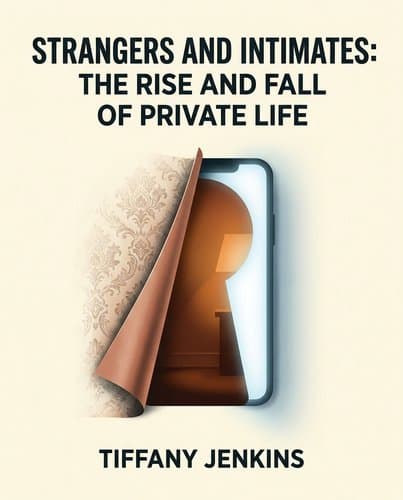
207579898_strangers-and-intimates
by Tiffany Jenkins
Privacy wasn't a natural human right—it was a fragile, centuries-long invention built through religious revolt and legal battles, and we're now dismantling it…
In Brief
Privacy wasn't a natural human right—it was a fragile, centuries-long invention built through religious revolt and legal battles, and we're now dismantling it not under duress but by choice. Jenkins traces exactly how that boundary was won, who it excluded, and why its quiet collapse tells us more about culture than surveillance capitalism.
Key Ideas
Privacy Was Fought For, Not Given
Privacy was not a natural human state — the ancient Greek word for 'private' literally meant 'deprived,' and for most of history communal surveillance was the default; understanding this means you're defending something that had to be fought for, not something you simply have
Accidents Built Our Fragile Privacy
The private sphere was built through specific, traceable accidents: Luther refusing to recant, Coke asserting the house as a castle, Mazzini's tampered letters — its fragility is not a recent development but a structural feature of something that was never supposed to exist
Privacy's Double Edge: Protection and Trap
The Victorian home-as-castle, which we now think of as the origin of modern privacy, was simultaneously a legal shield for domestic violence (State v. Rhodes) and a cage for women — any serious defense of privacy has to grapple with how to restore the wall without restoring the cage
Power Determines if Personal Liberates
'The personal is political' was a liberating slogan in 1647 when Locke argued the state had no business with souls; it became a totalizing surveillance when applied by the 1960s New Left to intimate relationships — the same principle can build freedom or destroy it depending on who holds the authority to define what counts as political
Authenticity Seeking Replaced Privacy Protection
The collapse of privacy wasn't primarily caused by technology or government overreach — it was driven by cultural changes that made self-exposure feel more authentic than self-protection; Cambridge Analytica-style alarm is partly a way for governing elites to avoid acknowledging that millions of people genuinely changed their minds
Privacy Protects Democracy, Not Threatens It
When the private sphere dissolves, democratic public life doesn't expand to fill the space — it degrades into personality politics, 'lived experience' credentialism, and moral surveillance of individual lifestyle choices; protecting privacy is not a retreat from civic life but its precondition
Who Should Read This
History readers interested in Democracy and Social Issues who want a deeper understanding of how we got here.
Strangers and Intimates: The Rise and Fall of Private Life
By Tiffany Jenkins
15 min read
Why does it matter? Because the privacy you take for granted was invented by accident — and is being dismantled just as accidentally.
You probably think privacy is a natural human right — ancient, obvious, self-evident. Something you were born with, like dignity or hunger. Here's the problem: the ancient Greeks had a word for the private realm, and it meant deprivation. To be without public life was to be less than fully human. Medieval peasants slept six to a bed and called it normal. The monk, the merchant, the midwife — all conducted their most intimate business before witnesses: the priest at confession, the guild at the deathbed, the neighbors at the birth. What we call privacy was, for most of human history, simply not on offer. It had to be invented. And the invention was accidental — a byproduct of religious revolt, legal stubbornness, architectural innovation, and philosophical argument that nobody planned and everyone fought over. Tiffany Jenkins's The Case for Privacy reconstructs that invention from the inside out, tracing how a concept nobody chose to create became the one we're now dismantling without quite realizing it. The question she forces you to ask isn't how we protect privacy. It's whether we ever understood what we built — before we started tearing it down.
Privacy Isn't Ancient — It Was Considered Deprivation
Most people assume privacy is a basic human instinct — wired in, ancient, perhaps even biological. The very word 'privacy' comes from the Latin privatus, meaning deprived — specifically, stripped of public office. That etymology isn't a quirk. It's a diagnosis.
In ancient Athens, life was organized around two distinct realms: the polis, the arena of politics and civic glory, and the oikos, the household. The polis was where life meant something. Free men debated, competed, proved their humanity there. The oikos, by contrast, was where the merely biological happened — cooking, sex, childbirth, labor. Everything the body needed but no one celebrated. Women and enslaved people were confined there, tending to the physical necessities that allowed male citizens to go be fully human somewhere else (Aristotle's 'political animal' made flesh in the architecture of daily life). The private was not a sanctuary. It was a holding pen for the animalistic, the subordinate, the unfree. To be 'private' was to be absent from the only realm that mattered.
That framing held for centuries before the concept quietly flipped. It wasn't until the eighteenth century, and then with full Victorian conviction by the nineteenth, that privacy was recast as something desirable — a personal resource, a sanctuary for the self, the very thing worth protecting. That reversal is historically recent and geographically specific, concentrated in Western Europe and the cultures it shaped.
The instinct that one's private life is a birthright, then, turns out to be a fairly new idea — and one, Tiffany Jenkins argues, that is already beginning to unravel.
The Private Self Was Born in a Moment of Defiance — By Accident
Picture a man in a plain monk's robe standing before seventy princes glittering in ceremonial regalia, torchlight reflecting off their jewels, knowing that the wrong answer could end his life. Martin Luther at the Diet of Worms in 1521 was there to answer a simple question: would he take back everything he'd written? He refused. Not because he was stubborn, but because — and this is the turn that mattered — his conscience was bound to scripture, and no earthly authority, not emperor, not pope, could override it. 'Here I stand; I can do no other.' He walked out alive, barely, and the ripple from that moment eventually reached into your phone and your bedroom and every claim you've ever made to a life the state cannot enter. Luther had no idea.
He wasn't arguing for privacy. He was arguing about how to save your soul. But the logic carried a concealed charge: if the individual's relationship with God was direct, unmediated by any church hierarchy, then there existed an interior space — a conscience — that belonged to the person alone. The theological argument was really, accidentally, a philosophical one. It planted the idea that the self had an inside that authority could not legitimately reach.
The English state tried very hard to prove otherwise. When Henry VIII demanded that every man in England swear an oath accepting his supremacy over the Church, he wasn't just reorganizing religion — he was demanding that inner conviction match public performance. Some men swore with their mouths and added silent mental asterisks. When Thomas More refused even to swear, the Crown's lawyers argued at his 1535 trial that his silence was proof of malice — that the state could read guilt from the gap between a man's words and his presumed thoughts. More, who had sent men to the stake for heresy, now found himself arguing the opposite position: human law has no jurisdiction over inward things. The man who had enforced conformity was claiming the same interior freedom he had denied to others. He was executed anyway.
What Luther and More had each done — from opposite ends of every theological argument — was authorize the individual to follow private conviction over public command. Neither intended it. Both died without understanding what they'd set loose. The private self wasn't invented by a philosopher sitting down to think it through. It was born sideways, in a series of confrontations between state power and the one place power couldn't quite reach: the mind behind the face.
The Community Used to Be the Panopticon
In September 1610, a brewer's wife named Jane Hall pressed her eye to a hole in the wall of her room and watched her neighbor Michael Payne climb into bed with Jone Anslett, a married woman. Then Hall walked next door to fetch a third neighbor, so there would be a witness to the witness. Then they both went to the church court and testified. Hall had done nothing wrong. She had done exactly what was expected of her. Stay silent, and she could have been charged with abetting the sin.
Surveillance before technology: a hole in a wall, a neighbor's obligation, a court that ran on testimony from people who watched each other through gaps in the plaster. The Gloucester church tribunal — the Bawdy Court — didn't need cameras or algorithms. It had communities, and communities had always understood that sin was everyone's business. Not from nosiness alone, but for a concrete material reason: the parish paid for illegitimate children. Private conduct had a public invoice.
Privacy, in this world, wasn't a default. It had to be invented — and it was invented sideways, through legal rulings nobody designed for that purpose. In 1604, a minor property dispute in London's Blackfriars district worked its way to the Court of King's Bench. The question was whether a sheriff could force his way into a house to seize a dead man's belongings. Edward Coke, the most influential common-law judge of his era, ruled that state agents could only enter under specific legal conditions — a valid warrant, a lawful reason. Almost incidentally, he invoked an old proverb: every man's house is his castle. It became the first legal firewall between domestic life and government reach, and over the following century that phrase hardened into doctrine.
Even architecture contributed by accident — the corridor, a foreign innovation in English houses, meant for the first time you could reach any room without walking through another, making genuine room-by-room separation physically possible.
The panopticon didn't begin with Bentham or Zuckerberg. It began with Jane Hall and her hole in the wall. What's worth sitting with is that the private sphere wasn't recovered from some earlier era of freedom. It was constructed, piece by piece, by people arguing about property rights and floor plans.
Privacy Became Sacred the Moment the State Tried to Open Your Mail
In early 1844, Giuseppe Mazzini — Italian revolutionary, exile, and by most accounts the most dangerous man in Europe — began playing a game with his own mail. He asked friends to seal envelopes with a few undetectable objects before posting them to his London bedsit: a strand of hair, a handful of poppy seeds, a pinch of sand. When the letters arrived, the items were gone. Someone was opening his correspondence, copying it, and resealing it before delivery — and doing it badly enough to leave the traces he was hunting for.
What Mazzini did next turned a spy scandal into a cultural turning point. He brought the evidence to Parliament. A Radical MP named Duncombe stood in the Commons and asked, on behalf of Mazzini and three associates, whether British subjects could expect their sealed letters to be treated as private. Home Secretary Sir James Graham, with the easy authority of a man who didn't realize the ground had shifted, cited a law from Queen Anne's reign and declined to say more. He thought that would end it.
Instead, Carlyle wrote to The Times comparing letter-opening to picking pockets. Charles Dickens scrawled taunts on his own envelopes addressed directly to Graham. Punch magazine sold anti-Graham stationery. The parliamentary debate ran to 550 pages. The Post Office's secret interception chamber was abolished. And a practical solution was invented almost immediately: the gummed envelope, sold with an advertisement promising that the contents couldn't be read without destroying the seal.
The speed and fury of the reaction is worth pausing on. Graham hadn't done anything new — his predecessors had been opening letters since at least 1711 and nobody had cared much. What changed wasn't the government's behavior. It was the introduction, just four years earlier, of the Penny Post: a one-penny stamp covering any distance, volumes of mail jumping from 76 million letters in 1839 to 350 million by 1850. Suddenly letters weren't dispatches for officials and merchants. They were how separated families stayed connected across cities — Valentine's cards, Christmas greetings, everyday intimacy conducted at a distance. The Post Office had quietly become the guarantor of a private realm, and Graham had violated it.
Five years later, the same logic reached the courts. When a stolen cache of Queen Victoria and Prince Albert's personal etchings was about to go on public exhibition, the royals sued to stop it. The judge condemned the planned display as "sordid spying into the privacy of domestic life" and the ruling established, for the first time in English law, that making something conferred a property right in it — and that private material couldn't circulate publicly just because someone had managed to steal it. What had been a postmaster's administrative discretion was now a legal doctrine. Privacy had become the kind of thing a court would defend.
The Private Sphere Was Built on Women's Exclusion — and Used Against Them
Who built the private sphere — and who was it built for? The chapters you've just moved through tell a story of hard-won sanctuary: the gummed envelope, the corridor, the legal ruling that said the state needed a warrant to cross your threshold. But Jenkins wants you to feel the discomfort beneath that story. The same walls that kept the government out also kept women in.
The clearest proof isn't an argument — it's a courtroom in North Carolina in 1868. A woman named Elizabeth Rhodes took her husband before a jury and alleged he had beaten her with a switch as thick as his thumb. Nobody disputed it. The husband admitted to the blows, three of them, delivered without provocation beyond words he couldn't quite recall. The jury heard all of this and still found against her. When she appealed, the state Supreme Court upheld the result. Justice Edwin Reade acknowledged, in writing, that the same act performed on a stranger would have constituted assault. But Elizabeth wasn't a stranger — she was a wife. Dragging domestic disputes into public view, Reade reasoned, would cause more harm than the beating itself. Lifting the curtain on the nursery and bedchamber would produce evils greater than those involved in the 'trifles complained of.' The privacy of the household wasn't Elizabeth's protection. It was her husband's defense.
This is the same logic — the castle doctrine, the sanctity of the domestic realm — that the prior hundred years had elevated into a near-sacred principle. But 'the right to be let alone' turned out to mean something different depending on where you stood inside the house. For a man, it meant freedom from state interference. For his wife, it meant the state would not interfere on her behalf either.
Charlotte Perkins Gilman, writing thirty years after the Rhodes case, gave this dynamic its sharpest formulation. She distinguished between what she called aggregate privacy — the family's collective shield against the outside world — and individual privacy, the autonomous mental space a person needs to think and create. For women, she argued, the Victorian home delivered the first while making the second nearly impossible. You were never alone in any useful sense. You were perpetually available to children, servants, tradesmen, and callers. The private sphere protected the unit. The woman inside it had no room of her own.
Gilman was writing from experience: her nervous breakdown, the rest cure, the doctor's instruction to abandon intellectual work entirely. The walls had nearly finished her. What she couldn't have known was that the next generation of reformers — labor organizers, civil rights workers, second-wave feminists — would come for those same walls with a different set of tools, targeting the domestic sphere not as a sanctuary to be defended but as a structure to be dismantled. The private realm was a genuine achievement. It was also built on women's subordination. That tension doesn't get resolved here. It gets carried forward.
The Logic That Built Privacy Was Then Used to Demolish It
The same logic that built the private sphere eventually destroyed it. Not from the outside — not by kings demanding oaths or governments steaming open mail — but from within, by people who believed that making the personal political was an act of liberation. They were wrong in a way that took decades to fully see.
The fuse was lit in 1962. Tom Hayden and the Students for a Democratic Society drafted the Port Huron Statement as a demand for authentic life against the hollow conformity of corporate America — a call for meaning that was 'personally authentic' rather than image-driven. The instinct was understandable. But the logic had a hidden payload: if private life was political, then private life was subject to political scrutiny. That conclusion arrived faster than anyone expected.
By 1969, the Weather Underground — the radical faction that had seized control of the SDS — had worked the logic out to its endpoint. They didn't just want to change laws or end the war in Vietnam. They wanted harmony between inner conviction and outward action, which sounds reasonable until you see what it meant in practice. Monogamous couples were declared counterrevolutionary. Partners were separated and sent to different cities. Meetings ran on Maoist-style self-criticism sessions where members confessed ideological impurity and exposed each other's intimate failings. A Seattle couple named Jay and Beverly who stayed together were formally reprimanded for 'flagrant monogamy.' There was a sex schedule. The most private room in anyone's life had become a party committee's jurisdiction.
The same logic consumed the movement's own theorists. Kate Millett had helped build the intellectual framework for 'the personal is political' — the idea that power operated not just in legislatures but in bedrooms and marriages. Then, in 1970, that framework turned on her. At a packed Columbia University event, a Radical Lesbian activist heckled her from the floor, demanding she publicly declare her sexuality in front of five hundred people. Millett, who was married to a man but had also had relationships with women, capitulated under pressure. She came out. It still wasn't enough. Activists attacked her for the delay, and then for the honest complexity of her bisexuality — the movement required a clean lesbian identity, not the ambiguity she actually lived. The woman who helped open private life to political inspection found her own intimate life picked over by the movement she'd built.
The private sphere wasn't dismantled by authoritarians. It was dismantled by people who believed total transparency was freedom. What they'd actually constructed was a new panopticon — not a government one, but a communal one, policed by peers rather than states. Jane Hall peering through the wall at her neighbor in 1610 would have recognized the architecture immediately.
We Didn't Lose Privacy to Big Brother — We Handed It Over Voluntarily
Imagine you're watching someone sleep. Not because you broke in — because they invited you. They set up the camera, posted the link, and went to bed. That image, absurd as it sounds, was literal reality in 1996, when a nineteen-year-old computer science student named Jennifer Ringley pointed a webcam at her dormitory room at Dickinson College and left it running. She didn't expect anyone to watch. Within months, four million people were.
Ringley had a name for what she was doing: authenticity. When David Letterman asked her about 'intimate moments,' she said yes, those too — because if she was portraying real life, that was part of it. Then she corrected herself: 'portray' was wrong. What the camera showed wasn't a performance. It was reality. Keeping something private, in her framework, was the unnatural act. She invoked zoo animals as proof: they don't hide their private functions from observers, so why should humans feel differently? The camera wasn't an intrusion into her life. Removing it would have been.
Endemol's television producers took notes. The result was Big Brother, which debuted in 2000 with forty thousand applicants competing to live under round-the-clock observation. Contestants described the experience as a 'personal journey' — a path to self-knowledge. The logic had fully inverted: visibility was virtue, and privacy was something you maintained only if you had something to hide.
Christopher Lasch had seen this coming in 1979, before the webcam existed. He sat at a White House dinner and tried to tell Jimmy Carter that America's crisis wasn't just spiritual — it was structural. His book argued that the emerging narcissistic self wasn't inflated but shrunken: so weak it could no longer tell the difference between its own feelings and external reality. The narcissist doesn't love himself too much; he can't locate himself at all, and so he outsources the job to whoever is watching. In a world without selfies or live-streaming, Lasch observed that people had already begun responding to their own lives as if the footage were being transmitted to an invisible audience.
That's the thing surveillance capitalism and state surveillance found when they arrived: a population already trained. The technology didn't dissolve the line between public and private. By the time the cameras were everywhere, millions of people had already decided the line was a pretense — and that dropping it felt like freedom.
The State Deletes Its Own Records While Prosecuting Yours
Here is the asymmetry at the heart of modern democratic life: the state claims total confidentiality for its own deliberations while treating your private communications as evidence. The direction runs one way, and it runs by design.
The UK's 2023 Covid Inquiry is where the contradiction becomes impossible to ignore. The British government fought in court to keep 55,000 WhatsApp messages private, arguing they were 'unambiguously irrelevant' — this from an administration that had, by most accounts, governed a national emergency primarily through quick-fire messaging threads. Matt Hancock, the health secretary responsible for protecting the population, learned that excess care-home deaths had reached 10,000 by glancing at a WhatsApp notification and typing back: 'Aargh sorry — just got this.' Meanwhile, Scottish government officials were developing pre-bed rituals — their own description — of clearing chats before sleep, and a deputy chief medical officer was reminding colleagues mid-crisis that 'plausible deniability is my middle name' before hitting delete. These were the same officials invoking privacy law to block scrutiny.
At the same time, in the same country, ordinary citizens were being jailed for what they sent in private group chats. James Watts, a trainee police officer, was imprisoned for twenty weeks over racist memes shared with former colleagues — a sentence longer than many courts hand down for actual assault. The Scottish Parliament had gone further still, passing a hate speech law that removed the 'dwelling defense' entirely: hate speech inside your own home is now, in Scotland alone among Western nations, subject to up to seven years' imprisonment.
The pattern isn't hypocrisy in the ordinary sense. It's architecture. Governments expand their own communicative privacy precisely as they shrink yours — the same institutional hands holding the delete key and the prosecution brief. Historian Orlando Figes, who documented the self-censorship of Stalin's Terror, showed how a population learned to filter every private word through the assumption of surveillance. Jenkins sees the same thing emerging not through terror but through law, one quietly passed statute at a time. The dissolution of the private sphere isn't a force of nature. Someone is choosing it.
Without a Private Life, There Is No Public One Worth Having
What does it actually mean to lose your private life? Not the inconvenience of someone reading your messages, but the deeper structural loss — the thing that goes when the boundary between private and public finally collapses for good. The answer is counterintuitive: you don't just lose privacy. You lose the public sphere too.
Here's the mechanism. When politicians are judged on their personalities, their traumas, their 'lived experience,' democratic debate stops being about what we share and becomes a competition over who has suffered most relevantly. The public square — the arena for things that concern us collectively, the place where people who disagree can find common ground through argument — gets flooded with private matter it was never built to process. Emotion crowds out reasoning. Scandal displaces policy. Credentialism of experience replaces common judgment. The political stops being political enough.
The positive case for privacy isn't about secrecy or shame. Solitude is the laboratory of originality, and permanent visibility destroys it before it produces anything. Darwin spent years at Down House turning over the same ideas in private correspondence and long solitary walks before he published a word of natural selection — the theory needed a wall between him and the audience while it was still half-formed. The thought you need to have alone first, before the audience arrives, requires exactly that wall. Without it, you don't become more authentic. You become more conformist, continuously calibrating yourself against the imagined reactions of strangers.
The dissolution isn't destiny. Privacy was born in specific acts of defiance — Luther insisting his conscience was his own, More claiming the law couldn't reach inward things. The same move is available now: not to rebuild the Victorian arrangement, which kept women trapped behind the very walls it celebrated, but to insist that the boundary exists, that its two sides serve different purposes, and that collapsing one doesn't liberate the other. The choice is still open. The question is whether we're paying attention.
The Wall That Nobody Built Is the One We Have to Choose
Here is what makes Jenkins's history unsettling in a way that stays with you: the private sphere was never anyone's project. It grew from a monk's refusal, a pedantic judge's property ruling, a Victorian outrage over stolen etchings — each accident producing something nobody intended. Five centuries of accumulated accident gave you the room to think thoughts nobody owns yet, to become someone before the audience decides who you are. What's different now is the direction of travel. Dismantling it isn't an accident. It's a choice — made by legislators who delete their own records while prosecuting yours, by theorists with blueprints for a more transparent world, by all of us who quietly decided that exposure felt more honest than reserve. Choosing looks like that: a policy, a platform design, a personal habit — each one small enough to feel inevitable, none of them actually that. But it does mean you can't pretend you don't know you're choosing.
Notable Quotes
“Are you a Lesbian? Say it? Are you?”
Frequently Asked Questions
- What is Strangers and Intimates about?
- Strangers and Intimates traces how privacy was never a natural human condition but a hard-won achievement built through religious revolt, legal battles, and philosophical argument. Jenkins examines how privacy is eroding through cultural shifts rather than government coercion alone. The book provides historical context for understanding what privacy actually is, why it matters for democratic life, and what is genuinely at stake in its disappearance. The work reframes privacy as a fragile, constructed right that required centuries of struggle to establish.
- Was privacy always a natural human condition?
- Privacy was not a natural human condition—the ancient Greek word for 'private' literally meant 'deprived,' and for most of history communal surveillance was the default. Jenkins emphasizes that "understanding this means you're defending something that had to be fought for, not something you simply have." Privacy is a hard-won achievement that required specific legal, religious, and philosophical developments. Jenkins traces how it emerged through distinct historical moments—Luther's refusal to recant, Coke's assertion of the house as a castle, and Mazzini's tampered letters—each showing privacy is fragile by structural design.
- What problems does Jenkins identify with Victorian-era privacy?
- Jenkins identifies a critical paradox: the Victorian home-as-castle, which we now think of as the origin of modern privacy, was simultaneously a legal shield for domestic violence and a cage for women. The case of State v. Rhodes illustrates how privacy law enabled abuse. Jenkins argues that "any serious defense of privacy has to grapple with how to restore the wall without restoring the cage." This historical complexity demonstrates that privacy cannot be defended without acknowledging its entanglement with forms of control, requiring approaches that protect freedom without perpetuating constraint.
- What caused the collapse of privacy?
- According to Jenkins, the collapse of privacy wasn't primarily caused by technology or government overreach—it was driven by cultural changes that made self-exposure feel more authentic than self-protection. The narrative blaming Cambridge Analytica avoids acknowledging that millions of people genuinely changed their minds. As Jenkins notes: "When the private sphere dissolves, democratic public life doesn't expand to fill the space — it degrades into personality politics, 'lived experience' credentialism, and moral surveillance of individual lifestyle choices." Protecting privacy is therefore not a retreat from civic life but its essential precondition.
Related Book Summaries
Read the full summary of 207579898_strangers-and-intimates on InShort