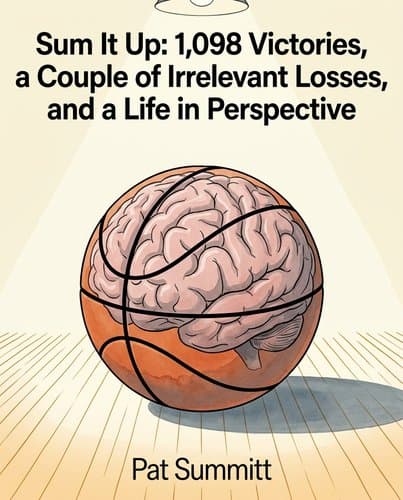
15841863_sum-it-up
by Pat Summitt, Sally Jenkins
Pat Summitt won 1,098 games by demanding more from her players than they believed they could give—then discovering that Alzheimer's would be the opponent she…
In Brief
Pat Summitt won 1,098 games by demanding more from her players than they believed they could give—then discovering that Alzheimer's would be the opponent she couldn't outcoach. Her memoir reveals how the same relentless love that built champions also cost her, and what remains when the scoreboard goes dark.
Key Ideas
High standards demonstrate genuine belief
Toughness and tenderness are not opposites — the most demanding coaches (and parents, and leaders) are often the ones whose people feel most genuinely loved, because high standards communicate belief in someone's potential
Childhood wounds become unconscious methods
The patterns that wound us in childhood don't disappear — they become our methods; recognizing the difference between inherited behavior and chosen strategy is one of the hardest forms of self-awareness
Accountability becomes destructive under power
Public accountability is a legitimate tool when it creates shared honesty about failure — but it crosses a line when it becomes habitual negativity rather than a diagnostic moment, and the line is harder to see from inside the power relationship
Success demands hidden relational costs
Building a program (or a team, or a family) so consuming that it becomes your primary emotional world is a form of greatness and a form of risk — the people outside that world pay a price you may not notice until it's too late
Uncontrollable losses reveal true motives
The losses you can't coach your way out of — illness, grief, divorce, a disease that steals your memory — are the ones that reveal whether your method was ever really about the people, or about your own need to be the one who fixes things
True leaders build independent successors
What you build outlasts you only if you deliberately produce people who don't need you — the real measure of any leader is whether their team can win the final seven minutes without them
Who Should Read This
Readers interested in Memoir and Leadership, looking for practical insights they can apply to their own lives.
Sum It Up: 1,098 Victories, a Couple of Irrelevant Losses, and a Life in Perspective
By Pat Summitt & Sally Jenkins
11 min read
Why does it matter? Because the woman who built her life on never quitting is being told her brain won't let her finish.
A doctor told Pat Summitt — the winningest coach in the history of college basketball — that she needed to quit immediately, disappear from public life, and protect what remained of her reputation. She had just been diagnosed with early-onset Alzheimer's. His advice was medically reasonable and entirely sensible. She wanted to punch him in the face. What follows is the story of a woman who spent nearly four decades doing what she did to Michelle Marciniak: taking a talented, infuriating, not-yet-finished kid and refusing to let her stay that way. She called it love. From the outside, it looked a lot like cruelty. The question this book forces you to sit with isn't whether her methods worked. They did, measurably, repeatedly, over 1,098 wins. The question is what it costs to be that kind of force — and what happens when the mind that held everything together starts, quietly, to let go.
The Doctor Said Quit. She Felt Her Fist Clench.
The doctor leaned across his desk and told Pat Summitt, the winningest coach in college basketball history, that she needed to quit. Immediately. Walk away from the game, disappear from public view, before the dementia progressing through her brain could humiliate her and ruin everything she'd built. As he spoke, Summitt felt her hand curl into a fist. Her whole life she had refused the word 'can't' — she banned it from her players' vocabularies, coached through broken bones, drove home in darkness after midnight to film sessions that started again at dawn. Now a doctor who didn't know her was telling her to fold. She wanted to drop him with one punch.
She drove home weeping instead. Walked inside, climbed into bed, and didn't get up for hours.
That gap — between the fist and the bed — is the whole story. Summitt's defiance was real. She had just sat in a clinic and failed to count backward from one hundred by sevens, failed to draw a clock face, received results showing the beta-amyloid buildup in her brain that signals Alzheimer's. The diagnosis was irreversible. But the woman who once soaked off a cast so she could keep shooting through a broken arm was not going to accept a stranger's verdict on her own limits. She told herself, in her own words, that she was coming for the disease — that it had no idea who it was dealing with.
The defiance that carried Summitt through thirty-eight years — from gyms with bird droppings on the floor to national championships — was the same armor that made her almost impossible to reach. Her son Tyler, twenty years old, found out about the diagnosis and wept at her bedside. And Summitt, who had spent a career pulling young women through their respective fires and teaching them to own their pain, had to be shown by her own child how to finally do the same. He knew what he hadn't said. She knew what she couldn't say back. Defiance is good armor. It's a bad door.
The Rattling Ice Glass That Made Her Who She Was
The most ordinary was a sound. After dinner on the Head family farm in Henrietta, Tennessee, one of Pat's brothers would drain his glass and extend it, rattling the ice. Then another. Their mother, Hazel — who had already worked a full shift in the tobacco fields, then come inside to cook and clean and mend — would make her way around the table and refill it. The expectation was wordless and absolute. When Pat was old enough to feel the sound go up her spine, she snapped: 'Get it yourself.' The brothers sometimes poured their own tea. More often, Hazel just came around the table anyway.
That rattle lodged somewhere in Pat permanently. She watched her mother work both the outside and the inside of the farm, ruining her shoulder hauling eighty-pound milk cans, sewing the family's clothes after midnight — and still serve the men their drinks. The lesson Pat drew wasn't about her mother's weakness. It was about what strength looked like when the system didn't notice it. She decided early that she was not going to bed in second place. That refusal would power everything: the championships, the standards, the famous thousand-yard stare.
But the container had another shape to it. When Pat finally left for college, she gathered her courage at the door and told her father — a 6'5" Scotch-Irish patriarch for whom praise was a foreign language — that she loved him. Richard Head said: 'Shut up.' No cruelty intended; he simply had no register for open tenderness. She walked out the door carrying it, and she never quite put it down.
When Half Your Players Walk Out and You Call It a Good Day
The best coaching programs, received wisdom says, are built on recruiting budgets and training facilities and institutional muscle. Pat Summitt built hers by being willing to empty the room. When forty women showed up to her first Tennessee tryout in 1974 — one of them in denim cutoffs carrying a purse, another wearing earrings and a necklace — Summitt ran them through three hours of bleacher sprints until half climbed to the top and simply never came back down. Four more bolted out the gym door mid-drill and disappeared entirely. She called Billie Moore that night, rattled, wondering if she'd gone too far. Moore's response stopped her cold: wonderful, she said. Better to have seven who actually want to be there.
Summitt ended up with eleven players. Their uniforms were orange polyester bought with doughnut-sale money, and they bled in the wash into slightly different shades. She swept the floor herself before games, taped their ankles badly enough that some still had scars decades later, and drove the van on road trips. What she was building, without yet having a name for it, was a program that pre-selected for a specific kind of person — someone who would not quit when it got ugly. She had no other resources to filter for character, so the conditions became the filter. The bleacher sprints, the dye-stained jerseys, the coach hauling a mop across a gym floor she didn't own — these weren't just hardship. They were a continuous audition, and only certain people pass an audition they didn't know they were taking. Once she had those people, the question became what to do with them.
The Garbage Cans in the Corners Were Not Metaphors
Two in the morning. The team bus pulls into Knoxville after a loss to Vanderbilt — the first time Tennessee had ever dropped a game to that program — and the players shuffle toward the door ready to go home and sleep. Summitt stops them. Everybody to her office. Right now. They squeeze in and sit on the floor with their knees at their chins while she loads game film and hands out paper and pencils. Write down every moment you didn't sprint the floor. By the time the tape ends, it's almost four in the morning. She sends them to the locker room and tells them they have two minutes to change. When they get there, they find their game uniforms heaped in a pile, still damp, smelling of a game just played. Put them back on, she says — she's not having the managers do extra laundry for someone else's mistakes. Then she runs them. A thirty-second suicide for every item on their lists. Some lists run fifteen items long. They go until they can't feel their legs. Around six in the morning she finally cuts them loose — go get some breakfast, get the complaining out of your system, and don't miss your seven-fifty class.
What you have to notice is the precision of the blame. Summitt didn't punish them for losing. She punished them for the specific moments on the tape when they chose not to run. Each item on their handwritten lists was a decision they had made, recorded and played back and now running through their bodies at five in the morning. The sweaty uniform wasn't humiliation for its own sake — it was evidence returned to its owner. You made this. Now wear it. The logic underneath all the brutality was medicinal: shame that belongs to you is the only kind you can actually do something with. Borrowed shame, the kind a coach just screams at you, rolls off. But when you've written down your own failures in your own hand and then run for each one, the accounting is yours.
Tennessee graduated every single player who completed four years in the program. The same woman who stationed garbage cans at the corners of the court during punishment runs — four of them, placed with clear-eyed expectation — also learned the menu at restaurants so a coal miner's daughter from rural Kentucky wouldn't have to admit she'd never seen half the items before. The garbage cans and the quiet menu ordering were the same gesture: she was always trying to give people accurate information about themselves. The accounting is yours.
She Reproduced the Pattern That Damaged Her and Called It Methodology
Maybe the coaching philosophy that built the most successful women's basketball program in history was something Pat Summitt never actually chose. Maybe it was just her father, running on a longer delay.
Here's the sequence that makes you stop: Richard Head, a man who communicated love through expectation and withheld praise as a matter of principle, raises a daughter who turns that pattern into methodology. Summitt's approach with Michelle Marciniak — a gifted point guard she systematically starved of approval, blamed publicly after a championship loss, and warned explicitly that the job would fall on her when things went wrong — looked from the outside like sophisticated psychological engineering. It also looked exactly like growing up in Henrietta.
Five minutes before the UConn rematch that would decide everything, Summitt pulled Marciniak aside and told her she was the best point guard she'd ever coached. That's it. No context, no warm-up. Marciniak's face did something complicated — years of waiting for that sentence arriving in the worst possible moment to process it. Summitt had calculated exactly this: approval, released at the right instant, hits like a detonator. It worked. What she was also doing, less consciously, was replicating the exact emotional logic her father had used on her — the logic that left her walking out a farmhouse door carrying an unanswered 'I love you' like a stone in her coat.
The father eventually said the words. After Summitt's fourth national title, Richard Head hugged her and told her he loved her — then immediately added that he didn't ever want to hear about it again. The joke was the confession: he knew what he'd been withholding, and he still couldn't quite stop. His daughter, who had spent a career understanding exactly what her players needed and precisely when to give it to them, recognized the pattern well enough to use it. What she didn't fully examine was whether she should. The wound became a method. The method worked. Both things are true, sitting right next to each other, and the discomfort of that is the point.
The Losses She Couldn't Coach Her Way Out Of
The coaching method that made Summitt unbeatable in gyms was completely useless against the losses that actually broke her. She could outwork any opponent, reshape any player, install new circuits of confidence in young women who arrived barely able to speak in her presence. She had no equivalent tool for her own grief.
She could change a tractor tire. She could not change this. The helplessness was particular and total. Four miscarriages, between 1982 and 1989, staggered through the seasons of her greatest professional ascent — national championships, the 1984 Olympic gold by an average of 33 points, her face becoming synonymous with women's basketball. All of it happening alongside losses she couldn't outwork or outthink or coach her way through.
Then in 2006, the night before she was set to host fifty people and appear live on ESPN for the NCAA tournament selection show, she picked up R.B.'s cell phone and read a text message that ended their twenty-seven-year marriage on the spot. What she did next is the detail that reveals everything: she cooked anyway. Fed everyone, appeared on national television, held herself upright through the whole performance while her marriage dissolved underneath her. Later that night she sat with Tyler and had what she called the hardest conversation of her life. She read the rheumatoid arthritis that followed as a cascade, grief finding new exits.
Finally Alzheimer's arrived to take the specific instrument she had used on everyone else. The tool was her mind — her ability to read a situation in real time, hold the emotional temperature of twenty people simultaneously, find the word that unlocked someone. The disease began stealing exactly that. Every prior loss had left her standing. This one was taking the coach herself, one circuit at a time.
When the Undefeated Season Nearly Ended in Seven Minutes
Kellie Jolly had never once raised her voice at a teammate. Four years of Tennessee basketball — all those five-in-the-morning practices, the clipboard eruptions, the punishment runs — and not a single outburst. Then, with 7:19 left in the 1998 Elite Eight, Tennessee trailing North Carolina by 12 and an undefeated season about to slip away, she grabbed Summitt's footstool, slammed it on the floor hard enough to nearly split the legs, and screamed: I am NOT going home. So you better get out there and help me, because I can't do it alone.
Summitt had already hurled her clipboard — broken it clean in half, pieces airborne — and delivered her own speech about clawing eyes out. It hadn't moved them. Chamique Holdsclaw sat on the bench telling Summitt the ball kept slipping from her hands. 'Don't make excuses,' Summitt said. 'Make plays.' That didn't move them either. What broke the trance was the quiet one, the point guard who had absorbed everything the program had to offer and, for the first time, couldn't stay quiet anymore. Tennessee scored 27 points over those final seven minutes. North Carolina managed 9. The undefeated season survived.
Summitt had spent that season adjusting to a team that needed something different from her. Nine of twelve players had been raised by single mothers or grandmothers — kids for whom one more hard voice wasn't going to unlock anything. She softened the edges, met them where they were. What she got back, in a gymnasium in North Carolina at the edge of elimination, was Kellie Jolly finding a voice loud enough to fill the room. The method only works if it produces people who don't need you to rescue them. That's the whole point, and that's what happened: Summitt stepped back, and her program took over.
161 Faces Are the Only Tattoos That Matter
At some point late in Pat Summitt's final season, someone asked what she'd built. The answer she gave was this: the 161 players who had come through Tennessee were her tattoos. Not the 1,098 wins. Not the eight championship banners. The faces.
Look at what those faces were doing. Niya Butts, who learned to lead by watching Summitt run a room, took over a program that had won twelve games and grew it to twenty-one. Holly Warlick had been present for 949 of Summitt's 1,098 victories, and in 2012 she took the head coach's chair herself. The system had reproduced. It was running without her.
The clearest proof of this came not from a scoreboard but from a hospital room. Near the end of the 2011–2012 season, Summitt sat through a memory evaluation at UT Hospital — struggling to reverse the letters in a five-letter word, losing threads mid-sentence, the disease doing what diseases do. When the examiner asked whether she felt helpless, she said no. When asked whether she felt purposeless, she said no. Outside the window, Tyler's vegetable garden was coming in on the ridge above the Little River, and every morning Pat walked her dogs up there and looked toward the Smokies, the same hills she'd run toward as a girl. The woman who had spent four decades teaching players that ownership was everything — own your failures, own your will, own your work — owned this too, without flinching.
Summitt told her players that God doesn't take things away to be cruel — he takes them away so we can fly. The 161 faces were already airborne.
What the Tattoos Actually Are
Every morning she walks her dogs to the ridge above the Little River and looks out at four layers of the Smoky Mountains dissolving into each other like memory itself. She can't hold all the names the way she once could. The seasons blur. Her son Tyler planted a vegetable garden outside her house, which she tends in the mornings. But somewhere out there, one of her people is running a practice, and one is sitting with a daughter explaining why hard things matter, and one is in a courtroom, and one is in a clinic, and one is in a gym with bird droppings on the floor wondering if anyone will stay. They are the system, still running. The wins are carved into a record book that will yellow and fade. The tattoos are walking around, breathing, multiplying. So here is the question she leaves you with, whether you want it or not: what are you building right now that will still be moving through the world on the morning you can no longer remember making it?
Notable Quotes
“Do you have any idea who you’re dealing with?”
“You don’t know me, and you don’t know what I’m capable of.”
“You can’t say ‘can’t’ to me,”
Frequently Asked Questions
- What does Pat Summitt's "Sum It Up" explore?
- "Sum It Up" traces Pat Summitt's transformation from a Tennessee farm to becoming the winningest coach in college basketball history. Published in 2013 with Sally Jenkins, this memoir integrates her legendary coaching career with her Alzheimer's diagnosis, offering hard-won lessons on leadership, demanding the best from others while genuinely caring for them, and building something that outlasts you. Rather than simply celebrating her 1,098 victories, the book examines what true excellence means when memory and health become unreliable. It transforms from a sports memoir into a deeper exploration of purpose, legacy, and what endures when the mind begins to fail.
- What are the key lessons about leadership in "Sum It Up"?
- "Sum It Up" teaches that toughness and tenderness are not opposites — the most demanding coaches are often the ones whose people feel most genuinely loved, because high standards communicate belief in someone's potential. The book emphasizes that what you build outlasts you only if you deliberately produce people who don't need you — the real measure of any leader is whether their team can win the final seven minutes without them. Public accountability can be a legitimate tool when it creates shared honesty about failure, but it crosses a line when it becomes habitual negativity rather than a diagnostic moment. True leadership combines rigorous expectations with authentic care and genuine investment in people's development.
- How does Pat Summitt's Alzheimer's diagnosis shape "Sum It Up"?
- Summitt's Alzheimer's diagnosis serves as the emotional center of the memoir, forcing her to examine losses you can't coach your way out of — illness, grief, divorce, a disease that steals your memory — and whether her method was ever really about the people, or about her own need to be the one who fixes things. The disease becomes a lens through which she confronts how her consuming dedication to building a program — which was both a form of greatness and a form of risk — affected those outside that emotional world. This diagnosis transforms the narrative from a straightforward success story into a reckoning with legacy, vulnerability, and what actually remains when the mind begins to slip away.
- What does "Sum It Up" reveal about childhood patterns and leadership?
- The book explores how patterns that wound us in childhood don't disappear — they become our methods, and recognizing the difference between inherited behavior and chosen strategy is one of the hardest forms of self-awareness. This insight deepens when examined through Summitt's Alzheimer's diagnosis, which forces a confrontation with habitual patterns now becoming involuntary. Additionally, building a program so consuming that it becomes your primary emotional world is both a form of greatness and a form of risk — the people outside that world pay a price you may not notice until it's too late. Understanding these deeply ingrained patterns becomes essential to conscious, intentional leadership.
Related Book Summaries

Read the full summary of 15841863_sum-it-up on InShort