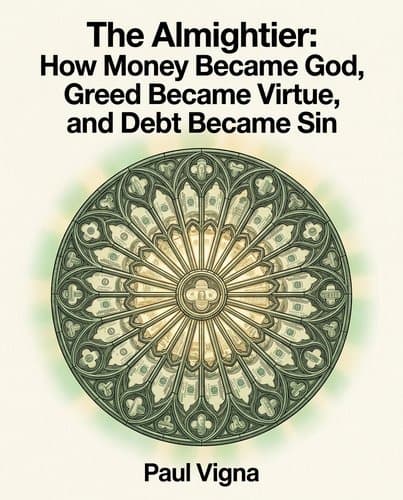
217387914_the-almightier
by Paul Vigna
Money didn't corrupt finance through greed alone—it collapsed when human judgment, accountability, and skin-in-the-game were systematically replaced by…
In Brief
Money didn't corrupt finance through greed alone—it collapsed when human judgment, accountability, and skin-in-the-game were systematically replaced by algorithms, quarterly targets, and anonymized debt. Vigna traces how every American became collateral damage in a system engineered to extract rather than serve.
Key Ideas
Personal financial stake drives institutional behavior
When evaluating any financial institution, ask whether the people running it have personal financial skin in the outcome — the 1981 shift from partnership to public corporation at Salomon Brothers shows how quickly removing that skin changes behavior
Technology reshaped what finance asks
The question 'what is most likely?' produces fundamentally different decisions than 'what is possible?' — and the shift from paper spreadsheets to computer models changed which question finance asked, with consequences that reached every American borrower
Credit scores measure compliance not character
A credit score measures compliance with the system's rules, not trustworthiness — Nazareth Andonian could have had a perfect FICO score while laundering a billion dollars for a cartel; human judgment about character caught what no algorithm could
Earnings targets make honesty structurally difficult
Quarterly earnings pressure doesn't just incentivize short-term thinking — it makes long-term honesty structurally difficult; once a company is on the 'beat and raise' treadmill, the exit is often a greater fool, not a soft landing
Pension promises burden least powerful citizens
Municipal pension shortfalls are a systemic time bomb, not a series of local accidents — politicians across the country have been promising future benefits to avoid current-year cash outlays, and the people who will bear the cost are the ones least able to absorb it
Understanding finance enables democratic accountability
Financial literacy isn't just personal protection — it's the prerequisite for democratic accountability; Orange County residents voted down a half-cent tax to cover a debt they didn't understand, and the least powerful residents paid the price
Who Should Read This
History readers interested in Behavioral Economics and Economic History who want a deeper understanding of how we got here.
The Almightier: How Money Became God, Greed Became Virtue, and Debt Became Sin
By Paul Vigna
16 min read
Why does it matter? Because the financial system didn't become dangerous through greed — it became dangerous when it stopped knowing your name.
There's a moment most of us have had — reaching for money we were certain was there and finding nothing. For the author, it was a childhood savings account, years of patient dimes, quietly consumed by a fee he never agreed to and was never told about. The bank hadn't stolen from him exactly. It had simply stopped thinking of him as a person. That distinction — between theft and indifference, between malice and mechanism — turns out to be the whole story. Because the financial system didn't turn predatory through a conspiracy of villains. It turned predatory the way a river changes course: gradually, through a thousand small redirections, each one logical in isolation, catastrophic in aggregate. What this book traces is exactly that erosion — the precise moments when character left the ledger, when relationship got replaced by algorithm. That erosion leaves traces, if you know where to look.
The Moment a Banker Stopped Needing to Know You
Bank of America trained its loan officers on what they called the five C's of credit: capital, capacity, conditions, collateral, and character. The first four could be calculated. The fifth was the one that actually kept you from disaster.
The proof walked in every day carrying grocery bags. Nazareth Andonian was a Lebanese-Armenian gold dealer with an infectious appetite for life — fast cars, big offices, prostitutes flown in from Atlanta, and a standing offer to young banker Chris Varelas of "good boogie action" that never stopped being declined. Nazareth called him "Baby Chris" and arranged a penthouse at Caesars Palace with a phone call, no last name required. His business was growing so fast it required four extra tellers to process his daily cash deposits. In his back office, he showed Varelas a knee-high stack of gold bars and said, dreamily, "Can you believe there is so much gold?"
The gold was painted lead. The cash was Pablo Escobar's cocaine money. Nazareth was running a laundering operation called La Mina — the mine — that cycled more than a billion dollars through the jewelry district and back to the Medellín cartel. The bags weren't filled with gold-trade proceeds. They were so stuffed with drug money that his counters threw away any bill smaller than a twenty because sorting it wasn't worth the time.
Varelas never suspected a thing. Not because he was careless, but because Nazareth was genuinely warm, genuinely funny, and genuinely good at projecting the image of an immigrant making it in America. Character, it turned out, was the one variable that could fool you completely — and also the only one worth measuring.
Which is precisely why, when the algorithm came along, it felt like progress. Around the same time, the yellow paper spreadsheet gave way to the computer. The difference sounds administrative. It wasn't. Working by hand forced analysts to ask one question: what outcome is most likely? You committed to a single scenario before writing down a single number. The computer asked a different question — what is possible? — and let you run scenarios until the numbers said what you wanted them to say. That shift quietly rewired how Wall Street thought about risk. Eventually it produced the FICO score, a single number meant to replace the judgment of every handshake-voucher conversation that had previously stood between a bank and a catastrophic loan. Someone could be a liar and a cheat and still score beautifully, so long as the bills got paid on time. The algorithm had no way to tell the difference between Nazareth Andonian and anyone else. Everybody called that progress.
When You Play With House Money, You Play to Lose
The corruption that nearly destroyed Salomon Brothers in 1991 wasn't a character flaw in one rogue trader. It was the predictable output of a structural change made a decade earlier, one that quietly severed the connection between risk and consequence for everyone inside the building.
Under the old partnership model, Salomon's senior people kept their own money in the firm. When Billy Salomon ran the place, a partner who wanted to withdraw capital to buy a luxury car was laughed out of the room. The answer was always the same: the money stays in, because it's your money on the line when the firm bets wrong. That shared exposure created its own discipline — partners watched each other, because one bad gamble could wipe out what belonged to all of them.
In 1981, Salomon went public. The partners cashed out at enormous valuations, and overnight the trading floor was no longer populated by people playing with their own chips. They were playing with the firm's balance sheet — house money, held by shareholders they would never meet. The phrase that started circulating captured the new logic perfectly: heads I win, tails the firm loses. Higher risk tolerance followed as night follows day. Proprietary trader John Meriwether lobbied successfully for a bonus structure that paid his team fifteen percent of whatever they made for the firm, a deal struck with the knowledge of only two other executives. When other departments found out, they demanded the same. Compensation became personal, disconnected from how the firm as a whole performed.
Out of that culture came Paul Mozer — head of government bond trading, nursing a grudge over the $18 million gap between his own bonus and what Meriwether's team was collecting. Mozer began placing illegal bids under customer names to circumvent a federally imposed cap on auction purchases, eventually cornering 87 percent of a single Treasury auction — in the market that sets borrowing costs for every government on earth. When CEO John Gutfreund learned of the breach in April 1991, he sat on it for months. His explanation, when finally cornered: apologies don't mean anything, what happened happened. The ego of a butcher's son turned King of Wall Street had become its own liability.
Sitting inside that building as a summer intern, I found myself absorbing the logic of the place without quite realizing it. The guys around me talked about trades the way gamblers talk about hands — not what it meant for the client, not what it meant for the market, just the number. That was the architecture doing its work. And it was doing it on me too.
Shareholder Value Saved Disney — and Taught Wall Street the Wrong Lesson
By the time Saul Steinberg began quietly accumulating Disney stock, the company had recorded its first-ever studio loss — $33 million in a single year. The classics sat sealed in a vault, released to theaters only every seven years as if they were sacred relics rather than commercial assets.
Walt himself had kept balloon and milk prices deliberately low. He believed every child deserved access to the magic regardless of how much change was in their parents' pocket.
His successors kept the prices low and the innovation lower, coasting on the founder's reputation while the culture moved on without them.
Steinberg, backed by Michael Milken's high-yield bond market at Drexel Burnham Lambert, didn't need to complete a takeover to win. He needed only to threaten one convincingly enough to terrify the board. Within forty-eight hours of his intentions becoming public, Disney was negotiating to buy back his stock at a premium. He walked away with a personal profit exceeding fifty million dollars. Within seven weeks, the board had cleared out the old management entirely and installed Michael Eisner, who promptly raised ticket prices, released the film archive on home video, opened merchandise stores worldwide, and greenlit a string of adult-oriented hits under a new studio imprint. Disney stock rose. So did the price of milk and balloons.
The lesson Wall Street absorbed was clean and compelling: stagnant management destroys value, and raiders force accountability. What got quietly buried in that lesson was everything the milk-and-balloons policy represented — the idea that a company's obligations extend to people who can't reward you on a quarterly earnings call. Maximizing shareholder value replaced creating the best product as the explicit goal, and it sounded like discipline. It was permission — a single metric to optimize and a clean excuse for everything else that got sacrificed along the way.
The Quarterly Earnings Trap Has Only One Exit — and It's a Trap Too
A stretch limousine circles the block outside a Manhattan restaurant. Inside, Dick Heckmann — the man who turned a failing company called American Toxxic Control into a multibillion-dollar water empire through more than 250 acquisitions in under a decade — finally tells his banker and his lawyer what he's been hiding. The stock is at twenty-six and a half, he says. The growth rate is about to fall off a cliff. There are no more targets left to buy. They won't hit the quarter. When he stops talking, the banker — me — reaches into his jacket, produces a pen, and holds it across the seat without saying a word. Sign the papers. Get out now. Heckmann laughs and takes it.
That moment doesn't look like corruption from the inside. It looks like pragmatism — the only rational move left after a decade of genuine building. And that's exactly what makes it worth examining closely.
Heckmann's empire ran on an accounting method called pooling, legal at the time and abolished in 2001. When a company acquired another under pooling rules, it could merge the financials as though the two had always been one — restating history, resetting the numbers, burying whatever ugliness existed in either set of books. The result was that no one on the outside could tell how much growth came from acquiring companies versus actually running them better. More usefully, a management team could tuck away financial reserves during an acquisition and release them later, whenever a quarterly earnings target threatened to slip out of reach. Heckmann called it a great game of hide the bean: the bean exists, you just can't find it. General Electric used the same method to post thirty consecutive quarters of earnings growth. So did U.S. Filter. So did Enron, until it didn't.
Here's the structural logic that produces this behavior. Public companies exist in a rhythm of three-month cycles. Results land, the stock moves, and the expectation resets higher. Miss once, and investors don't adjust the bar — they question whether the whole story was ever real.
Heckmann got out. He found a buyer in Jean-Marie Messier, the CEO of the French conglomerate Vivendi, a genuine visionary who believed in a converged media-and-utilities empire and wanted American water assets to anchor it. The sale closed at six billion dollars in cash. At the closing party — rented water park, the Beach Boys, three hundred guests — Heckmann danced at the front of a conga line in a Hawaiian shirt, cocktail raised.
What he was celebrating wasn't dishonesty. It was survival.
The system had one exit, and he'd taken it. The man who bought him out would not be so lucky.
The 'Too Big to Succeed' Bank Was Built on One Bragging Phone Call
A Monday afternoon, a conference room, five minutes to kill before the meeting starts. Sandy Weill — the man who had just assembled the largest bank in human history by folding Travelers Group into Citibank for $83 billion — walks in early and starts talking. Two junior bankers sit across from him with nowhere to go.
He tells them about a phone call with Jack Grubman, Citi's star telecom analyst, the highest-paid analyst on Wall Street at something north of $20 million a year. Grubman had built his reputation by publicly savaging AT&T for years, a sell rating worn like a badge of conviction. But Sandy needed AT&T's wireless IPO business — a mandate worth roughly $45 million in fees — and you can't pitch an IPO when your own analyst is telling the world the stock is worthless. So Sandy called Grubman and told him to change the rating. Grubman changed it. Citi won the deal. What Sandy didn't mention in that conference room, and what investigators would later excavate from a private email, was the rest of the arrangement: Sandy also steered a million dollars of Citi's money to the 92nd Street Y preschool — one of Manhattan's most exclusive — to smooth the path for Grubman's children to get in.
The two junior bankers sat there thinking: is he actually bragging about this? He was. Not in a late-night confession, not in a wiretapped call — in a conference room, killing time before a meeting, with the casualness of someone describing a weekend round of golf.
That's the detail that reframes everything. Financial misconduct on this scale doesn't require darkness. It requires a structure so large and so complex that accountability has nowhere to land. Sandy wasn't hiding; he had simply grown into an institution where the consequences of his actions were spread across hundreds of thousands of employees, shareholders, regulators, and counterparties — diffuse enough that no single person felt the weight. The bank was too big for any one act to register as a crisis until all the acts accumulated into one.
Lucent Technologies ran the same logic to its conclusion. A treasurer named Bill Viqueira spent two years watching the company lend customers money to buy its own equipment, book those loans as revenue, and ignore the fact that nearly every one was already in default. He presented the full disaster to the board in what he later described as a sweating, doomsday slideshow. Their response: thank you very much. No questions. Acknowledging the problem would have forced them to restate the revenue and collapsed the stock — and the whole story the market had built around them. The rational move, for everyone in that room, in that quarter, was to keep looking away.
The system didn't reward honesty. It rewarded the performance of health until the performance became impossible to sustain.
A Bonus Isn't a Reward — It's a Psychological Weapon
What does a bonus actually do to the person receiving it? The intuitive answer is that it rewards good work and motivates more of it. The more unsettling answer is what happened the day a first-year investment banker at Salomon Brothers sat in a cubicle after learning he'd been paid triple his best-ever salary and felt, genuinely, that he was thriving — until a colleague produced a Yankees hat.
Thirteen associates in the first-year class had agreed to break the rules: each scrawled their bonus amount on a slip of paper, dropped it in, and listened as the numbers were read aloud. Nobody claimed their figure. But the math was quick and brutal. Within minutes, the same person who had that morning shaken his boss's hand with unforced gratitude was calculating layoff odds and cataloguing every way he had failed to distinguish himself. The money hadn't changed. The knowledge of what other people received had. That's the mechanism: not deprivation, but comparison. What he gained in information, he lost in everything else.
The same structure scales up in ways that become genuinely grotesque. By the time Varelas was running the technology group and dispensing hundreds of millions of dollars in bonuses each year, he'd watched the same drama play out across every level of the firm. At one end: a second-year associate, Tim, who walked out stunned and grateful after being handed $320,000. At the other: a managing director who generated $55 million in fees and erupted with rage when told his bonus was being held flat at $2 million because colleagues found him intolerable to work with. The enraging part isn't the tantrum. It's that the strategy worked. Expressing fury at a large number signaled that you knew your market value and wouldn't be placated cheaply. Genuine gratitude, as Tim would likely discover, was a rookie mistake you'd eventually be trained out of.
Varelas knows this because he performed the same ritual himself. When his boss arrived in May 2000 to guarantee him $4.3 million — more than triple his previous bonus — his M&A instincts kicked in automatically: reveal nothing, push back, make them feel they've undervalued you. The number climbed to $6.7 million.
He'd become precisely the ungrateful bastard he'd once watched with bafflement from the other side of the desk. The system hadn't corrupted him through greed. It had trained him, slowly and thoroughly, through the logic that contentment is a negotiating liability. Once you understand that, the treadmill has you. The number that would let you finally stop — your exit figure, your freedom number — simply grows faster than the account balance chasing it.
When Public Money Disappears, the Poor Take the Bus to the Wreckage
She stepped up to the microphone at the Orange County Board of Supervisors hearing and thanked the panel before describing, in plain logical steps, exactly what she stood to lose. She takes the bus to her job. The job pays for an apartment. The apartment gets her out of a marriage to a man who hurts her. Remove the bus and the whole chain collapses — job, apartment, escape, future. Three minutes, then she sat down, and a man in fishnet stockings shook a cage containing two tiny banker statues and screamed for someone to lock them up. The room had been full for hours.
The people filling those seats weren't abstractions. They were the specific human beings left standing at the end of a decision chain that started with a canary-yellow-suited county treasurer named Robert Citron, who consulted astrologers about market movements, required Orange County homeowners to write their property tax checks directly to him by name rather than to the county, and leveraged $7.6 billion in public funds into a $20.6 billion pile of interest-rate derivative bets. When rates moved the wrong way in 1994, the county lost $1.64 billion. Citron later admitted he barely understood what he'd done and had simply followed his Merrill Lynch bankers wherever they led him. Merrill had flagged his portfolio's recklessness internally since 1992 and kept selling anyway.
The woman at the microphone didn't cause any of that. Neither did the man with diabetes who needed the number-59 bus to reach his doctor. But when the reckoning arrived, they were the ones explaining to a panel of supervisors why the consequences shouldn't land on them. The officials who approved Citron's unchecked authority faced no serious punishment. Merrill Lynch paid a fine representing roughly a quarter of one year's earnings and resumed business. Citron served a year, went home to sleep in his own bed each night, and kept collecting a pension of nearly $93,000 annually.
Stockton followed the same script a decade later, just with less wealth to cushion the fall. Lehman Brothers arrived in 2007 pitching pension obligation bonds — borrow at five percent, invest in the market at eight, pocket the spread — and the city council voted unanimously to approve them. Lehman collected its fees and went bankrupt fourteen months later. Stockton lost its tax base, slashed its police force, and watched homicides rise as officers fled to cities where their pensions weren't in jeopardy. A 911 dispatcher named Kristina Pendergrass, seventeen years on the job, lost her health coverage. A retired SWAT officer battling a brain tumor told the council that without his medical benefits, the bankruptcy was effectively a death sentence. His three minutes ran out mid-sentence.
The woman who needed the bus to leave her husband understood the system more clearly than most of the people who ran it. The decisions that broke the chain weren't hers.
The System Isn't Broken — It's Working Exactly as Redesigned
None of the scandals in this book are accidents. They are outputs. Once you see the through-line — from yellow spreadsheets to FICO scores to pooling accounting to Sandy Weill bragging in a conference room before a meeting even started — what looks like a series of individual moral failures resolves into something colder: a machine that was deliberately redesigned to produce exactly these results, and has never been meaningfully redesigned back.
The pension shortfall is where that logic becomes impossible to ignore. Somewhere between four and twenty trillion dollars in unfunded obligations sits accumulating across state and municipal retirement systems right now — an estimate so wide it should terrify you, and a range so wide it shows how successfully the people responsible have avoided measuring it precisely. The method is the same one Dick Heckmann used to run U.S. Filter for a decade: hide the bean. A pension board that adjusts its expected investment return from seven percent down to a realistic five forces the municipalities it serves to make up the cash difference today. Nobody in office today wants to make up that difference. So the return assumptions stay aggressive, the funding gaps keep growing, and the day the numbers finally demand a reckoning gets handed to whoever is elected next. This is not negligence. It is a rational response to an incentive structure that rewards officials for what they promise and never holds them accountable for what they deliver, because the delivery date is always after they're gone.
A Desk by the Front Door
He didn't retire to the lobby because he'd lost a step. Uncle John dragged his desk to the front door because he understood, with the clarity that comes from building something slowly, that the whole point of a bank is the person standing in front of it. Not the rate. Not the score. Not the quarterly target. The person. Every chapter of this story — from Nazareth's painted gold bars to the woman who needed the bus to leave her husband — traces the distance between that desk and wherever the decision finally landed. Recovery, if it comes, won't arrive as a regulation. It will look like someone choosing, again, to learn the names.
Notable Quotes
“If you think you can come up in here and stop the buses, my buses, you got another think coming!”
“Another think coming! Without the number-59 bus, I can’t get to my doctor.”
“Thank you, ladies and gentlemen. All right, thank you, thank you.”
Frequently Asked Questions
- What is the main argument of The Almightier?
- The Almightier argues that modern finance replaced human judgment, accountability, and relationships with algorithms, incentives, and abstraction, making the financial system fundamentally more dangerous. Author Paul Vigna traces how this shift occurred through cases ranging from Wall Street partnerships to municipal pension crises. The book demonstrates that when personal financial stakes are removed and decisions are automated or abstracted, accountability disappears. Vigna shows how this transformation affected everyone—from borrowers to pension holders—and offers readers tools to understand complex financial systems and recognize who truly bears the costs when failures occur.
- How did the 1981 shift from partnership to public corporation change Wall Street?
- The 1981 shift from partnership to public corporation at Salomon Brothers demonstrates how quickly removing personal financial skin in the game changes behavior. When partners personally owned the firm, their entire wealth was at stake, creating natural incentives for careful judgment and accountability. After going public, individual decision-makers no longer bore the full consequences of their actions. Vigna uses this case to show how removing personal financial stakes leads to fundamentally different decision-making patterns. This structural transformation illustrates a principle applicable across finance: without skin in the outcome, the alignment between personal responsibility and institutional behavior disappears.
- What does The Almightier say about credit scores?
- A credit score measures compliance with the system's rules, not trustworthiness. Vigna demonstrates this through the case of Nazareth Andonian, who could have had a perfect FICO score while laundering a billion dollars for a cartel; human judgment about character caught what no algorithm could. This example reveals the fundamental limitation of automated financial assessment: algorithms identify compliance patterns but cannot assess integrity or detect sophisticated deception. The book argues that finance's shift toward algorithmic credit evaluation has replaced the human judgment needed to distinguish between those following the rules and those genuinely trustworthy.
- What does The Almightier reveal about municipal pension crises?
- Municipal pension shortfalls are a systemic time bomb, not a series of local accidents. Vigna explains that politicians across the country have been promising future benefits to avoid current-year cash outlays, with the people who will bear the cost being those least able to absorb it. The Orange County example demonstrates how financial literacy gaps enable this system: residents voted down a half-cent tax to cover debt they didn't understand, and the least powerful residents paid the price. The book frames this both as a financial mechanism of inequality and a breakdown of democratic accountability.
Related Book Summaries
Read the full summary of 217387914_the-almightier on InShort