50043108_the-beauty-in-breaking
by Michele Harper
Michele Harper's unshakeable calm in the ER wasn't professional mastery—it was a survival skill forged in a violent childhood. Her memoir reveals how…
In Brief
Michele Harper's unshakeable calm in the ER wasn't professional mastery—it was a survival skill forged in a violent childhood. Her memoir reveals how confronting that truth unlocked what medicine alone never could: genuine healing begins not by escaping brokenness, but by walking through it.
Key Ideas
Clinical composure may mask survival mode
Clinical composure can have traumatic origins. The stillness that makes you effective under pressure may be the same dissociation that protected you as a child. Recognizing the difference — professional skill versus inherited survival mode — is what gives you a choice about when to use it.
Honest refusal can be true care
When you cannot do something you know how to do, it isn't always a technical failure. Harper's inability to intubate the twelve-day-old was her body's honest refusal to mar perfection. Stepping aside, naming what you can't do in the moment, is sometimes the most honest care available — to patients and to yourself.
Institutional channels won't protect your truth
'Speak these truths aloud, for it is only in silence that horror can persist' — but Harper's own 911 call made things worse. Truth-telling is the book's moral north star and its demonstrated failure mode. Build the practice, but don't assume institutional channels will validate or protect you when you use it.
Examine inner stories behind self-sabotage
Everyone carries an inner contract — an unconscious story about what they deserve. Mr. Spano's self-sabotage wasn't irrational; it was perfectly loyal to a contract written in a harder time. The work of healing isn't just treating the wound — it's examining the story that made you leave it untreated.
Forgive to stop carrying their burden
Forgiveness is not a transaction with the person who harmed you and has nothing to do with what they deserve. It is structural self-liberation: releasing the obligation to carry someone else's wrongdoing into every room of your life. You forgive to get yourself back.
Fractures forge what couldn't exist whole
Brokenness is not an interruption to your becoming — it is how becoming happens. The Kintsukuroi vessel repaired with gold does not return to what it was; it becomes something that has never existed before. The question worth sitting with is not what your breaks cost you, but what they opened up that couldn't have been opened any other way.
Who Should Read This
Readers who connect with first-person stories about Memoir and Mental Health and want to see the world through someone else's eyes.
The Beauty in Breaking
By Michele Harper
11 min read
Why does it matter? Because the doctor trained to hold dying strangers and the girl who survived a violent childhood learned exactly the same skill.
Most people assume the emergency physician stands on the far side of suffering — professionally armored, technically capable, separated from the grief that floods the room. Michele Harper never had that distance to draw on. The stillness she brings to a dying man's bedside, the capacity to stay whole while holding the worst, was not forged in medical school. It was learned earlier, in a childhood home she could not leave, where the skill of not coming apart was first and most urgently required. The ER cases and the personal history are not running in parallel. They are the same story. And the central argument in both — that what cracks us open is not the opposite of healing but its necessary beginning — turns out to be, by the last page, something Harper has proved by living it.
The Stillness That Keeps You Alive in an ER Was First Learned in a House You Couldn't Leave
Michele Harper stands still in the trauma bay the way someone does who learned it long before medical school.
She grew up on Washington's Gold Coast — the historic enclave of the Black upper-middle class — in a Colonial house where the family kept a fish tank for positive chi and her father beat her mother behind closed doors. The exterior was immaculate. The interior was a war zone. Michele learned stillness not in a lecture hall but in the space between those two worlds, where falling apart cost too much.
She was a tween the afternoon she called 911. Her father and older brother were fighting in the master bedroom — John had intervened again to protect their mother — and Michele slipped to the kitchen phone and whispered the emergency to the operator. When officers arrived, they looked down at a girl in her favorite striped dress in the doorway, listened to the competing accounts, and delivered their verdict: they would arrest both the father and the son defending his mother. Harper's mother, terrified of her son being jailed, backed down. The officers left without a word of censure to the father, without asking if the children were safe.
Harper never called 911 again.
The stillness she carries into every trauma bay was first built in that foyer, and knowing its origin doesn't change what it is — only what it costs.
The Night Harper Cried for the First Time Was the Night She Finally Diagnosed Herself
At 1 a.m. on a Wednesday, a twelve-day-old boy named Christopher Tally arrives at Harper's emergency department with no pulse and no breath sounds. The EMS team has already been working him for sixteen minutes. Everyone in the room knows what they know. Harper moves to intubate — a procedure she has never missed in a pediatric patient, because children's airways are shorter and more anterior than adults', so open you can practically see the vocal cords when a kid laughs. She has the wrong blade at first — a Miller 0 fetched from the ambulance corrects that — and still cannot push through. The problem is that she can see the baby's face: dark eyes fixed open, blue-tinged brown skin, lips parted as though mid-exhale. He looks like her nephew, like the children she and her ex-husband had already named (Nella Vita and August) who were never born. She cannot bring herself to split his mouth, to leave the smallest mark on what she keeps calling, in her own mind, perfection. A paramedic steps in, drives the blade through, and intubates on the first attempt. The corners of the baby's mouth tear. The tube goes in. It doesn't matter.
Harper pronounces time of death at 1:41 a.m., speaks to the family — the mother drops to the floor before Harper can finish the word "sorry," the father collapses beside her, the grandmother remains upright — and goes home as the sun rises. She makes chicken stew. The pot is wide and yellow, new enough that it still smells faintly of the store, and for the first time in her adult life, she cries.
She catalogs what she didn't cry over: patients who died in her arms during residency, women she had told their husbands were on ventilators with no promise of recovery, her own divorce finalized only months earlier. The private accounting runs further back — to being a girl in a house run by a violent father, praying to the crescent moon she could see from her bedroom window that she might survive. None of it had earned a real cry. She had always been the doctor: someone who categorized, stabilized, and moved on.
Baby Tally's death springs a diagnostic trap on her. Years of training had taught her that each patient case is a story whose details must cohere. Standing at that stove, she finally applies the principle inward. Her own story has a logic, and it points toward damage: a childhood she never got to have, a marriage that reopened a deep wound of abandonment, a loneliness that a thirty-fifth-floor apartment with floor-to-ceiling windows cannot fill. The breakdown is the diagnosis. The woman who could not mark the dead baby is finally letting herself be marked.
Refusing to Examine a Handcuffed Patient Is a Medical Decision With a 200-Year History
Four white police officers march Dominic Thomas — young, Black, handcuffed — into the ER with a demand: examine him. Their story is that they watched him swallow drug bags during a raid. Their expectation is that the hospital will restrain him, draw blood, run X-rays, and if necessary force a tube down his nose and pump laxative fluid through his gut. Another doctor did exactly this the other day, they offer, helpfully.
Harper puts on her white coat (the one she almost never wears, but reaches for when she needs the costume to do work), walks to triage, and asks Dominic the one question the room has skipped: does he want to be examined? He says no. She discharges him.
Her resident Lauren calls Hospital Ethics without telling Harper, citing two white male attendings who treat forced exams as routine. Hospital Ethics confirms: Harper is right. You cannot compel a competent adult to submit to a medical procedure without a court order.
What makes this look like a clinical edge case is the assumption that forced exams on prisoners are anomalies. Harper knows they're not.
In the mid-1800s, a physician named J. Marion Sims (later canonized as the father of gynecology) developed pelvic surgical techniques by operating on enslaved women. No anesthesia. When he felt confident in his methods, he performed the same procedures on white women, this time with anesthesia. Same surgery. Same doctor. Different bodies, different pain. The gap between whose suffering required managing and whose could simply be observed is not ancient history; it is the logic Harper is standing inside when the officers expect Dominic's body to be opened on their authority.
The costume matters, she thinks, looking at her dark hands against the white coat's cuffs, a reminder of which bodies in America get to hold authority and which get processed. That same morning her department chairman had told her she hadn't gotten a promotion despite being the only applicant. He expressed regret, then sat back in his chair. She was the one left to fight for Dominic. That night she sent her resignation letter — not as a protest but as a reckoning: the institution had made its terms clear, and so had she.
The Story You Hold About What You Deserve Determines What Healing You'll Accept
She sends the letter and goes back to work.
What would it take for a patient who arrived in genuine terror — "Am I going to die from this?" — to walk out before the cure is complete?
Mr. Spano is twenty-nine, and his right calf looks like charcoal: puffy, blackened skin from injecting crack cocaine into his leg. He arrives at Harper's VA emergency department weeping, his pain at "one hundred out of ten," asking whether he is about to die. Harper stabilizes him, calls in the orthopedic service, watches an abscess get drained at his bedside. His vitals normalize. His labs come back reassuring. And then, within the same shift, in the same room, he tears his IV from his arm, lets his blood drip to the floor, and hobbles out without his antibiotic prescription, without dressing instructions, without follow-up appointments. He has custody paperwork to finish. A job interview to prepare for.
Harper stands at the nurses' station reconstructing what she saw. The care wasn't rejected because it failed. It was rejected once it had worked well enough to dissolve the immediate terror. He came in afraid he was dying. He left the moment that fear passed. What she can't shake is the precision of the exit: not too soon, not when he was well, but exactly when the worst had cleared. She's seen enough to recognize what it means. Some people cannot let themselves have more than relief. The same reckoning, she suspects, shows up in which partners they stay with, which salaries they accept, which apologies they never demand. You cannot let another person treat you better than you believe you deserve.
Joshua Clements carries the opposite conviction. At sixty-eight, he receives news that his prostate cancer has seeded his chest and abdomen beyond counting, and responds by placing both hands on his torso, breathing slowly, and laughing with what can only be called recognition: this is still my body, and I am still at peace inside it. He spent twenty years living cleanly after refusing chemotherapy and radiation when younger, choosing herbal supplements and long walks over what his doctors called the only path forward. Now, facing the same cancer grown vast and metastatic, he holds the same position. After Harper delivers the results, he opens his arms. She feels every ER protocol tighten in her spine — distance, contamination, the sanctity of professional boundaries — and then accepts the embrace anyway. "Sis," he says, "I want to thank you for making me feel like a human being."
The difference between these two men lives in what each believed he was allowed to receive.
Forgiveness Is Not About the Person You're Forgiving
The letter has been sitting at the bottom of Michele Harper's bag for an entire shift. Delivered six months late through VA hospital mail — and her father, himself a physician, must have known the VA's system ran months behind — it arrived sandwiched between thank-you cards and a recruitment flyer. She recognized his handwriting immediately and didn't open it. She carried it through every patient encounter, every conversation, like a stone in her pocket.
She reads it at home. He followed her career through online searches. He took responsibility for what he did. He included his phone number.
She has spent an entire shift watching people decide whether to let anger be the whole story. Before she has worked out what she thinks, she is dialing.
What Harper has been testing, case by case, in the VA's psychiatric wing, is this: forgiveness that operates as a moral verdict, something withheld until the wrongdoer earns it, doesn't function as release. You keep waiting for them to deserve it, and they never quite do, and you carry the injury forward into every room. Earlier that shift, a veteran named Vicki Honor had described her pastor's sermon on forgiveness the way you might describe receiving a bill you didn't run up. Vicki had survived two rapes in her own unit, an abortion alone, the deliberate erasure of her service records, and now her faith's insistence that her anger was itself a sin requiring remedy. Harper hadn't argued theology. She'd pointed at what Vicki already knew from her own experience: Vicki had already forgiven her addicted mother, not because her mother became worthy of it, but because carrying the injury had made Vicki smaller. The release was Vicki's recovery. Her mother's absolution was beside the point.
The father answers on the third ring. He says he has remembered something Harper told him years ago: that you don't own anything. She had meant he couldn't claim credit for a life he hadn't shown up for. He took it as a different instruction: owning his failures, acknowledging them and taking them as his, was the foundation of twenty years of work to change.
She agrees to meet him next month.
Her forgiveness, she realizes, had arrived years earlier, on some unremembered date, without ceremony. The call gave her one thing she hadn't required: a partial explanation for a wound she had been carrying into every room. A gift she could only receive because she no longer needed it.
You Cannot Become What You're Becoming Without First Dissolving
Inside a cocoon, a caterpillar doesn't slowly rearrange itself into a butterfly — it dissolves. The organism breaks down into undifferentiated goo, and from that formlessness the new creature assembles itself. Returning from a medical conference, Harper reads this in an in-flight magazine. It lands as something that has been true all along: the condition for becoming is not pain endured and survived but dissolution undergone.
Ms. Mary Giannetta arrives at the ER by ambulance, seventy-eight years old, already three rounds of epinephrine deep and nineteen minutes without a pulse. Harper runs the code, listens at the carotid and femoral, watches the monitor, and calls time of death at 4:29 p.m. The family, still making phone calls, is on their way. Then Nurse Crystal appears in the doorway with a face Harper has never seen before and leads her back into the room. Condensation is rising and falling in the breathing tube. The monitor is still flatline. No pulse anywhere. The woman is dead by every clinical measure, and she is breathing.
Harper restarts the code. No one in the room has ever seen this. Eventually the family arrives, three or four generations assembling in pairs outside the curtain. Only when the last daughter-in-law steps through do the monitor's beeps stop. Ms. Giannetta had returned from death to wait for everyone she loved, and once they had gathered, she let go.
Not every break leads here. A patient named Jeremiah wept that he was going to die, and he was right. The Tally baby did not live. Some breaks leave only loss. Harper doesn't promise transformation from every rupture.
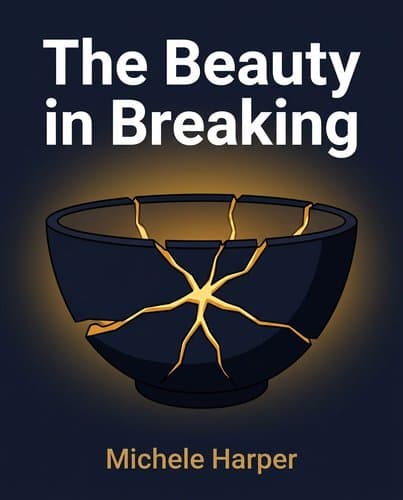
What she offers instead is Kintsukuroi, the Japanese practice of filling broken pottery's cracks with gold, not to disguise the damage but to illuminate it. The repaired vessel is not restored to what it was. It becomes something that never existed before, made more fully itself by what it survived.
The Vessel That Has Been Broken Before Can Hold More
Medicine, like yoga, is a daily practice — not a problem you solve and move on from, but a commitment you renew each time you walk back into the room, demanding the same discipline whether or not you can see progress. The Kintsukuroi image isn't a promise that suffering makes you stronger. That's the lie that frames pain as a deal: damage goes in, strength comes out. The gold poured into the crack doesn't erase the fracture — it moves into it, traces every fault line, and makes the break the most visible thing about the vessel. The bowl becomes more itself for what it couldn't survive intact. The question Harper leaves you with isn't whether your breaks can be healed. It's whether they can be honored — and what it would mean to stop treating the damage as an interruption to who you were supposed to become, and recognize it instead as the shape of who you actually are.
Notable Quotes
“Is there a smaller blade? Do we have a Miller zero?”
“I'm going out to the truck. I'm pretty sure we have a smaller blade, Doc,”
“Doc, do you mind if I try?”
Frequently Asked Questions
- What is The Beauty in Breaking by Michele Harper about?
- The Beauty in Breaking follows Black emergency physician Michele Harper as she connects her violent childhood survival skills to the composure she brings to trauma patients in the ER. The book reframes brokenness—in bodies and in lives—not as an obstacle to healing but as its necessary beginning. Through cases from the ER and her own life, Harper explores how recognizing our own brokenness can make us more effective healers and more fully human. She demonstrates that trauma and healing are inextricably linked.
- How does Michele Harper connect her childhood trauma to her clinical effectiveness?
- Clinical composure can have traumatic origins, according to Harper. The stillness that makes physicians effective under pressure may originate from dissociation that protected a person during childhood violence. The Beauty in Breaking explores how recognizing the difference between professional skill and inherited survival mode gives practitioners a choice about when to use composure. Harper's work demonstrates that understanding this connection transforms trauma from a hidden liability into a source of empathetic understanding. This self-awareness enables more authentic, responsive care for patients in crisis.
- What is Michele Harper's perspective on forgiveness?
- Forgiveness is not a transaction with the person who harmed you and has nothing to do with what they deserve, Harper argues. Instead, it is structural self-liberation: releasing the obligation to carry someone else's wrongdoing into every room of your life. According to Harper, you forgive to get yourself back. This reframing shifts forgiveness from a moral duty toward a perpetrator into a practice of reclaiming your own freedom and agency. The Beauty in Breaking demonstrates forgiveness as an act of self-protection rather than absolution.
- How does Harper reframe brokenness as a path to transformation?
- Brokenness is not an interruption to your becoming—it is how becoming happens, Harper writes. She illustrates this through the metaphor of Kintsukuroi, the Japanese art form: the vessel repaired with gold does not return to what it was; it becomes something that has never existed before. Rather than viewing breaks as costs, Harper asks what they opened up that couldn't have been opened any other way. The Beauty in Breaking positions suffering not as a liability but as a generative force that enables unexpected growth and self-discovery.
Related Book Summaries

Read the full summary of 50043108_the-beauty-in-breaking on InShort