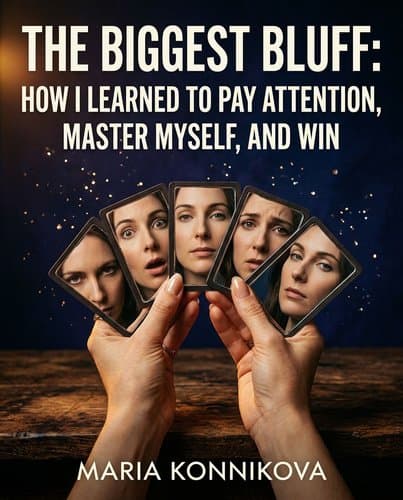
49814228_the-biggest-bluff
by Maria Konnikova
A psychologist bets her career on mastering poker in one year—and discovers the game's real lesson isn't how to read opponents, but how to stop misreading…
In Brief
A psychologist bets her career on mastering poker in one year—and discovers the game's real lesson isn't how to read opponents, but how to stop misreading yourself when luck, ego, and self-deception quietly sabotage every decision you think you're making rationally.
Key Ideas
Question loss narratives before rehearsing
Before recounting any bad outcome — to yourself or anyone else — ask: 'Do I have a question about how I handled it?' If no, don't tell it. The narrative you rehearse about misfortune shapes what you're primed to notice next.
Separate decision quality from outcome luck
Separate the quality of your decision from the result every single time. Evaluate yourself only on what you controlled. A correct decision that produced a bad outcome is not a mistake — but treating it as one is.
Question yourself hardest when confident
When you feel most confident in your approach is precisely when early-success bias is most active. 'Less certainty, more inquiry' is not humility theater — it's the operating posture that keeps the illusion of control from blocking real feedback.
Map your stressed-response patterns first
Build your own if-then behavioral profile before trying to read anyone else's: identify how you actually behave when threatened, when losing, when under social pressure — because those patterns are visible to skilled observers even when invisible to you.
Why is where real wisdom lives
Never act without knowing exactly why. Never judge another person's decision without asking why they made it — including decisions that look obviously wrong. The why is where the useful information lives.
Volatility buffering enables skill compounding
Buffer yourself against variance in any high-stakes domain: you'll never experience the long run if short-term swings eliminate you before your skill edge can compound. Staying in the game is itself a skill.
External accountability forces hard questions
Knowing about a cognitive bias — in vivid, academic detail — does not protect you from it. It can make you more confident that you've handled it. The corrective isn't more knowledge; it's external accountability structures and forcing yourself to ask the questions you don't want answered.
Who Should Read This
Curious readers interested in Memoir and Behavioral Psychology and the science of how the mind actually works.
The Biggest Bluff: How I Learned to Pay Attention, Master Myself, and Win
By Maria Konnikova
9 min read
Why does it matter? Because you've been misdiagnosing the enemy of good decisions.
Here's what most of us believe without quite knowing it: that rigorous preparation is a kind of armor. Sleep enough, think carefully, stay honest with yourself — and you've done your part. What happens after is just luck, to be endured with grace.
Maria Konnikova believed this. She took preventive Advil. She slept nine hours. She meditated. She still spent hour two of the World Series of Poker Main Event curled on a casino bathroom floor, vomiting, while $10,000 bled away at a table she hadn't reached.
The preparation hadn't failed. The armor was never real. What poker turned out to be — the most brutally honest mirror she'd ever looked into — wasn't a test of readiness. It was a test of self-knowledge. And discovering how badly she'd overestimated hers was the most useful diagnostic she'd ever run. Not on the game. On herself.
Betting Is the Only Way to Know What You Actually Believe
Imagine a doctor who has just confidently told you what's wrong. He's seen this before, he knows the signs, his tone leaves no room for uncertainty. Now ask him to stake his entire savings on that diagnosis. Something shifts. Kant had a name for what vanishes: the air of triumph, the false certainty of someone who believes they've just settled a question. Maybe the diagnosis is 80% certain. Maybe 60. The bet doesn't change what he knows; it changes what he admits he knows.
Poker does something ordinary life refuses to do. Every hand forces you to put actual money behind your read of the situation. You can't say "I think I'm probably ahead here" and act as if you're certain, because acting certain costs you when you're wrong, and the price arrives instantly. The bet exposes the gap between what you claim to believe and what you actually believe.
Most of us live permanently on the wrong side of that gap. When Nate Silver published his final 2016 election forecast (71% Clinton, 29% Trump), the public read it as a guarantee. But 29% isn't close to zero. In poker terms, it's roughly the odds of flopping a pair: something that happens constantly at any table, that any player has watched clean out an opponent's stack. Silver, who spent years making a living as an online poker professional before turning to election modeling, had felt 29% in his bones. The people reading his forecast had never had to bet on 71% and watch, in real time, how often "likely" doesn't happen.
Poker is the corrective. You learn probabilities the only way the brain actually retains them — through consequences. The number stops being abstract the moment it empties your stack.
Early Success Is More Dangerous Than Early Failure
Winning feels like confirmation. When something goes right, especially early, the brain files it as evidence: you have the instincts, you read it correctly, keep doing what you're doing. This is exactly where things go wrong.
In the 1970s, Harvard psychologist Ellen Langer ran a disarmingly simple experiment. Students guessed coin-toss outcomes one by one and were told immediately whether each guess landed. The only variable was the pattern of correct guesses — randomly distributed, clustered near the end, or clustered at the beginning. Total hits: identical across all three groups.
Then Langer asked everyone: Could you improve at this? Do you have a natural talent for it? Would fewer distractions help? The correct answers are obviously no. Coin tosses are random, full stop. The groups with random or late-clustering success answered accordingly. But the students whose wins came early said yes. A streak that contained zero information about their ability had convinced them that predicting coin flips was a skill they possessed and could refine. The paper's title nails it: "Tails, I Win. Heads, It's Chance." Konnikova later replicated the study alongside Walter Mischel, who spent his career studying why people can't stop themselves. The illusion held just as strong, decades on.
Early success seals off the feedback loop before you've had any chance to test whether you're thinking clearly or just riding variance. The early-success students weren't foolish. They were doing what brains do: finding patterns and assigning credit to themselves. What they lacked was a corrective. Without early failure, there's nothing to disrupt the story you're telling yourself.
Dan Harrington — four-time Main Event finalist — put the principle directly: a player who gets lucky from the start has been robbed of the only experience that would reveal whether their approach actually holds up. Everyone executes the plan well before they take a hit. The hit is the test.
The inversion is genuinely uncomfortable: early triumph is the greater threat. Disaster is the teacher. One leaves you certain you're onto something real. The other hands you something rarer — an honest look at whether you are.
The Story You Tell About Bad Luck Becomes Your Luck
Maria is barely halfway through explaining the hand where a near-certain win collapsed on the final card when Erik stops her cold. She hasn't even reached the devastating part yet. He asks one question: does she have anything to ask about how she played? Not really, she says. The cards were the cards. Then stop there, he says. Bad beat stories are waste you're offloading onto someone else's attention. They don't improve your thinking, and they don't improve your play.
His prescription is stranger still: when recounting hands, don't even say how they ended. Forget the outcome entirely. The only thing worth examining is whether you thought correctly.
Konnikova found it harsh until she traced the logic. Language, Auden argued, is the mother of thought, not its servant — words will tell you things you never thought or felt before you said them. The bad beat story, repeated often enough, stops being a story and becomes a worldview. "The cards went against me" positions you as someone things happen to. That framing reshapes how you move through the world.
She has a name for each pattern: a luck-dampener and a luck-amplifier. Victim framing (the variance, the timing, the table draw all conspired against me) accumulates invisibly. You start missing what's salvageable because you've filed the situation under injustice rather than problem. Your social network, tired of the grievance loop, grows quieter. You stop trying things you might win, because the story you've been telling is that outcomes aren't yours to shape. The spiral tightens.
Victor framing runs the same sequence in reverse. You made the correct decision; the variance didn't cooperate this time. That posture keeps your attention on what you control, which keeps you ready. When your network hears you're between jobs, they think of you — because you sound like someone who'll do something with a lead. Readiness attracts opportunity, and opportunity looks, from the outside, a lot like luck.
The cards don't change. The framing changes what you do next. And what you do next is the only part that compounds.
Attention Is Not a Virtue — It's the Mechanism of Luck
But framing what's already happened is only half the equation. The other half is what you're paying attention to while it's still unfolding.
What is luck, exactly, if not randomness falling in your favor? That definition sounds right until you watch Andrew "LuckyChewy" Lichtenberger fold top pair in a Las Vegas high-roller event while still holding one of the stronger hands at the table.
Chewy had been watching a businessman she calls Bob for the entire session. Not his own cards. Bob. Bob played few hands, and when he entered a pot, he didn't simply call every bet — sometimes he folded to pressure, sometimes he raised, and when he called a re-raise, the hand he eventually showed was almost always the best one at the table. His calls were announcements. Chewy had been reading them all evening.
When Bob started calling relentlessly against a German professional she calls Edward, who'd spent most of the session on his phone, Chewy quietly folded top pair and watched. Edward had real justification for staying in. He held the ace of diamonds (a blocker: a card that reduces the likelihood of an opponent holding the best possible hand), and his game-theory-optimal read said this was a credible bluffing spot. The math was sound. He shoved all his chips in on the river. Bob called and flipped over a straight flush. Edward was gone.
Edward wasn't unprepared. He'd studied thousands of simulated hands, knew the frequencies, the blockers, the optimal play for every scenario. What he lacked was information sitting openly on the table all evening: Bob's calling pattern reliably signaled genuine strength. A blocker reduces the probability of an opponent's hand; it doesn't eliminate it. Without observation, Edward had no evidence that could interrupt his plan before it executed perfectly — into disaster.
Louis Pasteur is usually quoted on the second half of a sentence: chance favors the prepared mind. The full version is: "Where observation is concerned, chance favors only the prepared mind." Almost everyone drops the first clause. That clause is doing all the work. Preparation gives you the capability. Observation routes that capability to the specific situation unfolding in front of you. Without it, everything you've learned stays inert in your head, unable to reach the table.
Attention is how preparation becomes outcome. Edward's knowledge was real. It never made contact with the room he was sitting in.
The Most Important Player You've Never Profiled Is Yourself
Deep in the tournament that would close her time in Monte Carlo, Konnikova held what poker players call a bluff-catcher — top pair, good only against a bluff. The Russian across the table had been her study subject all day: he'd shown her bluffs, bragged in Russian to a friend about "beating the girl" (unaware she spoke the language), cursed out another player for the offense of holding aces. She had his profile cold. Bully. Tilt-prone. Quick to lash out when challenged.
Then he shoved all his chips in. As she thought it over, he stood up and started dancing.
She called. He tabled a set. Her stack went with it.
A dancing player is the oldest tell in poker — the veteran poker theorist Mike Caro catalogued it decades ago. Acting strong means strong. She had correctly read her opponent's archetype all day, then ignored the clearest signal he sent because she was too busy running her psychological model of him to look at what was actually happening in front of her. She had been reading everyone at the table. She had never once stopped to read herself.
That is the sequence most people get backwards. Behavioral analyst Blake Eastman spent six years and 1,500 hours observing live cash games with RFID card-readers (technology that logs hole cards so you can match behavior to actual hand strength). What he found wasn't a catalog of individual tics. It was a taxonomy of thought-process patterns: the way decisiveness and hesitation express themselves in motion, timing, the cleanness of a reach for chips. His prescription for Konnikova was direct: don't standardize your physical movements, standardize your thought process. Before every action: stop, think, execute. The natural variation in how your body moves through that sequence eliminates detectable patterns, because the input changes with every hand. The only consistent thing is that you thought first.
That instruction is harder than it sounds, because most people can't locate their own thought process in the moment. They're running if-then profiles they've never written down. Mischel called these behavioral signatures: if-then reactions hardwired to specific triggers, not the fixed personality traits we imagine we have. If threatened, lash out. If losing badly, chase. If someone is dancing across the table — call anyway, because you've already decided what kind of player he is.
The profiles you've built for everyone else at the table are running fine. The one you've never written is the one governing everything.
Understanding Your Biases Makes You More Confident in Them, Not Less
Knowing a cognitive bias by name is not a shield against it. It might be the opposite — a way of feeling protected while the bias runs unopposed underneath.
Konnikova had a PhD in the psychology of decision-making. She had studied, written about, and taught every bias that unraveled her at the 2017 World Series of Poker. She watched herself commit the planning fallacy (she was nowhere near ready), the status quo bias (sticking to her original timeline despite evidence that changed everything), and the sunk cost fallacy (not financial costs, but intangible ones: the narrative, the reputation, the identity of someone who had set this goal). She proceeded anyway. She fired five entries into the Colossus at $565 each, never mentioning the number to Erik. She entered the Main Event with a migraine already building at the base of her skull and texted Erik "hanging in there" before she'd even sat down. On Day 2, short-stacked and panicking, she check-raised with king-jack and called off her tournament life to a re-raise that announced exactly what it was. She knew it. She knew it as she shoved the chips in.
Kahneman and Tversky had anticipated this precisely. In a 1977 memo to DARPA, they noted that knowing your intuition is fallacious provides no protection from it: erroneous intuitions "resemble visual illusions in a crucial respect: both types of error remain compellingly attractive even when the person is fully aware of their nature." You can correctly diagnose "planning fallacy" and still find the plan irresistible. The label doesn't break the spell; it just furnishes a more sophisticated story about why you're proceeding anyway.
There's one more mechanism, grimmer still. Konnikova never asks Erik whether she's ready for the Main. Some part of her knows exactly what he would say, and that part ensures the conversation never happens. Woolley and Risen found in 2018 that people routinely avoid information that might change a choice they've already emotionally committed to: they won't check the calorie count, won't ask what the boring job pays. The mind defends its preferred conclusion by keeping contradicting evidence out of reach.
Self-knowledge is where the work starts. The rest happens on days when you know exactly what you're doing wrong and do it anyway.
The Biggest Bluff Is the One You Have to Keep Making
There's a story Konnikova returns to: a farmer loses his horse. Bad luck, says the neighbor. Twelve wild horses arrive. Good luck! His son breaks a leg taming one. Terrible. The army passes him over for conscription. Wonderful. The farmer shrugs through all of it, refusing to name anything until the story is finished. It never is.
That's where she lands after a year at the table. At the Prague EPT, Konnikova won $84,600, and still couldn't say, honestly, how much of it she'd earned versus how much was just the cards that fell her way. That irresolution is the whole point. You own your process, your attention, the frame you put around what happens to you. Everything else — the cards that fell, the timing, the stranger who happened to hold the straight flush — is variance. The biggest bluff isn't a move. It's believing your skill will eventually outrun that truth. It won't. But you have to act as if it will, because that's the only ground from which genuine agency grows. The winnings were always secondary. What stays is knowing how to think when it actually matters.
Notable Quotes
“Real life consists of bluffing, of little tactics of deception, of asking yourself what is the other man going to think I mean to do,”
“And that is what games are about in my theory.”
“You know, psychology really is the most fascinating part of the game,”
Frequently Asked Questions
- What is The Biggest Bluff about?
- The Biggest Bluff follows psychologist Maria Konnikova as she learns poker to expose the hidden forces that distort human decision-making. Through her poker journey, Konnikova teaches readers to distinguish luck from skill, evaluate their choices based on process rather than outcome, and develop the self-awareness required to perform under uncertainty. The insights she shares extend far beyond card games, offering practical wisdom for decision-making in any high-stakes domain where you must manage risk, handle outcomes separate from decisions, and maintain feedback loops that prevent overconfidence from blocking real learning.
- What are the key takeaways from The Biggest Bluff?
- The Biggest Bluff emphasizes separating decision quality from results, evaluating choices only on what you controlled, and maintaining 'less certainty, more inquiry' instead of relying on confidence. Key insights include: narrative control over how you rehearse failures, the dangers of early-success bias, the importance of understanding your own behavioral patterns under stress before judging others, and the critical skill of staying in the game through variance management. Konnikova stresses that knowing about cognitive biases academically doesn't protect you from them; external accountability and forcing yourself to ask difficult questions is the corrective, not mere knowledge.
- Why should I read The Biggest Bluff?
- The Biggest Bluff is worth reading if you want practical wisdom on decision-making under uncertainty and managing your own psychology during high-stakes situations. Rather than offering formulaic advice, Konnikova grounds her insights in poker while explicitly extending them to any domain requiring skillful judgment — from career decisions to financial planning. The book teaches you to audit your own decision process instead of outcome, manage the narratives you tell yourself about failure, and build immunity to overconfidence. It's particularly valuable for professionals, entrepreneurs, and anyone who needs to perform consistently despite incomplete information and unpredictable results.
- How does The Biggest Bluff help you make better decisions?
- The Biggest Bluff helps you make better decisions by establishing that decisions should be evaluated on process and what you controlled, not on outcomes alone. Konnikova teaches you to examine why you made choices rather than simply judging results, separating skill from luck. She emphasizes building self-awareness of how you behave when threatened, losing, or under pressure — patterns visible to others but invisible to yourself. The book also addresses the false confidence that knowledge about biases provides, advocating instead for external accountability structures and the discipline to ask questions you'd rather avoid.
Related Book Summaries
Read the full summary of 49814228_the-biggest-bluff on InShort