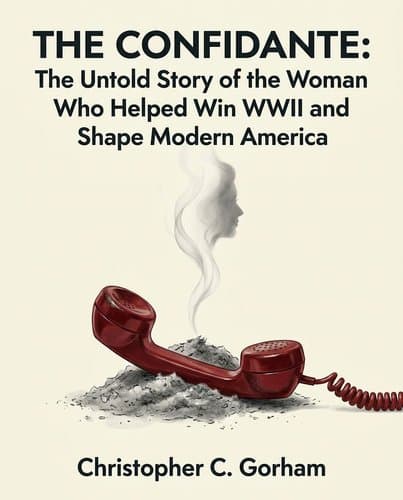
61192830_the-confidante
by Christopher C. Gorham
She helped win WWII and draft postwar policy—then vanished from history because she worked by phone, not memo, and gave away credit instead of keeping it.
In Brief
She helped win WWII and draft postwar policy—then vanished from history because she worked by phone, not memo, and gave away credit instead of keeping it. Anna Rosenberg's story exposes the hidden cost of wielding power through trust rather than paper trails.
Key Ideas
Personal trust becomes fragile across generations
Influence built on personal trust and verbal communication is powerful in the moment but fragile across generations — it depends entirely on the person who trusted you still being in power, and it leaves nothing for historians to find when that person is gone.
Identity-based attacks transcend anonymity
Operating without seeking credit or leaving a paper trail can protect you from frontal attacks, but identity-based attacks — targeting someone as Jewish, immigrant, woman, or New Dealer — find you regardless of how carefully you've stayed in the background.
De facto power exceeds official titles
The gap between formal title and actual authority is larger than institutional history acknowledges — Anna was described as 'de facto Secretary of Labor' while Perkins held the position, and she appeared on FDR's appointments calendar more easily than most cabinet members despite holding no cabinet role.
Giving credit away builds lasting leverage
Giving away credit consistently, over decades, builds a specific kind of trust — the kind that gets a union boss to abandon organizing drives at classified sites on nothing but a presidential promise relayed through an intermediary. Credit-taking builds visibility; credit-giving builds leverage.
Documentation choices erase historical significance
The historical record is shaped by who chose to document their work, not solely by who was consequential. Those who operated through phone calls rather than memos, and burned their correspondence rather than depositing it in archives, have been systematically removed from our understanding of how power actually worked.
Who Should Read This
History readers interested in Political Figures and World History who want a deeper understanding of how we got here.
The Confidante: The Untold Story of the Woman Who Helped Win WWII and Shape Modern America
By Christopher C. Gorham
12 min read
Why does it matter? Because the woman who helped shape the American century chose to disappear from it — and the cost of that choice is still being paid.
History records its powerful figures carefully. FDR has his presidential library. Marshall has his biographers. Frances Perkins has her biographers. But General Walter Bedell Smith, Eisenhower's wartime chief of staff, said FDR relied on one person more than anyone outside his personal secretary. She left behind almost nothing. No memoir. No archived correspondence. She refused a biographer four times, burned the president's letters rather than let them survive, and told Edward R. Murrow on camera, "That's a book that will never be written." She meant it as pride.
Her name was Anna Rosenberg. The American social contract — Social Security expansion, the GI Bill's education provisions, military desegregation, the first federal ban on racial discrimination in hiring since Reconstruction — was shaped at its decisive moments by a Jewish immigrant from Budapest who deliberately left no paper trail. This book is the paper trail she refused to leave.
Before She Was FDR's Most Trusted Wartime Adviser, She Was Standing in a Liberated Death Camp With Nothing But Lipstick in Her Purse
April 1945. A woman in a borrowed Army uniform climbs down from a jeep at Nordhausen, a Nazi concentration camp liberated days earlier by American troops. Around her: pyres of corpses. Survivors in tattered striped uniforms shuffle past, eyes unfocused. Medics race between the living and the dying. A woman — one of the survivors — spots her and slowly crosses the yard. After a moment, the woman in the Army uniform reaches into her purse and a briefcase she always carried, and presses what she finds into the survivor's filth-caked hands: a lipstick. Some pencils. She is immediately ashamed. How could she give lipstick and pencils to a starving woman?
Then she sees the survivor's face close around the objects. "It was the first thing she had owned in years," Anna later recalled. "Everything had been taken from her. Even her name had been blotted out by the Nazi stamp 'Juden.'"
Anna Rosenberg was there on personal orders from Franklin Roosevelt. The Chicago Tribune had written that she was "perhaps the closest person to FDR during the war years, with the exception of Harry Hopkins" (his closest wartime aide). General Walter Bedell Smith was more direct: FDR relied on her, he said, more than any other single individual — the President's own secretary included. In 1945, she became the first person in American history, man or woman, to receive the Presidential Medal of Freedom.
You have almost certainly never heard her name.
The gap is disorienting because of what the influence actually touched. Anna Rosenberg pushed Roosevelt to sign Executive Order 8802, opening defense industry jobs to Black Americans. She protected the secrecy of the atomic program before most officials knew it existed. She helped shape the G.I. Bill, the legislation that arguably built the American middle class. By 1944, her labor mobilization blueprint had become the national model for deploying the country's workforce at war.
That is the résumé of someone history wrote out deliberately — erased by gender, immigrant status, and a 1950 McCarthyite smear campaign that exploited the coincidence of her last name with atomic spies Ethel and Julius Rosenberg. "I was Jewish, an immigrant, pro-labor, and a woman," she said later. "What could have been worse?"
She Never Sent a Memo, Never Took Credit, and May Have Used a Phone That Wasn't Connected to Anything — That Was Exactly the Point
In the early 1940s, Anna Rosenberg ran monthly meetings in the Hotel Astor ballroom in Times Square. She was directing emergency operations across four states, with David Rockefeller as her assistant. Military commanders, industrial leaders, and city officials sat at a long table. On that table sat two telephones: one black, one red. The red one, she said, was a direct line to the White House.
One month, a Navy admiral reported he couldn't deliver promised housing at the Yard because lumber wasn't available. Anna picked up the red phone. She said a few words. She said "dollink." She hung up. The lumber arrived.
A staff member who attended those meetings later said he could never determine whether the red phone was connected to anything, or to the White House in particular. And yet: the lumber appeared. So did missing plumbing. So did scarce medical supplies. Whatever the phone was or wasn't, it worked.
Anna Rosenberg built her power like a password.
Think of the difference between a key and a password. A key is mechanical — it either fits the lock or it doesn't. A password works differently: it functions because a network of people has agreed to treat it as valid. The key belongs to whoever holds it. The password belongs to whoever the network trusts.
By 1941, Anna had spent two decades accumulating the kind of trust that makes institutions move. She had run thousands of calls, each one ending with "goodbye, dollink," building relationships across New York's labor halls, city agencies, investment houses, and union locals. When she reached FDR's scheduler, she got through. When she called a general, he called back.
Her method was built to be invisible. She gave credit to the people she negotiated with. She never sent memos if a call would do. She never sought titles when access was available. She was listed on White House calendars, when she appeared at all, as "Miss Rosenberg" — schedulers assumed someone this close to the President must be unattached, which made her appear smaller than she was. That suited her fine. The only ledger recording what she'd actually done was kept in other people's heads.
The phone's ambiguity was the proof, not the exception. The network was real even when the wire might not have been.
She Talked a Union Boss Out of Organizing the Manhattan Project, Got an Executive Order Signed With a Hatbox, and Rewrote the G.I. Bill From Battlefield Notes
In the fall of 1943, Anna Rosenberg walked from the White House to the headquarters of the Congress of Industrial Organizations, the country's dominant labor federation, carrying nothing but FDR's word and her own reputation. Philip Murray, the CIO's Scottish-born president, had heard about the mysterious mass layoffs at the University of Chicago: physicists and chemists dismissed without cause after 60 or 90 days, workers with an unambiguous legal right to organize. Murray was ready to fight.
Anna had never asked Murray to back off an organizing drive, not once in a decade, and she said so when she sat down. She had come to ask him to do it now.
"The President assured me it was absolutely necessary for national security," she told him.
Murray asked why.
She had seen Secretary of War Stimson's letter to FDR. She leveled with him about what was being built.
The labor leader took a moment. "You are asking me to do a tough thing," he said. "But I'll do it."
"Okay. And Phil — lay off Berkeley, the radiation lab. Ask no questions."
This was the transaction at the heart of Anna Rosenberg's wartime power: not a memo, not a legal threat, but the accumulated weight of a decade of keeping her word. A Secretary of Labor could not have done what she did in that room. A formal demand would have produced a formal response: a grievance filed, a legal challenge, publicity of exactly the kind that would have exposed the bomb. What shut down the organizing drive at the Manhattan Project's two most critical research sites was Murray's trust in one person, built up over years of Anna never asking for anything she didn't need.
Workers at the university labs were being terminated in rotating batches to prevent them from piecing together what they were building. Dismissed without cause, without explanation, they had every legal right to organize. Anna extinguished that legal protection with a single conversation. The workers who had organized "underestimated the power that was going to be lined up against us," one later said. What they couldn't have known was that the power wasn't institutional. It was personal.
The same mechanism had worked two years earlier, but in reverse: pushing FDR to act rather than asking Murray to hold back. By June 1941, 100,000 Black Americans were preparing to march on Washington to protest their exclusion from defense industries that explicitly refused to hire Black workers except as janitors. Roosevelt had dispatched his best liberal operatives to New York to stop the march and failed. He delayed, deflected, bargained. After ten days of stalled drafting, Anna returned from a shopping trip in Georgetown carrying a hatbox and a folded draft executive order in her purse. She walked straight to his desk, spread the papers across it, and put a pen in his hand.
"Sign it, Mr. President; sign it!"
Executive Order 8802, the first federal prohibition on racial job discrimination since Reconstruction, was signed two days later. Anna was not listed as its author. She faded from the picture, as she always did. But the Fair Employment Practices Committee it created mirrored the compliance agencies she had run in New York, and its initial membership included two people she personally recommended.
No formal appointee could have walked into the Oval Office at that moment, uninvited, and made signing feel less optional than not signing. That required something a title couldn't confer.
The mechanism worked in a third direction too: not blocking action, not forcing it, but seeding an idea. Traveling through the Pacific in 1944, Anna ate C rations off a jeep hood with enlisted men who told her, with more resignation than bitterness, that if they had a college education they'd be lieutenants by now. She filed the observation and reported it to FDR the next morning. He lit up. He directed Samuel Rosenman and Harold Smith to "come up with something." The 1945 amendments that turned the G.I. Bill into an education bill followed within months — a policy change affecting millions of veterans, started in the field, by someone with no formal role in veterans' affairs.
When McCarthy's Network Called Her a Communist, Everything That Made Her Indispensable Became a Bull's-Eye
On December 8, 1950, Ralph De Sola walked into a Senate hearing room, swore to tell the truth, and claimed he had once spoken to Anna Rosenberg at a Communist cell meeting fifteen years prior. He had spent the previous night at Senator McCarthy's office (Room 254), which mattered because McCarthy held no seat on the Armed Services Committee running the hearing.
Whoever assembled the attack had done the same accounting Anna's allies had done for years. Jewish, Budapest-born, FDR loyalist, pro-labor, a woman, and now sharing a surname with atomic spies Julius and Ethel Rosenberg, arrested that summer. Each of those facts had built her effectiveness. In 1950, every one was a mirror image in McCarthy's playbook. The traits that got her through doors made her a perfect canvas for the word "Communist."
Marshall had recruited her because the Korean War had exposed catastrophic unpreparedness: the Army needed to triple in size, fifty-plus agencies shared personnel decisions, and no one in Washington could navigate that tangle like Anna. She took the job reluctantly, cutting her consulting income to a government salary and leaving her husband sick in New York. The day after her appointment, Fulton Lewis, a conservative radio commentator with sixteen million nightly listeners on five hundred stations, told his audience she was linked to Communist Party cells. He cited no evidence. He didn't need to.
Her first confirmation hearing, November 29, had been a masterclass in her range. She opened with practiced self-effacement: apologizing for nerves, describing her wartime direction of the northeastern labor force as "part-time jobs" at thirty-five dollars a week to support a sick husband. Then she pivoted. Her clients included all five Rockefeller brothers, Alfred Vanderbilt, Lazard Frères, Pfizer, Macy's. "Most of my clients are Republicans," she told the committee, "and my fees are large." All thirteen senators confirmed her in seventy minutes.
McCarthy then found a sworn affidavit, persuaded the Senate Minority Leader to delay the full vote, and sent the proceedings back. When De Sola's connection to Room 254 emerged in open testimony, the committee was visibly shaken: coordination between a witness and a senator not on the committee was not what they had expected. But McCarthy had calculated correctly; in that climate, the hearing itself was the weapon. Just the fact of a reopened loyalty proceeding had ended the career of Dorothy Kenyon, a prominent civil rights attorney, and Esther Brunauer, a State Department official and UNESCO delegate.
What happened next is why the scene survives. After two and a half hours of De Sola's testimony, he looked Anna up and down and announced he recognized her. The room went silent.
"It's a goddamned lie."
Senator Herbert Lehman, attending as a spectator, was in tears. Fifty years of careful credit-giving, quiet calls, invisible maneuvering — none of it constituted a record that could defend her from an identity-based attack. The only thing that could was genuine outrage, and she had saved enough of it.
De Sola's case unraveled within days. His ex-wife described his instability; former colleagues called him compulsively dishonest; fifteen ex-members of the John Reed Clubs, Communist Party-affiliated writers' organizations, testified they had never heard of any Anna Rosenberg. The FBI file contained, in the committee's own words, "not a word" of damaging material. The actual Communist writer named Anna Rosenberg was eventually found living in California.
In the Senate corridor afterward, Lyndon Johnson scolded her for swearing — especially, he said, a woman. She told him he'd say the same if falsely accused of disloyalty. He admitted it. "But that's all right. I'm a man." A thirty-five-year political alliance began in that hallway. LBJ's later legislative work on labor and social welfare would reflect her influence more than official Washington knew. The crucible made her visible in a way the shadows never had.
The Same Operating System That Made Her the Most Effective Operator in Washington Made Sure History Would Lose Her
Was Anna Rosenberg erased by history, or did she help it along?
The doctrine that would govern her entire career was installed when she was twenty. Belle Moskowitz, the most powerful woman in New York politics and de facto chief of staff to Governor Al Smith, had hired Anna Rosenberg to manage logistics for Jewish charity banquets. The lesson came with the job. Moskowitz never grabbed credit for the speeches she wrote or the legislation she shaped; she directed it all toward Smith. Her counsel to the younger woman was blunt: "Women in politics can achieve more behind the scenes than in office." Anna heard it. She lived by it for the next sixty years.
That doctrine maximized her reach during her lifetime. The invisible position was also the protected position. She could function as the de facto Secretary of Labor without absorbing the abuse hurled at the actual Secretary of Labor. She could deliver bad news to James Byrnes, FDR's domestic mobilization chief, on the president's behalf without becoming the story. She could walk a labor leader into standing down from organizing the Manhattan Project precisely because she wasn't formally anyone. Just a woman with relationships, a phone, and a reputation for keeping her word.
But doctrines applied for fifty years have consequences. She refused every memoir offer from major publishers. She told Edward Murrow directly: no memoir, ever. She issued no memos. The telephone was her instrument, not the typewriter, and calls leave no archive.
The burned letters are where it ends. Toward the end of her life, Anna told her driver Cleotha Gibbs something she had never made public: Roosevelt had sent her love letters — daily, in envelopes arriving straight from the White House. Then she said what she had done with them. Burned them. Not because they were embarrassing, but because FDR's son James wanted them, and she refused to let private correspondence between her and the president she revered become material for a playboy's memoir. She told Gibbs this in the back of a moving car, then turned to look out the window. They drove on.
That is the final act of the Moskowitz doctrine: destroying the evidence of the thing you valued most, because the alternative was handing it to someone who would use it wrong. She had spent her life building influence by giving credit away. She spent her last years making sure even the private record couldn't be claimed.
The paradox is exact. The doctrine that made her irreplaceable — stay invisible, issue no memos, give credit away, work the phone — is what left the archive empty. Scholar Anna Kasten Nelson called her a "pioneer with no followers." You cannot follow a model no one documented. The most effective operators are, by design, the ones the record loses.
Whether that was wisdom or a trap, she never said.
The Letters She Burned
She didn't burn them out of shame. She burned them because she wouldn't let private letters become material for someone else's account — the same reflex behind every memo she never sent and every credit she quietly gave away. The operating system, one final time.
You can call that wisdom, or you can call it the trap finally closing. Probably it was both. The question Belle Moskowitz's advice left behind — liberation or a cage dressed as strategy — is worth carrying out of the book.
Notable Quotes
“casually met 15 years ago.”
“And you remember talking to Mrs. Rosenberg on only one occasion?”
“in the Roosevelt administration and, accordingly, there had been no reason to sound the alarm. But now”
Frequently Asked Questions
- What is The Confidante about?
- The Confidante recovers the hidden career of Anna Rosenberg, a Jewish immigrant who advised FDR, negotiated with union bosses, and shaped wartime labor policy during WWII. She deliberately avoided seeking credit and left no paper trails, enabling extraordinary influence through personal trust and verbal communication. However, this same method ensured her erasure from the historical record. The book examines how operating outside formal structures allowed Rosenberg to wield power comparable to cabinet members while remaining largely unknown to history, exploring the paradox of influence built on personal relationships — powerful in the moment but fragile across generations.
- What are the key takeaways from The Confidante?
- The book reveals five critical insights about power and historical documentation. First, influence built on personal trust is powerful immediately but fragile long-term once that person loses power. Second, operating without credit or paper trails protects against institutional attacks but not identity-based discrimination. Third, actual authority often far exceeds formal titles — Anna was described as "de facto Secretary of Labor" despite holding no cabinet position. Fourth, consistently giving away credit builds leverage in ways credit-taking cannot. Finally, those who operated through phone calls and burned correspondence have been systematically removed from historical understanding, meaning the record reflects who documented work, not who was consequential.
- Who was Anna Rosenberg and why is her story important?
- Anna Rosenberg was a Jewish immigrant whose decades-long career advising presidents and shaping wartime labor policy remained largely hidden because she deliberately avoided seeking credit. Operating through personal relationships and verbal communication rather than formal channels, she wielded extraordinary influence—appearing on FDR's appointments calendar more frequently than most cabinet members despite holding no official cabinet role. Her erasure from the historical record despite her consequentiality demonstrates how the gap between formal title and actual authority is larger than institutional history acknowledges. Rosenberg's story reveals how women, immigrants, and those working outside official structures have been systematically removed from our understanding of how power actually operated during critical historical periods.
- How did Anna Rosenberg build influence without formal authority?
- Rosenberg built extraordinary leverage through a method most institutional histories overlook: consistently giving away credit. "Credit-taking builds visibility; credit-giving builds leverage." By operating through personal trust and verbal communication with key figures including FDR and union leaders, she created relationships of unusual strength. A union boss would abandon organizing drives at classified sites on nothing but a presidential promise relayed through her as intermediary—demonstrating the depth of trust she'd cultivated. However, this approach had a critical weakness: it left no paper trail, no memos, no archived correspondence. Once those who trusted her died or lost power, nothing remained for historians to document.
Related Book Summaries
Read the full summary of 61192830_the-confidante on InShort