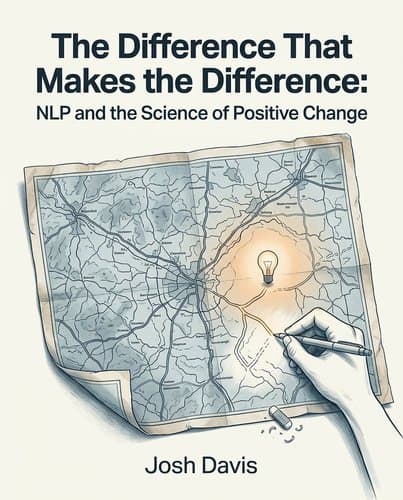
217388068_the-difference-that-makes-the-difference
by Josh Davis, Greg Prosmushkin
Your reality is a mental model you unconsciously built—and NLP gives you the tools to rewrite it. Learn to dissolve stuck beliefs, set goals your brain can…
In Brief
Your reality is a mental model you unconsciously built—and NLP gives you the tools to rewrite it. Learn to dissolve stuck beliefs, set goals your brain can navigate toward, and influence others by mastering the one reframe that separates those who change from those who can't.
Key Ideas
Five Diagnostic Questions Clarify Every Goal
Before pursuing any goal, run it through five diagnostic questions: Is it framed as what you want (not what you don't want)? Will getting it create other problems? Is it within your control? Can you define success specifically? When and where do you want it? Vague goals have no destination for the brain to navigate toward.
Communication Meaning Equals Response Received
When a conversation stalls or escalates, stop defending what you meant and take ownership of what was received. The meaning of your communication is the response you get — and accepting that shifts you from victim of misunderstanding to agent of repair.
Cartography Questions Melt Frozen Language
The next time you catch yourself using 'always,' 'never,' 'people,' 'should,' or a frozen noun like 'trust' or 'freedom,' ask the cartography question: Who specifically? How specifically? What would happen if? These questions don't just clarify — they melt stuck states back into navigable actions.
One Belief Shift Unlocks Skill Mastery
To model a skill someone else has, don't just observe their behavior — get curious about their internal logic. Ask what they believe about the task, how they feel while doing it, what they picture. The 'difference that makes the difference' is usually one belief or one reframe, not a technique.
Pacing Creates Space for Influence
When you need to influence someone's state or belief, pace first. Match their language, their energy, their current frame — then lead. Skipping pacing doesn't save time; it creates resistance that costs more time than the pacing would have taken.
Structural Edits Transform Emotional Memory Weight
To change the emotional weight of a memory or anticipated event, change its structural features: move the mental image further away, shrink it, turn down its volume, or shift your perspective from inside the scene to watching it on a screen from a distance. The brain responds to these structural edits as if they were real.
Anchor Peak States With Repeated Triggers
Install anchors deliberately: associate deeply into a resourceful state, activate a specific cue (a gesture, a word, a touch) at the peak of that state, then repeat. Over time the cue becomes a reliable on-ramp to that state — a circuit you can trigger rather than wait for.
Who Should Read This
Readers interested in Self-Improvement and Cognitive Psychology, looking for practical insights they can apply to their own lives.
The Difference That Makes the Difference: NLP and the Science of Positive Change
By Josh Davis & Greg Prosmushkin
15 min read
Why does it matter? Because the resistance you feel isn't coming from the world — it's coming from the map you've drawn of it.
You think the obstacle is out there. The difficult colleague, the career that won't move, the version of yourself that keeps arriving late to your own intentions. But there's a more unsettling possibility: the obstacle has an address inside your skull. Somewhere between reality and your response to it, you built a mental model — a map with hidden assumptions baked in about what's possible, who you are, and what certain situations mean — and you built it so early, so automatically, that you've been mistaking it for the world itself ever since. This book is about that model. How to read it, how to find where it breaks down, and how to rewrite the specific structures that keep turning your most reasonable efforts into the same familiar dead end. The world didn't build your cage. You did. That's actually the good news.
Your Brain Isn't Showing You Reality — It's Showing You Its Best Guess
Picture two sets of football fans watching the same stadium screen after a collision on the pitch. The same footage plays, the same bodies collide, the same referee raises his card — and each side watches with mounting certainty that the replay is vindicating them. The fans whose player fell see deliberate aggression, clear as day. The fans whose player was ejected see a good-faith challenge, nothing more. The more times the jumbotron rolls the footage, the more convinced each side becomes. Nobody is lying. Nobody is pretending. They are, in the fullest sense, seeing different things.
This is what the authors want you to sit with, because it is genuinely uncomfortable: your brain does not deliver reality to you. It delivers a version it has constructed — stitched together from expectations, past experiences, and whatever you already believe is true. The brain receives an overwhelming flood of raw sensory data every waking second and discards the vast majority of it, filling the gaps with what it predicts should be there rather than what's actually there. Your perception feels like a live feed. It's closer to a heavily edited highlight reel.
The implications land hard once you see them. That argument where you and the other person both walked away convinced the other was being unreasonable? You weren't disagreeing about what happened — you were reporting from two different internal broadcasts of the same event. Presenting more facts rarely helps, because the facts get filtered through the same lens that created the disagreement in the first place. The model shapes what the evidence means before you've even started talking.
Call it a mental model — the invisible blueprint that decides, before you've consciously noticed anything, where you can and cannot go. The unsettling part isn't that other people run on one. It's that yours feels indistinguishable from clarity.
Failure Only Feels Like a Verdict Because You're Using the Wrong Frame
Think of a GPS. You miss a turn, and the device doesn't pause to question whether you're the kind of person who misses turns. It doesn't catalog the error as evidence of some deeper inadequacy. It just recalculates and offers the next instruction. The destination hasn't changed. The device simply updates the route from wherever you actually are.
That contrast — between the GPS's quiet recalculation and the spiral most people enter after something goes wrong — points at something the authors call the feedback frame. The word 'failure' isn't a fact. It's a choice of frame, and that choice has measurable consequences inside the brain.
In one set of studies, participants were shown the same photograph of a person lying ill in a hospital bed. Same image, same facts. But different groups were guided toward different interpretations. Those who framed it as someone suffering, possibly dying, possibly leaving people behind — their brains showed elevated negative emotional activity. Those who framed it as someone exhausted but taking care of themselves, likely to recover — measurably less distress, less arousal in the emotional centers. After a few practice sessions with the new frame, the effect persisted on later encounters with the same image. The facts hadn't changed. The meaning had. And the meaning rewired what the brain actually did with the incoming information.
The failure frame doesn't just feel bad — it actively degrades what your brain does next. When the mind is busy judging, it captures less of the information that might actually help. The feedback frame does the opposite: it orients attention toward what can be learned and used.
Greg Prosmushkin, one of this book's co-authors and now a prominent trial lawyer, lost his first jury case early in his career. His initial read was the failure read — maybe he wasn't suited to trial work, maybe he should find a different lane in law. That frame would have ended the story there. What he eventually did instead was ask a different question: what does this loss actually tell me about how trials work and what I need to do differently? That reframe converted the same event from a verdict on who he was into data about what to do next. The destination — becoming an effective trial lawyer — didn't change. He just recalculated from where he actually was.
The Brakes Were Rubbing the Whole Time
One morning, Josh climbed onto his bike with his four-year-old son strapped into the back seat and started pedaling toward preschool. Every stroke felt like pushing through wet concrete. He kept trying to find a rhythm that would make it easier, assuming he was just tired, maybe coming down with something. After dropping his son off, he wheeled the bike along the sidewalk — and heard it. A faint scraping sound. The brakes had been pressing against the wheel the entire ride. Not hard enough to stop him, just hard enough to make every inch feel like a fight.
Most unfinished goals feel exactly like that. The people working toward them assume the difficulty is the point — that wanting to lose weight is just hard, that starting a business is just scary, that changing a relationship pattern is just slow. But often the drag is structural, built into how the goal is framed before a single step is taken. The authors call this the brakes-rubbing problem, and they offer five diagnostic questions to locate it.
The first is also the most common source of drag: is your goal moving toward something, or away from something? Greg spent years telling himself he didn't want to be fat. Real motivation — but no destination. The moment he converted it into '215 pounds, BMI of 20, 15 percent body fat,' something shifted. Not because he wanted it more, but because his brain now had coordinates. The Away system drives urgency through anxiety; the Towards system drives movement through desire. Same person, same goal, completely different motivational architecture.
The remaining four questions each target a different kind of hidden drag. Will achieving this goal break something else in your life? Andy kept sabotaging her financial goals because, in her mental model, wealth meant becoming an absent mother — so every step forward triggered an unconscious correction backward. Is this actually within your control? Can you define what success looks like clearly enough that your brain can register progress — not someday, but this week? And when, specifically, do you want it? A goal without a deadline isn't a goal; it's a preference. Any one of these can keep the brakes rubbing without you ever knowing why the ride feels so hard.
The Story You Tell About Other People Is Mostly About You
Josh had just finished rearranging his week to carve out time for his daughter during her school break — two hours a day, the rest spent working, already feeling like it wasn't enough. At dinner, she looked up and asked, 'Why do you have to work?' He felt the familiar squeeze. After everything he'd reorganized, she was angling for more. He started assembling the lecture: be grateful for what we have, I'm doing my best, this is how it works. Then she kept talking. She wanted to know what his writing and teaching actually did — how it helped people, where the money went. She wasn't asking for more time. She was just curious about his life.
Every interpretation Josh had loaded onto six words was entirely his own. The facts were a question. The meaning — resentment, ingratitude, impossible expectations — came from somewhere inside him, not from her.
When your message lands differently than you intended, the received version is what's actually in the room. Your intent is a private document. No one else has access to it.
The instinct is to defend anyway — to explain what you actually meant, why their reading is wrong, how they'd see it your way if they'd just listen properly. Call it the defensive move. It almost never works, because it asks the other person to abandon their genuine experience in exchange for yours. The responsible move starts from the opposite assumption: the gap between what you meant and what they heard is your problem to close, not theirs.
Greg learned a version of this in front of juries. 'You are mistaken' and 'You are wrong' are dictionary synonyms. In a courtroom, one lands as a respectful correction; the other lands as an attack. The words aren't the message. The message is whatever detonates inside the listener. Once he understood that, he stopped treating communication as transmission — information packaged and sent — and started treating it as a feedback loop where the only measure that matters is what actually arrived.
The discomfort is real: taking ownership of the gap means giving up the comfort of being technically right. But technical rightness and effective communication are different games, and confusing them is exactly how most misunderstandings survive.
Most Daily Friction Is Caused by Words That Sound Specific but Contain Nothing
Vague language is not a stylistic habit. It is a structural feature of how problems stay unsolvable — and it connects directly to the communication gap: when people talk past each other, they are usually hiding inside imprecise words, not withholding information.
Here is what that looks like in a real conversation. A husband comes home from work and his wife asks how his day went. He says something went wrong, that at least it's over, that he's tired. She offers sympathy. He reassures her it's fine. She suggests dinner. The conversation lasted three minutes and communicated almost nothing. If she had simply asked, 'Tired — you mean physically, or tired of something?' the answer that surfaced was this: 'I'm over doing these kinds of events. I'm tired of this job. It's time to find something new.' The whole conversation had happened without contact. Not because either person was withholding, but because deletion — leaving out the referent of a sentence — had hollowed out every exchange. 'At least it's done' sounds like a complete sentence. It has a subject, a verb, even a sense of resolution. But the thing that is done, what was hard about it, why it matters, what comes next — all of it missing.
The same trap operates at a larger scale when people swap specifics for abstractions. A consultant named Kara wanted to leave her job and start her own company but kept telling herself that 'people would think she was irresponsible.' That felt like a wall. Her friend finally asked, 'Who, specifically?' The question sounds almost rude in its literalness, but it did something precise: it forced a vague crowd of invisible judges to resolve into actual faces. After a pause, Kara named two — her husband and her mother. A verdict from 'people' cannot be argued with or addressed. Two conversations with two specific people can. The wall dissolved into a to-do list.
The same mechanism runs through words like 'trust' and 'respect' and 'communication' — what linguists call nominalizations, verbs that have been frozen into nouns. When a colleague says 'there's no trust in this office,' trust sounds like a substance that has run out, a fixed condition that either exists or doesn't. Asking 'How, specifically, are people not trusting each other?' thaws it back into behaviors. Suddenly the conversation is about who withholds information in which meetings, or whose decisions get second-guessed publicly. Something you can actually work with.
And then there are words like 'always' and 'never' — words that seal a problem inside a permanent verdict. Albert Ellis, one of the architects of modern cognitive therapy, used to shout at patients in his thick New York accent, 'You're should-ing all over yourself!' The comedy concealed the serious point: 'I should' and 'I should never' are not descriptions of reality. They are compressions of judgment, helplessness, and moral self-condemnation, dressed up as obvious facts.
The questions that cut through all of this are almost embarrassingly simple. What does this pertain to? Who, specifically? How, specifically? Really — always? Their power is not rhetorical. They work because they force vague mental structures to become specific enough to be examined, and once something is specific enough to be examined, it is almost always smaller and more manageable than it felt a moment before.
If They Can Do It, You Can Learn to Do It — That's Not Optimism, That's Modeling
Once you start hearing the gaps in your own language, the next question is where better language comes from — and the honest answer is: from people who already think differently than you do. When a colleague makes decisions effortlessly while you agonize, or someone walks into a room and immediately puts people at ease while you're still rehearsing your opening line, the assumption most people carry, quietly and tenaciously, is that the gap is constitutional. They're wired differently. You're not.
That assumption is what this book wants to dismantle, and it does it with something embarrassingly concrete. At a cocktail party, Josh got talking to a senior executive who visibly did not suffer from decision fatigue — the kind of person who commits quickly and is usually right. Instead of writing it off as personality, Josh asked if he could interview her about how she did it. She agreed. The conversation covered a lot of ground, but the piece that changed everything was a single belief she held: if a decision feels difficult, it just means I don't yet have the information I need to make it easy. Not a technique, not a personality trait — a frame. Decisions, in her model, weren't tests of nerve or intuition. They were information-gathering problems. When Josh hit a hard decision after that conversation, instead of reading the difficulty as evidence of his own inadequacy, he started asking: what would I need to know to make this easy? That question has a path. The old interpretation had a dead end.
Modeling, as the authors use the term, isn't imitation. It's reverse-engineering the internal logic of someone who excels at something you struggle with. The insight isn't that you should try harder. It's that the person doing it well often holds a belief that makes the skill feel natural — and that belief is transferable in a way raw talent is not. You can interview someone. You can read their account. You can ask the right questions and walk away with a mental model you didn't have before.
Once you see this, the fixed-wiring story collapses. Excellence in most domains that involve thought, behavior, or interaction turns out to be a learnable architecture. The fastest way in is interviewing the person who already does it well.
Every Behavior Has a Positive Intention — Even the Ones That Drive You Crazy
Before this section, the book has been building a vocabulary for how experts read other people — tracking eye movements, mirroring physiology, listening for the words someone reaches for. Now it puts that observation in service of something more counterintuitive: the thing you're observing isn't the problem.
A woman in the audience had been interrupting Josh's conference session every few minutes, each question edged with skepticism — not useful, not realistic, won't work in my organization. The room was starting to feel it. Josh could have defended the material, pushed back on her tone, or simply moved on. Instead he paused and named what he actually saw: 'It seems like you're putting a lot of effort into figuring out whether these ideas can work for you.' Her posture changed on the spot. She wasn't hostile — she was anxious about applying this stuff in a resistant organization, and that anxiety had been wearing the mask of dismissiveness. Once he spoke to the intention underneath, she stopped being an obstacle and started helping the whole room think more clearly.
Every behavior, no matter how obstructive, has a positive intention running underneath it. Not sometimes — every time. That claim will irritate you if you've ever dealt with a genuinely difficult person, and the authors know it. They're not saying bad behavior is fine. They're saying the behavior is the wrong target. The behavior is how someone is trying to meet a need. The need is where the leverage lives.
Josh's nightly dessert sabotage makes this concrete. He kept undermining his diet after dinner, and the obvious response was self-criticism — willpower problem, character flaw, try harder. Instead he asked why dessert mattered. Surface answer: it tasted good. Asked again: it marked the end of a hard day, made the evening feel like a reward instead of a continuation of effort. That's a legitimate need — marking the end of effort, reclaiming the evening — just met through the wrong method. He found other ways to meet it. The weight came off within a month, not because he'd found more discipline but because he'd stopped fighting himself and started negotiating.
That two-step — why does this matter, then why does that matter — is the diagnostic. Ask once and you get the surface behavior. Ask again and you reach the value underneath, which is almost always worth respecting. The behavior stops looking like the enemy and starts looking like a bad solution to a real problem. That reframe doesn't excuse anything. It just shows you where to actually intervene.
You're Not Living Reality — You're Living Your Posture, Your Language, and the Distance of the Image in Your Head
Your emotions are not responses to situations. They are responses to mental representations of situations — and that distinction hands you a lever most people don't know exists.
The brain doesn't process raw reality. It processes images, sounds, and feelings it constructs internally, and those representations have structural features: how close the image sits, how bright it is, how loud the voice, whose eyes you're looking through. Change those features and you change the emotional weight, the way adjusting the crop on a photograph changes what the image means without altering a single underlying fact.
Laura, a seasoned consultant, had been hired by a small firm whose CEO had a pattern of testing anyone who would work with clients — and systematically dismantling them. Every time she tried to prepare her presentation, she heard his voice saying her name in that particular way he reserved for disappointment, and saw his face hovering close in her mind, disapproving. She kept stumbling through practice runs. With an NLP coach, she made one structural change: took his mental image, shrank it, pushed it to the far distance, added a clown nose and monkey arms, and ran his voice up to a squeaky mouse pitch. Nothing about the CEO changed. The brain doesn't distinguish between vividly imagined and actually seen — which is why his hovering face was already changing her body chemistry before she'd said a word. Editing the settings on that image wasn't denial. It was adjusting a representation that had been shaping her physiology whether she touched it or not. Freed from that hovering presence, she focused on her own judgment and outperformed every person who had taken the test before her.
Greg's legal work shows what happens when you pull the distance in rather than push it out. In a standard deposition, a witness says 'I was hit in the back' and 'it was a pretty hard hit' — abstract, past-tense, emotionally flat. Greg guides witnesses differently: he asks them to place themselves back in the seat, see what they were seeing, feel what they were feeling. The same person, the same memory, produces something entirely different — 'something that smells like burned rubber explodes with a woosh' and 'I feel my body thrown around like a bowling pin.' That's not coaching the content. It's changing the structural form of how the memory is held, and the emotional and sensory vividness follows automatically.
What this means in practice: you don't have to wait to feel differently. You can ask how the scene is being staged right now — how close, how loud, through whose eyes — and adjust.
Meeting Someone Where They Are Isn't Soft — It's the Prerequisite for Moving Them Anywhere
Before anyone follows you anywhere, they need to feel that you're standing where they are — that their current state, their language, their internal weather have actually registered. The research is stark: people who feel genuinely heard will accept unfavorable performance reviews, adapt to new procedures in a crisis, even go along with decisions they dislike — because the process felt fair and respectful, not because they liked the outcome. Feeling heard is the prerequisite, not a nicety you add after the real work is done.
Call it skipping the pace — and the cost is immediately measurable.
Here's what it looks like when it works. Josh's five-year-old was ricocheting around the bedroom at bedtime, talking at full speed, pretending to fall off the bed, entirely impervious to his calm, gentle suggestions that it was time to brush and sleep. He kept meeting her with the energy he wanted her to have. She kept ignoring him. Then he tried something different: he matched where she actually was. Eyes wide, voice at machine-gun pace — brush brush brush, open wide, fast fast fast. Something immediate and almost comic happened. She took her full wild energy and applied it directly to the task. Spit, back, under the covers, snuggled in. No resistance, no delay. He hadn't calmed her down. He'd joined her, and she followed him out.
That's pacing and leading in miniature, and the mechanism is the same at every scale. You go at their pace first — inhabiting their language, their mood, their model of the situation — and only then do you move. Skip the first step and you're pushing against a door that opens toward you.
The Manual You Were Never Given for Your Own Brain
What if the emotional states and beliefs that shape your days aren't things that happen to you, but things you can learn to operate deliberately — like switches that were always there, just unlabeled?
Greg Prosmushkin discovered one of his by accident. When he starts losing his temper with his kids, he licks his finger and sticks it in his own ear. The absurdity of it — the cold, wet shock of a self-administered wet willy — snaps him out of the anger spiral before anything destructive happens. What started as a goofy pattern interrupt became, over repetition, a kinesthetic anchor: a physical cue wired through practice to a specific mental state. The mechanism is simple: repeat the pairing enough times, and triggering the cue pulls the state with it automatically. You can do this intentionally, with any cue that's easy to activate discreetly — a hand position, a phrase, a mental image. The state you want to access, calm before a hard negotiation or focus before a presentation, gets associated to the trigger through deliberate rehearsal. Then it's there when you need it.
The same logic extends to belief. When Nora, an operations leader, needed a skeptical board to approve a million dollars for a factory they'd already written off, she didn't try to argue them from conviction to conviction. She asked them to take one smaller step: to be open to doubting their current certainty that the money belonged elsewhere. Just that. Not belief in her facility — doubt in the opposing view. The board could do that. They approved the funding. Moving from firm conviction to doubt is a manageable step. Doubt to openness is another. Openness to a new belief is a third. Demanding the whole journey in a single argument is why most persuasion fails — it asks for a leap when a step is available.
Once you see this, you start noticing the controls everywhere: in how you enter a room, how you frame a question, how you walk into a conversation you've been dreading. The controls were always there. You just weren't told they existed.
The Map Was Always Editable
Here is what the book is really telling you, underneath all the techniques: the friction you've been absorbing as just-how-things-are has mostly been a feature of the map. Not the territory. The map. And that is not comforting news — it's a transfer of responsibility. If the filter was installed without your awareness, then running it without your awareness from here on is no longer ignorance. It's a choice. But the same logic that makes that uncomfortable also makes it useful, because maps, unlike circumstances, can actually be redrawn. You don't need exotic tools or years of therapy to start. You need the discipline to ask, in any stuck moment, what's actually here versus what I've added — and then the flexibility to try something different when the approach that isn't working keeps not working. The manual existed the whole time. You just picked it up.
Notable Quotes
“Why do you have to work?”
“It’s never enough. She’s not being grateful. I’m being squeezed in all directions and won’t be able to work enough. She is upset.”
“How else could I interpret her question?”
Frequently Asked Questions
- What is The Difference That Makes the Difference about?
- This 2025 work demonstrates how your experience of reality is a mental model you constructed and can deliberately redesign. Using neurolinguistic programming, it provides practical tools for setting precise goals, shifting emotional states, modeling others' skills, and influencing conversations. The book offers a concrete system for transforming stuck patterns into actionable change. Rather than focusing on external circumstances, it emphasizes how intentionally adjusting your mental models—your beliefs, perspectives, and linguistic patterns—creates measurable improvements across communication, skill development, and emotional regulation.
- What framework should I use to set effective goals according to this work?
- Before pursuing any goal, run it through five diagnostic questions: Is it framed as what you want (not what you don't want)? Will getting it create other problems? Is it within your control? Can you define success specifically? When and where do you want it? These questions matter because vague goals have no destination for the brain to navigate toward. This diagnostic approach ensures your goals are neurologically actionable, internally aligned, and actually achievable rather than remaining abstract aspirations that lack a clear destination.
- What techniques does this work offer for changing emotional states?
- This work offers two powerful techniques for emotional change. First, you can alter the emotional weight of memories or anticipated events by changing their structural features: move the mental image further away, shrink it, turn down its volume, or shift your perspective from inside the scene to watching it on a screen from a distance. The brain responds to these structural edits as if they were real. Second, install anchors by associating deeply into a resourceful state, activating a specific cue at the peak, then repeating until that cue reliably triggers the desired state.
- How do you model someone else's skills in this approach?
- To model a skill someone else has, don't just observe their behavior—get curious about their internal logic instead. Ask what they believe about the task, how they feel while doing it, what they picture. The key insight is that "the 'difference that makes the difference' is usually one belief or one reframe, not a technique." Understanding someone's internal framework and fundamental beliefs is far more valuable than simply copying their observable actions. By identifying and adopting their unique beliefs and mental models, you can replicate their expertise in any skill or domain.
Related Book Summaries

Read the full summary of 217388068_the-difference-that-makes-the-difference on InShort