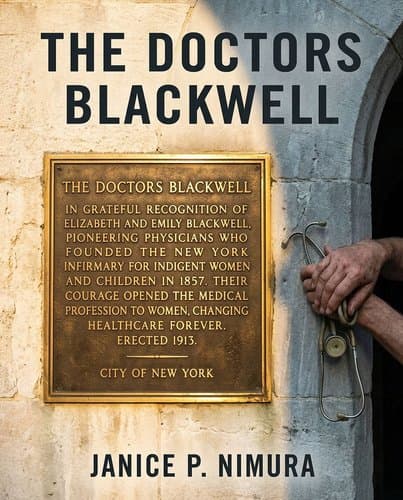
53404774_the-doctors-blackwell
by Janice P. Nimura
History credited one Blackwell sister with breaking medicine's gender barrier—but the other built everything that made it last. Uncover how the myth of the…
In Brief
History credited one Blackwell sister with breaking medicine's gender barrier—but the other built everything that made it last. Uncover how the myth of the lone trailblazer erases the people who actually do the work, and why the monument and the legacy rarely belong to the same person.
Key Ideas
Hidden contributors in pioneer narratives
When you hear a 'lone pioneer' story, ask who was standing beside the pioneer that didn't make the plaque. That person often did more of the actual work — and the myth endures partly because the institution they built is still standing.
Barrier-breakers and builders need different skills
The skills that break barriers (symbolic certainty, willingness to be the exception, tolerance for isolation) are different from the skills that sustain institutions (clinical patience, daily presence, collaborative trust). These roles rarely live in the same person. Knowing which one you are is not a limitation — it is honest self-knowledge.
Conviction enables and blinds simultaneously
Conviction is a launching pad, not a landing pad. Elizabeth's certainty that disease was a moral condition gave her the force to walk into rooms that didn't want her — and also prevented her from accepting germ theory when the evidence arrived. Strong frameworks produce strong blind spots.
Symbols get monuments, daily work endures
The person who gets the monument is often the person who believed most fiercely in their own symbolic importance. The person who showed up every day for thirty years sometimes just gets the work — which turns out to be the more durable legacy.
Ideology sustains conviction while limiting growth
Elizabeth chose medicine explicitly to 'forestall love and explain its absence.' Ideology can sustain a person through rejection that would defeat ordinary ambition — but it can also prevent them from finding what Emily quietly built: a life that was both meaningful and livable.
Who Should Read This
History readers interested in Scientists and World History who want a deeper understanding of how we got here.
The Doctors Blackwell
By Janice P. Nimura
10 min read
Why does it matter? Because the pioneer on the plaque is almost never the whole story.
In 2018, activists unveiled a plaque at Bleecker and Crosby in Manhattan: Elizabeth Blackwell, America's first female doctor. The T-shirts were triumphant. The image was satisfying.
Nimura lets you hold it for exactly one beat before dismantling it. Because standing beside Elizabeth at every breakthrough — every lecture hall door forced open, every degree earned — was her younger sister Emily. More capable surgeon. More devoted clinician. More honest about what medicine actually required. Emily's name appears on none of the plaques.
That erasure is not an accident of history. It is the story. What this book reveals is that breaking a door down and building the room behind it are entirely different kinds of work — and that the myths we make about pioneers almost always honor the wrong sister.
Medicine Was Her Proof That God Was Right About Women — Not Her Calling
The opening of New York's first hospital staffed entirely by women, in May 1857, required a famous man to make it respectable. Henry Ward Beecher, Brooklyn's most celebrated pastor known for his silver tongue, took the podium and declared that women were naturally suited to medicine. Their intuition, their mother wit, their very footstep in a sickroom: all antidotes in themselves. Standing nearby, Elizabeth and Emily Blackwell listened without expression and then applauded with everyone else. They understood the transaction. Beecher's condescension was their best advertisement.
Nobody in that room mentioned that the woman who had spent sixteen years fighting for female doctors to exist found sick people repellent. Elizabeth Blackwell equated illness with weakness. She cared little for people outside her immediate family. The physical body, with all its functions and failures, struck her as — her own word — disgusting.
So why medicine?
At twenty-three, stuck teaching school in Cincinnati after her father's death left the family nearly bankrupt, Elizabeth was reading Margaret Fuller, the era's most forceful advocate for women's intellectual equality, and burning for an object worthy of her ambitions. A dying friend suggested that female physicians could spare women the indignity of male doctors. Elizabeth's first response was dismissal: women who called themselves doctors were quacks or worse. But the idea caught. Not because it moved her toward the suffering patient (she was never much drawn to individual suffering), but because it was a proof-of-concept no one had yet run. If she could earn a medical degree on identical terms as any man, she would demonstrate something divinely significant: that women could reach their fullest potential, and that in doing so, they would raise humanity toward its better self. Medicine was the experiment. She was the evidence.
The reframing explains how she lasted. When every medical school in Philadelphia laughed at her request or stared in appalled silence; when, alone in her boarding room, she dissected a beetle with a hairpin and found only yellowish dust inside; when she taught Sunday school to enslaved children she was legally forbidden to teach to read, practicing defiance of unjust limits wherever she could — wanting to help people would not have sustained her. Empathy fades under that kind of rejection. Ideology doesn't. Elizabeth had assigned herself a sacred mission, and she was constitutionally unsuited to quitting.
Her sister Emily, who would become the more committed practicing physician of the two, was equally honest. She once wrote that sick patients interested her only as scientific illustration, not as people. The Blackwells were not healers who chose medicine. They were intellectuals who made medicine prove something.
The Most Historic Vote in American Medicine Was Cast as a Prank
In October 1847, Dean Charles Lee walked into the Geneva Medical College lecture hall with a letter and an expression even more worried than usual. He had, he announced, received a request unlike anything the faculty had ever been asked to consider: a young woman wanted to enroll. Several prominent schools had already turned her down. The faculty at Geneva had put the question to a student vote, with the stipulation that a single "nay" would settle it against her.
The 113 young men in that room understood two things immediately. Their professors were cowards — too timid to refuse outright, too frightened to agree. And they had just been handed a magnificent opportunity for mischief.
When it came time to debate Elizabeth Blackwell's application, the class clowns competed to outdo each other in theatrical support for a hypothetical female classmate — because what could be funnier than a lady doctor? When the speeches were spent and the vote was called, the room roared "aye." One dissenter managed a tentative "nay" before his classmates dragged him to the front by force. He quickly changed his vote. The students carried their decision in triumph to the horrified faculty, then assured each other the whole thing was probably a prank by a rival school anyway. They had forgotten about it by morning.
Three weeks later, Elizabeth walked through the door.
Stephen Smith, one of the students present, described what followed: for the first time in memory, a lecture proceeded without a single interruption. Every word was audible. A roomful of what Smith called "lawless desperadoes" sat with spines straight and feet flat on the floor, transformed by the presence of a slight woman in a plain dress who took her seat, placed her bonnet beneath her chair, and turned her gaze toward the front of the room. She had not said a word. She had simply appeared, and the joke became something else entirely.
The students who voted aye to mock the idea of a female physician had accidentally made one possible. Now they had to sit next to her.
Breaking a Door Down and Building the Room Behind It Are Different Jobs
The New York Infirmary for Indigent Women and Children opened in May 1857, staffed by female physicians, with a mission to treat poor women and children and train the next generation of doctors — and the person who kept it running was not Elizabeth Blackwell. It was Marie Zakrzewska, a Berlin-trained midwife who had come to America precisely because no European institution would license a woman to practice medicine. She moved into the infirmary's attic as resident physician, woke before dawn to order supplies, led student case reviews while mending sheets at night, and kept the whole household in bed by midnight unless a birth emergency required otherwise. Elizabeth and Emily Blackwell walked over from their house on East Fifteenth Street to staff the morning dispensary hours, then left. When the New York Times ran its first major profile of the infirmary, it devoted a full paragraph to Zakrzewska's credentials and energy and noted that the Blackwells merely "aided" her.
Elizabeth was extraordinarily good at a different kind of work. She could absorb ridicule, frame her cause in terms that kept powerful men from dismissing it outright, and stand before an audience as living proof that a thing previously considered impossible had now been done. What she was less equipped for was staying.
Temperament, not failure. Elizabeth once wrote that she had "boundless love & faith in Man" — humanity as an abstraction — while individual people, in their particular suffering and need, moved her far less. Running a hospital is the opposite of abstraction. It is the same problems returning every morning, solved by whoever is present.
The fullest proof came over a decade later. In November 1868, Elizabeth delivered the opening address at the Woman's Medical College of the New York Infirmary: three years of study, progressive coursework, bedside examinations, higher standards than any comparable school in the country. "It is knowledge, not sympathy, which can administer the right medicine," she told the room. Eight months later, she sailed for England and never came back.
Her memoir called this a logical transition: "the early pioneer work in America was ended." What she left behind sounds different. Emily's note, written in pencil, pointed out that a ten-year partnership with shared names, shared initials, and intertwined reputations shouldn't end without at least six months' warning. The institutions were built around the name Elizabeth Blackwell. Emily would spend years reassuring donors, students, and patients that the college could survive without her sister's famous presence.
She ran it for thirty more years. In April 1897, a messenger woke the household in the middle of the night: the college was on fire. By morning, the building was gutted: equipment lost, the contents of the dissecting room cremated in the blaze. Emily's letter to Elizabeth, written a few days later, mentions the weather and local news, then, nearly in passing, the fire: "We have taken the next house, and made the best arrangements we can. We shall go to work at once to rebuild." Within a year, the college had reopened with an unusually large incoming class.
The institution survived, people said, because it represented "the life work of Elizabeth and Emily Blackwell." Three decades of evidence showed that sustaining a life's work (the daily showing up, the rebuilding after fires, the convincing of people that the mission still existed when its symbol had sailed away) required a different kind of person entirely.
The Certainty That Gets You Through the Door Can Eventually Lock You Out
Elizabeth's certainty was not stubbornness in the ordinary sense. It was philosophical architecture. For her, illness was inseparable from moral condition: fear had caused ship fever among Irish immigrants, licentious behavior caused venereal disease, weak living produced weak bodies. Her framework was complete: disease was always amenable to moral cure. Hygiene, chastity, right living: both prevention and treatment, cause and remedy.
When Pasteur's experiments in the 1860s confirmed germ theory (that specific microbes caused specific diseases, independent of the patient's virtue or choices), Elizabeth refused it. Not because she hadn't read the evidence. Because amoral microbes could not cause disease in her framework. If they did, illness was not a moral condition. And if illness was not a moral condition, the entire architecture of her career (prevention over cure, hygiene as ethics, the body as moral instrument) fell apart. She had built her life on the premise that right living kept disease away. She could not now accept that a creature with no opinions whatsoever could make you sick.
She had used exactly this certainty to walk past every "no" in Philadelphia, to survive six months on the syphilis ward at Blockley (Philadelphia's public hospital for the destitute), to stand before audiences who had never seen a female physician and not flinch. Certainty was not a quality she could disable when it became inconvenient. It was structural.
Mary Putnam Jacobi eventually wrote Elizabeth a letter that read as a verdict. Jacobi was Elizabeth's most accomplished successor: first female fellow of the New York Academy of Medicine, winner of Harvard's Boylston Prize for research that demolished the orthodoxy requiring women to rest during menstruation. You conceived the idea of women physicians at a level few had ever imagined, she told her. But the practical ground where that vision had to be realized — you never came down to it. You left that for others.
Putnam Jacobi was naming the gap between the conviction required to open a door and the adaptability required to build what comes after. Elizabeth's refusal to doubt had carried her past two decades of rejection. The same refusal made her unable to update: on germ theory, on the science remaking the profession she had sacrificed so much to enter. She grew contemptuous of the next generation of women physicians, finding their clinical manner cold and their scientific orientation a betrayal of everything medicine should mean. The same iron that forged her achievement kept her fixed in place while the world moved.
The Better Doctor Got the Plain Headstone
In January 1911, the auditorium of the New York Academy of Medicine filled with hundreds of New Yorkers (most of them women or physicians, many of them both) to memorialize Elizabeth and Emily Blackwell, who had died within months of each other. Speaker after speaker eulogized Elizabeth with respect and a certain careful distance, the inevitable result of forty years' absence. Then Alice Stone Blackwell, niece to both sisters and editor of the suffragist Woman's Journal, took her turn. She remembered that Elizabeth had always seemed taller than she actually was. "I was not quite so much afraid of Dr. Emily," she added. "She used to give me chocolate drops."
The line is funny, and it is also the whole story. Elizabeth, who opened the profession to women, left for England in 1869 and never returned. She spent forty years campaigning for moral purity, rejecting germ theory, and dismissing her British successors as "hard, mannish, soulless," increasingly alone in her certainty. Emily ran the infirmary and college for three decades after her sister departed. She rebuilt after fire. She adopted a daughter who called her Mama. She found in a younger colleague named Elizabeth Cushier a companion she called "like a younger sister or elder daughter," though Mary Putnam Jacobi, the sharpest medical mind of the next generation, saw it more plainly: she wrote to Elizabeth in England that Emily was transformed by Cushier's company, visibly so, as if she had spent her whole life waiting for exactly this person to arrive. They shared a household for thirty years, a daily companionship Emily had never quite had with her actual sister.
When Emily closed the Woman's Medical College in 1899, she was seventy-three and doing it voluntarily. Johns Hopkins had opened to women in 1893, Cornell in 1898. The battle had been won. At the final commencement, Emily stood before eighteen graduates in black caps and gowns and told them the college had "held open the door for women until broader gates had swung wide for their admission." Then she said what Elizabeth — convinced that women physicians occupied a morally unique role — never quite managed: that the profession should be proud of "her daughters as of her sons." Equal, not exceptional.
The Headstone That Didn't Need Any Words
Ten years after the infirmary opened, hospitals that had refused to hire women were interviewing its graduates. No single dramatic moment made that happen — just Emily, there the next morning, and the morning after, for thirty years.
The cross is beautiful. The work is what remains.
The two graves are 3,500 miles apart. Elizabeth's is in Kilmun, Scotland: a tall Celtic cross carved with her own words — The pure in heart shall see God. Emily's is on Martha's Vineyard: her name, her dates, nothing else.
One headstone makes a case. The other marks where someone is. You know her from the chocolate drops.
Notable Quotes
“I did not wish to do so,”
“but would yield to any wish of the class without hesitation, if it was their desire.”
“He could hardly guess how much I needed a little praise,”
Frequently Asked Questions
- What is The Doctors Blackwell about?
- The Doctors Blackwell chronicles how sisters Elizabeth and Emily Blackwell broke into American medicine in the 1840s, and how history remembered one while the other built the institution that made the work last. Janice P. Nimura explores a central insight: barrier-breaking and institution-building require different skills, and these roles rarely live in the same person. Through their parallel stories, the book examines why one sister achieved fame while the other's foundational work remained obscure—not from inferior accomplishment, but because they excelled at different types of work. It challenges the "lone pioneer" myth and reveals what truly creates lasting change in institutions.
- What different skills do barrier-breaking and institution-building require?
- The skills that break barriers are fundamentally different from the skills that sustain institutions. Barrier-breakers possess symbolic certainty, willingness to be the exception, and tolerance for isolation—qualities that propelled Elizabeth forward despite rejection. Institution-builders possess clinical patience, daily presence, and collaborative trust—what Emily demonstrated consistently. These roles rarely live in the same person, and knowing which skills you have is honest self-knowledge, not limitation. Elizabeth's fierce conviction gave her force to challenge medicine's barriers, but prevented her from accepting germ theory when evidence arrived. Strong frameworks produce strong blind spots. This explains why transformative figures often struggle to shepherd their own innovations into practice.
- Why does history remember Elizabeth Blackwell but overlook Emily?
- The person who gets the monument is often the person who believed most fiercely in their own symbolic importance. Elizabeth's public prominence and fierce conviction made her the face of medical change, while Emily's essential daily work building institutions remained invisible. The lone pioneer myth obscures the reality: when you hear a 'lone pioneer' story, ask who was standing beside the pioneer that didn't make the plaque, because that person often did more of the actual work. Emily built lasting institutional change, but because her work was daily and collaborative rather than dramatic and individual, she faded from public memory while Elizabeth's monument remained.
- Is The Doctors Blackwell worth reading?
- Yes, if you want to understand how real change happens and why our histories are incomplete. Conviction is a launching pad, not a landing pad—Elizabeth's certainty about disease being a moral condition gave her the force to walk into rooms that didn't want her, yet prevented her from accepting germ theory when evidence arrived. Strong frameworks produce strong blind spots. This insight applies far beyond medicine. Emily's quieter approach shows that ideology can sustain someone through rejection while preventing them from finding what she discovered: a life that was both meaningful and livable. The book reframes what legacy truly means.
Related Book Summaries

Read the full summary of 53404774_the-doctors-blackwell on InShort