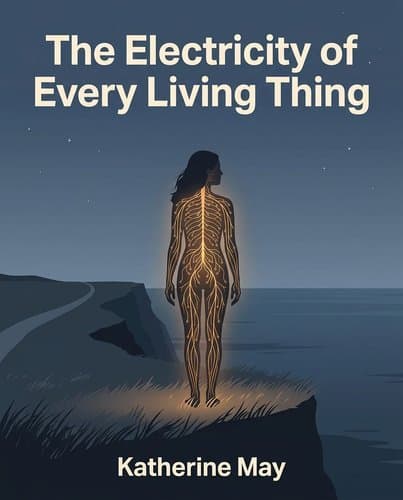
37831997_the-electricity-of-every-living-thing
by Katherine May
Forty years of performing normalcy so convincingly you fool even yourself—then the shattering relief of a diagnosis that finally makes your life story cohere.
In Brief
Forty years of performing normalcy so convincingly you fool even yourself—then the shattering relief of a diagnosis that finally makes your life story cohere. Katherine May traces the quiet devastation of mistaking masking for coping, and the dignity of finally having language for why the world has always landed differently.
Key Ideas
Persistent struggle despite effort signals difference
If you've spent years building social skills through deliberate observation and effort — and still feel bewildered, exhausted, and somehow wrong after social contact — that effortfulness itself is information, not evidence that you're coping.
Sensory overwhelm operates on different terms
Sensory overwhelm (the electric charge of crowds, the unbearable texture of touch, the white-out of emotional shock) isn't introversion or anxiety. If the world consistently lands on you at a different volume than it seems to land on others, that difference is worth investigating on its own terms.
Late diagnosis restores life story coherence
Seeking a late autism diagnosis isn't about finding an excuse for past failures. It's about having a life story that coheres — and that coherence, May argues, is a basic form of dignity that people who have spent decades 'circling the plug hole of not coping' are entitled to claim.
Close relationships already accommodate your wiring
The people closest to you may have already built a working model of your neurodivergence and adapted their lives accordingly, without ever naming it. Their accommodation isn't evidence you don't have a condition — it may be the clearest evidence that you do.
Present-moment practices reveal actual neurology
Walking, meditation, or any practice that drops you out of performance-mode and into sensory present-tense can function as accidental self-knowledge — a way of discovering what you actually are before you have formal language for it.
Who Should Read This
Readers who connect with first-person stories about Memoir and Mental Health and want to see the world through someone else's eyes.
The Electricity of Every Living Thing
By Katherine May
8 min read
Why does it matter? Because performing normalcy so well you fool yourself isn't coping — it's a forty-year delay.
Katherine May is in her car, driving to a different optician in a different town — the last appointment ended with her running out the door, shaking, after a confrontation she couldn't account for. On the radio, a woman begins describing her inner life back to her, and the word she uses is autism.
May is nearly forty. She has a husband who has quietly built his life around her in ways she hasn't examined. A child whose birth she barely survived emotionally. A coastal walk she undertakes in driving rain, partly for midlife reasons, partly because it's the only place she doesn't have to perform. She has been, by every available measure, coping.
The question this book asks is what forty years of that actually costs.
The Most Convincing Performance Is the One You Don't Know You're Giving
May is driving at dusk along the tip of Kent, half-listening to a radio interview about autism, when the interviewer asks whether autistic people make undesirable romantic partners.
She nearly shouts at the dashboard. She's married; the implication is absurd. And she finds herself saying aloud that they are not, in fact, repellent.
We're not.
The word stops her cold. She hasn't said I. She's said we: a community claimed, an identity stated, before she's allowed herself to sit with a single one of those precise descriptions, before she's consciously framed the question they would answer. Her whole adult life has run on a private system of not-quite-connections: a recognition noticed, quickly filed under something more comfortable, and moved past. The we bypasses all of it.
You're watching the mechanism of a lifetime's self-description fail in real time.
May has been accumulating evidence her entire life. The walk she's about to describe — 630 miles of England's South West Coast Path, started in a fit of midlife restlessness — turns out to be the first time she has slowed down enough to read it.
Some People Don't Just Feel Overwhelmed — They Feel the World at a Different Volume
The word "overwhelmed" doesn't capture it. Overwhelmed implies a threshold that can be managed with rest, reduced input, a better attitude. What May describes is different: a sensory system receiving the world at a gain setting that was never in her control.
She writes that people carry a charge — not a scent but a texture, humanity as a substance you wade through until you're depleted.
That's easy to dismiss as vivid metaphor. Then you get to Cornwall.
On a February walking trip, after a long day of wet hillside and missed landmarks, May and her husband H sit down over gin and tonics and he tells her something true: that their son Bert, and the family in general, is easier when she's not there. He doesn't say it cruelly. He says it as a man who has spent a week watching everything bother her — the noise, the smoke alarm, the early starts, the planning that never works. May tries to take this as data. She actually says those words to herself: this is information. Plain data. Receive it that way.
She cannot. Her mind goes white — a specific kind of white, like Arctic cold, with no words anywhere in it. Her arms begin to flap at the elbows, moving without instruction and without her ability to stop them. When she tries to speak, only the first letters of words come out, stuttering and incomplete. When H tries to calm her with touch, each pat arrives as a small electric shock rather than comfort. She runs upstairs, moves a chest of drawers in front of the bedroom door, and paces the tight circuit around the bed until three in the morning.
H's words weren't wrong. He wasn't being cruel. The meltdown wasn't caused by cruelty — it was caused by accurate information arriving in a form her nervous system couldn't process at its standard voltage. The gap between what her rational mind can accept and what her body immediately enacts is the size of an ocean.
At 3am she moves the drawers, goes to him, holds on. He kisses her head. They sleep. But the question the scene raises doesn't resolve overnight: what's the voltage she's running at all the time?
The Better You Are at Hiding What's Wrong, the Harder It Is for Anyone to Help You
How do you get help for something that makes you exceptionally good at appearing fine?
May's answer, built from decades of failed appointments, is: you don't. Not until the camouflage collapses under its own weight.
From age fourteen onward, she sought mental health help repeatedly: a hospital consultant who treated her depression as a waste of his time; a GP at seventeen whose antidepressants left her feeling marooned at the bottom of a well; a psychiatrist who huffed and checked her watch while May sat silent across the desk; a counselor at twenty-two who discharged her early because nothing appeared to be wrong. Each time, the professionals saw a woman who was coping. Each time, she was.
What produced this outcome is the same thing May spent her life assembling: a social repertoire reverse-engineered from observation. She learned to hold eye contact by noticing what people expected. She learned to ask after someone's children from a woman on a train. She built warmth, humor, and apparent ease by watching other people deploy those things — and the performance grew so fluent she lost track of where each piece came from.
The clearest illustration comes after her son Bert is born. A health visitor pulls the postnatal depression questionnaire from her briefcase, studies May for a moment, and slides it back unread. She can tell May is fine. May smiles, says yes, of course. And while that smile sits on her face, she is silently begging for someone to see through it.
Her own competence was the real trap. The performance she built to survive was exactly what made her invisible to anyone looking for signs of struggle. She'd built it so well it ran even when she needed it not to. That's a specific kind of isolation: the person who most needs help is the one who looks, to every professional she encounters, like she doesn't need any at all.
She Heard Her Own Life Story on the Radio and Her First Reaction Was to Reject It
Her first response is to run an inventory of what she knows autism looks like. The boy who lists facts and cannot meet your eyes. A man she once sat beside at a conference who spent the whole day talking over her and at lunch explained, apologetically, that he brushed his teeth with a needle. A former student who needed a fresh checklist each morning just to remember her bag, who was brilliant at sciences and couldn't see the point of literature. May holds each image up and finds the same answer: not me. She is married. She is funny. She has learned, painstakingly, to read people. She goes to the optician, drives home, and does not think about it again.
Except the recognition keeps arriving. She finds a blog written by people who identify as autistic — reading it, she says later, is like walking into a room of mirrors. The hope carried into every new group of people that this time the rules will finally be legible. The moment two strangers swap a look across a table and something passes between them, visible to her but meaning nothing. The accumulated weight of performing ordinary, and underneath it, the fear not that she'll be caught but that the real self, once seen, won't be wanted. She wants to run toward these people with open arms. But joining them requires accepting a word she has been, without quite knowing it, refusing all along.
The word is autism. She will need to wear it for a while, she says, to see if it fits.
The Hardest Part of Getting a Diagnosis Is Realizing Other People Already Had One
The bedroom is dark. May has just moved H's hand away from her waist because his palm was too warm, rubbed away the trace of his lips from her ear, gone rigid while he tried to be close. He has already sighed and turned away when she starts to cry, and eventually the words come out: she heard a radio program about Asperger syndrome, she says. It described her life, exactly, and she needs to know if he thinks it could be true.
He listens. Then he takes a breath, and she notices him choosing his words. Yes, he says. It does explain how she is.
That phrase takes a moment to land. He already had an explanation. He had been walking around with a working model of his wife — what she could tolerate, what would tip her over, where to apply pressure and where to leave space — without ever bringing it into the open. Not out of deception but out of something more disorienting: kindness. He had been quietly managing her for years, and the most careful thing he could do was never tell her.
May's response is immediate: "Oh God. Are you my carer?" He laughs and says no, genuinely, not defensively. Then, after a long pause, he asks if she'd like a hug. She says yes.
The scene reframes everything she thought would be hard. She had spent weeks bracing for skepticism: the convincing, the performance, the polished surface working against her. Instead, the person who knew her best had already adapted his life around something she couldn't name. She was the last one to know what she was.
When H takes the same diagnostic questionnaire months later, he scores far lower than a man who color-codes his record collection and reads science fiction as a primary interest has any right to score. May says she never would have thought she was the autistic one in the relationship. He tries, briefly, to look offended.
That's the wound no one prepares you for. The competence she spent her life building — the eye contact, the timely questions, the performance of warmth — was so complete that it hid her not just from doctors and colleagues but from herself. Everyone else had quietly built their accommodations around who she actually was. She had spent forty years trying to become someone else.
A Diagnosis Isn't Bad News. It's the First Story About Your Own Life That Finally Makes Sense.
For someone who has spent forty years invisible to every doctor, counselor, and psychiatrist she ever sat across from, a diagnosis isn't a loss of identity — it's the acquisition of one.
Katherine May sits in a yellow room, walls painted the color someone decided was calming, artificial perfume so thick she can taste it in her glass of water. A man across the desk has a file with her name on it and takes notes as she runs through the catalogue: jobs abandoned after mysterious collapses, breakdowns at seventeen and then again and again, hiding in toilet cubicles at parties, the shame of being overwhelmed by her newborn's touch. When he finally says she fits the profile of someone with ASD, she doesn't feel labeled. She feels narrated.
A narrative, then. Finally. All the wreckage assembles into something coherent (not fixed, not erased, but legible for the first time).
The clinician adds one observation she doesn't expect: people are always pleased when diagnosed with ASD. Everything else, he says, tends to be bad news. When you've spent decades on the verge of not coping, when the effort to appear functional drives up your blood pressure and sends you to the bottle and keeps collapsing your life in ways you can never explain, naming the cause isn't a bid for sympathy. It's the minimum coherence a person is owed.
She asks the clinician, half-joking, whether she ever has to go to another party. He says he'd never recommend avoidance — adjustment, certainly. She turns the word over. Adjustment. That's all she's ever been doing: adjusting to a world tuned for someone else, without knowing why the calibration cost her so much. Now she has a word for the gap.
The Word That Describes Everything She's Ever Had to Do
Here's what the clinician meant by adjustment: minor calibrations, reasonable accommodations, the small courtesies a world makes for those who navigate it differently. Here's what May found it meant: something closer to excavation. 630 miles of coast path had already been doing the work before the yellow room and the file with her name on it. The Māori word for autism — takiwatanga — translates roughly as "in my own time and space." Not absence. Not deficit. A different coordinate system. What the diagnosis handed her wasn't a new identity but permission to stop apologizing for the one she'd always had. If you've spent years being good at appearing fine, that permission is not a small thing. It's the whole thing.
Frequently Asked Questions
- What is The Electricity of Every Living Thing about?
- The Electricity of Every Living Thing traces Katherine May's autism diagnosis in her late thirties and how it reframed decades of unrecognized neurodivergence. The memoir distinguishes between coping and thriving, arguing that late diagnosis offers a coherent life narrative—a fundamental form of dignity. Through her journey, May explores how sensory overwhelm, social exhaustion, and the effortful navigation of a neurotypical world shaped her life. Rather than an excuse, late diagnosis provides an empowering reframing that allows readers to understand their own experiences through the lens of neurodivergence, transforming confusion into clarity.
- What are the key takeaways from The Electricity of Every Living Thing?
- The Electricity of Every Living Thing offers several key insights about autism, coping, and late diagnosis. May reveals that sustained social exhaustion and effortfulness with social skills constitute meaningful information about neurodivergence, not evidence of successful coping. The book emphasizes that sensory overwhelm differs fundamentally from introversion or anxiety, representing how an autistic nervous system actually processes stimuli. Late diagnosis is reframed not as excuse-making but as narrative coherence and dignity. Additionally, loved ones may have already adapted to someone's neurodivergence without naming it, and May shows how embodied practices like walking or meditation provide "accidental self-knowledge" before formal diagnosis.
- Is The Electricity of Every Living Thing worth reading?
- The Electricity of Every Living Thing is worth reading if you've experienced persistent social exhaustion, sensory overwhelm, or the feeling that you're somehow "wrong" despite functioning effectively. May's account is particularly valuable for adults with late diagnoses or those who recognize themselves in descriptions of autism without formal identification. The book offers more than self-diagnosis potential; it reframes neurodivergence as a coherent life narrative rather than deficiency, providing readers with language and dignity for experiences previously unexplained. Whether or not you identify as autistic, May's exploration of how our nervous systems interact with the world offers profound insights into human variation and the cost of forced conformity.
- What does Katherine May explain about sensory overwhelm in The Electricity of Every Living Thing?
- In The Electricity of Every Living Thing, Katherine May distinguishes sensory overwhelm from introversion or anxiety, describing it as "the electric charge of crowds, the unbearable texture of touch, the white-out of emotional shock." May argues that "if the world consistently lands on you at a different volume than it seems to land on others, that difference is worth investigating on its own terms." Rather than a personality trait or mental health concern, sensory overwhelm reflects how an autistic nervous system processes stimuli differently. This recognition is crucial for late-diagnosed adults, as it reframes decades of exhaustion and avoidance as neurological reality rather than personal failure or social inadequacy.
Related Book Summaries


Read the full summary of 37831997_the-electricity-of-every-living-thing on InShort