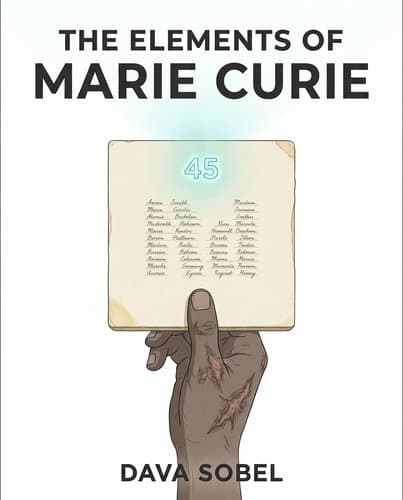
208580608_the-elements-of-marie-curie
by Dava Sobel
Marie Curie's forty-five female protégées reveal the hidden architecture of scientific exclusion—and how she systematically dismantled it.
In Brief
The Elements of Marie Curie (Octo) traces how Marie Curie deliberately built an institution that trained forty-five women scientists, making her laboratory a durable argument for women's place in science. Drawing on the careers of her students, it reveals how structural defaults — not malice — erase women's contributions, and documents the full human cost of radioactivity research.
Key Ideas
Institutional infrastructure creates lasting change
The Curie laboratory was a deliberate institution, not an accident — Marie actively recruited women from countries where they were barred from universities, wrote letters of recommendation, and secured fellowships, understanding that individual brilliance without institutional infrastructure produces no lasting change
Default assumptions erase women scientists
The erasure of women's scientific contributions operates through mundane structural mechanics: only Pierre was permitted to speak at the Royal Institution; his solo acceptance of a shared medal made him appear the sole winner — the machinery doesn't require malice, only default assumptions about who the scientist is
Mentorship cannot overcome institutional pressure
Mentorship that doesn't address institutional pressure can be overridden by it — Marie offered Harriet Brooks every professional advantage available, but the same social forces that Marie had navigated through marriage and motherhood were still powerful enough to end Brooks's career when she tried to navigate them alone
Deaths complete the scientific record
The physical cost of scientific work is not incidental — it is part of the record. Marie's aplastic anemia, Irène's leukemia, the Radium Girls' destroyed jaws, and the deaths of Demelander, Demenitroux, and Yamada are not footnotes to the discovery of radioactivity; they are its full accounting
Small decisions reveal institutional values
An institution's willingness to include women is visible not in its stated values but in its smallest decisions: who is allowed to speak at a lecture, whose name appears on an award, whether the flowers under the balance table ever make it to the podium
Who Should Read This
Science-curious readers interested in Scientists and Mentorship who want to go beyond the headlines.
The Elements of Marie Curie
By Dava Sobel
10 min read
Why does it matter? Because the woman on the classroom poster was running the most radical experiment in the history of science — and it wasn't the one you think
Everyone knows the story: Polish girl overcomes impossible odds, moves to Paris, discovers two elements, wins two Nobel Prizes. Lone genius triumphs. The statue gets built, the biopic gets made, and the lesson is safely filed under exceptional individual. What that version quietly omits is the laboratory she ran for nearly three decades — one of the most sustained experiments in what happens when women are actually given the conditions to do science. Forty-five of them passed through that shed on the rue Cuvier, from Norway, Canada, Poland, England, Japan. Most people have never heard a single name. And here's what nobody mentions alongside the Nobel medals: the work was killing them. Slowly, invisibly, in ways they were only beginning to measure. Dava Sobel's The Elements of Marie Curie tells the story the statue leaves out — far stranger, costlier, and more important than the one you already know.
Behind the Icon Is a Leaking Shed and Forty-Five Names You Don't Know
Marie Curie's legacy, as most people have received it, fits on a single index card: two Nobel Prizes, one for Physics, one for Chemistry, the only person ever to win in two separate scientific fields. That version is true, and it's also the smallest possible version of the story. The more consequential thing she built wasn't a prize record — it was a room where women could actually do science.
The Nobel medals themselves show what she was working against. On the reverse of each: two robed goddess figures, one labeled Science, one labeled Nature, posed in a moment of discovery. Women belonged on the medal as allegory. The name engraved beneath that allegory was almost always a man's. Curie broke through that symbolism twice, watching it operate in real time.
So she built something structural. Between 1906, when she took over Pierre's laboratory, and her death in 1934, forty-five women passed through the Curie lab as researchers. A few months after she died, some of them formed an alumni association and called themselves the Marie-Curie-ites. They came from countries where women had been barred from universities within living memory. At the Curie lab, they did serious work: isolating radioactive elements, exploring radiation as a medical treatment, probing the interior of the atom. Several went home to become the first female professors their countries had ever seen.
Those forty-five names barely appear in the famous biography written by her daughter Ève. Until recently, they were the part of the legacy that got lost. The Marie-Curie-ites scattered across a dozen countries, building the future she had quietly made room for — and most histories of science never noticed they existed.
What Genius Actually Looks Like: A Woman Stirring Boiling Ore at Midnight in a Shed That Leaked
February 6, 1898. Marie Curie is in a storage room on the ground floor of the École de Physique, and she is cold. The temperature is 6.25 degrees Celsius — just above freezing — and she notes it in her lab notebook with ten exclamation points. The room is dank, unheated, and barely hers. She is holding a stopwatch in one hand and a set of tiny weights in the other, watching a needle on an electrometer and waiting for the exact moment to drop a weight onto a quartz crystal to generate a current that will cancel the current created by radioactive ore sitting on a metal disc below her. The balance point, when it arrives, tells her the radiation level of her sample, measured in millionths of an ampere.
Discovery looked like this: not a flash, but a procedure, rehearsed until her hands could run it smoothly even as her breath fogged in the cold. The quartz crystal was an instrument she and Pierre had adapted from his earlier work on piezoelectricity — squeeze or stretch it and it generates a current. Marie used it as a counterweight against uranium's emissions, making the invisible measurable for the first time.
When a lump of pitchblende — a heavy black ore mined primarily as a source of uranium for coloring glass — registered four times more radioactive than pure uranium, the only logical conclusion was that something else was hiding inside it, something nobody had ever named. That was the moment Pierre set aside his own research on crystal growth and joined her.
Proving the new element existed meant extracting it, which meant leaving the storage room entirely. The school's director found them a wooden shed across the courtyard — a former medical anatomy theater, drafty, with a glass roof that leaked and no ventilation hoods for toxic gases. Marie processed the ore in twenty-kilogram batches, stirring boiling slurry with an iron rod for hours at a stretch. Poisonous fumes meant the early chemical stages had to happen outdoors in the courtyard. When rain pushed them inside, they opened the windows and continued. It took roughly a ton of processed ore to yield a fraction of a gram of anything. After dinner, she and Pierre would walk back to the shed and stand in the dark watching their materials glow — a soft blue light, suspended in the blackness, evidence that they were right.
The Partnership That Elevated Her Also Erased Her
Think of a magnet hidden inside another magnet. The outer field does real work — it holds things together, orients them, makes them move — but it also completely overwhelms the inner one. You can't measure the smaller field while the larger one is active. That's roughly what the Pierre-Marie partnership did to Marie Curie's reputation, and it wasn't cruelty. It was physics.
The French word for magnet, aimant, doubles as the word for loving. The same force that bound them — intellectually, romantically, professionally — was the one that made Marie disappear. When Pierre abandoned his own research on crystal growth to join her investigation of radioactive ore, it was an act of devotion. It was also, structurally, an act of eclipse. Two people working in the same lab, on the same problem, under the same name, produced results the world assigned to one of them.
The machinery was impersonal. In June 1903, the Curies visited London. Only Pierre was permitted to lecture at the Royal Institution — the rule applied to all women, not to Marie specifically. Pierre stressed her contributions from the podium; audiences heard a man explaining a woman's work. Months later, Pierre returned to London alone to collect the Davy Medal, because Marie was ill. His solo appearance made him look like the sole winner, because he was the only one in the room. The Nobel committee, the following year, initially planned to award the physics prize to Pierre and Becquerel alone, leaving Marie out entirely. Pierre pushed back and she was included — but the near-miss revealed the default assumption.
Hertha Ayrton, a British physicist who had deliberately separated her research from her husband's specifically to avoid having her discoveries absorbed into his name, watched the pattern repeat in the press and wrote to a London newspaper to correct it: an error attributing a woman's work to a man, she said, has more lives than a cat.
She was right. The woman who would spend the next three decades opening her laboratory to other women had first to spend years being subtracted from her own.
The Lab Was the Argument: How Marie Built the Only Place on Earth Where Women Could Do Science
Ellen Gleditsch arrived in 1907 having never handled a radioelement. Within months, Marie handed her a radium preparation worth a hundred thousand francs and instructions to proceed. Gleditsch later said she couldn't understand how anyone had dared trust her with it — which tells you something about what she'd been accustomed to, and everything about what Marie was doing. That trust wasn't sentimental. It was a research decision: Gleditsch was meticulous, patient, and trained in exactly the kind of precise dissolution and recrystallization work the lab needed. So Marie gave her not just the radium but a genuine scientific problem — replicating and, if possible, refuting a claim by Sir William Ramsay, a Nobel laureate, who said he'd transmuted copper into lithium using radium emanation. Gleditsch worked through the procedure systematically, swapped Ramsay's glass vessels for platinum ones, and watched the supposed lithium vanish. It had been leaching out of the glass all along. The result appeared in the Comptes rendus under both their names.
The famous-woman-scientist story tends to obscure what Marie was actually doing: not just science, but transferring the conditions for doing it. The forty-five women who passed through the lab between 1906 and her death came from Norway, Canada, Russia, Poland, England, and beyond — countries where women had been locked out of universities within living memory. They left with publications, techniques, and in several cases the title of first female professor their home country had ever appointed.
None of this was uncomplicated. Harriet Brooks, the Canadian physicist who had co-discovered radium emanation alongside the physicist Ernest Rutherford, landed in Paris in 1906 after Barnard College told her she had to choose between her career and her engagement. She fought back — argued it was a duty she owed her profession and her sex to prove that a woman need not abandon one for the other — and lost. She came to a lab run by a widow and mother who was proof the argument could be won, and then, a year later, left to marry anyway. Her research program ended with her departure; the questions she'd been pursuing passed to other hands. The lab was the only place on earth where the choice shouldn't have been necessary. It didn't always feel that way inside it.
The Woman Who Separated Science from Private Life — While Living Proof That They Were Inseparable
On November 7, 1911, Marie Curie turned forty-four. A mob had gathered outside her house in Sceaux that week, shouting 'foreign woman' and 'husband stealer' after stolen letters between her and the married physicist Paul Langevin appeared in the Paris press. André Debierne had to physically escort her and her daughters to safety at a friend's apartment across the city. On that same birthday, a telegram arrived from Stockholm: a second Nobel Prize, this time in Chemistry, for the discovery of radium and polonium.
When Svante Arrhenius — a Nobel laureate who had once championed her — wrote to suggest she skip the ceremony to spare everyone the embarrassment, Marie replied with a sentence that has since achieved its own kind of fame. In her letter, she wrote that she believed there was no connection between her scientific work and the facts of her private life. Then she got on the train to Sweden, accompanied by Irène.
The sentence reads as a principled defense of science's objectivity. It also asks you to ignore almost everything the book has shown you. The letters Langevin's wife intercepted were written by a woman conducting a secret relationship with a colleague she had met through her dead husband's professional circle, in a two-room apartment he rented to work near her lab. The affair didn't emerge from Marie's private life drifting into her professional one. There were no separate banks to overflow — the lab and the life were the same body of water.
Seven months before the Langevin story broke, three of her laboratory researchers — Ellen Gleditsch, Eva Ramstedt, and Sybil Leslie — had pooled money to buy flowers for the moment Marie was elected to the Académie des Sciences. When Édouard Branly won instead, 30 votes to 28, the three women quietly asked the laboratory mechanic to retrieve the bouquet from its hiding place under the precision balance table and dispose of it before Madame saw it. Marie made no public comment about her defeat. No private one either, that anyone remembered.
The lab held her loneliness and her ambition, her grief over Pierre and her hope that it might be survivable. The separation she claimed in that letter to Arrhenius was not a description of her life. It was the only argument that could get her to Stockholm.
The Discovery That Was Destroying Everyone Who Made It
Marie Curie knew radiation was killing people. That's the sentence the famous version of her story doesn't sit with long enough.
In the mid-1920s, reports arrived from New Jersey about young women who painted luminous numerals onto watch dials using brushes tipped with radium-laced pigment. The recommended technique was to press the bristles between your lips to bring the brush to a fine point. Margaret Carlough did this, as did dozens of her coworkers at the U.S. Radium Corporation. What it did to her jaw, over time, was not metaphorical. Radium behaves chemically like calcium — the body can't tell them apart — so it settles into bone. Once there, its radiation works from the inside. Doctors who examined these women found they exhaled radon gas with every breath. When Marie heard this, her response was precise and devastating: once absorbed into tissue, the substance could not be removed by any means then known — or, she implied, any means at all. Not a cure she hadn't found yet. Not a problem science might solve. A permanent fact about what her element did to the tissue that absorbed it.
And she kept working.
Her own hands by this point were 'burnt and scarred by radium' — Frédéric Joliot's words, describing the January 1934 morning when Irène and he brought Marie the tube of newly created artificial radioactivity and watched her hold it near a Geiger counter to hear the clicks. He called it the last great satisfaction of her life. The hands that held it were the evidence of its cost, written in the same tissue the Radium Girls had lost.
She had joined a commission to mandate lead screens in industrial settings after two former students, dead at thirty-five and forty-one. She signed the recommendations. She also told herself, in letters to her sister, that her own survival at sixty suggested existing lab protocols were probably sufficient. Both things were true simultaneously. She understood exactly what radiation did to a body, and she understood it the way you understand something you cannot afford to stop doing. The discovery was also the exposure. There was no version of the work that didn't include both.
The Chain Marie Started Was Still Fighting the Same Battles a Generation Later
The chain Marie started didn't end with Marie. It extended through her laboratory, her daughter, and then her daughter's assistant — and at every link, it ran into the same wall.
Marguerite Perey arrived at the Radium Institute in 1929 as a twenty-year-old vocational-school graduate, the fifth child of a widow who couldn't afford to send her to university. Marie took her on anyway — the same bet she'd made on Ellen Gleditsch, on Harriet Brooks, on anyone whose work spoke louder than their credentials. Within months, Marguerite was Marie's personal assistant on actinium. After Marie died in July 1934 — aplastic anemia, her bone marrow destroyed by decades of accumulated radiation — Marguerite kept working. In 1939, studying actinium's decay in careful isolation, she noticed a second beta pattern that spiked and faded too quickly to belong to anything already known. Actinium, she realized, occasionally emitted an alpha particle instead, producing a never-before-seen element. She named it francium, after France, and it filled the number-87 slot on the periodic table that had sat empty for decades.
In 1962, Marguerite Perey became the first woman admitted to the Académie des Sciences — the same institution that had rejected Marie by two votes in 1911, and had never opened its doors to Irène either. The distinction sounds like vindication. Then you read the fine print: Marguerite's membership was corresponding, conferring no voting rights and no formal title. The Académie had let a woman through the door and quietly locked the inner room. Full membership wouldn't come to any woman until 1979.
Marie built the chain. The chain worked. And the wall, one generation later, was still exactly where she'd left it.
What the Burnt Fingers Actually Proved
Frédéric Joliot never forgot what Marie's hands looked like that January morning — burnt, scarred, the tissue permanently altered by the same element she'd named and chased and built a laboratory around. She held the tube of artificial radioactivity close and listened to the Geiger counter register it, and that was, by his account, the last time she looked fully satisfied. The hands were the receipt. The work and its cost were the same object.
Radium was a claim she made about reality before she could prove it — element 88, a name for something that had to exist because the numbers said so. The lab was the same kind of claim. Marguerite Perey, discovering francium in 1939, was still making that argument. So, in 1962, was the institution that finally let her partway through the door.
Notable Quotes
“A Story of Love: Madame Curie and Professor Langevin.”
“A Romance in a Laboratory: The Love Affair of Mme. Curie and M. Langevin,”
“In the name of the Curie family,”
Frequently Asked Questions
- What is The Elements of Marie Curie about?
- The book traces how Marie Curie deliberately built an institution that trained forty-five women scientists, serving as a durable argument for women's place in science. Rather than presenting Marie as an isolated genius, the work reveals how she strategically recruited women from countries where universities excluded them, securing fellowships and writing recommendations. By examining her students' careers, it shows how structural defaults—not malice—erase women's scientific contributions. The book also documents radioactivity's full human cost: Marie's aplastic anemia, Irène's leukemia, the Radium Girls' destroyed jaws, and deaths of laboratory workers, insisting these harms are central to the scientific record.
- How did Marie Curie deliberately build institutional support for women scientists?
- Marie Curie understood that individual brilliance without institutional infrastructure produces no lasting change, so she deliberately built her laboratory as an engine for women's advancement in science. She actively recruited women from countries where universities barred them, wrote letters of recommendation, and secured fellowships—strategic decisions that transformed her lab into a training ground. By training forty-five women scientists, she created structural change rather than relying on exceptional talent alone. However, the book also reveals limitations of institutional support: even with Curie's mentorship, student Harriet Brooks faced social forces powerful enough to end her career when she navigated them alone.
- What does the book reveal about how women's scientific contributions disappear from history?
- The erasure of women's scientific contributions operates through mundane structural mechanics requiring no malice—only default assumptions about who constitutes 'the scientist.' The book demonstrates these mechanisms: only Pierre Curie was permitted to speak at the Royal Institution, and his solo acceptance of a shared medal made him appear the sole winner. These structural defaults systematically erase women's names and achievements without requiring conscious bias. An institution's true commitment to women is visible not in stated values but in smallest decisions: who speaks, whose name appears on awards, and whether women's contributions officially count as part of the scientific record.
- Why does the book emphasize the physical costs of radioactivity research?
- The physical cost of scientific work is not incidental to discovery but part of its complete record and accounting. Marie's aplastic anemia, Irène's leukemia, the Radium Girls' destroyed jaws, and laboratory worker deaths including Demelander, Demenitroux, and Yamada are not footnotes—they are fundamental to understanding radioactivity's real history. The book insists on documenting these human harms alongside scientific achievements, refusing the conventional narrative that cleanses discovery stories of bodily damage. By centering these costs, the work argues that complete scientific history must account for the price paid by those who worked with radioactivity, treating human suffering as integral to the historical record rather than incidental.
Related Book Summaries

Read the full summary of 208580608_the-elements-of-marie-curie on InShort