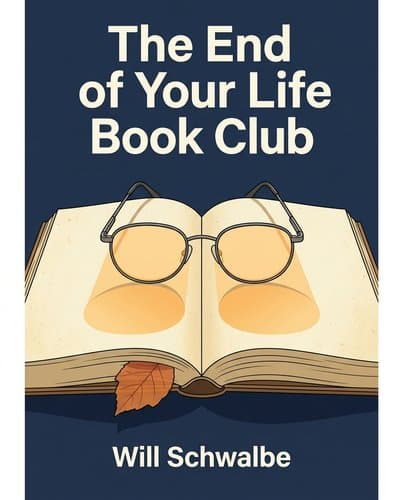
13414676_the-end-of-your-life-book-club
by Will Schwalbe
A mother and son read dozens of books together during her cancer treatment, using stories as a way to say everything love makes it hard to say directly—grief…
In Brief
The End of Your Life Book Club (2012) chronicles Will Schwalbe's two-year book club with his mother as she undergoes treatment for pancreatic cancer.
Key Ideas
Let others control emotional conversation dynamics
Ask 'Do you want to talk about how you're feeling?' instead of 'How are you feeling?' — the second question gives the other person control over whether they want to be the sick person in this conversation
Offer concrete help, not vague questions
When someone is ill, don't ask 'Is there anything I can do?' — suggest something specific, or simply do it without asking
Use shared stories to bridge difficult truths
Books create enough distance from the hardest truths that two people can approach them together — find the shared text, the film, the story that lets you say the thing you can't say directly
Presence is practice, not personality trait
Giving someone your full, undivided attention — the way Mary Anne greeted fifty strangers at a fundraiser dinner while dying — is not a personality trait, it is a practice and a choice
Small contributions matter more than nothing
The people who feel they can't do enough often end up doing nothing; a small contribution, a signed petition, an invitation to dinner counts and matters
Continue conversations through shared reading
Keep reading what the people you love read — after they're gone, those books become a way to continue the conversation
Express specific pride, not just love
Tell the people you love that you're proud of them, specifically — not just that you love them; the precision of that word carries something love alone doesn't
Who Should Read This
Readers who connect with first-person stories about Memoir and Family and want to see the world through someone else's eyes.
The End of Your Life Book Club
By Will Schwalbe
12 min read
Why does it matter? Because the conversations you keep postponing are the ones you'll miss most.
In a chemotherapy waiting room in Manhattan, between the blood draw and the doctor and the poison that might buy a little more time, a son asks his mother what she's reading. It's the most ordinary question imaginable. It's also, it turns out, the beginning of a two-year conversation about everything they've never managed to say directly — about faith, about courage, about what a life is actually for. Will Schwalbe and his mother, Mary Anne, read their way through her terminal pancreatic cancer diagnosis, using novels and novellas and the occasional mystery as a kind of permission slip: to talk about death by talking about characters, to grieve the future by discussing the past, to find their way toward things that couldn't be said without a book in hand. The books aren't the point. The books are how two people who are too close for the direct declaration find a way to have it anyway.
A Lie About a Book Becomes the Start of Everything
In the waiting room of Memorial Sloan-Kettering's outpatient care center in Manhattan, sometime in November 2007, Will Schwalbe and his mother Mary Anne discovered that pushing the mocha button on a mediocre coffee machine — blending two bad things into something surprisingly good — was one of the small pleasures available to them. They were there regularly by then, passing time between her blood draws and her chemo appointments, killing hours in a pleasant fourth-floor room where everyone around them was also killing time in the same specific, terrible way.
That's when his mother mentioned she was reading Wallace Stegner's 1987 novel 'Crossing to Safety.' And that's when Will, a twenty-one-year veteran of book publishing who had spent two decades telling booksellers how much he loved that book, confessed that he had never actually read it. The lie had been professional habit — in publishing, you praise books you haven't read the way other people discuss movies they slept through — but with his seventy-three-year-old mother in a cancer center, the habit broke. He went home and read it that weekend, and by page twenty he was absorbed completely.
The novel follows two couples across a lifetime of friendship. At its opening, one of the wives is dying of cancer. So when Will and Mary Anne began talking about the book, they were also, carefully, talking about something else. Will would ask whether the character Sid — the husband left behind — would be all right after losing his wife. Mary Anne would say yes, it would be hard, but he'd be fine eventually. Neither of them used the word 'Dad.' They didn't need to.
The book club was a structure for telling the truth sideways. A shared language precise enough to carry questions too large to ask directly: to talk about death by talking about characters, to say 'will he survive this' and mean someone still alive. Books had always let them approach difficult subjects at an angle, but it took the diagnosis to show them that this is what they had been doing together for years — and that the question 'What are you reading?' asked over a bad mocha in a waiting room, was the most direct thing either of them knew how to say.
She Already Knew How It Ended — and Chose to Begin Anyway
Mary Anne Schwalbe was performing optimism for everyone around her, and she was very good at it. The performance had a backstage, and it looked nothing like the show.
Consider the moment a young social worker arrived in the chemo cubicle with a clipboard and a bright smile, asking whether Mary Anne had time for a survey. The study, the woman explained, was examining the spiritual health of people undergoing treatment for cancers that had spread throughout the body — Stage Four cancers. Mary Anne answered the questions politely: Christian, daily prayer, yes she would describe herself as happy, though not thrilled about the cancer. After the social worker left, she turned to Will with a mildly stunned expression and said she thought his father was going to be surprised. Not about the survey. About the fact that she had Stage Four cancer. She had, genuinely, not known.
This is the book's central puzzle: the woman who could not bear suspense — who read the final pages of every novel before the middle because she had to know how things ended — had arrived at her third chemotherapy session without knowing her own medical category. And yet weeks earlier she had already updated her living will, confirmed her DNR paperwork, and begun coaching her daughter Nina on why she must relocate to Geneva for a new job rather than stay in New York. The logic she used was one she'd always applied to decisions: choose the option you can reverse. You could always come home from Geneva; you couldn't un-quit a job you'd abandoned out of fear.
None of that is contradiction. It's a portrait of someone who managed the feelings of everyone she loved with the same pragmatic efficiency she brought to her address book — which she was, around this same time, purging of duplicate entries, so things would be tidy afterward. She wasn't in denial. She was deciding, each day, what scale of truth each person around her could bear, including herself. And then she was reading whatever her son handed her, and handing him books in return, because that was one place where the question of what to perform and what to protect simply didn't apply.
The Books We Read Together Are Where We Actually Live
Think of a book you've packed for a long flight without knowing how long the flight would be. If it's short and you race through it, you're stranded. If it's enormous and you ration yourself carefully, you might land having barely made a dent. Will Schwalbe realized, waiting for scan results in early 2008, that this was exactly the problem he and his mother faced. The flight was in progress. No one knew how long it was. They couldn't pace themselves.
The books they read together turned out to be the only place they could think about this honestly. When Geraldine Brooks's novel 'People of the Book' gave them the Sarajevo Haggadah — a medieval illuminated text that had survived wars and persecutions through the hidden efforts of strangers — Will assumed he was reading a thriller about an artifact. But somewhere between the wine stain and the fossilized insect wing pressed into its pages, each a physical trace of someone who had risked something to carry it forward, he understood: the book itself was the main character. Every mark was a record of care. When he sat down with Mary Anne on the sofa in her apartment to talk about it, the conversation was ostensibly about whether Hanna's distant, accomplished mother deserved sympathy. But it drifted, as their conversations always did, toward what it means to leave something behind that outlasts you, and whether kindness — which Mary Anne defined as what you do rather than how you do it — is the only legacy that holds. She was calibrating, every day, how much truth each person around her — including herself — could actually hold. She had signed a DNR and updated her living will. That, too, was calibration.
Books weren't how they escaped the hard subject. They were how they inhabited it. On the page, they weren't the sick person and the well person. They were two readers, arguing about a fictional doctor's coldness while a very real question about time hung between them. The fiction provided just enough distance for the truth to come through. She was, in those conversations, the most alive person in any room she entered — sharp, impatient, insisting that cruelty be named and kindness be distinguished from mere pleasantness. She was also dying. Both things were true at once, and the books held both.
The Bravest Person in the Room Isn't the One Fighting Cancer
Mary Anne Schwalbe was the kind of person people constantly called brave, and she found it maddening. Every visitor to her chemo cubicle at Sloan-Kettering, every friend who learned she was fighting stage four pancreatic cancer, reached for the word as if it were the only one available. She rejected it every time, and her reasons revealed something more demanding than the courage everyone was trying to compliment.
When Will pushed her on it — you traveled through active conflict zones, you flew in unsecured Russian helicopters over Darfur, you shared a hostel in Afghanistan with two dozen armed fighters — she remained unmoved. None of that counted, she insisted, because she had wanted to go. Courage wasn't about doing something dangerous. It was about doing something you didn't want to do because it was right, or because someone else needed you to.
The counter-example she kept returning to was a young woman she'd encountered at the Sloan-Kettering pharmacy. The woman was standing in line in dark glasses, weeping quietly, trying to pay for her mother's medication. Her mother was caught in the Medicare doughnut hole — a structural cruelty in which the government paid for drugs up to a certain limit, then made patients cover thousands out of pocket before coverage resumed. Will's phone rang; he stepped into the hallway. When he returned, the woman was gone and his mother was sitting calmly, waiting for her own prescription. He already knew. She'd paid for it. When he called her on it, she told him not to tell his father, a little annoyed at being caught.
That moment — the quiet transaction, the political fury underneath it, the instruction to keep it secret — is Mary Anne in full. She didn't pay out of sentiment. She paid because she thought the entire system was unjust, and until the system changed, she would simply be the system herself, locally, one pharmacy line at a time. When Will tried to frame that as courage, she redirected again: the brave one, she said, was the woman in the dark glasses, who was trying to cover the cost without letting her sick mother know how much it was. That was the thing she admired — doing what needed doing while protecting someone else from the weight of it.
By the time the Women's Refugee Commission honored Mariatu Kamara — a Sierra Leonean woman who had both hands cut off by rebel soldiers at twelve and cradled a mango in her stumps rather than accept being fed — Mary Anne had been in chemo for eighteen months. She sat in her pistachio-green silk blouse and watched a woman she considered genuinely brave accept an award. The math was simple to her: Mariatu had nothing and rebuilt everything. Mary Anne had the best oncologist in the country, Medicare, and a family closing ranks around her. That's not bravery. That's luck.
What accumulates, across these moments, isn't a portrait of a saint. It's a portrait of someone who held herself to a standard most people only invoke in eulogies, and then actually lived by it, under conditions that would have justified lowering the bar considerably.
A Worn Book Carries Everyone Who Read It Before You
After Mary Anne died, her family searched the apartment for her reading glasses. She'd always used cheap pairs from the drugstore — she'd lose one, buy another, the lost one would surface weeks later behind a vase or wedged into a sofa cushion. When Will and his siblings went through the apartment, they found twenty-seven pairs. In drawers, in pockets, under pillows, tucked behind picture frames. Each one a small monument to the same refusal: she was not going to be caught somewhere in the apartment, wanting to read, without a way to do it.
That image sits alongside another object, the one that was on her nightstand when she died. A century-old devotional called 'Daily Strength for Daily Needs,' first published in 1884, had been Mary Anne's constant companion since a Harvard friend sent it to her early in her illness. The copy was worn past the point of resale — boards bleached from olive to a sickly beige, pages foxed and spotted, binding loosening with use. What stopped Will when he first examined it wasn't the age but the handwriting. Someone, before Mary Anne ever owned the book, had underlined passages in careful blue ink — but only in the first five pages, and only where the text touched on death. The underlining simply stopped after January 5th. That person either quit reading or quit living. Either way, they left the book behind, and it traveled forward through time to a woman dying of cancer who carried it in her chemo bag and kept a handmade refugee-camp bookmark in it until the last day she was conscious.
A physical book isn't just a container for ideas. It's an object that absorbs everyone who held it. The dog-ear, the blue ink, the loosening spine are a record of care, the same way the twenty-seven pairs of glasses scattered through an apartment are a record of desire. Someone wanted to keep reading. Someone else wanted to keep reading. You inherit both.
The vigil itself was nothing like the movies. Will sat beside his mother for hour-long shifts, holding her hand and listening to her breathing change, and five minutes would pass, and then fifty-five more minutes had to pass before someone came to relieve him. A local election meant politicians kept calling on autodial. The hospice nurse dabbed the corners of Mary Anne's eyes. Will and his partner drove out to find a toothbrush preloaded with toothpaste, because keeping her teeth clean was something they could actually do.
When she died, 'Daily Strength for Daily Needs' was still open to September 11th. The entry ended with a John Ruskin line about how praying for the kingdom isn't enough — you have to work for it. Will read it standing in her bedroom at dawn. He already knew it was true of her. But seeing it as the last thing she'd read made it feel like something she'd left there on purpose, which is exactly the kind of comfort that worn, secondhand books are specifically capable of providing.
Paying Full Attention Is the Only Real Answer to Mortality
At the IRC Freedom Awards dinner at the Waldorf Astoria in November 2008, Mary Anne told Will she planned to arrive just before the food was served — she couldn't stand through the cocktail hour anymore. She had a port in her chest, a C. diff infection recently behind her, and tumors still alive in her pancreas. She walked into that gilded ballroom and greeted roughly a hundred people over the course of the evening, each one receiving the same thing: her eyes, her attention, her full presence. Nothing divided, nothing rationed.
Watching her, Will finally understood what the Kabat-Zinn book he'd been failing to meditate on actually meant. Mindfulness isn't a wellness technique. It's a commitment: when I'm with you, I'm with you. Full stop. The interruption machine of modern life — email, texts, the restless mind moving to the next thing before the current thing is finished — is exactly what Mary Anne refused to run. Will had been running it constantly, splitting his attention between his cooking website and his dying mother and his own anxiety, giving no one the whole of himself. She, with far less energy and far less time, was somehow giving everyone exactly that.
The rigor behind it is what keeps this from being an inspirational anecdote. Mary Anne didn't treat presence as a mood or a gift she felt like offering on good days. In the chemo cubicle, she made eye contact with every nurse who entered — the one checking the drug dosages, the one bringing juice, the one fussing brusquely with a machine — and thanked each of them by name for something specific. Will found this slightly embarrassing, the way adult children always find their parents' warmth excessive. He eventually recognized it as a moral position: treating invisibility as a failure, treating attention as the one thing you could always give even when you couldn't give anything else.
This is the quiet protagonist arc of the memoir. Not Mary Anne learning to face death — she walked into that with her eyes open from nearly the first appointment. It's Will learning that paying full attention to another person is not a soft virtue or a mindfulness-retreat luxury. It's the only real answer to the fact that time is finite. You can't stop what's coming. But you can be entirely present for whoever is in the room with you right now, which is what she was, until she wasn't.
You Say 'I'm Proud of You' When You Mean 'I Can't Lose You'
He was standing in the hallway outside his parents' apartment, unable to press the elevator button. A few minutes earlier, Will Schwalbe had told his mother he wanted to write a book about their reading life together. He'd meant to say 'because I love you.' What came out instead was 'because I'm proud of you.' He kissed her cheek carefully — her skin bruised easily by then — and stepped out the door. And then he just stood there, staring at it, unable to move. The thought arrived fully formed and completely unwelcome: one day soon she would not be behind this door. She would simply not be there. Not behind any door, anywhere.
What he'd said by accident turned out to be the thing that needed saying. She already knew he loved her. What she didn't know — what he'd never told her — was that he was proud of her. Not proud in the reflected way children can feel about successful parents, but specifically, deliberately proud: of the work she'd done, the women she'd fought for, the inconvenient moral positions she'd refused to soften. The word broke in his throat because it was true, and because he'd almost let her die without saying it.
Her response tells you everything. That same evening, she sent him an email with a list of books and themes for the memoir he'd announced. She kept adding to it for weeks — Mariatu Kamara's story, the case for healthcare reform, the advice she most wanted to pass on, which was this: tell your family every day that you love them, and tell them you're proud of them too. She turned his grief into a collaboration before he'd even gotten home from the elevator he couldn't bring himself to call.
The book you have just finished reading is what she started that night. It is his grief given form before she was gone — a way of paying attention so complete that losing her couldn't take it back. Every book they discussed, every waiting room, every argument about a fictional character's moral failings: all of it documented, held, made into something that would outlast the apartment door. He stood in the hallway confronting an absence that hadn't happened yet. Then he went home and started writing.
The Conversation That Doesn't End
Twenty-seven pairs of reading glasses, scattered through every room like small acts of faith — each one placed somewhere she might suddenly want to read. That's what loving books actually looks like. Not a reading list finished and set aside, but a life organized around the possibility of the next sentence. When Will stood in her bedroom at dawn and read the Ruskin line she'd left open on the nightstand — that praying for the kingdom isn't enough, you have to work for it — he was still in conversation with her. The books made that possible. They make it possible with everyone we've lost, if we paid enough attention to know what they were reading, what they underlined, what question they hadn't finished answering. That's the argument the memoir builds toward, quietly: pay that kind of attention to the people you love now, while the door is still closed and someone is behind it.
Notable Quotes
“What movies have you seen?”
“Where are you going on vacation?”
“I’ll give you my copy when I’m finished,”
Frequently Asked Questions
- What is The End of Your Life Book Club about?
- The End of Your Life Book Club (2012) chronicles Will Schwalbe's two-year book club with his mother as she undergoes treatment for pancreatic cancer. Using their shared readings as a framework, the book explores how books create space for conversations that are otherwise impossible. Through their discussions of various titles, Schwalbe and his mother navigate the complex emotions of illness, mortality, and their deepening relationship. The memoir ultimately demonstrates how literature becomes a bridge for expressing feelings and sharing experiences during life's most challenging moments.
- Is The End of Your Life Book Club worth reading?
- The End of Your Life Book Club offers valuable insights for anyone supporting loved ones through illness, loss, or grief. This affecting memoir combines practical advice with literary recommendations, making it useful for both caregivers and those seeking solace. Schwalbe's reflections on presence, compassion, and meaningful connection resonate beyond cancer—they apply to any relationship navigating hardship. The book's pairing of personal narrative with actionable guidance makes it worth reading whether you're facing loss directly or want to better support others. Its literary foundation provides both inspiration and comfort.
- What are the key takeaways from The End of Your Life Book Club?
- The End of Your Life Book Club emphasizes how shared reading creates emotional connection during difficult times. Key lessons include asking "Do you want to talk about how you're feeling?" rather than "How are you feeling?" to give the other person control; suggesting specific help rather than asking "Is there anything I can do?"; and understanding that books provide enough distance to approach hard truths together. Schwalbe also stresses that giving full attention is a choice, that small contributions matter, and that continuing to read what loved ones read honors their memory after they're gone.
- How does The End of Your Life Book Club suggest supporting someone with serious illness?
- The End of Your Life Book Club offers concrete guidance for supporting the seriously ill. Rather than asking "How are you feeling?"—which frames the person as sick—ask "Do you want to talk about how you're feeling?" to give them agency. Instead of asking "Is there anything I can do?", suggest something specific or simply do it without asking. The book emphasizes that full, undivided attention is a practiced choice, not innate. Small gestures matter; hesitation often prevents action. Most importantly, books create enough distance from hard truths that two people can approach them together.
Related Book Summaries

Read the full summary of 13414676_the-end-of-your-life-book-club on InShort