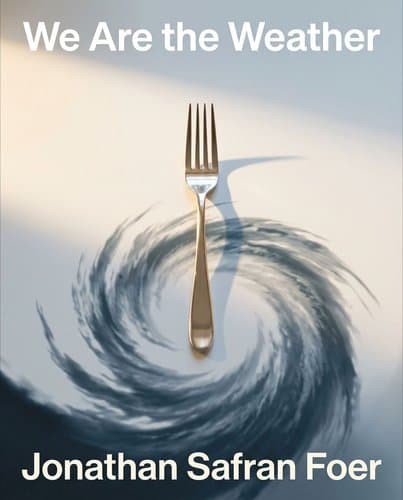
43565381_we-are-the-weather
by Jonathan Safran Foer
Knowing about climate collapse without changing your diet puts you in the same moral category as those who learned of the Holocaust and couldn't bring…
In Brief
Knowing about climate collapse without changing your diet puts you in the same moral category as those who learned of the Holocaust and couldn't bring themselves to believe it. Foer's prescription is bracingly specific: stop eating animal products before dinner, because the emotional urgency to act will never come.
Key Ideas
Knowing without acting is complicity
If you accept climate science but haven't changed your behavior, the book's central argument is that you share more with Felix Frankfurter — who acknowledged Karski's Holocaust testimony but 'couldn't believe it' — than with the allies you imagine yourself among. Knowing was the difference between a mistake and an offense.
Climate lacks urgency for evolved brains
Climate change fails every requirement of a human alarm system: it's abstract, distributed, distant, slow-moving, and doesn't produce the visceral urgency that evolved for predators and approaching armies. Waiting to 'feel' the crisis the way you'd feel a car pinning someone is waiting for something that will never arrive.
Performative action relieves pressure for real change
Performative engagement — watching climate documentaries, driving a hybrid, posting about the Amazon — can relieve precisely the moral pressure that would otherwise force real behavioral change. Foer's diagnostic: if it gives you the feeling of fighting without making you fight, it's firing blanks.
Meat consumption makes climate goals impossible
Animal agriculture is responsible for somewhere between 14.5% and 51% of global greenhouse gas emissions. A Johns Hopkins analysis found the Paris accord's 2°C target is mathematically unachievable if meat and dairy consumption continues to rise — even if every other emissions sector fully decarbonizes.
Action creates motivation, not the opposite
You don't need to feel moved before you act. Participation generates motivation rather than requiring it. The baseball wave never waits for enthusiasm. Thanksgiving achieves 96% participation not through inspiration but through calendar and convention. Polio wasn't eradicated by inspired individuals but by millions joining something already moving.
Breakfast-lunch vegetarianism beats dietary ideology
The single most accessible dietary change: skip animal products at breakfast and lunch. This alone saves 1.3 metric tons of CO2e annually and produces a smaller carbon footprint than the average full-time vegetarian diet — because time-restricted reduction outperforms ideological commitment when that commitment still includes dairy and eggs at every meal.
Who Should Read This
Science-curious readers interested in Climate Change and Sustainability who want to go beyond the headlines.
We Are the Weather
By Jonathan Safran Foer
8 min read
Why does it matter? Because accepting climate science while changing nothing is its own form of denial.
You believe in climate change. You accept the science, read the reports, feel genuine dread. That should count for something. It doesn't — and the proof arrived seventy-five years ago, in a Washington parlor, when Supreme Court Justice Felix Frankfurter sat across from a man who had witnessed the Holocaust firsthand, cross-examined him on every detail, and then said: "I am unable to believe you." Frankfurter was Jewish. His relatives were among the dead. He didn't dispute a single fact. He simply couldn't let what he knew reorganize how he lived. Jonathan Safran Foer's argument — which he confesses to violating for most of this book — is that most people who accept climate change are Frankfurter. And the specific act that would prove otherwise costs nothing more than what you eat before dinner.
The Difference Between You and a Climate Denier Is Smaller Than You Want to Believe
Washington, June 1943. Jan Karski, a young Polish courier who had smuggled himself out of Nazi-occupied Poland carrying eyewitness testimony of mass extermination, sits across from Felix Frankfurter, Supreme Court Justice and himself a Jew. For several minutes, Frankfurter interrogates him with the precision of a trial lawyer: the height of the wall around the Warsaw Ghetto, the details of what Karski witnessed in the camps. Then Frankfurter stands, paces, sits back down, and says: "I am unable to believe what you told me." When a colleague protests, Frankfurter clarifies: he isn't calling Karski a liar; he's describing something stranger and more honest: "My mind, my heart, they are made in such a way that I cannot accept it."
Frankfurter didn't dispute the facts. His own relatives were among those being killed, and he knew it. What he admitted was something rarer: that he could hold a truth in his hands and still not let it in.
Foer uses this scene to draw a line between knowing and believing. Knowing is receiving information. Believing is when that information reorganizes how you live. Frankfurter named the gap. Raymond Aron confessed to living inside it. Aron spent the war years in London; when asked later whether he knew what was happening in the East, he said: "I knew, but I didn't believe it, and because I didn't believe it, I didn't know." That sentence names a failure that feels like acceptance — and that failure has a shape we recognize.
Most people who engage with climate science accept that 97 percent of climate scientists have concluded the planet is warming because of human activity. They'd be offended to be grouped with those who call it a hoax. And yet their lives, diets, travel, and homes remain unchanged. Their acceptance produces no urgency proportional to what they claim to believe.
Foer argues this is the same position Frankfurter occupied. Frankfurter couldn't let the weight of what he knew reshape anything about how he moved through the world — his conscience remained unmoved. If accepting climate science as fact hasn't moved yours, the distance between you and an outright denier is thinner than you'd like. Foer is unsparing: to carry the knowledge that we are destroying the planet and continue unchanged is not a mistake. It is an offense. Future generations will draw no meaningful distinction between the denier and the paralyzed believer.
Climate Change Was Designed — by Accident — to Defeat Every Instinct That Saves Lives
What would it take to make you lift a car?
In 2006 in Tucson, a bystander named Thomas Boyle Jr. gripped the frame of a Chevrolet Camaro and held its front end off the ground for forty-five seconds while a teenager pinned beneath it was pulled free. A Camaro weighs between 3,300 and 4,000 pounds. The world deadlift record is 1,102 pounds. Boyle was not a weightlifter. Asked how he did it, he had no answer. Asked why: "All I could think is, what if that was my son?"
The why is the mechanism. Boyle didn't act on information; he acted on a feeling of proximity — the sudden, visceral sense that the person under that car was his, was now, was here. That substitution unlocked physical capacity his body couldn't access through will alone.
That's climate change's structural problem, and it has nothing to do with intelligence or moral seriousness. Human alarm systems evolved for threats that are visible, proximate, and immediate: the car, the fire, the shape moving in the dark. They weren't built to register emergencies that distribute their damage across decades and continents, requiring you to feel endangered by processes you can't see, causing outcomes you may never witness. When bombers are overhead, you turn off your lights without thinking. When the bombing is across an ocean, you know it's happening and still can't quite believe it. That gap — between knowing and the gut-level sense that makes you act — isn't a character defect. It's how human threat detection was built.
Climate change is an away game happening in a stadium on the other side of the planet. Foer calls this a crisis of belief, not information. Belief isn't an intellectual position; it's the feeling of proximity. Of now. Of "my son." No amount of better data closes that gap, because data doesn't make things feel near.
Your Hybrid Car and Your MSNBC Habit Are Making Things Worse
Imagine you are one of 150,000 soldiers hitting the beaches at Normandy, the largest amphibious assault in history. Your landing craft releases you into the surf. You wade toward the beach under fire. You pull the trigger. You throw a grenade. You lunge with your bayonet.
Your rifle fires blanks. The grenade is no more lethal than a baseball. The bayonet ends in a blunt stump. The chaos is total and consuming. Combat has the full texture of combat, so no one can tell they are exactly as effective as the cloth dummies dropped from aircraft to divide German attention. The feeling of being in the fight is indistinguishable from actually being in it. That's the trap.
Foer applies this image to recycling and the hybrid car. A study in Environmental Science and Technology examined 108 scenarios for electric vehicle adoption over 30 years and found no reliable trend toward lower overall emissions; tailpipe reductions are largely cancelled out by the electricity needed to charge the batteries. Vehicle emissions represent at most 20 percent of a person's total carbon footprint. The hybrid produces the feeling of having addressed something. The emissions continue.
The dangerous part is what these choices actually accomplish: a feeling, and that feeling discharges the moral pressure that might otherwise produce something real. The brain isn't built to sustain urgency toward abstract, distributed, future-facing threats. When it receives a signal that something has been done, the urgency releases. The MSNBC habit works the same way: an hour of climate disaster coverage produces the feeling of engagement without costing anything it would take to stop what's being covered. The green habits that feel most righteous — the Prius, the compost bin, the farmers market tote — were selected partly because they feel good, which means the danger is built into them from the start. They let you feel like a soldier while you fire blanks.
If the habit reliably quiets the alarm, it also reliably forestalls whatever the alarm was building toward.
Every Major Environmental Campaign Has Been Hiding the Same Argument
The argument every major environmental campaign has been hiding is not about coal or pipelines. It's about what you eat.
Foer spent the first 63 pages of this book avoiding exactly this — doing what he'd spent those pages criticizing Al Gore for. Gore's An Inconvenient Truth ended with a list of recommended actions: plant trees, call your power company, pray. Nowhere did it mention what Project Drawdown identifies as the single highest-impact individual action. Neither did major environmental advocacy websites. Neither did Dire Predictions, a book by two climate scientists summarizing the IPCC's fifth assessment, which instead recommended clotheslines and bicycle commutes. Foer named this as malpractice — then admitted he'd committed the same malpractice, steering around the subject for fear it would alienate readers. When the reveal finally comes, it arrives without ceremony: we cannot save the planet unless we significantly reduce our consumption of animal products.
The silence makes more sense once you see what animal agriculture actually contributes. The UN's Food and Agriculture Organization places it at 14.5% of global emissions, already matching electricity generation and triple all transportation. But that figure has structural gaps. It counts the CO₂ released when forests are cleared for feed crops, but not the CO₂ those forests can no longer absorb going forward. It excludes CO₂ exhaled by the animals themselves — farmed livestock are human constructions, not pre-industrial nature, and a breath from a feedlot steer is no more natural than exhaust from a truck. When Worldwatch Institute researchers corrected for those omissions, the estimate reached 51% of annual global emissions: more than all cars, planes, buildings, power plants, and manufacturing combined. Foer doesn't try to settle it. His point is narrower: we cannot address climate change without addressing animal agriculture.
Diet is the only one of the four highest-impact personal actions that doesn't require your city's infrastructure or your employer's permission.
What the environmental movement chose not to say, and what Foer spent most of this book not saying, turns out to be the same thing: the most accessible lever isn't a ballot or a solar panel. It's a fork.
You Don't Need to Care About Climate Change to Help Fix It
Imagine you're at a baseball game and the wave is coming from your left. Are you waiting to feel ready? Of course not. You stand when it reaches you. And for a moment — arms raised, part of something rippling through 50,000 people — you feel exactly the thing the wave was supposed to require.
Jonathan Safran Foer makes three confessions about waves: he has never started one, never been struck by enthusiasm at the precise moment one arrived, and never resisted one. The sequence that seems obvious — motivation first, participation second — is inverted. The feeling isn't a prerequisite. It's a byproduct.
That inversion is the book's most useful insight for anyone stuck at the door of climate action, waiting to feel sufficiently moved before doing anything. The feeling may only become available on the other side of the act.
Consider Thanksgiving. Ninety-six percent of American families gather for it. Not because of a law, not because Lincoln proclaimed it, not because anyone woke up on the third Thursday of November overcome with gratitude. People show up because it's on the calendar and because they did last year. The feeling of closeness isn't what gets them to the table. Getting there is what produces it. The ritual precedes the sentiment it appears to express.
The same structure that gets families to a table gets nations to donate organs. Countries where donation is the default achieve 90% participation; countries requiring an active choice get 15%. The structure does what motivation cannot.
Which means the only version of climate action that requires you to first achieve genuine, sustained belief is the one that will never happen. You don't need to feel it. You need to show up while the wave is moving through.
Skipping Meat at Two Meals Beats the Average Vegetarian's Entire Diet
You can outperform the average full-time vegetarian on carbon without giving up meat. You just have to stop eating animal products before dinner.
The arithmetic is precise. A serving of beef releases 6.61 pounds of CO₂-equivalent emissions. Potatoes release 0.03. The entire top tier of the emissions list — beef, cheese, pork, poultry, eggs, milk — is animal products; the entire bottom tier is plants. The average vegetarian, eating cheese omelets at breakfast and pizza at lunch, draws from the top of that list at every meal. Two animal-product-free meals, even with steak at dinner, produce a smaller carbon footprint than a vegetarian diet built on dairy and eggs throughout the day. The frequency of restriction matters more than the category label.
Foer translates that frequency into a number: skipping animal products at breakfast and lunch saves 1.3 metric tons of CO₂-equivalent per year. Hold that against the Paris accord's arithmetic. Each person's annual carbon budget must reach 2.1 metric tons by 2050 to stay within 2°C of warming. The global average today is 4.5 metric tons — roughly double what the planet can sustain. That gap is 2.4 metric tons. The breakfast-and-lunch shift closes more than half of it.
Of the four highest-impact individual climate actions — plant-based diet, no air travel, no car, fewer children — three collide immediately with infrastructure, employment, or the timing of your life. You can't simply decide to stop driving if your city wasn't built for it. Diet change asks nothing of your city. It requires no new infrastructure, no identity commitment, and no revision to dinner.
The only prerequisite is breakfast.
What a Life Note Looks Like
Belief that actually reorganizes behavior isn't a feeling. It shows up in what you do next Tuesday, not in how convinced you feel tonight. That's the gap Foer keeps circling, and the one most readers, including him, keep falling into.
You know the numbers. You know what's coming. The question the book finally leaves you with is the one Foer spent two hundred pages avoiding asking himself: does knowing reorganize anything? Skip the animal products before dinner. Save 1.3 metric tons. It's not absolution — it's arithmetic. And it's the only honest answer to having read this far.
Notable Quotes
“I felt I had to do something.”
“You're so lucky to be leaving,”
“You have to do something!”
Frequently Asked Questions
- What is We Are the Weather about?
- We Are the Weather explores why people accept climate science but fail to change their behavior. The book argues this gap stems from human cognition rather than moral failing, then provides a concrete action: skip animal products before dinner to reduce your carbon footprint. Foer examines how climate change fails to trigger our evolved alarm systems because it's abstract, distant, and slow-moving. The work ultimately argues that participation and behavioral change don't require feeling moved beforehand—motivation follows action. By breaking down the psychological barriers between knowing and doing, Foer offers readers both diagnosis and a practical pathway forward.
- What does Jonathan Safran Foer argue about knowing climate science but not acting?
- We Are the Weather argues that accepting climate science without changing behavior isn't a moral failing but a feature of human cognition. Foer compares this to Felix Frankfurter, who acknowledged Karski's Holocaust testimony but 'couldn't believe it'—"Knowing was the difference between a mistake and an offense." This distinction matters: recognizing the science without acting puts you in a position of moral responsibility. The book contends that climate change lacks the visceral urgency our brains evolved to detect—it's abstract, distributed, and slow-moving. Understanding this cognitive gap explains why knowledge alone doesn't drive change, and why we must act despite not "feeling" the crisis urgently.
- What's the specific dietary action We Are the Weather recommends?
- We Are the Weather recommends skipping animal products before dinner as the single most accessible dietary change for reducing emissions. More specifically, the book highlights that skipping animal products at breakfast and lunch alone saves 1.3 metric tons of CO2e annually—producing a smaller carbon footprint than the average full-time vegetarian diet. This counterintuitive finding demonstrates that time-restricted reduction outperforms ideological commitment when that commitment still includes dairy and eggs at every meal. The recommendation is practical and achievable for most people, avoiding the all-or-nothing mindset that prevents behavior change. Animal agriculture accounts for 14.5% to 51% of global greenhouse gas emissions, making this dietary shift genuinely impactful.
- Why does We Are the Weather critique performative climate engagement?
- We Are the Weather argues that performative climate engagement—watching documentaries, driving a hybrid, posting about environmental causes—actually undermines real climate action. Foer's diagnostic: "if it gives you the feeling of fighting without making you fight, it's firing blanks." These performative acts relieve precisely the moral pressure that would otherwise force genuine behavioral change. By creating the sensation of environmental activism without material impact, they allow us to feel like we're contributing without sacrificing comfort or convenience. This relief valve prevents the discomfort necessary to drive actual lifestyle modifications. True climate action requires moving beyond performative gestures to concrete behavioral changes, particularly in consumption patterns.
Related Book Summaries
Read the full summary of 43565381_we-are-the-weather on InShort