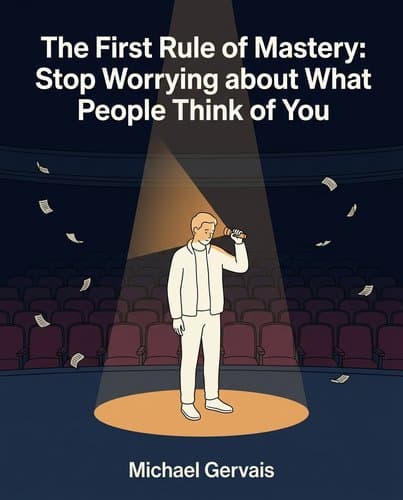
142030572_the-first-rule-of-mastery
by Michael Gervais, Kevin Lake
Your brain's ancient survival wiring—the obsessive fear of other people's opinions—is silently sabotaging your performance and authenticity.
In Brief
Your brain's ancient survival wiring—the obsessive fear of other people's opinions—is silently sabotaging your performance and authenticity. Learn to build an internal compass that lets you silence outside noise, take bold risks, and finally live and perform on your own terms.
Key Ideas
Curate Inner Circle of Truth Speakers
Build your 'roundtable': identify two to ten people whose opinions actually deserve weight. Admission requires three things — they support the real, unpolished version of you; they're committed to the truth over comfort; and they live in a way you respect. Everyone else gets the screen, not your nervous system.
Treat Emotional Spikes as Diagnostic Data
When you feel a visceral spike of FOPO — fight, flight, or freeze after a comment — treat that spike as data, not a verdict. Write it down, bring it to your roundtable, then ask: whose belief is this really, and when did I first adopt it?
Others Forget Your Social Mistakes
Practice the spotlight flip: the next time you're mortified by a social mistake, recall the last time a colleague fumbled in a meeting. You almost certainly don't remember it. Neither does anyone else remember yours.
Your Output Isn't Your Identity
Separate performance from identity. Replace 'I am a [role]' with 'I am someone committed to [purpose].' When criticism arrives, it now challenges your output — not your existence.
Mortality Becomes Your Best Filter
Use mortality as a filter. Before spending energy managing someone's opinion of you, ask: will this matter at the end? Bronnie Ware's patients didn't regret taking that risk — they regretted not taking it.
Control Where Your Worth Lives
Audit your self-worth anchors. List where your sense of value currently lives (approval, achievement, appearance). Any anchor outside your control is a structural vulnerability — a storm can pull it loose at any moment.
Who Should Read This
People working on personal growth in Self-Improvement and Confidence, especially those tired of generic motivational advice.
The First Rule of Mastery: Stop Worrying about What People Think of You
By Michael Gervais & Kevin Lake
10 min read
Why does it matter? Because the voice asking 'what will they think?' isn't a character flaw — it's an ancient survival alarm misfiring in a world it wasn't built for.
When did you last laugh at something that wasn't funny? Bite your tongue when someone said something you knew was wrong? Chase a version of your life that, if you're honest, belonged to someone else's vision of you? You probably filed those moments under people-pleasing or insecurity — personal flaws to manage or apologize for. But psychologist Michael Gervais, who has spent his career inside high-performance environments — Olympic athletes, Navy SEALs, professional teams — has a different diagnosis entirely. That voice asking what will they think? isn't a character defect. It's ancient survival code, forged when tribal rejection meant death, now misfiring sixty times a day in open-plan offices and Instagram comment sections. The problem isn't that you care what people think. The problem is that your brain can't tell the difference between a sabertooth tiger and a one-star review. This book is about learning to tell the difference — and what opens up the moment your brain finally can.
You're Not Insecure — You're Running Ancient Software
Here is a claim worth sitting with: your fear of other people's opinions is not a character flaw. It's a piece of ancient software still running on modern hardware, and it was never designed for the world you actually live in.
Psychologist Michael Gervais calls this FOPO — the fear of other people's opinions — and he argues it may be the single greatest constraint on human potential. Before you decide whether that's hyperbole, run down this partial list of what FOPO looks like in practice: laughing when nothing is funny, biting your tongue when someone says something offensive, chasing a career you were "supposed" to want, reading a room for belonging rather than genuine connection, formulating your response while the other person is still talking. Most readers will feel a quiet jolt of recognition somewhere on that list. That's the point. FOPO isn't occasional self-doubt — it's a background process running constantly, draining resources you didn't know you were spending.
The reason it runs so deep is biological. The sociometer is what researcher Mark Leary calls the brain's internal alarm for social inclusion — it monitors your status within the group in real time. His conclusion upended conventional thinking: self-esteem isn't a private happiness score. It's that alarm system, reading the room on your behalf, constantly. For your hunter-gatherer ancestors, the monitoring was life-saving. If you fell out of favor with the tribe — if the failed hunt got blamed on you — exclusion could be a literal death sentence. So the brain built circuitry to catch every hint of rejection early, before it became fatal.
Then came Slack notifications. And Instagram comments. And performance reviews. The alarm system didn't get an update. It still treats a cold reply from your boss with the same neurological urgency it once reserved for being cast out into the wilderness. You're not being dramatic when a critical comment from a stranger ruins your afternoon. You're running the original code on a problem it was never written to solve.
The Spotlight Isn't Real — And the Mind-Reader Is Wrong
Gervais was quietly celebrating in the back when his mentor called. The fighter Gervais had worked with for months had just pulled off a major upset, and somewhere in the walk-in, Gervais had been visible on camera. The mentor's question — what was Gervais doing on television — landed like a verdict: stay behind closed doors, know your place, psychology doesn't belong on a public stage. Gervais never asked what the man actually meant. He simply knew. That certainty steered his career for a decade, keeping him away from media, away from the public conversations he believed in. When he finally ran into the mentor again years later, the man seemed smaller than memory had made him — almost frail in a tweed jacket. They talked briefly, shook hands, and parted. The stone tablet Gervais had been carrying existed only in his own interpretation of a single sentence.
The research explains exactly what happened to him. Cornell psychologist Thomas Gilovich ran an experiment where students had to walk into a room of peers wearing a Barry Manilow T-shirt — chosen specifically because they'd find it mortifying. Each subject felt the heat of what seemed like twenty pairs of eyes cataloging their embarrassment. Afterward, they estimated that about half the room had noticed the shirt. Fewer than one in four had. That electric certainty of being watched — everyone registering the same thing you are — turned out to be a 25-point illusion. Gilovich called it the spotlight effect: we assume that because we're intensely focused on our own appearance and behavior, the room must be equally focused on us. It isn't.
The mind doesn't just inflate how closely we're being watched. It also inflates how accurately it reads what watchers are thinking. Nicholas Epley at the University of Chicago tested this with romantic couples together for around ten years — people who had shared beds and arguments and grocery lists for years. He asked one partner to answer twenty questions about their preferences and opinions, then had the other predict those answers. The predictors believed they'd nail about thirteen out of twenty. They got fewer than five right — barely better than random guessing. The confidence they felt in their mind-reading had almost no relationship to their actual accuracy.
Gervais built a decade of decisions around a judgment that existed only in his own head. The mentor may have been offering a small note. He may have been in a bad mood. He may have already forgotten the sentence by the time he hung up. Gervais never found out, because he never asked — because he was certain he already knew. The stone tablet he'd been carrying existed only in his own interpretation of a single sentence.
When Your Identity Is the Problem, Every Critic Becomes a Death Threat
It's 1997 and the NBA Finals are tied with nine seconds left. Karl Malone — the Mailman, the man who would retire as the second-greatest scorer in league history, a player with a 74 percent career free-throw rate — steps to the line for two shots. As he settles into his routine, Scottie Pippen drifts past and murmurs six words: 'The mailman doesn't deliver on Sundays.' Malone went through his normal pre-shot ritual, dribbled, spun, crouched — and missed. Both of them. The Bulls won the game and eventually the series.
The story haunts basketball fans precisely because of the proportion problem: a giant of the sport, at the peak of his powers, apparently undone by a whisper. The mystery dissolves once you understand how a performance-based identity works.
When your entire sense of self is built around being the person who always delivers, a pointed remark about not delivering isn't trash talk — it's a threat to your existence. Your nervous system doesn't distinguish between a rival questioning your identity and a predator questioning your survival. Both fire the same alarm. The brain floods the body with stress hormones, muscles tighten, fine motor control evaporates. For a pitcher, that means sweaty hands and a racing heart at ninety-eight miles per hour. For a free-throw shooter, it means two clanks in front of eighteen thousand people.
Researcher Ben Houltberg identifies the three-part trap at the center of a performance-based identity: self-worth that depends on results, a constant dread of failure, and perfectionism used not to excel but to avoid being exposed. The trap is anchoring worth to outcome, which turns every external judgment into a verdict on whether you belong. Each success buys temporary relief before the next performance arrives to threaten everything again. The trap isn't the ambition — pushing yourself to perform at a high level is genuinely valuable. The trap is that when worth is tied to outcome, every critic, every stumble, and every whispered jab becomes a referendum on whether you deserve to exist.
Calling these moments 'mental weakness' misses the point entirely. Collapse under that kind of pressure isn't a character flaw — it's the predictable output of a self built on sand. When the ground shifts, the structure falls.
The Imagined Audience Runs on 47% of Your Brain's Waking Hours
When neuroscientist Timothy Wilson wanted to understand what happens when people are left alone with their thoughts, he stripped a room bare, put college students in it one at a time, and gave them a single instruction: sit there. No phone, no book, no task. Just their own minds for fifteen minutes. Most found it unpleasant. Then Wilson added a twist: a button that would deliver an electric shock — one every participant had already tried and rated as something they'd pay money to avoid. Given the choice between boredom and pain, 25 percent of women and 67 percent of men chose the shock. One person hit the button 490 times.
That's not a quirk of the college-student sample. It's a window into what the idle brain actually does. The brain has a resting-state circuit — what neuroscientist Marcus Raichle calls the default mode network — that doesn't idle cleanly when there's no task demanding your focus. It defaults to social threat-scanning. Worrying about the future. Replaying conversations. Imagining what other people think of you. A Harvard tracking study found we spend nearly half our waking hours in exactly this mind-wandering state, and it correlates reliably with lower happiness.
FOPO's neurological home isn't occasional anxiety that flares under pressure. It's the brain's structural default, a survival circuit that evolved to keep early humans alert to social threat. The system worked. Then the threats changed and the circuit didn't. The jolt of recognition in Wilson's data isn't that people are weak-willed. It's that the alternative to distraction — sitting with an unmanaged default mode — feels, to the nervous system, genuinely dangerous. You're not anxious about judgment because you're insecure. You're running hardware that was never updated.
That's not just a biological curiosity. It's the engine running while your life happens around it.
The Cost of Letting Strangers Decide What You're Worth
For eight years, Australian Bronnie Ware worked as an in-home caregiver for people in the last weeks of their lives. She bathed them, prepared their meals, organized their medications. But the most important thing she did, she gradually realized, was listen. As her patients moved through that late-stage reckoning with how a life was actually spent, Ware cataloged what they said. The results were striking in their consistency. The single most common regret wasn't professional. It wasn't relational. It was this: they wished they'd had the courage to live a life true to themselves rather than the one others expected of them. At the very end, stripped of everything, the thing people mourned most was the years they had spent managing other people's opinions.
That's the full cost of FOPO. Not the missed opportunity in a single meeting or the performance tanked by a rival's whisper — the entire shape of a life, bent toward imagined expectations, discovered too late to unbend. What makes Ware's finding so hard to dismiss is that these are people who can see the whole picture. They know exactly how the story ends. They've run the full experiment and are reporting the results from the other side.
Hillary Allen fell 150 feet off a Norwegian cliff during a race, broke fourteen bones, and regained consciousness covered in blood on a near-vertical rock face. The first words she spoke to the racer who climbed down to reach her were: 'Am I going to be okay?' Even at the exact edge of death, the reflex was outward. That pull toward external confirmation — needing someone else to tell you your status — is the reflex at the core of FOPO, distilled to its simplest form. The question worth sitting with isn't whether you do this. It's what you're quietly building your life around while you wait for the answer.
You Can't Fix FOPO by Caring About No One — You Need a Roundtable
Nate Hobgood-Chittick was a 290-pound NFL defensive tackle whose coaches delivered their instruction wrapped in contempt — screaming, belittling, tearing players down in front of their peers. He couldn't tune them out entirely; there was genuine technical feedback buried in the abuse, and he needed it to get better. So he built what he called a screen. When a coach came at him, only the actionable content passed through — the half-step adjustment, the hand placement note — while the rage and humiliation stayed on the coach's side. The screen didn't make Nate immune to criticism. It made him the one deciding what criticism was worth processing. That pause, inserted between someone else's opinion and his own response, is the whole mechanism.
Both extremes of the FOPO problem arrive at the same dead end. Treat every opinion as equally valid and you'll never take a real risk, because someone will always disapprove. Decide nothing anyone thinks matters and you'll violate social wiring so fundamental to your survival that loneliness sets in before you notice. The fix isn't a mindset. It's an architecture — and Nate's screen is half of it.
The other half is deciding whose voice belongs in the conversation at all. As Brené Brown puts it, before an opinion earns your attention, the person has to be in the arena — trying, failing, risking something real. The ones in the cheap seats, lobbing criticism without any skin in the game, don't qualify. From there, Gervais suggests building a circle of two to ten people who meet three criteria: they're committed to you as you actually are, not the polished version; they'll tell you the truth even when it's uncomfortable; and they're living in a way you genuinely respect. Think of the friend who told you the hard thing about your business idea — not to be cruel, but because they cared more about your actual outcome than your feelings in the moment. That's who belongs in the circle. Get the roundtable right, and the feedback that survives both filters is almost always worth sitting with — which matters a great deal when the next section asks you to examine who you actually are underneath all the noise.
The Identity Swap That Makes FOPO Structurally Impossible
You could spend years patching individual anxious thoughts — suppressing this one, reframing that one — and still leave the underlying structure intact. The shift away from FOPO requires something more fundamental.
The Biosphere 2 project in Arizona tried to grow trees in a sealed, windless dome. The trees grew fast, but they kept falling over before reaching maturity. Researchers traced the problem to the absence of wind: without mechanical stress, the trees never developed the dense reaction wood that holds a mature tree upright. The dome had eliminated every external threat, and the result was structural collapse. Humans need the same thing. The goal isn't to wall yourself off from others' opinions — it's to build a root system strong enough that when the wind hits, you bend without toppling.
That root system is a purpose-based identity. Researcher Ben Houltberg's work shows that a performance-based identity is structurally fragile because self-worth becomes contingent on results that are never fully in your control. That's the performance-based identity trap Section 3 traced through Karl Malone — and the exit is a different kind of anchor entirely. When identity is anchored to purpose and values rather than results, criticism changes function. It becomes data about whether you're moving in the right direction, not a referendum on whether you're worth anything at all.
Florida State basketball coach Leonard Hamilton shows what this looks like in practice. He measures his wins not in scores but in whether his players become good fathers and partners — a standard entirely inside his own control, immune to the volatility of any scoreboard. His purpose doesn't move when external results do. That stability is the whole point.
The question worth asking: what are your core values, and are the choices you're actually making — in meetings, with your kids, in the work you avoid — moving toward them or away from them? When identity is anchored there, a critic's whisper stops being a threat to your existence and starts being just wind. You've grown the wood to stand in it.
The Question That Outlasts the Opinions
Beethoven wrote the Ninth Symphony in total silence — not merely while deaf, but while cut off from the one thing most artists need like oxygen: the immediate reaction of a crowd. He couldn't hear the applause, the whispers, or the critics sharpening their pens. What he had instead was a values-anchored purpose so clear it rendered the audience's judgment structurally irrelevant. The result outlasted everyone in that first concert hall by two centuries. The opinions you're managing right now — the ones pulling at your attention like an undertow — will grow quieter with time. The only question they leave behind is whether you used the hours they were occupying to build something worth the cost of your one life. The architecture you've been building across these pages isn't a set of coping tools. It's a way of closing the distance. Because FOPO is loudest in the gap between who you are and who you've decided to become.
Notable Quotes
“our job becomes to get specific on whose opinions matter and find the people who love you, not despite your vulnerability, not despite your imperfection, but because of it.”
“whose face is marred with dust, sweat, and blood.”
“a retrospective accounting of one’s life to date.”
Frequently Asked Questions
- What is FOPO and how does it affect high performance?
- FOPO — fear of other people's opinions — is "an evolutionary survival mechanism that now blocks authentic, high-performing living." This ancient adaptation triggers fight-flight-freeze responses to criticism that undermine performance. The book teaches that you can replace approval-seeking with "an internally anchored identity, so criticism no longer threatens your sense of self." When you treat FOPO as "data, not a verdict," you reclaim nervous system energy spent on audience management, enabling the focused clarity that elite performers demonstrate.
- What is the 'roundtable' and how do you build one?
- The 'roundtable' consists of "two to ten people whose opinions actually deserve weight." Admission requires three criteria: "they support the real, unpolished version of you; they're committed to the truth over comfort; and they live in a way you respect." Everyone else "gets the screen, not your nervous system" — meaning their opinions don't trigger your nervous system responses. By curating whose voice reaches your core self, you build authentic support that anchors your identity while filtering out feedback that destabilizes your sense of self.
- What is the spotlight flip technique and how does it reduce FOPO?
- The spotlight flip helps manage shame after social mistakes through this practice: "the next time you're mortified by a social mistake, recall the last time a colleague fumbled in a meeting. You almost certainly don't remember it. Neither does anyone else remember yours." This reveals that the spotlight you feel on your mistake exists primarily in your mind. By leveraging how quickly others' fumbles fade from collective memory, you deflate the anxiety that FOPO amplifies, showing that perceived social consequences are largely internal.
- Why should you audit your self-worth anchors to overcome FOPO?
- Auditing self-worth anchors means identifying where your sense of value currently lives — "approval, achievement, appearance." The critical insight: "any anchor outside your control is a structural vulnerability — a storm can pull it loose at any moment." When approval becomes your primary anchor, others' opinions directly threaten your sense of self, intensifying FOPO. Shifting anchors to internal sources like purpose and values creates stability that cannot be destabilized by external judgment, making this structural change foundational to authentic performance.
Related Book Summaries
Read the full summary of 142030572_the-first-rule-of-mastery on InShort