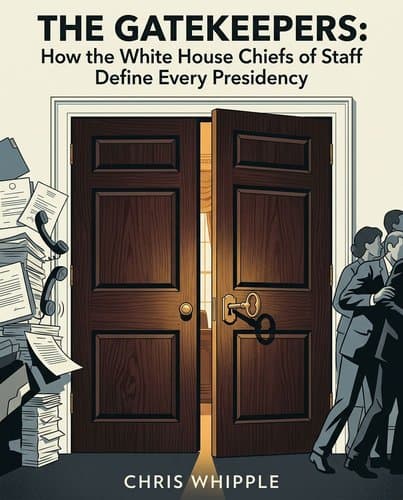
31159759_the-gatekeepers
by Chris Whipple
Every modern presidential disaster—Watergate, Iran-Contra, the Iraq invasion—was a process failure before it was a political one. Whipple reveals how the…
In Brief
Every modern presidential disaster—Watergate, Iran-Contra, the Iraq invasion—was a process failure before it was a political one. Whipple reveals how the unsung chiefs of staff who controlled information flow and killed bad ideas before they reached the Oval Office were the only thing standing between a president's worst impulses and history.
Key Ideas
Process failures enable presidential disasters
Every major modern presidential catastrophe — Watergate, Iran-Contra, the Iraq invasion, the healthcare.gov rollout — was a process failure before it was a moral or policy failure. In each case, there was a specific moment when the chief of staff was either absent, outmaneuvered, or too deferential to stop a bad idea from becoming a disaster.
Information gating prevents bad ideas
The chief of staff's primary job is controlling information flow to the president and ensuring bad ideas die before they need a formal 'no.' Baker's value wasn't that he said no loudly — it was that McFarlane was afraid to even propose an arms-for-hostages scheme while Baker was in the building.
Confusing authority creates dangerous vacuums
The failure mode to watch for isn't a weak chief — it's a chief who confuses the president's power with their own. Regan and Sununu both thought they were running things. That delusion created exactly the vacuum it was supposed to fill.
Relationships trump authority in crisis
The most effective chiefs (Baker, Panetta, Duberstein) ran on preparation and relationships, not authority. They built trust with the First Lady, the press corps, congressional leaders, and cabinet secretaries before they needed any of them — so that when crises hit, they had channels that bypassed the formal structure.
Distinguish instinct from conventional wisdom
Speaking truth to power sometimes means supporting a decision the entire foreign policy establishment condemns, not just one the president resists. The job requires distinguishing between the president's bad instinct and the establishment's conventional wisdom — they are not the same thing.
Gating function prevents organizational disasters
Any high-stakes organization needs the equivalent of this function: one person whose job is to gate the principal's time, stop bad ideas before they metastasize, and deliver honest assessments unclouded by personal agenda. The absence of this function doesn't prevent bad decisions — it just removes the last structural obstacle to them.
Who Should Read This
History readers interested in Political Figures and Leadership who want a deeper understanding of how we got here.
The Gatekeepers: How the White House Chiefs of Staff Define Every Presidency
By Chris Whipple
9 min read
Why does it matter? Because the person you've never heard of may be the most consequential in the building.
Here's what most people assume: the president decides, and the White House executes. Reasonable. Also dangerously incomplete. Watergate wasn't primarily a crime story — it was a story about a president who bypassed his own gatekeeper to take calls from someone who "clicked his heels and saluted." Iran-Contra wasn't ideology run amok — it was what happens when nobody is positioned to say "a Bible hidden inside a cake is probably a bad idea." The Iraq invasion: same pattern, different president, different catastrophe. Each one has a moment, usually quiet, usually undramatic, when a specific person either stopped something or didn't. Chris Whipple spent years interviewing virtually every living White House chief of staff to map that pattern. The answer involves one job most Americans can't name, and why getting it wrong tends to end presidencies, and occasionally something larger.
The System That Governs Every Modern Presidency Was Invented by a Man Who Went to Prison
December 19, 1968. The Pierre Hotel, Manhattan, thirty-ninth floor. H.R. Haldeman stood before the incoming Nixon administration's staff and laid out four rules that would quietly govern every White House that followed.
Nothing reaches the president unstaffed. No end-runs: no private meetings with the president to push a personal agenda without going through the chief first. The president's time is his most valuable asset; protect it ruthlessly. The White House decides policy; the cabinet executes it. The ban on end-runs, Haldeman noted, was the principal occupation of 98 percent of the bureaucracy: everyone was perpetually trying to slip around the chief and get an unfiltered moment with the man in the Oval Office. The system existed to stop that.
It worked. With Haldeman enforcing the system, Nixon opened diplomatic relations with China, established the EPA, and forged bipartisan policy during a period of genuine national fracture. Dick Cheney, who would go on to run Gerald Ford's White House, later said that every president, regardless of how they arrive, eventually adopts the system. Donald Rumsfeld used the Pierre Hotel speech as his own template when he succeeded Haldeman years later.
Then Watergate happened, and here's where the conventional reading goes wrong.
The common story is that Haldeman built a machine and used it to help Nixon commit crimes. But the people who examined the wreckage reached a different conclusion: the system wasn't too rigid — it simply wasn't followed. Nixon kept slipping around his own chief, turning instead to Charles Colson, a political operative who asked no questions and executed on command. John Dean warned Haldeman twice, in plain language, that an intelligence unit was planning illegal operations. Haldeman said he'd handle it. He didn't.
Haldeman understood the danger better than anyone. At a 1986 symposium of former White House officials, asked how Watergate had happened, he gave the cleanest possible answer: "The thing that went wrong is that the system was not followed." The man who invented the mechanism for telling a president hard truths had never used it on the one person who most needed to hear them.
He served eighteen months in federal prison.
When Carter Refused to Appoint a Chief of Staff, the Consequences Were Specific, Documented, and Avoidable
On January 20, 1977, Dick Cheney spent his last morning as White House chief of staff doing something unusual. His departing staff had given him a bicycle wheel mounted on plywood, every spoke snapped except one — a memorial to Gerald Ford's "spokes of the wheel" management philosophy, which Cheney had spent three years trying to repair. Rather than take it home, Cheney propped it in the office where Hamilton Jordan, Jimmy Carter's incoming top adviser, would be moving in that afternoon. He pinned a note to it: "Dear Hamilton, Beware the spokes of the wheel." Carter had just said in an interview that he believed in the concept, using Ford's exact phrase.
Jordan did not beware. Carter, determined to break with everything Nixon and Ford had represented, refused to appoint a formal chief at all. Jordan became the de facto gatekeeper while refusing to perform the job's basic functions. He hid in Executive Office Building offices so senators couldn't track him down; when calls came in, he routed them to a deputy or called back days later, if at all. Tip O'Neill, the Democratic Speaker of the House and the single figure Carter most needed to pass legislation, was reportedly seated in the last row of the second balcony at an inaugural Kennedy Center gala. O'Neill never forgave it. He called Jordan "Hannibal Jerkin" from that day forward.
A gatekeeper returns the Speaker's calls. Without one, Carter's legislative agenda kept colliding with a Congress that felt ignored: energy policy, the Panama Canal treaty, healthcare reform, all running simultaneously with no one forcing a choice. The machinery seized on the same friction, over and over.
Carter finally gave the chief's title to Jack Watson eight months before leaving office. Shortly after the election, at a reception in Washington, President-elect Reagan spotted Watson across the room and crossed over to find him. "My people tell me," Reagan said, shaking his hand, "that if you'd been chief of staff from the beginning, I wouldn't be here." Watson had served only those eight months — long enough for historians to name him one of the three best chiefs in modern history.
The Best Chief of Staff Doesn't Just Say No — He Ensures Bad Ideas Die Before They Need One
Two days after Reagan won the presidency, James Baker stood on the porch of Reagan's Los Angeles home and peered through the window at the inner circle gathered inside: every senior adviser he'd spent months battling as campaign manager for Reagan's opponent, George Bush. He was afraid to knock. Reagan appeared and waved him in, beaming.
The following morning, Baker invited Ed Meese, the loyal aide who had expected to be chief of staff himself, to breakfast and pulled out a yellow legal pad. Meese got a grand title and nominal control over policy. Baker kept something quieter: control over information flow, access to the president, and the White House staff. "I was still in a position to run everything," he said later.
Baker ran the Reagan White House through preparation rather than authority. He cultivated the press corps on background (never for direct attribution) because a chief needs advance warning before a problem becomes a headline. His most important instrument was Nancy Reagan, who could deliver unwelcome truths in ways that landed. When Reagan wanted to make Social Security voluntary, Baker worked through the first lady until the idea dissolved quietly in the residence rather than detonating on Capitol Hill. When deficits forced a tax increase, Baker spent weeks building the case through Meese, Deaver, and Nancy before confronting Reagan directly. The president threw his glasses on the desk: "OK, dammit, I'm going to do it — but it's the wrong thing to do."
Then he swapped jobs with Treasury Secretary Donald Regan, a Wall Street chairman who spent his first weeks having an aide announce his arrivals: "Ladies and gentlemen, the chief of staff to the president of the United States." Within two years, a National Security Council staffer named Oliver North was secretly diverting profits from illegal Iranian arms sales to Nicaraguan rebels, complete with hollowed-out cakes containing Bibles as gifts for the Iranian middlemen. The Tower Commission, Reagan's independent review panel, held Regan primarily responsible for "the chaos."
The logic is mechanical. Under Baker, CIA director Bill Casey was kept on a leash: whenever Casey met privately with Reagan, deputy chief Mike Deaver would immediately appear to ask what they'd discussed. The national security adviser who hatched the Iran scheme deferred to Baker; under Regan, the two men barely spoke. Peggy Noonan, who watched both men operate from inside the West Wing, put it simply: Baker was an established Texas lawyer. That world has a specific tolerance for risk, and it doesn't extend to scripture wrapped in pastry. "They don't do Bibles hidden in cakes." Dick Cheney was blunter: "Iran-Contra never would have happened on James Baker's watch."
Baker's job was never crisis management. It was ensuring that crises never became decisions — and the moment that changed, the machinery showed exactly what it had been holding back.
The Failure Mode That Ends Presidencies Is Not Weakness — It's the Wrong Kind of Strength
Doesn't a White House need a strong chief? By now the case for strength seems almost airtight. George H.W. Bush made it concrete: John Sununu, a former governor with a PhD from MIT, was the kind of man who walked into his first policy meeting, listened for two minutes, and announced to the room that none of them knew what they were talking about. Go back. Come back when you do.
Sununu treated the chief's borrowed authority as his own. He commandeered military aircraft for personal trips. He took a White House limousine to a stamp auction in New York. He stood on the White House lawn and screamed at a Washington Post reporter — "You're a liar, all your stories are lies" — while the reporter's editors quietly began investigating. Cabinet secretaries grew so frustrated with his gatekeeping that Bush set up a private post office box in Kennebunkport as a back channel around his own chief. When Sununu had to go, Bush sent his son to deliver the news. Sununu ignored him, walked into the Oval, and asked: "Am I doing a good job?" Bush, conflict-averse to his core, replied: "Fine."
When he fell, almost nobody came to his defense. An Agatha Christie mystery: every suspect had motive, every one had plunged the same knife.
Jim Baker's verdict was quiet and exact. The people who fail in this job, he said, are the ones who like the chief part and not the staff part. The title has two words. One of them is the job.
Card Whispered Four Words Into the President's Ear — and Then Lost Control of Everything That Followed
At Emma Booker Elementary School in Sarasota, Andrew Card received word a second plane had struck the World Trade Center. He crossed the classroom to where the president sat reading with second graders, leaned in, and said two sentences: "A second plane hit the second tower. America is under attack." Then he stopped — no question, no dialogue. While Bush sat motionless, Card spent the same ninety seconds getting Air Force One's engines started, the motorcade turned, and a line open to the vice president and the FBI director. The chief, at his most functional, in the worst possible moment.
What followed showed what the role couldn't do.
Dick Cheney, who had chaired Bush's search for a running mate and then offered himself for the job, brought something no previous vice president had: he had run a White House himself. He knew every lever, every bypass, every informal channel. When a senator asked the administration's position on the Kyoto Protocol — an international greenhouse gas agreement — Cheney drafted a letter of rejection, walked it directly to Bush, got it signed, and delivered it to Capitol Hill. He bypassed Card, bypassed EPA administrator Christine Todd Whitman, bypassed Secretary of State Colin Powell entirely. Powell learned the letter existed and rushed to the White House. He arrived too late. "The vice president has already taken it to the Hill," Rice told him. When Powell found out that Card hadn't known either, every cabinet secretary had learned something useful: the bypass worked, and Cheney would use it again. Erskine Bowles, Clinton's former chief, watched this from the outside and delivered the obvious verdict: "In my opinion, Cheney was the chief of staff." And unlike the actual chief, Cheney couldn't be fired.
Card insists he was never blindsided. But managing consequences you weren't consulted about is not the same as running the White House. When Bush decided to pursue war in Iraq, he pulled Rumsfeld aside after an NSC meeting and asked him to develop a plan — "outside the normal channels," he said. No meeting of principals debated the underlying decision. The pattern held from Kyoto to Baghdad: an administration that made its biggest choices by routing around its own system, and a chief left managing the wreckage of decisions he had never been part of making.
The Last Honest Voice in the Room Isn't Always the One Who Pushes Back
On the South Lawn, an hour before the announcement, Obama and Denis McDonough were walking. No aides. No note-takers. Just the two of them circling the driveway while the NSC waited inside.
The day before, Kerry had given a thundering speech calling for military strikes against Syria. Assad's regime had used sarin on a Damascus suburb, killing fourteen hundred people. The NSC session they'd just left hadn't been a debate about whether to strike. It was logistics: which targets, which assets, what to say afterward. Susan Rice wanted strikes. The consensus was so complete that what happened next stunned the room.
Obama came back inside and announced he was calling off the strikes and sending the matter to Congress.
The firestorm was immediate. McDonough's counter, made carefully in rooms where others could rebut him, was that Washington's unanimity was itself the problem. "There's a conventional wisdom that the use of force is important for the use of force's sake," he said later. The mind-set behind that consensus was the same one that got the country into Iraq. What he did on that walk wasn't push back against Obama. He was a sounding board for a president deciding to go against the current of expert opinion. Tom Daschle, who had known both men for twenty years, put it plainly: "The last person the president spoke to about that decision was Denis. And arguably the most influential person he spoke to was Denis." The president's threat meanwhile brought Russia to the table, resulting in the actual removal of Syria's chemical arsenal. The chief who let the president think clearly may have produced the better outcome.
Every catastrophe in the book — Watergate, Iran-Contra, Iraq, the healthcare.gov collapse — involved a chief who failed at this. Not always by cowardice. Sometimes by being so loyal they couldn't distinguish the president's judgment from their own job security. The Reince Priebus era was already visible before it began: ten former chiefs gathered to advise him, and few left confident he could do it. "Never has a president been more in need of a reality therapist," Whipple writes of Trump. The thin line between the president and disaster runs through one office, one person, one job that almost nobody fully understands until they're already in it.
The Thin Line, Wherever You Find It
Whipple ends on Trump, but the book's real question has nothing to do with Pennsylvania Avenue. Ten former chiefs of staff gathered to counsel Reince Priebus before he took the job. Few left confident he could do it — not because he was unserious, but because he had never run an organization at this scale and lacked the standing to tell Trump no. The president would need to hear no a lot.
Every organization of consequence (a company, a hospital, a family) has a principal who needs someone positioned between them and their own worst instincts. Someone who controls what reaches the decision-maker, who kills bad ideas before they need a formal veto, who tells the truth without calculating the cost to their own standing. Who is that person for you? Not in title — in practice. Do they have the access? The trust? The courage to circle a driveway for an hour and push back on the decision the entire room has already blessed? The epilogue frames this as a warning about the present. The rest of the book makes clear: it always was.
Notable Quotes
“Our job is not to do the work of government, but to get the work out to where it belongs—out to the Departments,”
“Nothing goes to the president that is not completely staffed out first, for accuracy and form, for lateral coordination, checked for related material, reviewed by competent staff concerned with that area—and all that is essential for Presidential attention.”
“That is the principal occupation of 98 percent of the people in the bureaucracy. Do not permit anyone to end-run you or any of the rest of us. Don't become a source of end-running yourself, or we'll miss you at the White House.”
Frequently Asked Questions
- What is The Gatekeepers by Chris Whipple about?
- The Gatekeepers examines how the White House chief of staff shapes — and sometimes saves — the modern presidency. Based on interviews with all living chiefs of staff, it shows how controlling information flow, managing presidential impulses, and building relationships before crises hit separates effective administrations from catastrophic ones. The book analyzes major presidential crises—Watergate, Iran-Contra, the Iraq invasion, and the healthcare.gov rollout—revealing that each "was a process failure before it was a moral or policy failure." In each case, the chief of staff was either absent, outmaneuvered, or too deferential to stop a bad idea from becoming a disaster.
- What makes a White House chief of staff effective?
- The most effective chiefs—Baker, Panetta, and Duberstein—"ran on preparation and relationships, not authority." They built trust with the First Lady, the press corps, congressional leaders, and cabinet secretaries before crises hit, creating channels that bypassed formal structures. The chief of staff's primary job is controlling information flow to the president and ensuring bad ideas die before they need a formal 'no.' Whipple shows that "Baker's value wasn't that he said no loudly — it was that McFarlane was afraid to even propose an arms-for-hostages scheme while Baker was in the building."
- How do process failures lead to presidential disasters?
- "Every major modern presidential catastrophe—Watergate, Iran-Contra, the Iraq invasion, the healthcare.gov rollout—was a process failure before it was a moral or policy failure." In each case, there was a specific moment when the chief of staff was either absent, outmaneuvered, or too deferential to stop a bad idea from becoming a disaster. Whipple identifies a critical failure mode: a chief of staff who confuses the president's power with their own. Regan and Sununu exemplified this problem—they thought they were running things, which "created exactly the vacuum it was supposed to fill."
- Does the chief of staff gatekeeping role apply to other organizations?
- Yes. "Any high-stakes organization needs the equivalent of this function: one person whose job is to gate the principal's time, stop bad ideas before they metastasize, and deliver honest assessments unclouded by personal agenda." Whipple argues that "the absence of this function doesn't prevent bad decisions — it just removes the last structural obstacle to them." This gatekeeping role is essential across all high-stakes enterprises. The function isn't specific to government; effectiveness depends on a structural capacity to control information flow, maintain relationships across constituencies, and ensure poor decisions face scrutiny before implementation.
Related Book Summaries


Read the full summary of 31159759_the-gatekeepers on InShort