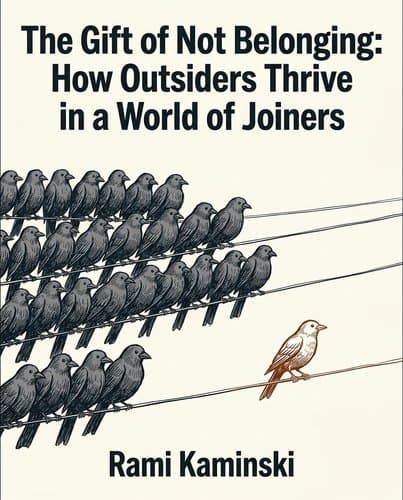
220175484_the-gift-of-not-belonging
by Rami Kaminski
Feeling like an outsider isn't a flaw to fix—it's a cognitive wiring called 'otroversion' that, once understood, becomes your greatest asset.
In Brief
Feeling like an outsider isn't a flaw to fix—it's a cognitive wiring called 'otroversion' that, once understood, becomes your greatest asset. Discover why you feel loneliest in crowds, how to engineer social situations that work for you, and how to stop apologizing for needing solitude.
Key Ideas
Loneliness in crowds is neurological wiring
If you feel loneliest in crowds rather than alone, you're not anxious — you may be missing what the book calls the 'Bluetooth signal,' the passive social sync that communal people access automatically. Recognizing this as wiring rather than a wound is the first practical step.
Solitude is personality, not problem
Stop trying to fix solitary children by pushing them into camps, clubs, and group activities. The research direction here runs the other way: forcing otrovert children into communal performance creates anxiety and learned helplessness. 'The art of letting be' — validating the preference for solitude rather than treating it as a problem — is the intervention.
Defined roles transform crowd overwhelm
When an otrovert has a defined role (host, presenter, DJ, team lead), large groups become manageable — not because of ego but because the role creates a boundary between self and crowd. If you're an otrovert navigating an unavoidable social obligation, engineering a role is a more effective strategy than willpower.
Unnecessary obligations require no attendance
Distinguish between necessary obligations (a child's performance, a critical work presentation) and unnecessary ones (multi-day wedding weekends, high school reunions, office happy hours). The social retribution for skipping the latter is largely a projection — communal people are focused on the group, not tracking individual absences.
Agreed exits make relationships sustainable
In relationships, an otrovert doesn't need a partner who is identical — they need one who offers acceptance without judgment. The practical tool: agree on a departure time and exit excuse before any social event begins. Knowing the end point transforms the otrovert's experience from trapped to tolerable.
Environment matters more than personality
If you're in a high-performing but emotionally draining career, ask whether the work itself is the problem or the environment. The pattern — initial enthusiasm, growing fatigue, Monday dread, eventual collapse — repeats until the structure changes, not the person. Independence, defined roles, and minimal mandatory collaboration are the structural requirements, not perks.
Inner life protects from collapse
The inner life is the one place no one else can access. Neglecting it — letting communal consensus substitute for personal instinct — is how burnout, midlife crisis, and depression actually form. Otroverts maintain a sharp boundary between self and group by default; communal people have to build it deliberately.
Who Should Read This
Curious readers interested in Self-Improvement and Mental Health and the science of how the mind actually works.
The Gift of Not Belonging: How Outsiders Thrive in a World of Joiners
By Rami Kaminski
10 min read
Why does it matter? Because the discomfort you feel in crowds, at parties, and during group rituals isn't anxiety — it has a name, a logic, and a set of advantages nobody told you about.
You've always known how to work a room. You just never wanted to stay in it. The party doesn't frighten you — it bores you, which somehow feels worse, because boredom looks ungrateful and boredom is hard to explain to someone who spent forty minutes finding parking. So you've spent years collecting explanations: introvert, homebody, socially anxious, selective. None of them quite fit. They all point to a deficit, something to overcome, a door you should eventually learn to open. Rami Kaminski, a psychiatrist, frames it differently. What if the problem isn't that you're standing outside the circle — what if you're simply facing the wrong direction to see that you were never wired for the circle in the first place? That's not a wound. That's a cognitive fact. And once you have the right word for it, everything you thought was broken about you starts to look like a feature, not a flaw.
You're Not an Introvert — You're Something More Specific
Have you ever taken the introvert quiz, scored firmly on the shy end, and still felt like the label didn't quite explain your experience? Introversion is about energy — crowds drain you, solitude restores you. But maybe what you feel in a crowd isn't depletion. Maybe it's something closer to alienation.
Psychiatrist Rami Kaminski draws a distinction that reframes the whole question. Introverts, extroverts, and social outsiders all have one thing in common: they orient themselves toward the center of the group. Introverts use the collective as protective cover, keeping individuals at arm's length. Extroverts need the audience. Outsiders, even when rejected, keep their gaze fixed on the circle they can't enter. Each of them is, in their own way, defined by the group's gravitational pull.
The otrovert is different in a single precise way: they stand inside the circle and face outward. They're welcomed, often well-liked, sometimes even seen as natural leaders — but they experience the group from the outside, always. It's not a matter of confidence or energy. The communal impulse that makes most people feel anchored by shared identity simply isn't there.
Kaminski's patient M understood this distinction without knowing it had a name. At professional conferences, M found cocktail hours almost painful — not because he was shy, but because he was the opposite of detached. He became deeply interested in every person he spoke with, which made the constant rotation of brief introductions and polite exits feel like a series of small losses. The moment a conversation ended and his companion drifted toward the next cluster, M felt it. Sit him at a dinner table with three or four people and the evening became manageable — the interactions had boundaries, the attachments could deepen. Same room, same colleagues, completely different experience.
What exhausted M wasn't the people. It was the group itself — the fluid, impersonal churn of collective socializing that most people navigate on autopilot. The framework you've been using doesn't have a word for that. Now it does.
The Wound Starts When Well-Meaning Adults Try to Fix What Isn't Broken
At eighteen, E had been a patient in a psychiatric day program for most of his teenage years, carrying a schizophrenia diagnosis that nobody had thought to question. When Kaminski — then a first-year resident — sat down with him one-on-one, he found a young man who was well-groomed, emotionally expressive, well-read, and writing poetry in his spare time. No delusions. No hallucinations. No flat affect. None of the clinical signs that schizophrenia actually produces. What E had was solitude, social reserve, and a deep disinterest in the group around him. The experienced staff had taken those qualities and, in the absence of a better framework, called them psychosis. They medicated him heavily for years on that basis.
Kaminski eventually had the antipsychotics tapered. E went on to become the director of an agency. What had looked like a mental breakdown was, from the beginning, a personality — one that nobody on the ward knew how to classify except as damage.
The wound almost always begins with good intentions. Adults converge on the reasonable-seeming goal of nudging the child back toward normal range. What they reliably produce instead is a child who now understands, with total clarity, that there is something wrong with the way they naturally are.
Kaminski is direct about what happens next: the child attempts to fake it. They perform enthusiasm for things that bore them. They sacrifice solitude to prove they can tolerate togetherness. And their sense of otherness sharpens with every performance, because the gap between the inner experience and the required display only grows more visible to them. Some develop the learned helplessness he describes — a deep exhaustion where the authentic self simply stops pushing back. Others, like E, land in systems that medicate the trait into submission.
The therapeutic move that actually works is absurdly simple: stop trying to fix it. Kaminski calls it the art of letting be. What the otrovert child needs isn't better socialization programs. They need at least one adult who can look at their particular way of moving through the world and decline to call it a problem.
Belonging Is Learned, Not Hardwired — And Some People Never Accept the Lesson
The drive to belong isn't wired in. It's installed — carefully, early, and without your consent.
Kaminski starts with something most people forget: newborns have no concept of other people as separate beings. A newborn doesn't experience other people as having competing needs. This isn't selfishness; it's just the operating system. The infant cries, and milk arrives. The world exists to serve the self. For roughly the first two years of life, this is the only frame available.
The communal upgrade happens around age three, and it's less a natural unfolding than a sustained campaign. Caregivers begin conditioning children toward group behavior through conditional approval: share, wait your turn, let others speak. No explanation is offered — no reasoning about why the group's needs should outweigh the child's own. The reward is simple and immediate: smile, hug, praise. The lesson isn't argued; it's repeated until it sticks. Most children absorb it so thoroughly that they come to experience the desire to belong as something they were born with. They weren't. They were trained.
True otroverts are the ones for whom the conditioning never quite takes. Not because they're damaged or unusually willful — but because the original self-sufficient operating system keeps reasserting itself. The social software installs but doesn't run cleanly. When everyone around them finds warmth and ease in group belonging, the otrovert finds mostly obligation and a low-grade sense of performance. Kaminski describes them as people who can follow the group's rules when necessary, but who never stop experiencing those rules as external to who they actually are.
The otrovert's resistance to belonging isn't a developmental failure — it's a persistence of original conditions. What that looks like in practice: a grown adult at a family dinner, going through the motions competently, wondering why everyone else seems to actually want to be there. The question stops being what went wrong with them. It starts being something stranger — why, even surrounded by people who care about them, they so often feel completely alone.
The Loneliest Place Is a Room Full of People — Here's Why
Imagine your phone has Bluetooth turned off. Everyone around you is pairing automatically — sharing playlists, syncing devices, exchanging data without thinking about it. You're standing in the same room, hardware intact, but none of the signals reach you. That's not a malfunction. It's just a different setting.
Kaminski describes something close to this when he explains how communal people move through shared spaces. Airports, grocery stores, elevators — in all of these, most people are running what he calls the Bluetooth phenomenon: a passive, largely unconscious social signal that pairs them with whoever happens to be nearby. It's why you know to smile at your neighbor in the elevator without being told, why strangers in a long checkout line coexist without friction, why a crowd of people who will never speak to each other still moves as something loosely coordinated. The signal is always on. It also mitigates loneliness — not by producing friendship, but by dissolving the hard edge between 'separate' and 'together.' Being surrounded by other humans, even anonymous ones, registers as a kind of company.
Otroverts can't access this signal. And that single fact explains something that often gets misread as social anxiety or depression: the experience of being most profoundly alone in the middle of a crowd. For the otrovert, a room full of strangers doesn't resolve into background comfort. It resolves into a room full of separate, individual minds — each one broadcasting, none of them connecting. The larger the crowd, the louder the noise. The crowd isn't a cure for loneliness; it's the primary source of it.
This is structural, not psychological. No amount of confidence or practice installs the signal. What feels to communal people like a neutral or even pleasant baseline — being surrounded by others — is, for the otrovert, genuine cognitive and emotional overload. The solitude they reach for isn't avoidance. It's the only setting in which the noise stops.
Kafka wrote it in a diary entry: being alone held a power over him that never failed. In solitude, something inside him would begin to order itself. He needed nothing more.
Staying in Bed Was Her Superpower
T had been in bed for two years. Not metaphorically — literally bedridden, Zooming with Kaminski from under the covers, disheveled and shaking, cycling through psychiatric medications that weren't helping. She came from old money in the Northeast, a family where the social calendar was the whole point, where women's professional lives consisted of elaborate lunching, and where the rules for correct living — the right weekend house, the right manner, the right approved ambitions — had calcified across generations. T had failed every rule since childhood. She'd internalized the failure so completely that she'd stopped being able to leave her bed.
When she told Kaminski she was good at nothing, a freak who couldn't crack the code everyone else seemed born knowing, he said: 'You're very good at one thing — staying in bed.' She shot back without missing a beat: 'Doctor, reverse psychology has been tried. It doesn't work on me. My entire psychology is already reversed.' But he wasn't trying a technique. He meant it literally. Staying in bed for two uninterrupted years requires a kind of iron commitment. Most people can't do it. She was, demonstrably, excellent at it.
The real diagnosis wasn't treatment-resistant anxiety. T had spent her entire life being told her natural self was a malfunction. Her family's pressure hadn't produced belonging — it had produced paralysis. Every drug and every therapist before Kaminski had accepted the same premise: that the goal was to make her fit. None of them had considered that the fitting itself was the problem.
For most people, feeling comfortable inside and fitting in outside move together — the more settled they are internally, the better they slot into the world around them. For T, those two things pulled in opposite directions. The more honestly she accepted her own nature, the less she would resemble the life her family had designed for her. That's not a problem to correct. It's the shape of the trade-off.
She eventually moved to the Caribbean and became a diving instructor. Not as a vacation from real life — as real life itself. The change wasn't the result of better coping strategies or finally mastering small talk. It happened when the treatment goal shifted from 'help her fit in' to 'let her be what she already is.' That shift — from pathology to personality — was the intervention.
The Same Wiring That Makes Parties Unbearable Makes Galileo Possible
The wiring that makes the otrovert miserable at cocktail parties is the same wiring that makes Galileo possible. Not two separate traits. One.
In 1861, Ignaz Semmelweis published data showing that doctors who washed their hands before delivering babies could drop maternal death rates from 18 percent to 2 percent. He had arrived at this by noticing something the medical establishment had collectively failed to see: physicians moving directly from autopsy tables to delivery rooms were carrying something deadly on their hands. The intervention took minutes. The results were immediate and dramatic. His colleagues responded by demanding a theoretical explanation for why it worked. Germ theory didn't yet exist, so Semmelweis couldn't provide one. They fired him, shunned him from academic medicine, and had him committed. He died in the asylum ten days later from infected wounds his guards had given him — killed by the very contamination he had solved.
Consensus functions as a filter. The medical community didn't evaluate Semmelweis's evidence; they measured it against existing theory and found it unaccountable. The hive mind doesn't ask whether an idea works. It asks whether the idea fits. Semmelweis saw what he saw precisely because he hadn't pre-sorted his observations through that filter.
Most people aren't filtering consciously — the communal framework runs automatically, flagging certain conclusions as implausible before they're fully formed. The otrovert doesn't have that filter installed. This is why they seem oblivious to social consensus in conversation, and why they can arrive at conclusions that consensus-dependent thinkers simply cannot reach. The imperviousness isn't a bug. It's the mechanism.
Kaminski puts it plainly: true creativity isn't about talent. A gifted person aims to be the best at something that already exists. A creative person does something no one else thought to try. Frida Kahlo painted her own reality without seeking permission for what it contained — and kept the exaggerated monobrow that everyone told her to soften. That stubbornness wasn't personal eccentricity. It was the condition of access to her own vision. You can't see what only you can see if you're adjusting for what the room expects.
Deep Conversation Is Not an Invitation — And That's Not a Flaw
The same perceptual independence shows up at smaller scale — in how the otrovert pays attention to one person.
L is genuinely delighted to meet you. He asks what you actually think, not what you've been up to. Within twenty minutes, strangers at parties feel they've had a conversation they'll remember for a week. Then they suggest getting coffee sometime, and L smiles warmly and declines. The warmth doesn't change. But the door doesn't open either. Some people leave flattered. Others leave stung, convinced they misread something — that the depth was a performance, a lure, or worse, a test they failed.
They didn't misread anything. The conversation was exactly what it felt like. For L, a genuine exchange with a stranger is complete in itself — not a first installment toward friendship, but the whole thing. His threshold for what counts as a real friendship is simply different from the communal one, where warmth signals availability and depth signals intention. For L, depth is how he talks to people. It's not an invitation to more.
The confusion runs deeper than crossed social wires. Communal empathy operates by projection: you imagine yourself into another person's situation and feel what you'd feel there. The otrovert does something structurally different — they try to imagine what the other person is actually experiencing from inside their own life, without substituting themselves for the subject. The difference isn't subtle. One produces sympathy mistaken for understanding. The other produces something closer to witness. The person on the receiving end feels genuinely seen rather than recognized.
That quality — attending to who someone actually is rather than who you'd be in their place — is the otrovert's most generous expression. It's what makes twenty minutes with L feel like more than an hour with someone who keeps steering the conversation back to themselves. The same wiring that produces social friction in crowds produces, one-on-one, something rare: real attention.
She Died at 98 Owing Nothing to Anyone
When Kaminski first met U, she was 93 and running her own life out of a small East Village apartment, still in Levi's, still smoking weed, still opinionated about everything. He was 43 and couldn't yet fathom what the end of life would feel like from the inside. She told him there was no particular mystery to figure out. 'At this stage,' she said, laughing, 'death is the primary plan for the future.'
U was a professor emerita who had spent her entire life inside her own mind — not as a retreat from the world but as the world itself. She cared deeply for other people, but out of genuine empathy, never obligation. She owed no one and felt no one owed her. When Kaminski asked her about fear, she said she'd been frightened of death once, as a child — but what scared her then was losing her parents, not losing herself. Now that the equation had reversed, she didn't see the problem. She would leave people behind, just as they had eventually left her. That was the arrangement.
She died at 98 in her sleep. No bitterness. No nostalgia. No unfinished business with herself.
The communal life, Kaminski argues, is built on a bargain: you trade your individuality for the protection and warmth of the group, a bargain most people make so early they forget the original terms. What the bargain can't deliver is what it was supposed to protect against — because death is a solitary experience, and no group membership softens it. The people who arrive at the end most frightened are the ones who spent their lives in that borrowed warmth and now find themselves alone in it anyway, holding an identity assembled from other people's approval.
U had never made the trade. Which meant she arrived at 98 with something intact. Not as resignation. As satisfaction.
That's the argument's final proof: not that the otrovert life is easier, but that it's honest. The acceptance of aloneness, practiced across a lifetime, is what makes the end peaceful rather than a reckoning. You can't lose what you never had to borrow.
The Thing You Were Told to Fix Was Never Broken
U never fixed herself. She never graduated from solitude into something more socially acceptable. She just kept living — deeply, selectively, entirely on her own terms — until there was nothing left to live and no debt outstanding. That's not an inspirational arc. It's something more useful: evidence. Evidence that the energy you're spending on performing belonging, on diagnosing your own distance as a deficiency, could be redirected toward actually inhabiting the life that's already yours.
Notable Quotes
“When we have a cocktail hour followed by a sit-down dinner, I am super uncomfortable during the standing part and much better during the sitting part.”
“That’s why you should leave right after the sit-down dinner,”
“Otroverts are masters of the ‘Irish exit.’”
Frequently Asked Questions
- What is The Gift of Not Belonging about?
- The book reframes social disconnection as a distinct cognitive wiring rather than a defect, introducing the "otrovert" — naturally solitary people who feel loneliest in crowds rather than alone. They lack what the book calls the "Bluetooth signal," the passive social sync that communal people access automatically. Rather than treating this as a wound, it provides practical strategies so otroverts can stop self-correcting and build lives that fit how they actually function, covering everything from engineering roles in group settings to restructuring work environments for naturally solitary people.
- What does the book mean by the 'Bluetooth signal'?
- According to the book, the "Bluetooth signal" is the passive social sync that communal people access automatically in group settings. Otroverts — naturally solitary people — are missing this signal, explaining why they feel loneliest in crowds rather than alone. Recognizing this difference as wiring rather than a wound is the first practical step toward acceptance. This reframing helps otroverts understand that their discomfort in crowds isn't anxiety or social failure, but a fundamental difference in how they process group environments, allowing them to stop self-correcting and work with their actual functioning.
- What does the book recommend for raising solitary children?
- The book advises against forcing solitary children into camps, clubs, and group activities. Research shows that pushing otrovert children into communal performance creates anxiety and learned helplessness rather than helping them adapt. Instead, the book emphasizes "the art of letting be" — validating the preference for solitude rather than treating it as a problem requiring intervention. By accepting their child's natural preference for solitude, parents help otroverts develop confidence in how they function rather than internalizing shame about their differences.
- How can otroverts manage mandatory social situations?
- When an otrovert has a defined role — such as host, presenter, DJ, or team lead — large groups become manageable because the role creates a boundary between self and crowd. For intimate relationships, the book recommends agreeing on a departure time and exit excuse before any social event begins; knowing the endpoint transforms the experience from feeling trapped to tolerable. Additionally, the book encourages distinguishing between necessary obligations and unnecessary ones, noting that social retribution for skipping the latter is largely a projection rather than actual consequence.
Related Book Summaries

Read the full summary of 220175484_the-gift-of-not-belonging on InShort