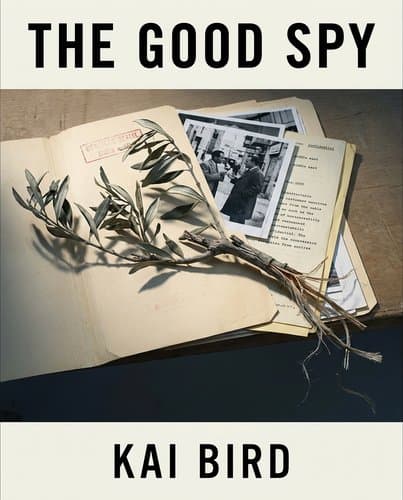
18373198_the-good-spy
by Kai Bird
Robert Ames built a secret diplomatic bridge to the PLO through genuine friendship rather than coercion—only for the CIA's institutional blindness and…
In Brief
Robert Ames built a secret diplomatic bridge to the PLO through genuine friendship rather than coercion—only for the CIA's institutional blindness and political cowardice to get him killed and erase everything he'd built, revealing how America's intelligence community systematically destroys its own most effective officers.
Key Ideas
Partnership builds deeper intelligence than formality
The most effective intelligence relationships are non-transactional: Ames's refusal to formally 'recruit' Salameh — to make him sign receipts and accept money — was what earned Arafat's trust to the level of 'whatever Bob says is like it is written in the Koran.' Treating a source as a partner rather than an asset produces better intelligence than treating them as a target.
Organizations systematically destroy unmeasurable human value
Institutional cultures that can't measure empathy will systematically undervalue it: the CIA's DO evaluated officers by formal recruitments, which meant Ames's most important work — a decade-long backchannel that helped produce the Oslo Accords — registered as mediocrity to his supervisors. Organizations that optimize for what they can count will destroy what they can't.
Refusing to decide makes the decision
The 'non-answer' is often the most consequential decision: when CIA leadership declined to tell Mossad whether Salameh was a protected asset, they believed they were deferring the decision. They were actually making it. The refusal to name what you value is itself a choice, and often a fatal one.
Tactical perfection can destroy strategy
Tactical victories can be strategic catastrophes: Mossad's assassination of Salameh was operationally flawless and strategically devastating — it eliminated the most pro-Western voice in Arafat's inner circle and severed the only reliable backchannel the U.S. had to the PLO at a critical moment. The question 'did it work?' depends entirely on the timeframe you use to answer it.
Intelligence failures stem from lack of will
Intelligence failures are often not failures of information — they're failures of institutional will to act on what you already know: Ames warned Salameh about the Verdun Street attack, the CIA warned Iranian moderates about Saddam's invasion, the NSA had an intercept ordering the Marine barracks bombing. The information existed. The problem was a system that kept choosing political convenience over strategic commitment.
Tactical history becomes strategic consequence chain
The tactic used to kill Ames in 1983 ran in a direct line to 9/11: the 9/11 Commission documented that bin Laden specifically sent operatives to learn the truck-bomb techniques from the 1983 Beirut attacks. Understanding that history matters not as a moral lesson but as a causal chain — the consequences of abandoning a diplomatic opening in 1983 were still arriving eighteen years later.
Who Should Read This
History readers interested in Geopolitics and World History who want a deeper understanding of how we got here.
The Good Spy
By Kai Bird
10 min read
Why does it matter? Because the man who built the secret foundation for Middle East peace was killed by the institution's own blind spots — not by its enemies alone.
The assumption is that spies win through leverage — secrets extracted, loyalties purchased, pressure applied. The CIA built entire bureaucracies around that assumption. But Robert Ames, the most consequential American intelligence officer of his generation, operated on something the agency's culture had no vocabulary for: he actually liked the people he was supposed to be recruiting. He learned their languages without being asked. He ate their food, understood their grievances, and told them things that were true. Through that quality alone — call it empathy, call it dangerous going-native — he quietly built the back-channel relationships that, a decade after his death, would make the Oslo Accords possible. Then a truck bomb in Beirut erased him in a single afternoon. The Good Spy is the story of what that loss cost us — and how the institutions that depended on his work were structurally incapable of understanding what they'd lost.
The Man Who Learned Arabic at a Footlocker Was the CIA's Most Valuable Asset
Sometime in late 1957, at a U.S. Army signals post perched 7,300 feet above sea level in Eritrea, a young soldier named Bob Ames sat cross-legged on his bunk, his footlocker serving as a desk, and began tracing Arabic characters onto paper. Nobody told him to do this. His job was tracking spare parts for radio transmitters. The Arabic-speaking world was simply outside his window — in the streets of Asmara, in the brief stopovers he'd made in Cairo and Dhahran — and something in him decided that was reason enough.
That decision, made in a barracks room with no instructor and no assignment, is the key to understanding Robert Clayton Ames and why the CIA would one day consider him among its most valuable officers in the Arab world. His effectiveness wasn't built from the tradecraft manual. It came from a quality he'd been quietly assembling his entire life.
Ames grew up a steelworker's son in working-class Philadelphia. At La Salle University he was good enough to earn a basketball scholarship but spent most of a championship season on the bench — an experience he later wrote about with clear-eyed honesty, calling it "the hardest thing in the world to be a sub." He absorbed the lesson rather than resenting it.
By the time he reached Saudi Arabia as a CIA officer in 1962, Ames was doing something the Ivy League men who ran the Agency largely couldn't: he was actually fluent. Not tourist-phrase fluent. He took private lessons, tracked Bedouin camel herds to sharpen his ear, and eventually became the kind of man who could sit at a Saudi emir's weekly gathering, eat goat with his hands, and land a joke in Arabic that made the room laugh. The emirs sought him out.
He kept deciding — at a footlocker in Eritrea, in a language classroom in Beirut, at a table in Riyadh — to go further in than the job required.
Empathy Isn't a Soft Skill — It's the Only Skill That Gets a Revolutionary to Trust You
The CIA's default assumption about intelligence relationships is transactional: find what someone wants, offer it, collect what you need. When agency leadership sent an officer to Rome in late 1970 to meet Ali Hassan Salameh — chief of Fatah's Force 17, the most connected Palestinian intelligence figure alive — they brought money. Specifically, $300,000 a month. Salameh was insulted. He mocked the approach, and in a single evening the CIA nearly destroyed something Bob Ames had spent years quietly building.
Ames had reached Salameh through Mustafa Zein, a Lebanese Shi'ite businessman who'd gone to college in small-town Illinois and genuinely believed the United States could be a bridge to the Arab world rather than an obstacle to it. When Ames finally sat down with Salameh, he didn't offer money or leverage. He told Salameh that the President of the United States wanted to hear the Palestinian case directly. This was a calculated stretch — Ames would have needed authorization before the claim held — but it was precisely the right kind. It positioned Salameh as a political interlocutor rather than a recruitment target, as someone whose views carried weight rather than someone whose silence could be purchased.
What cemented Ames's credibility wasn't that meeting. It was a letter. In March 1972, he wrote Zein with a veiled warning: Salameh should consider moving his family from their apartment on Beirut's Verdun Street. Ames knew the Mossad was hunting him. Months later, Israeli commandos led by a future prime minister landed by rubber raft under cover of darkness, drove into the city, and killed three senior PLO figures in their Verdun Street apartments. Salameh had ignored the warning. His family survived anyway. And Yasir Arafat — who had every reason to assume an American spy's advice was manipulation — told Zein something he would never have said about a man who'd tried to buy his intelligence chief's loyalty: whatever Bob says from now on, treat it as written in the Koran.
The CIA Had the First Real Backchannel to the PLO — and Couldn't Decide What to Do With It
What was the CIA's real problem with the Palestinians? The common answer is ignorance — that Washington simply didn't understand Arafat's world well enough to engage it. The actual answer is almost the opposite, and considerably more damning.
By 1974, Ames had built something no American diplomat could officially construct: a functioning back channel to Fatah's inner circle. Through years of patient relationship-building — through Mustafa Zein, through Salameh, through the sheer accumulated credibility of a man who warned his source's family off Verdun Street months before Israeli commandos came — Ames had positioned himself as someone Arafat was willing to trust. That year, Salameh traveled to New York and met with CIA officials at the Waldorf Astoria. Around the same time, Arafat delivered his famous 'olive branch' speech at the United Nations and, through the back channel, signaled for the first time that Israel was a permanent fact the Palestinians could learn to live with. This was seismic. Ames had sourced the opening of a door that an entire foreign policy apparatus had assumed was locked.
Kissinger walked past it. His attention was on Cairo and Amman; the Palestinians were a problem to be managed, not a party to be negotiated with. In September 1975, sitting with Israeli negotiators at a table where he was finalizing the Sinai II disengagement deal, he formalized the bypass entirely — pledging that the United States would hold no official contact with the PLO. The intelligence kept coming. The policy door closed anyway.
Inside Langley, the frustration ran in the opposite direction. Ames's superiors in the Directorate of Operations couldn't understand why he wouldn't convert Salameh into a formal asset — logged, handled, managed like an acquisition. Duane Clarridge, his boss for Arab operations, put the institutional logic plainly: 'Ph.D.s don't do well in the espionage business. They are trained to see the gray. So they never pull the trigger in terms of recruiting somebody.' What Clarridge couldn't see was that the relationship's value depended entirely on its informality. Salameh was useful precisely because he was operating as a political interlocutor, not a paid spy — and because Arafat knew it and permitted it. Formalizing the recruitment, as the Rome debacle had already demonstrated, would have ended everything.
The Non-Answer That Killed Ali Hassan Salameh
The Mossad officer who came to Washington in late 1978 to ask about Ali Hassan Salameh had a simple question. David Kimche, one of Israel's senior intelligence figures, wanted to know whether the CIA considered Salameh a protected asset — whether the relationship Ames had spent nearly a decade building meant the Americans would object to what Mossad was planning. CIA leadership considered the question and arrived at a decision: they would say nothing. No yes, no no. No answer at all.
Frank Anderson, who worked the Palestinian file, understood immediately what that silence meant. The Israelis had come asking for permission in the form of a question, and the Agency had just given it to them without using a single word. A non-answer, in this context, was the only answer that mattered.
What followed was meticulous. A British woman operating under the name Erika Chambers — her Mossad cryptonym was 'Penelope' — rented an eighth-floor apartment on Beka Street in Beirut and spent months on its balcony, painting, watching. She was mapping Salameh's movements, learning the timing of his routes, noting which car he favored and how his security detail was arranged. On January 22, 1979, she was in position when his tan Chevrolet turned onto her street. She pushed a remote-control switch. The parked Volkswagen below her exploded, then Salameh's car, then a car driven by a thirty-four-year-old British secretary named Susan Wareham who happened to be driving behind him. Salameh was pulled from the wreckage still alive and taken to the hospital at the American University of Beirut, where surgeons found a metal fragment lodged in his brain. He died on the operating table at four in the afternoon. Chambers walked downstairs, got into a rented Datsun, and that evening boarded a rubber raft to an Israeli naval ship.
What Ames had built across a decade was something the CIA had no category for. The relationship had produced the first Palestinian signal that Israel was a permanent fact — not a recruited agent passing secrets, not a diplomatic back-channel, but something harder to file and therefore harder to defend. Ames had warned Salameh's family off Verdun Street and been proven right. He had sat in that Waldorf Astoria suite and helped negotiate what amounted to a quiet nonaggression pact. And when the Israelis came to ask whether any of that mattered, the CIA's answer was to look at the ceiling until the question went away.
Frank Anderson wrote condolence notes to Salameh's widow and son afterward. There's no clean way to read that detail — a man at his desk, composing sympathy letters for someone his own agency had not protected, honoring a relationship his institution had found impossible to defend.
The Man Who Warned Tehran About Saddam Hussein Died Because Washington Kept Making the Same Mistake
In August 1979, Ames flew into Tehran under a pseudonym and walked into a meeting with Iran's interim prime minister, Mehdi Bazargan, and his foreign minister. The new revolutionary government was brittle, internally contested, and deeply suspicious that Washington was plotting to reverse the revolution the way it had reversed an earlier Iranian government in 1953. Ames's job was to make a single reframe stick: the real threats to the new Iran weren't American. They were next door. He spent two hours walking Bazargan and Foreign Minister Yazdi through the neighborhood — Iraq, the Soviet Union, the pressures converging on Iran's borders — arguing that the 'Great Satan' was their geography, not their embassy down the street. The briefing, scheduled for an hour, ran to two. Bazargan asked for another one in two months.
Two months later, George Cave returned to Tehran with something more urgent than geopolitical framing. American intelligence had collected hard technical evidence that Saddam Hussein was quietly positioning his military for a full-scale invasion. Cave laid it out plainly. Yazdi's response — 'They wouldn't dare' — was the sound of a government that had spent its credibility on ideology and had none left for threat assessment.
Between those two meetings, Carter had specifically worried that admitting the Shah would cost American lives in Tehran — and then admitted him anyway. When radical students stormed the embassy on November 4, Khomeini praised them, used the seizure to purge his own government's moderates, and the CIA documents found in the rubble — painstakingly reconstructed from shredded paper — implicated Entezam, Ames's Iranian contact, as a spy. He spent the next decade and a half in prison.
In September 1980, Saddam invaded exactly as predicted. The war killed half a million people across eight years. Ames had built a channel to the one faction inside revolutionary Iran that wanted the relationship. Washington made the one decision it had been warned not to make, and the channel collapsed. The invasion came anyway. The body count was the final bill.
The Oslo Handshake Had a Footnote Nobody Read — and It Was Written in a Cemetery
At 11:43 on the morning of September 13, 1993, forty CIA officers stood among headstones at Arlington National Cemetery as Yitzhak Rabin and Yasir Arafat shook hands on the White House South Lawn three miles away. Not one Agency officer had been invited to the ceremony. Frank Anderson, the CIA's chief of Near East and South Asia operations, had checked. So when his morning meeting noted the historical moment approaching, he turned to his assistant and said the words that tell you almost everything about what the Agency had sacrificed and received in return for decades of clandestine work in the Middle East: 'Let's get a bus and go visit our dead.'
They gathered at the grave of Robert Clayton Ames and stood there at the precise minute of the handshake, looking toward the White House. The gravestone was one of the few in the Agency's history to publicly identify its occupant as CIA. What Anderson was transmitting to his young officers — the thing that had brought them to a hillside instead of a Rose Garden — was this: the ceremony across the water had begun not with a diplomatic breakthrough in Oslo but with a spy's patient cultivation of a back channel across twenty years, in Beirut cafés and Waldorf Astoria suites and Lebanese living rooms that smelled of cardamom coffee and spent gunpowder.
That back channel ended on April 18, 1983, when a truck loaded with two thousand pounds of explosives turned into the U.S. Embassy driveway in Beirut and detonated. Eight CIA officers died. Ames was found in a stairwell, killed by the concussion of the blast — intact enough that colleagues could identify him on sight, a small cut on his neck the only visible mark. He had been at a contentious meeting on the fifth floor that morning, arguing about whether the American-brokered peace plan could still hold. He was forty-nine years old.
The Oslo Accords ceremony produced no acknowledgment of what it had cost to get there — no mention of the back channel, no reference to the decade of clandestine meetings that had first persuaded Yasir Arafat's inner circle that Washington could be trusted as an interlocutor. The institution that built the foundation sent a bus to a cemetery. That's what institutional memory looks like when the institution failed to protect what it had built.
The Man Who Probably Ordered the Bombing Is Living in Texas Under CIA Protection
The man who most likely ordered the 1983 bombing of the U.S. Embassy in Beirut — the attack that killed Bob Ames and sixty-two others — is almost certainly living in America right now, protected by the CIA.
Judge John Bates awarded Yvonne Ames and her children over thirty-eight million dollars in a 2003 civil suit against Iran. She has collected none of it. Iran ignores U.S. court judgments, and no one has successfully seized Iranian assets to satisfy the debt. The money is a number on paper.
Then there is the operational inheritance. In the autumn of 1993 — the same autumn Rabin and Arafat shook hands on the South Lawn — Osama bin Laden sent Al-Qaeda operatives to the Bekaa Valley in Lebanon, the same valley where Iranian Revolutionary Guard units had been based a decade earlier. The 9/11 Commission documented what bin Laden told them to learn: specifically, how to build and deploy the kind of truck bomb that killed 241 Marines in October 1983. The tactic that murdered Ames traveled, intact, from Beirut to lower Manhattan.
Ali Reza Asgari was a young Iranian Revolutionary Guard intelligence officer stationed at the Sheikh Abdullah Barracks in Baalbek in 1982. He recruited Imad Mughniyeh, arranged the financing and logistics, and supplied the Iranian-manufactured PETN explosives. According to Mustafa Zein, who spent years tracking down the people responsible, Asgari ran the operation from the Iranian state level while Mughniyeh handled the street-level execution. In 2007, Asgari defected to the West. The Bush administration's National Security Council decided his intelligence on Syria's covert nuclear program was worth more than any accounting for sixty-three dead. He was admitted to the United States under a CIA authority allowing the agency to bring in up to one hundred foreign nationals per year when doing so is worth more to the Agency than accountability would be. He reportedly ended up in Texas.
This is what 'unfinished work' actually means. Not that the peace process stalled, or that the Palestinian question remains unresolved, but that the men who ordered the bombing were either protected by the agency Ames served or never touched at all, while the tactic they pioneered was methodically studied and improved by the people who brought down the towers. Ames was a good spy working in a system that couldn't decide, when it mattered, what it was for.
The Good Spy's Unfinished Sentence
Here is what you're left holding: forty CIA officers standing at a grave while history happened across the river, and somewhere in Texas, the man who probably put Ames there is living under the protection of the agency Ames died serving. The money his family was awarded sits as a number on a court document. The tactic used to kill him became the blueprint bin Laden's people studied in the Bekaa Valley before they loaded the trucks. Ames believed the thing was possible — the handshake, the recognition, the long patient work of convincing two peoples that the other was real. The evidence suggests he was right. The question Bird leaves you with isn't whether better intelligence might have changed history. It's this: what kind of institution keeps dismantling its own best work, and what would it actually cost to build one that doesn't — starting with the name of the man in Texas who has never answered for any of it?
Notable Quotes
“they missed us four days ago, but this time they really got us.”
“Ali looked at Bob, and then pointed to me,”
“and said, ‘This is my man.’”
Frequently Asked Questions
- What is The Good Spy about?
- "The Good Spy" chronicles CIA officer Bob Ames and his covert backchannel relationship with PLO leader Ali Hassan Salameh, exploring how empathy-driven intelligence can build diplomatic foundations for peace. Kai Bird's narrative traces how Ames's refusal to formally recruit Salameh—avoiding the transactional approach of making him sign receipts and accept money—earned such profound trust that Arafat believed "whatever Bob says is like it is written in the Koran." The book reveals how institutional blind spots, political expediency, and the CIA's inability to value unmeasurable work consistently destroyed its most consequential achievements, ultimately connecting Cold War-era decisions to the tragic events of 9/11.
- What does The Good Spy teach about intelligence relationships?
- The most effective intelligence relationships are non-transactional, according to "The Good Spy." Bob Ames's refusal to formally recruit Salameh—to make him sign receipts and accept money—was what earned Arafat's trust to the level of "whatever Bob says is like it is written in the Koran." Treating a source as a partner rather than an asset produces better intelligence than treating them as a target. This non-transactional approach contrasts sharply with the CIA's standard operational model, which evaluated officers by formal recruitments. Ames's most important work—a decade-long backchannel that helped produce the Oslo Accords—registered as mediocrity to his supervisors because it couldn't be quantified.
- What does The Good Spy reveal about institutional culture?
- Institutional cultures that cannot measure empathy will systematically undervalue it, a central theme in "The Good Spy." The CIA's Directorate of Operations evaluated officers by formal recruitments, meaning Ames's most important work—a decade-long backchannel that helped produce the Oslo Accords—registered as mediocrity to his supervisors. Organizations that optimize for what they can count will destroy what they can't. Additionally, Bird documents how "the 'non-answer' is often the most consequential decision": when CIA leadership declined to tell Mossad whether Salameh was a protected asset, they believed they were deferring the decision. They were actually making it, with fatal consequences for U.S.-PLO relations.
- What is the connection between The Good Spy and 9/11?
- "The Good Spy" traces how decisions in 1983 directly contributed to 9/11, making it a cautionary tale about the long-term consequences of abandoning diplomatic openings. Kai Bird documents that "the tactic used to kill Ames in 1983 ran in a direct line to 9/11: the 9/11 Commission documented that bin Laden specifically sent operatives to learn the truck-bomb techniques from the 1983 Beirut attacks." The book demonstrates that intelligence failures often aren't failures of information—they're failures of institutional will to act on what you already know. The information about threats existed, but the system kept choosing political convenience over strategic commitment, with catastrophic consequences arriving eighteen years later.
Related Book Summaries
Read the full summary of 18373198_the-good-spy on InShort