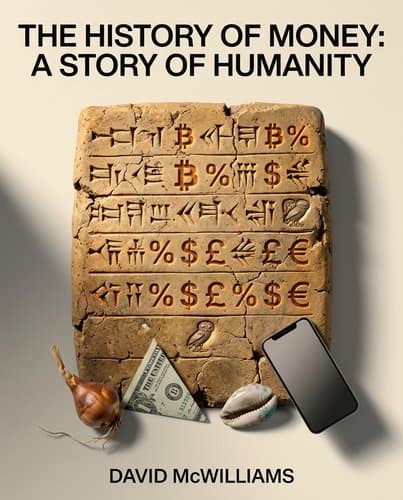
222376657_the-history-of-money
by David McWilliams, Michael Lewis
Money isn't currency—it's the social technology that allowed strangers to trust each other and build civilization. Trace how every financial crisis…
In Brief
The History of Money: A Story of Humanity (2024) traces money from ancient barter systems to digital currencies, arguing that money is a social technology built on trust rather than a neutral economic tool.
Key Ideas
Recognize the Financial Crisis Stage
Every financial crisis follows the same script: a period of low interest rates breeds confidence, confidence breeds leverage, leverage breeds a speculative class of Ponzi borrowers, and the crash comes when there are no new buyers at the bottom of the pyramid — recognizing which stage you're in is the most useful thing monetary history teaches
Every Monetary System Redistributes Wealth
Money is not neutral: a fixed-supply currency (gold, Bitcoin) systematically enriches creditors and asset owners over wage earners and debtors, while elastic fiat money can lift living standards but enables the credit cycles that make financial crises more severe — there is no 'safe' monetary system, only different distributions of risk
Banks Create Money, Central Banks React
The 'push story' taught in economics textbooks — that central banks control the money supply and push it into the economy — is largely fiction; commercial banks create money in response to demand, and central banks discover what has happened after the fact, which is why regulatory responses to crises are always reactive
Financial Innovation Comes From Outsiders
Financial innovation has historically been driven not by institutions but by individuals operating outside the rules — Gutenberg's debt-financed press, Law's fiat currency experiment, Hamilton's federalized debt — meaning the next monetary revolution is more likely to come from an outsider solving a real problem (like M-Pesa) than from an established institution
Currency Destruction Has Political Consequences
When a state destroys its currency through hyperinflation or debasement, it is not committing an economic error — it is breaking the social contract; the political consequences (Weimar to Nazism, Roman debasement to the fall of the Empire) are more dangerous than the inflation itself
Limited Liability Hides Human Consequences
The limited liability company is morally neutral: the same financial structure that funded Florentine art and Atlantic trade also allowed European investors to profit cleanly from colonial atrocity — understanding this duality is essential to evaluating any financial instrument that promises to abstract risk away from its human consequences
Who Should Read This
History readers interested in Economic History and World History who want a deeper understanding of how we got here.
The History of Money: A Story of Humanity
By David McWilliams & Michael Lewis
14 min read
Why does it matter? Because money is not a tool — it's the operating system of civilization itself.
In the summer of 1942, Hitler's most dangerous weapon wasn't a tank or a bomb — it was a printing press. His plan: flood Britain with perfect counterfeit pounds, watch ordinary people pocket the cash, and let inflation do what the Luftwaffe couldn't. He understood something most economists still won't admit in polite company: money isn't a tool for moving value around. It's a collective hallucination, a species-wide act of faith so powerful that destroying it destroys the society built on top of it. Which raises an uncomfortable question — if a forged banknote spends exactly like a real one, what exactly makes the real one real? The answer turns out to be stranger and more consequential than anything in a textbook.
The Most Dangerous Weapon Ever Invented Has No Moving Parts
Picture a telegram arriving at the gates of Sachsenhausen concentration camp in the summer of 1942. It calls for a very specific kind of prisoner: printers, engravers, mathematicians, bank officials, paper experts. From camps across the Third Reich, 142 emaciated men are assembled and put to work on a single task — breaking the Bank of England. Their product: £132 million in counterfeit sterling, equivalent to roughly £7.5 billion today. Hitler's plan was not to spend it. It was to drop it from Luftwaffe bombers over British cities and let ordinary people do the rest.
The logic was grimly elegant. Britain in wartime had almost no consumer goods in circulation, which made prices ferociously sensitive to any surge in money supply. Flood the country with fake banknotes and prices would spiral. Panic would follow. The Blitz spirit, which had survived bombs, would crumble under something far more insidious: the suspicion that the paper in your pocket was worthless. Hitler had lived through the Weimar hyperinflation and understood what Lenin had articulated in a London newspaper interview in 1919 — that the fastest way to destroy a society is to wreck its currency. Two men who agreed on almost nothing agreed on this: money is not a neutral instrument. It is a promise. Shatter the promise and you shatter everything built on top of it.
Money has no intrinsic value. A central bank creating currency from nothing is performing roughly the same trick as a priest consecrating bread: the transformation is real only because everyone in the room agrees it is. That consensus is money's great strength and its fatal vulnerability. Hitler understood he didn't need to outfight Britain. He only needed to make the British stop believing. Which raises the obvious question: if the fake notes and the real ones were physically identical, what exactly makes the real one real? The answer turns out to be stranger and more consequential than anything in a textbook.
The First Name in Human History Belonged to a Beer Merchant Running a Loan Shark Operation
Here is the oldest financial record we have: a clay tablet, baked in Mesopotamian sun around 3400 BCE, bearing the name of a man called Kushim. He wasn't a king or a priest. He was a brewer who borrowed barley and owed it back at 33.33 percent annual interest — a rate that would make a payday lender blush — over two and a half years. His tablet predates the Epic of Gilgamesh by centuries. The first named person in recorded history was a small businessman losing sleep over his loan repayments.
That interest rate is worth pausing on. By the time Kushim scratched his name into wet clay, money had already made a leap most people assume came much later: it had separated from physical stuff and become a price on time itself. Lend me barley today; I return more barley tomorrow. The gap between today and tomorrow — the risk that tomorrow never comes, the harvest fails, or I skip town — has a cost, and that cost is the interest rate. The Sumerians understood this so precisely they deployed not just simple interest but compound interest: debt that grows exponentially, devouring the borrower who can't keep up. The maths hasn't changed. Only the currency has.
Archaeologists found a tablet from the Mesopotamian city of Drehem, dated around 2100 BCE, containing rows and columns projecting the future value of a cattle-rearing business: expected births, deaths, milk yields, mortality rates, all run against the prevailing interest rate to produce a profit-and-loss forecast. A spreadsheet, in every meaningful sense. A founder pitching to venture capitalists today would recognise the structure immediately. The people who built it had no Arabic numerals, no paper, and believed the weather was controlled by gods — yet they had already invented financial modelling.
The through-line from Kushim to every modern bank is direct and unbroken. Interest rates, double-entry logic, forward projections, the tension between borrower and lender — none of this was invented by the Medicis, the Dutch East India Company, or the City of London. It was worked out by barley merchants in what is now southern Iraq, five thousand years ago, because once you allow debt to exist, all the rest follows. Every financial innovation you've ever heard of already has an ancient ancestor.
Democracy Was a Side Effect of Silver Coins
Here is the claim: democracy was not a political invention. It was a monetary side effect.
Athens in the fifth century BCE was, by any material measure, a city that should not have worked. It sat on thin, rocky soil, could not grow enough food to survive, and imported roughly three quarters of its basic staples from distant ports. What kept the whole precarious thing alive was a coin — the silver tetradrachm, stamped with an owl on one face and the goddess Athena on the other, minted from the enormous silver deposits at Laurion just south of the city. Over seven centuries, Athenians struck around 120 million of them, flooding the Aegean with a currency so trusted it became the ancient world's default medium of exchange. A single drachma was worth roughly a day's labor. With enough of them moving fast enough, Athens could conjure grain, timber, and loyalty from people who had never seen the Acropolis.
The deeper transformation was social. In the agora — the marketplace at the heart of every Greek city — a coin performed a quietly revolutionary trick: it didn't know who was holding it. A baker's two drachmas bought exactly as much as a princess's two drachmas. In every previous civilization, your purchasing power was a function of your birth. Coinage made it a function of how many coins you had. That sounds mundane. It wasn't. Once the market flattened hierarchy structurally, the question of who deserves to govern became genuinely answerable in new ways. The Athenian statesman Cleisthenes didn't invent democracy from abstract principle — he was codifying something that commerce had already made thinkable. When a baker can out-negotiate a noble in the marketplace, the divine right of nobles starts looking threadbare.
Rome inherited this monetary logic and extended it — and then provided the sharpest possible lesson in what happens when credit cycles escape political control. In 33 CE, the emperor Tiberius moved to punish a cohort of conspiring senators by forcing them to liquidate their speculative provincial landholdings. The effect was immediate and catastrophic: land prices collapsed, the debts that senators had used to buy those lands did not, and banks from Tyre to Alexandria began to fail in sequence, each ruined balance sheet pulling down the next. Tiberius had tried to discipline a few powerful men and instead triggered the ancient world's first documented credit crisis. His solution was to inject 100 million sesterces directly into the credit markets, taking land as collateral — stabilizing the system by becoming, in effect, lender of last resort. Two thousand years before Ben Bernanke deployed quantitative easing to contain the 2008 financial collapse, a Roman emperor had already written the playbook, for the same reasons, in the same panic.
The textbook will tell you Rome fell to barbarians. The deeper story is that Rome fell when its emperors debased the currency to pay for wars they couldn't otherwise afford, shredding the monetary trust that held the whole system together.
Every Financial Revolution Was Led by a Criminal
Every major financial revolution was engineered by criminals, fugitives, and gamblers — and their willingness to break the rules was precisely what made them effective.
Consider John Law: a 23-year-old Scottish fugitive who fled London in 1694 after killing a man in a duel over a woman who also happened to be King William III's mistress. Not the biography of a careful reformer. Yet Law spent the next two decades developing the most coherent theory of money anyone had yet produced: that currency should be severed from gold and silver, that its supply should expand to match the energy of the economy, and that a central bank issuing paper money could stimulate what he called the 'animal spirits' of trade. The insight was genuine. The scheme he built on top of it was spectacular.
In 1716, Law persuaded the French regent to let him establish a national bank and take over the Mississippi Company, which held monopoly trading rights over French Louisiana — territory France had barely explored but which Law marketed as a paradise of untapped wealth. His masterstroke was a debt-for-equity swap: holders of worthless French government IOUs could exchange them for company shares at a deep discount, guaranteeing an immediate bounce. The winners did what winners always do — they bragged. Stories of overnight fortunes colonized the taverns of Paris. By December 1719, shares that had opened at 500 livres were trading at 10,000. The crowd in the rue Quincampoix was so dense and frantic that one entrepreneurial hunchback rented out his back as a writing desk to traders who needed somewhere to scratch out their contracts. That detail tells you everything about speculative mania at street level: no surface goes to waste.
The scheme collapsed when the gap between the paper promises and the actual swamps of Louisiana became impossible to ignore, and Law died in Venice, broke. But his intellectual legacy survived. The elastic money supply, the central bank as economic accelerant, the idea that credit creation drives growth — these are the foundations of every modern central bank, including the US Federal Reserve. The framework governing trillions of dollars in monetary policy today was invented by a fugitive gambler who used a woman as his alibi and a wilderness he'd never visited as his collateral.
The Same Tool That Built the Renaissance Funded Genocide in the Congo
Think of a hammer. It builds shelters and breaks skulls, and it has no opinion on which you're doing. Financial instruments work the same way — which is what the story of progress-through-commerce would rather you didn't notice.
Florence, 1252: the city mints the gold florin. Within decades, fractional reserve banking exists, invented by merchant bankers who noticed that most depositors never collected their gold simultaneously — so why not lend the idle metal out at interest, earn a spread, and use the repayments to fund further loans? Letters of credit followed, allowing merchants to move fortunes across Europe without touching a coin: a piece of paper, backed by a reputable family bank, was as good as gold in Lyon or Bruges. The royal mint had monopolized money creation for centuries; suddenly a network of Florentine counting houses was conjuring credit from nothing but trust and arithmetic. The surplus funded Brunelleschi's dome, Botticelli's canvases, the whole extravagant flowering we call the Renaissance. Finance had broken free from the palace.
Now forward to 1892. A publicly traded company called ABIR — the Anglo-Belgian India Rubber and Exploration Company — acquired thirty-year extraction rights over one of the world's largest rubber forests in the Congo. The financial architecture was identical: limited liability, shares quoted in European newspapers, middle-class Belgian and British savers clipping coupons. The balance sheet was immaculate. What it didn't record was the cost-control system the Belgian Force Publique had devised in the field. Ammunition budgets were running over, so Brussels demanded proof that each bullet had killed a threatening local rather than being stolen or wasted. The proof required was a severed human hand. Soldiers smoked them for preservation and delivered them in baskets to European agents, who matched hands against spent cartridges with the diligence of any good auditor. You can picture the scene: a colonial office, a wooden table, a man in a suit checking columns while baskets sit at his feet. The physical fact of what was being counted didn't touch the paperwork. Between 1885 and 1908, somewhere between five and ten million people died. ABIR's share price bobbed up and down in crisp newspaper columns, entirely legible to the investors funding it.
The same instrument — the limited liability company, with its ability to atomize ownership until no single shareholder feels responsible for anything — that let a Florentine merchant bank collect deposits from widows and fund a cathedral also let a Belgian rubber firm convert mass murder into quarterly returns. The abstraction wasn't a bug. It was the product. Financial innovation doesn't care what it builds. It only asks whether the numbers balance.
Bubbles Are Not Irrational — They Are the Logical Result of How We Are Wired
Why do intelligent people reliably do stupid things with money? It happens in every era, every country, every asset class — and yet each time, the participants insist this particular boom is different, this particular price is justified. The question isn't why bubbles happen to fools. It's why they keep happening to everyone.
The Dutch tulip mania of 1636–37 is the go-to example of collective madness, but look at the mechanics and you see something more unsettling than mass stupidity. As Amsterdam's financial markets matured — futures, options, margin lending all operating daily — capital piled into whatever was rising. Stories of neighbors turning a profit on bulbs spread through taverns and market stalls the way a good rumor always spreads: fast, vivid, and slightly exaggerated. McWilliams calls this the 'economics of gossip.' We are social animals. When rising prices generate stories of easy fortune, rational people don't ignore those stories — they update their behavior based on them. One person buying because prices are rising is sensible. A thousand people doing it simultaneously is a bubble. The difference is scale, not stupidity.
At the peak, a middling tulip bulb ran from 25 guilders to 220. The legendary Semper Augustus variety hit 6,000 guilders — twenty times what a skilled worker earned in a year. Buyers pledged a thousand pounds of cheese as collateral. And yet when the crash came, it was sharp and contained, not systemic. The mania was collateralized by real wealth rather than borrowed money. When prices broke, losses were painful but bounded. Nobody had leveraged ten-to-one into bulbs using bank credit. The financial system survived.
That distinction maps directly onto McWilliams' taxonomy of what bubbles actually contain. Most buyers are hedge borrowers — they can cover both interest and principal and will be bruised but solvent if prices fall. A second group are speculative borrowers, covering interest only and banking on appreciation to clear the capital. The system tips into danger only when Ponzi borrowers — who need prices to keep rising just to service existing debt — become the dominant type. At that point the entire structure is one wobble away from cascade failure, because these buyers aren't investors in any meaningful sense. They are chairs in a game of musical chairs, viable only while the music plays.
The crash is then structurally inevitable for a reason that has nothing to do with irrationality. It is individually rational to sell the moment you sense a wobble. When everyone acts on that individual rationality at once, the market evaporates. Every seller needs a buyer; when sellers multiply simultaneously, buyers vanish. The system doesn't fail because people behave badly — it fails because they all behave the same way at the same moment. Trust between strangers, accumulated slowly through rising prices and shared gossip, collapses at a speed that makes the accumulation look almost quaint. And then, somehow, it rebuilds. That resilience — the fact that after every crash in recorded history the mechanism reconstitutes itself — is the genuine surprise. Money is fragile and it keeps surviving anyway.
Whoever Controls the Money Supply Controls Everything Else
An elderly man stands at a market stall in Kehl, Germany, in the autumn of 1922. He wants to buy an apple. He cannot afford it. The apple costs twelve marks — a sum so trivial that the young Ernest Hemingway, watching from a few feet away, could barely process what he was seeing. Hemingway had crossed the Rhine from France that morning, changed ten francs, and been handed 670 marks in return. He and his wife had spent lavishly for an entire day and still had change. Across the river, a man who had worked his whole life and saved faithfully in government bonds could not buy a piece of fruit.
This is what happens when a state uses its money supply as a weapon against its own citizens — even when that isn't quite the intention.
The mechanics of the Weimar collapse have nothing to do with German incompetence or national character. Imperial Germany had financed the First World War entirely through domestic debt, promising citizens their savings would be repaid from the assets of conquered nations. When the conquest failed and the reparations bills arrived — equivalent to the entire pre-war national income — the government was trapped. It couldn't raise taxes without collapsing the republic. So it printed marks to pay workers to strike against the French occupation of the Ruhr, gambling that American pressure would force France to withdraw before German society buckled. Neither side blinked. By November 1923, one dollar bought 630 billion marks. The middle class — teachers, civil servants, doctors, everyone who had played by the rules and trusted the state — was erased. Landlords, farmers, and industrialists who held physical assets survived, because bricks and soil rise with inflation. The people with nothing but paper promises lost everything.
Hitler watched this carefully. He understood what the respectable analysis missed: hyperinflation isn't primarily an economic event. It's a rupture in the social contract, the moment when a government's promise — you save, we protect — is publicly torn up. The middle-class ballast of society, the people who had the most reason to believe in the system, discovered that their belief had been exploited. The political vacuum that followed wasn't an accident of history. It was the predictable outcome of a state treating its currency as an instrument of power rather than a public trust.
The standard account of monetary policy obscures all of this. Central banks are presented as neutral technical institutions staffed by competent economists managing the money supply in the public interest. The reality, as economist Brendan Brown has argued, is a pull story, not a push story: commercial banks create roughly ninety percent of money in response to economic demand, and central banks are largely reacting to a system they don't fully control. The Fed isn't driving. It's holding on.
What Weimar makes viscerally clear is that whoever decides to print — or not, or how much — is making a political choice about who bears the cost. The middle class bore it in 1923. Someone always does. The battle over who controls money, and whose savings it protects, isn't a historical curiosity. It's the argument still being waged between central banks, commercial lenders, governments, and the public right now.
Bitcoin Is the Gold Standard With Better Branding. M-Pesa Actually Solved Something.
Bitcoin is the Gold Standard with better branding — and it will fail for exactly the same reason.
Every monetary system in this 5,000-year story survived by doing one thing: solving a real problem for enough people that they chose to use it. Cowrie shells moved trade across Bronze Age networks. The silver tetradrachm unified the Aegean. M-Pesa, launched in Kenya in 2007, solved something specific and unglamorous: bus drivers were charging communities 30 percent to physically haul bags of cash between towns. No banks, no alternatives, just a brutal informal tax on moving money. M-Pesa's answer was to turn mobile phone airtime — something millions of Kenyans already owned — into transferable currency, redeemable through 50,000 street-corner agents. No venture capital fanfare. No Super Bowl ads. It now handles roughly 30 percent of Kenya's entire GDP.
Bitcoin launched the same year and solved nothing except how to generate speculative returns for people who got in early. Its foundational flaw is structural, not incidental. A fixed supply — 93 percent already mined by 2024 — means that as demand rises, the price rises with it. That's not a feature. That's the Gold Standard. When money reliably appreciates, nobody spends it; they hoard it. The egalitarian rhetoric dissolves on contact with the numbers: early adopters and the Wall Street firms the movement claimed to be dismantling captured most of the gains. The people drawn in by Reddit threads and Super Bowl spots absorbed most of the losses.
The reality is that this pattern repeats across the entire history. The battle between public money — managed, accountable, imperfect — and private money — speculative, exclusionary, answerable only to its holders — never ends. It changes costume. William Jennings Bryan raging against the gold bugs in 1896, Brexit voters in 2016, crypto enthusiasts in 2021: all responding to the same grievance, that the monetary system rewards those who already own assets at the expense of those who don't. The cost of every monetary experiment that failed was borne by the same people — the ones who couldn't get out in time, who held savings rather than assets, who mistook the costume for something new. The question of who bears that cost has never been answered once and for all. Only deferred.
The 18,000-Year Experiment That Is Still Running
Eighteen thousand years ago, someone on the banks of the Congo scratched notches into a baboon bone. Today, on those same banks, people settle debts with a mobile phone. The experiment never stopped — it just changed materials. Every monetary system in between was built by someone bending or breaking the rules, inflated by confidence, stretched by greed, and eventually rebuilt by the same improbable mechanism: strangers deciding, again, to trust each other. That trust has been betrayed so many times you'd think it would have learned its lesson. It hasn't. Neither have we. The person haggling at a Lagos market stall, the prisoner in Sachsenhausen trading cigarettes for bread, the Kenyan bus driver checking his M-Pesa balance — each of them is a node in an argument that has never stopped: who gets to create money, who gets to accumulate it, and what happens to everyone else when those two interests collide. You don't need to predict who wins. You need to know what's actually being fought over.
Frequently Asked Questions
- What is The History of Money: A Story of Humanity about?
- The History of Money: A Story of Humanity (2024) traces money from ancient barter systems to digital currencies, arguing that money is a social technology built on trust rather than a neutral economic tool. The book draws on centuries of financial crises, innovations, and collapses to help readers recognize recurring monetary patterns—from speculative bubbles to currency debasement—and understand how monetary systems shape power, inequality, and civilization. By examining historical examples from Gutenberg's debt-financed press to Hamilton's federalized debt to modern digital currencies like M-Pesa, it demonstrates that financial systems are fundamentally shaped by individual actors solving real problems and political choices rather than predetermined economic laws.
- What are the key takeaways from The History of Money?
- The book identifies six major insights. First, financial crises follow a predictable script: low interest rates breed confidence, confidence breeds leverage, and collapse comes when new buyers disappear. Second, money is not neutral—different systems distribute risk unequally between creditors and wage earners. Third, central banks react after the fact rather than controlling supply. Fourth, financial innovation comes from outsiders, not institutions. Fifth, currency destruction breaks social contracts with severe political consequences. Sixth, financial structures like limited liability companies enable both art patronage and colonial exploitation. Together, these insights reveal that monetary systems reflect political choices about who bears financial risk, not economic inevitability.
- How do financial crises develop according to The History of Money?
- Every financial crisis follows identical stages according to The History of Money. The book explains: 'a period of low interest rates breeds confidence, confidence breeds leverage, leverage breeds a speculative class of Ponzi borrowers, and the crash comes when there are no new buyers at the bottom of the pyramid.' Recognizing which stage the financial system occupies—whether in the confidence phase, the leverage acceleration phase, or the collapse phase—is the most useful lesson monetary history teaches. This cyclical pattern has repeated throughout financial history, enabling contemporary readers to identify dangerous periods and predict when financial bubbles might burst by understanding the historical patterns underlying modern markets.
- What does The History of Money say about money and neutrality?
- The book argues that money is fundamentally not neutral. According to the text, 'a fixed-supply currency (gold, Bitcoin) systematically enriches creditors and asset owners over wage earners and debtors, while elastic fiat money can lift living standards but enables the credit cycles that make financial crises more severe.' Rather than a safe monetary system existing, the book contends there is only 'different distributions of risk.' This means every monetary choice—whether to use gold, fiat, or cryptocurrency—benefits some groups while imposing costs on others. Monetary policy is therefore ultimately a political decision about distributing financial vulnerability across society, not an apolitical technical matter.
Related Book Summaries


Read the full summary of 222376657_the-history-of-money on InShort