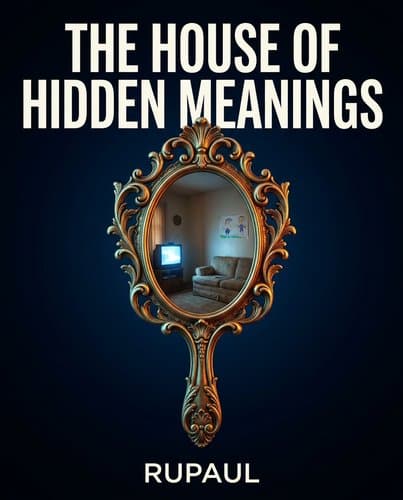
181109983_the-house-of-hidden-meanings
by RuPaul
RuPaul maps the decades-long unraveling of a persona built to survive a chaotic childhood, revealing how the same performance that made him a global icon also…
In Brief
RuPaul maps the decades-long unraveling of a persona built to survive a chaotic childhood, revealing how the same performance that made him a global icon also kept him a stranger to himself—until he learned to live in the living room instead of the spotlight.
Key Ideas
Survival mechanisms become prisons in adulthood
The mechanisms that protect a sensitive child from chaos — dissociation, performance, perpetual reinvention — don't disappear when the danger does. They become the prison the adult has to consciously dismantle.
Performance is strategy and avoidance together
'Act as if' is a legitimate creative strategy and a symptom of avoidance at the same time. You don't have to choose one interpretation — but you do have to know which one is running the show on any given day.
Strangers' stories reveal your own truth
The story you most need to hear will often come from the mouth of a stranger who has nothing to gain from telling it to you. When someone else's confession feels like a 'hoax' because it describes your life too precisely, that's not coincidence — that's arrival.
Parental approval shapes your public persona
The parent you perform for shapes the persona you build for the world. Recognizing whose approval you are still chasing — and whether they were ever capable of giving it — is the prerequisite for building anything that belongs to you.
Quiet authenticity is harder than performance
Sobriety, domesticity, and letting someone love you without making them earn it first can be more disorienting and more radical than any public reinvention. The stage is easier than the living room.
Know if performance liberates or anesthetizes
Drag, performance, and persona can simultaneously be liberation and anesthesia. The goal isn't to decide which one is 'really' true — it's to stay awake to which function is active.
Who Should Read This
Readers who connect with first-person stories about Memoir and Self-Improvement and want to see the world through someone else's eyes.
The House of Hidden Meanings
By RuPaul
12 min read
Why does it matter? Because the self you built to survive is not the same as the self you were born to become.
He spent decades becoming the most visible person in any room — and doing it, in part, to disappear. That's the paradox at the center of this memoir: the sequins and the six-foot-four silhouette and the name said like a proclamation were not vanity but armor, engineered by a boy who learned early that if you made people laugh, they couldn't hurt you. RuPaul has told the origin story before — Atlanta basements, genderfuck punk drag, a song that cracked open the mainstream. This book is not that story. It's what lived underneath it. Getting high since he was ten. The father whose approval rewired every relationship that followed. The moment, in a recovery meeting he attended for someone else, when a stranger's mouth opened and his own life came out. The most radical thing RuPaul ever did had nothing to do with a stage. It was letting someone love him without running.
The Child Who Learned to Direct His Own Trauma
A small boy stands across the street from his family's garage on Hal Street in San Diego, watching his mother pour gasoline over his father's Oldsmobile Delta 88 while she holds a book of matches in her free hand. The whole neighborhood has come outside. His sisters are frozen beside him. His father stands on the far side of the car, begging. And RuPaul — maybe eight or nine years old — does something extraordinary without knowing it: he leaves his body. Not in pain, but in craft. He becomes a camera. He cuts to his sisters' horrified faces. He pans the crowd. He finds the angles — a dolly shot here, a crane shot there. The scene turns cinematic before it can turn catastrophic.
He only understood decades later that this was full dissociation. The horror was too complete to absorb head-on, so the mind converted it into something it already knew how to handle: a show. The television in the living room had long been his education in how to hold the world at a useful distance. It ran credits, which meant it acknowledged what it was — a construction, a performance — and in that honesty it felt more trustworthy than the domestic chaos it helped him escape. He had already started learning that reality could be rewritten in real time. When his mother sank into one of her storms of quiet rage, he would perform — Tina Turner, a comedic aunt, any character who could make her laugh — because he had figured out that a laugh broke the weather, even briefly. That discovery, made in a living room by a child who needed to survive, is the engine that would eventually power one of the most disciplined performance careers in American entertainment.
Drag Was Never About Dressing Up — It Was About Who Gets Power
Drag, in RuPaul's telling, is not costume — it is argument. The precise psychological counter-move to a specific, structural injury. Understanding which injury makes everything else click into place.
The injury arrives in a single conversation. RuPaul's father, Irving — a man who had paid no child support and offered no emotional presence across years of absence — summons his son to discuss reports that he has been seen with gay men in Balboa Park. The nerve of this stuns RuPaul into a cold clarity. He responds slowly, deliberately, the way you speak when anger has burned itself down to something harder and more permanent. You have never sent a dime, never offered an ounce of support, so my personal life is none of your business. Irving stammers. He has no ground to stand on and they both know it. But what cuts deepest isn't the confrontation itself — it's what follows. Irving had always fawned over women. His daughters, their beauty, their femininity — these were what moved him to attention. A son who violated the codes of masculinity simply didn't register, except as a potential embarrassment. And so RuPaul arrives at the thought that will organize the next decade of his life: what would it mean to become the prettiest girl of all? That, he understood, would be real power.
Both things were true at once and couldn't be separated — that's the point. By the time RuPaul is performing in Atlanta — smearing lipstick across his cheek, gluing plastic bits to his face, wearing thrift-store rags and combat boots — he insists that drag had nothing to do with identity. It was a middle finger, pure subversion, a mockery of the whole absurd ritual of choosing a gender. And both were true. Drag was a radical refusal of categorization and a strategy built from a wound — a way of finally earning the gaze of a man who only ever looked at women. Liberation and approval-hunger sharing the same dress.
The persona that would eventually become one of the most recognizable on earth was constructed at this intersection — where genuine freedom and the hunger for a father's attention couldn't be told apart. That doesn't diminish what he built. It explains why it lasted.
Finding Your People Is Survival — But the Scene Can Become Its Own Cage
Think of it this way: the kid who spent years eating alone finds a table where everyone knows the language — the jokes, the references, the unspoken codes — and the relief is so total it can be mistaken for arrival.
The basement studio where RuPaul first appeared on a low-budget Atlanta public access show called The American Music Show had no business being anyone's spiritual home. Harsh fluorescent lights, stale cannabis in the air, newspapers piled on cheap linoleum. Nothing hummed with significance. But through a camera lens, something strange happened: everything became magical. The sloppiness didn't disappear — it transformed. And that transformation was the lesson, more important than any performance he gave there. Art doesn't document reality; it converts it. You walk into a fluorescent-lit basement and walk out of a television screen, and those are not the same place.
What the community around that show offered — the punk kids, the drag queens, the fellow misfits parading up Peachtree Street — was the particular oxygen of being understood without explanation. After years of existing outside every available category, being read instantly by people who spoke the same frequency is not a small thing. It's survival-grade relief. RuPaul built real work in that atmosphere: posters plastered across the city, a band, short films, a developing persona. The counter-graffiti that appeared — someone crossing out his name, writing WHO-PAUL, predicting he would 'fade into obscurity' — he received as confirmation. You're nobody until somebody hates you. The scene was working.
But a scene runs on its own currencies, and not every currency travels. When RuPaul walked into a break room at a New York club and encountered Madonna — pre-superstardom, already cold, already calculating — she assessed him in one glance and found nothing useful. The contempt was naked and deliberate. He recognized the logic immediately: she moved through a world where sexual power was the only exchange rate that mattered, and she could see he didn't have it in the form she recognized. The scene back home had insulated him from that equation. Now he was outside it again.
The tribe had been real. The magic had been real. Neither was enough — and that gap was the thing he'd have to close on his own, which meant building an identity that didn't depend on a room full of people who already got it.
The 'Act As If' Strategy Was Both Genius and a Symptom
What does it mean to act like a star when you have no evidence you are one? The question sounds like it's about confidence — fake it till you make it, the motivational-poster version. But in RuPaul's case, the answer is stranger and more instructive than that.
After a failed attempt to stow away on a flight to his mother's house in San Diego — he got the connecting cities wrong and ended up stranded in Dallas — RuPaul slept on a park bench and eventually hitched a ride with his sister to visit his father in Mansfield, Louisiana, a town so deep in the country the main street offered a rib joint and an auto parts store and not much else. He brought along a copy of one of his Starbooty films — cheap blaxploitation homages shot in his apartment for zero dollars — and screened it for his father, a man who had paid no child support, maintained no real presence, and had last seen his son seven years earlier. His father watched the opening sequence — RuPaul's legs sprinting through Times Square — and his eyes went wide. 'Are those your legs?' he kept asking, incredulous. Then, settling back, he offered his highest praise: Ru had been such a good baby. Never cried. Never needed anything from anyone.
That was the compliment. The ideal son was the invisible one.
RuPaul sat with that, and with the terrifying thought that followed: his father had retreated to this dead-end town after escaping it, pulled back by some nostalgic gravity. And here was RuPaul, broke and adrift, attempting the same thing — slip back into Mama's living room, wait for the world to catch up. The 'act as if' campaign had always looked like strategy from the outside. From inside that Mansfield living room, it looked like something else: a man in continuous flight from the stillness where the real questions lived. The engine underneath it was the same reflex the little boy had discovered in front of his mother's burning rage: convert the wound into a show before you have to feel it. Keep moving. Keep performing. Keep the camera rolling.
By the time 'Supermodel' played on Z100 and strangers in a pizza parlor on Sixth Avenue heard his voice for the first time, RuPaul experienced not joy but inevitability — the most obvious thing in the world, he would say. Which is a strange thing to say after a decade of near-misses, humiliations, and park benches. It suggests the man watching himself arrive had been somewhere else the whole time — rehearsing the arrival rather than living toward it. The world finally saw him clearly. The question the book keeps pressing, quietly, is whether he was there to see it too.
The 71-Year-Old Woman Who Told His Story Back to Him
He went to the meeting to support Georges. That was the framing — the loyal partner, sitting in a folding chair at a recovery meeting in South Beach, being present the way good people are present in a crisis. And then a 71-year-old woman walked to the podium, and the story collapsed.
She talked about cocaine. She talked about the club scene. She talked about feeling invisible inside her own family, about parents who couldn't hold their relationship together, about being the middle child in a house where no one quite saw her. She described drinking as the only way to make an intolerable life feel survivable. And RuPaul sat there thinking: is this some sort of hoax? Everything she is saying is mine. He took a seat — not metaphorically. He sat down inside the room he had arrived in as a visitor.
The timeline snapped into focus the way timelines do when you finally stop moving long enough to look at them. He had been getting high every day since he was ten years old. He had cleaned himself up once, in the aftermath of the 'Supermodel' era, when the stakes felt high enough to demand it — and then the partying had crept back in, the way it always does, quietly, incrementally, upgrading its disguises as his circumstances upgraded. What had once been cheap weed in a punked-out Atlanta apartment was now backstage champagne and a morning spliff in a London hotel, purchased by a man too famous and too busy to notice the continuity. The anesthetic had kept pace with the career. It had changed costumes, just like he had.
The memoir's hinge is hidden inside a chapter that looks like it's about Georges's crystal meth problem. The performer who had learned, at eight or nine years old, to leave his body at the first sign of pain — to convert the wound into a show before it could become a feeling — had spent three decades in successful flight. 'Supermodel' on the radio. Diana Ross kissing his boyfriend on the mouth. Aretha Franklin writing a check to 'Ruth Paul.' The motion was real and the achievement was real. And none of it had required him to sit still long enough to hear his own story.
Then a stranger told it to him from a podium in South Beach, and there was nowhere left to go.
What It Cost to Clean Your Mother, and What It Gave Back
Years later, near the end, the house on Hal Street is dark and quiet when RuPaul hears his mother call his name. He is sleeping in the back room — the same house where he performed Tina Turner impressions for her as a boy, the same living room where, just hours earlier, they watched an MTV segment about him together and she looked over with the expression of someone who has won a private bet and said, simply, 'Nigga, you are crazy.' Four words carrying what she couldn't otherwise assemble: acknowledgment, pride, the vindication of having believed in something the world had not yet caught up to. He heard an ocean in them.
Now she is calling from the front room, where her bed has been moved so caregivers can reach her more easily. 'I need you,' she says, and then, embarrassed, tells him why. He doesn't hesitate. He cleans her. He carries her to the restroom. He makes it all better. What passes through him is not pity, not grief — it is recognition. She had changed his diapers once, that same body, that same helplessness running in reverse. The debt wasn't financial or moral. It was just human, the oldest kind, being paid in the only currency that mattered.
Toni Charles had spent her life protected by anger. RuPaul would say later that the cancer took her body, but what really finished her was a grudge — that she had held onto the darkness his father planted in her until it calcified into something no surgeon could touch. The woman who stood over an Oldsmobile with gasoline and a book of matches, who told her son he was too sensitive for this world, who kept the temperature in any room a few degrees below comfort: she had been armored the whole time. The armor kept her upright for decades. It also kept her from putting it down.
RuPaul had inherited the same instinct — performance as protection, the camera in the skull that converts unbearable things into viewable ones. The difference is that he could see it. Her death handed him that clarity the way a mirror hands you your own face: not as accusation, but as information. She made him sensitive enough to feel everything, then taught him, by example, what happens when you refuse to. He had been gathering that lesson his whole life without knowing it. The night on Hal Street, carrying her in his arms, was when he finally understood what he'd been holding.
The Man You Let Lift You Off Your Feet
At a Manhattan club on a January night in the mid-nineties, RuPaul did what he always did when he walked into a crowded room: scanned for height, plotted his navigation, kept moving with the efficiency of someone who had learned to control his environment before it could control him. He found Georges LeBar almost by accident — six foot seven in bare feet, a foot taller still in platforms, dancing with a wild, uncoordinated joy that looked nothing like performance. When RuPaul crossed the room and got close enough to speak, he said something he had never said to anyone: he asked if he could put his arms around the man's shoulders. He had always been the tallest person in every room, always the one nobody could reach up to, and he had never in his life been able to reach up. Georges didn't answer in words. He just lifted him off the floor. RuPaul gasped. Then they both laughed.
What followed was not simple. Back at RuPaul's apartment, he picked a fight — pressed Georges about his history with other men, baited him toward an exit, ran the old script that had always kept love at the workable distance of unrequited. When Georges asked, with genuine hurt rather than manipulation, whether he should just leave, something shifted. RuPaul recognized the mechanism: his father had left, so he had spent decades arranging to be the one abandoned first, by someone he'd already decided didn't love him enough. Georges wasn't playing that game. He didn't know the rules. His refusal to perform cruelty on cue was the most disorienting thing RuPaul had ever encountered.
He let him stay.
The Porch, the Living Room, the Hotel Room — They Were Always the Same Place
What's new is what he does next: he turns away from the window and walks back into the room. Back into the love that doesn't require a performance to survive. And somewhere in that turn, the child on the porch, the supermodel on the runway, and the sober man with a suitcase become the same person. It was always just the long way home.
Notable Quotes
“I’m so embarrassed, but I’ve messed myself and I need your help.”
“I just want you to know that I love you so much and I am so proud of you.”
“I watched you on C-SPAN!”
Frequently Asked Questions
- What is The House of Hidden Meanings about?
- The House of Hidden Meanings is RuPaul's memoir examining how childhood survival strategies shaped his public persona and private identity. The book traces the gap between the performer and the person, exploring how performance, dissociation, and reinvention—mechanisms that once protected a sensitive child from chaos—persist into adulthood. Rather than disappearing, these protective strategies often become obstacles to authentic living. Through personal narrative, RuPaul offers readers a framework for recognizing whose approval they still chase and what it takes to build an identity that genuinely belongs to them rather than one constructed solely for external validation.
- How do childhood survival strategies affect adults according to The House of Hidden Meanings?
- Childhood protection mechanisms don't vanish when danger ends—they become internalized patterns shaping adult life. "The mechanisms that protect a sensitive child from chaos — dissociation, performance, perpetual reinvention — don't disappear when the danger does. They become the prison the adult has to consciously dismantle." RuPaul argues that awareness allows us to recognize when these strategies serve us versus limit us. The goal isn't to eliminate them but to stay conscious of their function. By understanding their protective origin, adults can choose whether to maintain or release these patterns.
- What does RuPaul say about performance as both liberation and anesthesia?
- RuPaul presents performance and persona as serving dual purposes simultaneously. "Drag, performance, and persona can simultaneously be liberation and anesthesia. The goal isn't to decide which one is 'really' true — it's to stay awake to which function is active." Similarly, "act as if" functions as both a legitimate creative strategy and a symptom of avoidance. Rather than choosing one interpretation, the emphasis is on maintaining awareness of which function operates on any given day. This conscious attention allows readers to harness performance's creative power while avoiding its numbing, dissociative effects.
- Why is recognizing parental approval important for building authentic identity?
- Recognizing whose approval you chase is foundational to building genuine identity. "The parent you perform for shapes the persona you build for the world. Recognizing whose approval you are still chasing — and whether they were ever capable of giving it — is the prerequisite for building anything that belongs to you." Understanding this pattern reveals whether we're seeking validation from sources incapable of providing it. By identifying these patterns and acknowledging parental limitations, people can construct identities rooted in self-acceptance rather than perpetual external validation.
Related Book Summaries

Read the full summary of 181109983_the-house-of-hidden-meanings on InShort