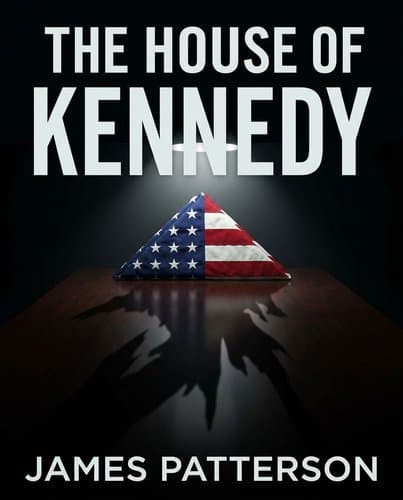
51285366_the-house-of-kennedy
by James Patterson
Joe Kennedy Sr. built America's most glamorous dynasty on one instruction: win at any cost. Trace that mandate through mob deals, silenced daughters, and…
In Brief
Joe Kennedy Sr. built America's most glamorous dynasty on one instruction: win at any cost. Trace that mandate through mob deals, silenced daughters, and Chappaquiddick cover-ups as it runs unchecked across three generations—until the family it was designed to protect becomes its final casualty.
Key Ideas
Ethical Compromise Becomes Inherited Mandate
When a founding leader rewards winning over ethics, successors don't just apply that lesson to competitors—they apply it to each other. Joe Sr.'s 'win at all costs' mandate eventually produced Joe Jr.'s fatal mission, Ted's Chappaquiddick cover-up, and the mob deal that bought the presidency. The original instruction was about survival; the inheritance was a logic that kept running after the man who designed it was paralyzed and mute.
Public Legacies Are Manufactured Narratives
Public legacies are manufactured events with specific authors. Jackie Kennedy turned three and a half hours of grief into one of the most powerful political narratives in American history, dictating the 'Camelot' framing while Life magazine held its presses at $30,000 an hour. Understanding a public figure's legacy requires asking who shaped it, when, and what they needed history to believe.
Suppressed Vulnerability Emerges As Addiction
Suppressing vulnerability in high-achieving families doesn't make the vulnerability disappear—it routes it underground, where it re-emerges as addiction, recklessness, and the inability to ask for help at critical moments. The Kennedy children who most needed processing—Rosemary, David Kennedy, Ted after Bobby's death—received silence, medication, or institutional management instead.
Engineered Rivalry Outlives Its Architect
Sibling rivalry engineered by a parent doesn't end when that parent loses power. Joe Sr. was already incapacitated by a stroke when Joe Jr. volunteered for a near-suicidal bombing mission driven partly by his need to outpace Jack's war-hero status. The competition Joe designed kept running at full speed, unmaintained.
Adaptive Crisis Traits Become Fatal
The same qualities that make someone effective in high-stakes situations—refusing to acknowledge limits, ignoring fear, declining help—become lethal when the situation actually requires those limits. Every safety net JFK Jr. had on the night of his crash was voluntarily declined. The family system had no vocabulary for 'I can't do this.'
Who Should Read This
History readers interested in Political Figures and World History who want a deeper understanding of how we got here.
The House of Kennedy
By James Patterson & Cynthia Fagen
11 min read
Why does it matter? Because the "Kennedy Curse" was never a curse—it was a bill coming due.
Here's what most people believe: the Kennedys were America's closest thing to royalty — brilliant, beautiful, bred for greatness — and fate kept striking them down for reasons nobody can explain. The assassinations. The plane crashes. The drownings. A curse, people said, and half the country agreed. House of Kennedy accepts the facts and dismantles the explanation. These tragedies don't look random from the inside. They trace a straight line back to one man's founding instruction. Joseph Kennedy Sr. taught his children that winning justifies everything: rigged elections, a daughter lobotomized to protect appearances, mob money, silence kept across the breakfast table. He built a dynasty and installed its operating logic — one that rewarded ruthlessness, converted vulnerability into liability, and made exposure inevitable. The curse was never fate. It was a family running exactly as designed.
A Paralyzed Old Man, a Flag, and Two Teardrops—Everything Else Is Commentary
Three days after John Kennedy was buried, his father woke screaming inside an American flag.
Joe Kennedy Sr. was 75, mostly paralyzed from a stroke. He had two words: "yaaa" and "nooo." Jackie had left the ceremonial flag near his bed before returning to her children; a well-meaning niece had unfolded it and draped it over him like a blanket. He surfaced in the dark, tangled in the same cloth that had just covered his son's coffin at Arlington, and could do nothing but scream.
When Eunice and Ted came to his bedside to deliver the news, Eunice reached for softening language—"Daddy, there's been an accident." Ted, face streaked with tears, said it plainly: "Dad, Jack was shot." Joe had spent a lifetime teaching his children that weeping was weakness. He closed his eyes. Two tears ran down his cheeks.
The Kennedys are usually framed as a dynasty the world kept striking down. The House of Kennedy begins with that image and asks you to hold a harder picture: a man who engineered his family's ascent with ruthless precision, whose foundational instruction to his children was "win at all costs," lying helpless as the costs arrived.
Jack's death is the fourth child he'll outlive. The catastrophes are real. But the man at the center isn't a passive victim of fate—he built the machine that ran his children toward greatness, and toward whatever greatness costs.
Joe Kennedy Sr. Didn't Build a Dynasty—He Built a Machine That Ran on Fraud, Bribery, and Silence
Joe Kennedy Sr. didn't build power by outworking his rivals. He built it by identifying what they most wanted to protect and finding ways to threaten it.
The clearest proof is Alexander Pantages, a Greek-born theater chain owner with 60 movie palaces across the country who repeatedly refused Joe's buyout offers during the years Joe was building his Hollywood studio empire. Within months of that final refusal, a 17-year-old girl named Eunice Pringle accused Pantages of raping her in a broom closet at one of his own theaters. He was convicted and sentenced to 50 years in prison.
On appeal, Pantages was acquitted — the broom closet, measured, was physically too small for the assault as described. But by then his fortune was demolished. He sold the entire chain to Joe for $3.5 million, less than half of the original $8 million offer. Then in 1933, Pringle was preparing to go public about who had arranged the setup when she died, possibly from cyanide, cause undetermined. Her deathbed confession named Joe as the mastermind, claiming she'd been promised $10,000 and a guaranteed career. She received neither.
Joe's involvement was never legally established. But the sequence — refusal, accusation, conviction, bankruptcy, forced sale, accuser's sudden death — is difficult to explain as coincidence. This is what building a dynasty looked like at the foundation. Not inspiration. Leverage.
The same ruthlessness operated privately, in the one domain where you'd hope a man would be different. When Rosemary, Joe's eldest daughter, began exhibiting erratic behavior in her early twenties — sneaking out of her convent school at night, becoming harder to manage — Joe authorized a lobotomy without telling his wife Rose. Dr. James Watts drilled two holes in Rosemary's temples and inserted a blunt metal rod while she recited prayers and songs, conscious and mildly sedated. The surgeons tracked their progress by monitoring her responses. When she stopped talking, they stopped cutting. The damage was immediate and permanent: Rosemary's mental capacity was reduced to that of a preschooler. She spent the rest of her life in a care facility in Wisconsin. When a journalist later asked Joe about Rosemary, he said: "I guess it's the hand of God."
Joe Kennedy constructed something real: wealth, political access, a family the country couldn't stop watching. But the foundation ran on a consistent logic: identify the threat, neutralize it, and if anyone asks, point toward fate. God, luck, misfortune. Never Joe.
Joe Sr. Wired His Sons to Compete for His Approval—That Competition Killed the First One
On the morning of August 12, 1944, a fellow officer on the tarmac at RAF Fersfield, an English airbase, asks Joe Kennedy Jr. whether his life insurance is current. Joe flashes a grin. "I've got twice as much as I need," he says.
What brought him to that tarmac matters. Joe had logged well over the twenty-five missions required to rotate home, more heavy-bomber sorties than nearly any pilot at his rank. He wasn't obligated to be there. He'd volunteered. And the reason had everything to do with his younger brother Jack.
A year earlier, Jack's PT-109 had been rammed by a Japanese destroyer. Jack swam his wounded crew to safety, was celebrated as a war hero, and received a Navy medal. He made light of it afterward—"They sank my boat"—but the recognition was official and the story was everywhere. Joe, by his own accounting, had accumulated risk without glory: he'd never directly engaged a German enemy. He congratulated Jack on the medal and used the same letter to keep score. The Navy was so stingy with recognition, he wrote, that receiving anything at all was practically worth a campaign medal of its own. His projected return home: "the European campaign medal if I'm lucky."
That's the score Joe was running in his head when he volunteered for the Anvil mission, a classified operation flying remote-controlled drone bombers packed with eleven tons of Torpex, aimed at a German weapons complex. Electronics officer Earl Olsen had warned him days earlier that faulty wiring could set off the payload in flight. Joe flew anyway. Eighteen minutes after takeoff, two explosions turned the sky over the English countryside into fire and black smoke. His last radio words were a code phrase: "Spade Flush." The target he died trying to reach had been abandoned by the Germans three months earlier.
Joe Sr. made sure everyone knew that his son's posthumous Navy Cross outranked the non-combat medal given to Jack. The competition outlived one of its players.
JFK's Presidency Was Purchased with Mob Cash—and Then Sold to History as Camelot
In the spring of 1960, a young woman named Judith Exner boards a train to Chicago carrying a satchel of cash. She's been sleeping with John Kennedy for two months—daily phone calls, a night at the Plaza Hotel the eve of the New Hampshire primary, a dozen roses the next morning. She's also been sleeping, since April, with a man Frank Sinatra introduced as "Sam Flood," one of nineteen aliases for Sam Giancana, who controls the Chicago outfit and has told an FBI agent, without embarrassment, that he owns Chicago, Miami, and Las Vegas.
Exner is carrying the money because Kennedy needs Giancana's reach in West Virginia, where a primary against Hubert Humphrey is slipping. State law permits paying staffers and voters to turn out; the Kennedy machine intends to use it. By Exner's own account, she's the right courier because she "could come and go without notice, and if noticed, no one would have believed it anyway."
West Virginia goes 60% for Kennedy. Humphrey drops out. In November, Kennedy takes the presidency by 118,550 votes out of 69 million cast, a margin so thin that Giancana tells Exner exactly what he believes it proves: "Your boyfriend wouldn't be president if it wasn't for me."
Six days after the assassination, Jackie Kennedy summons Life journalist Theodore White, who'd covered Kennedy since the 1960 campaign, to Hyannis Port in a nor'easter. Life holds its presses at $30,000 an hour while she talks. Over three and a half hours, she dictates the frame that will define her husband in history: the lines Jack had loved from the Broadway musical Camelot, something about a brief shining moment that must not be forgotten. White's byline runs over the spread. The vision is entirely Jackie's.
Same operational logic, different theater. Joe Kennedy bought the presidency through channels no one was supposed to trace. Jackie secured its legacy through a single controlled session no one else attended. Both moves run on the same principle: you don't let events determine their own meaning. You determine it first, before anyone else can frame it for you. Rose's own diary called it Joe's "unremitting labor" to make Jack president, which lands as grim irony against what that labor actually required. But Jackie's Camelot play shows the lesson held past Joe. The Kennedys win. Then they seal the story of winning, before the facts have time to complicate it.
Bobby Kennedy's Transformation Was Genuine—Which Makes What Happened Next Unbearable
Was Bobby Kennedy actually any different from the rest of his family?
The reasonable early answer is no. He spent six months working for Joseph McCarthy's investigations. He muscled onto the Rackets Committee through family connections and pursued Jimmy Hoffa with a tenacity a future colleague described as "militant, aggressive, intolerant." Bobby had absorbed the same lesson Joe installed in all his sons: find your enemy, overwhelm them, treat stopping as failure.
Then came April 4, 1968.
Martin Luther King Jr. had been shot in Memphis. Bobby was between campaign stops in Indiana, airborne, when the news arrived. That morning at Ball State University he'd told a Black student that faith in white America was justified. Now he was learning a white man had killed the country's most important Black leader. He hid his face in his hands.
Indianapolis Mayor Richard Lugar tried to redirect him away from the city's Black neighborhoods, where riots were expected and some in the gathering crowd were armed. Bobby refused. He sent Ethel to the hotel, dismissed his police escort at the neighborhood's edge, and climbed onto a flatbed truck in a parking lot wearing a black overcoat that had once belonged to Jack.
For six minutes, without notes, he spoke. He made his first public reference to his brother's assassination, telling the crowd he knew exactly what it felt like to have a family member killed by a white man. That night, more than a hundred American cities burned. Indianapolis didn't.
The transformation behind that speech was real. Marian Wright, the civil rights attorney who would later found the Children's Defense Fund, had watched Bobby months earlier crouched inside a Mississippi sharecropper's quarter and come away describing someone she no longer recognized, genuinely shaken by children going hungry inside the wealthiest nation on earth. Martin Luther King, still wary of Bobby's political past, put it plainly: "Somewhere in this man sits good."
But here's what the book won't let you miss: the Senate seat that gave Bobby the platform, the presidential campaign that put him in Indianapolis, the political network that made the crowd listen—all of it ran through Joe Sr.'s machine. That same machine had lobotomized Rosemary and accidentally produced Eunice, who founded Special Olympics in 1968 and built power through inclusion rather than domination. Joe never planned for that. The son who most escaped his father's logic was still launched by it. Two months after Indianapolis, Bobby was shot in a hotel kitchen in Los Angeles with no meaningful security, his last reported words to the busboy cradling his head: "Is everybody OK?"
Ted Kennedy's Private Confession Shows Exactly How the Family System Was Supposed to Work
Chappaquiddick wasn't a cover-up. It was the Kennedy operating system performing exactly as designed.
Mary Jo Kopechne drowned in eight feet of water in Poucha Pond on July 18, 1969. Ted Kennedy walked away. Then he did what everyone around him, trained by Joe Sr., knew how to do: he went silent for seven days while lawyers and crisis managers mobilized, delivered a nationally televised speech crafted by Jack's old speechwriting team, and kept his Senate seat. A Gallup poll showed the damage. The phone lines in his Boston office showed the recovery.
The clearest evidence of the system at work isn't the crisis management. It's what Ted told his old friend and Senate colleague John Tunney in private, where no cameras were rolling and no operatives could edit him.
"I tried to save her but I couldn't," Ted said. "I almost drowned myself." Then, in the same breath, he drew the line the Kennedys had always drawn: "Obviously, I can be faulted terribly from a judgment point of view, but from the point of view of was it a killing, absolutely not. It was an accident."
Judgment versus morality. Two different courts. Joe Sr. had spent his life keeping those courts separate — the things you could be charged with and the things you actually did — and his sons had learned to parse responsibility the same way. Ted wasn't being cynical in that moment. He believed it. The system didn't just govern Kennedy behavior; it governed how Kennedys understood themselves.
Jackie Kennedy had watched Joe Sr.'s competitive engine up close for decades. She knew what it was built to produce, and she recognized its exhaust in Ted. She told a biographer that Ted had "an unconscious drive to self-destruct" because he knew he would never be Jack or Bobby, and had come to believe that what he was, was simply not enough. The same pressure Joe had installed to produce greatness had, in the son who survived, produced a man who couldn't fully inhabit his own life. The system that made the Kennedys extraordinary and the system that hollowed them out were the same system. It just ran longer on Ted.
JFK Jr. Said 'Fucking Kennedy Curse' Because the System Had Nothing Left to Teach Him Except How Not to Stop
On the evening of July 16, 1999, Roy Stoppard, another pilot who'd just flown the same Cape Cod route, walked over to tell John F. Kennedy Jr. what he'd found: thick haze the whole way, John might want to hold. John's answer was immediate. "No chance. I'm already late." A flight instructor offered to ride along as copilot. John declined. He climbed aboard his Piper Saratoga on crutches — broken ankle, Vicodin in his system — licensed only for visual flight in an evening that had already turned instrument, requiring the certification he didn't hold.
What he was flying into, he already knew. John Perry Barlow, a writer and old friend, had warned him: "You're going to find yourself flying in instrument conditions because you think you can." His own flight instructor had flagged him fifteen days before the crash: not ready for an instrument evaluation, needed more training. None of it registered as a reason to stop.
Three weeks earlier, John had driven four hours home after visiting his cousin Michael Kennedy in rehab. When he and his friend Stephen Styles-Cooper finally parted that night, John said three words: "Fucking Kennedy Curse."
That's not a curse. That's a curriculum.
The system Joe Sr. built had one non-negotiable principle: weakness is disqualifying, and the worst form of weakness is stopping. Joe Jr. had it. Bobby had it. Ted had it at Chappaquiddick, a call so catastrophic it cost a woman her life and cost him the presidency. What the system never installed was a circuit breaker, some mechanism that let a Kennedy hear "you are not ready" and treat it as information rather than challenge.
Joe Sr. died in 1969. By 1999, there was no one left with the authority, or the nerve, to tell John no. The last safety net that night was a man on crutches deciding he didn't need one.
What Joe Sr. Actually Installed
Here's what the Kennedys finally reveal, if you let the whole picture land at once: Joe Sr. didn't give his children a curse. He gave them an instruction so effective it became invisible — never show what can be used against you, and never stop. That instruction produced a president, a civil rights champion, and Eunice Kennedy Shriver, who founded the Special Olympics, the one Kennedy legacy built on inclusion rather than domination. It also produced a son who died chasing a medal to outrank his brother's, another who left a woman underwater while the lawyers assembled, and a grandson who declined every safety net on the last night of his life. The tragedy runs deeper than bad luck: the same system that made them extraordinary was still running when there was no one left to stop it — and by then, stopping wasn't something any of them knew how to do.
Notable Quotes
“Shots! Shots! Look out, look out, there's a madman in here and he's killing everybody!”
“is the same person who trash collector Alvin Clark remembers pledging to shoot Bobby on the day that Martin Luther King Jr. was killed. His name is Sirhan Bishara Sirhan, a twenty-four-year-old Christian Palestinian whose family fled Jerusalem for Pasadena in 1956. Sirhan—whose notebook containing repeated declarations that”
“was entered into evidence at his 1969 murder trial—rejects Bobby's pro-Israel stance. Bill Barry wrestles the weapon away from Sirhan, but not before the gunman fires off enough rounds to wound five others. When onlookers turn on Sirhan, Barry orders Kennedy aide Jack Gallivan and football star Rosey Grier,”
Frequently Asked Questions
- What is The House of Kennedy about?
- The House of Kennedy traces how Joe Kennedy Sr.'s win-at-all-costs ethos shaped—and ultimately destroyed—three generations of America's most celebrated political family. Patterson and Fagen examine decades of scandals, cover-ups, and tragedies to reveal how a patriarch's founding ethics become the operating logic that successors inherit. The book demonstrates what happens when that logic runs unchecked long after its architect is gone. Through detailed narrative, the authors show how Joe Sr.'s original instruction about survival transformed into a destructive inheritance that produced Joe Jr.'s fatal mission, Ted's Chappaquiddick cover-up, and the mob deal that bought the presidency.
- What are the key takeaways from The House of Kennedy?
- The House of Kennedy reveals that "When a founding leader rewards winning over ethics, successors don't just apply that lesson to competitors—they apply it to each other." Patterson and Fagen show how Joe Sr.'s 'win at all costs' mandate evolved across generations, producing catastrophic outcomes. The original instruction was about survival, but "the inheritance was a logic that kept running after the man who designed it was paralyzed and mute." This pattern demonstrates how organizational cultures and family systems can perpetuate destructive behaviors long after their originators lose agency to control or modify them, affecting multiple generations simultaneously.
- How did Jackie Kennedy shape JFK's public legacy?
- Public legacies are manufactured events with specific authors, and Jackie Kennedy exemplifies this perfectly. She transformed three and a half hours of grief into one of the most powerful political narratives in American history by dictating the 'Camelot' framing while Life magazine held its presses at $30,000 an hour. Understanding a public figure's legacy requires asking who shaped it, when, and what they needed history to believe. Jackie's careful curation established the Kennedy legacy as aspirational mythology rather than allowing it to be defined by tragedy or scandal, demonstrating how private individuals strategically shape collective memory.
- What does The House of Kennedy reveal about suppressed vulnerability in high-achieving families?
- Suppressing vulnerability in high-achieving families doesn't make it disappear—it routes it underground, where it re-emerges as addiction, recklessness, and the inability to ask for help. The book shows how Kennedy children who most needed processing—Rosemary, David Kennedy, Ted after Bobby's death—received silence, medication, or institutional management instead. This created a family culture where acknowledging human limits became impossible. When qualities enabling high-stakes performance (refusing limits, ignoring fear, declining help) persist in situations requiring those limits, results become lethal. "The family system had no vocabulary for 'I can't do this.'"
Related Book Summaries
Read the full summary of 51285366_the-house-of-kennedy on InShort