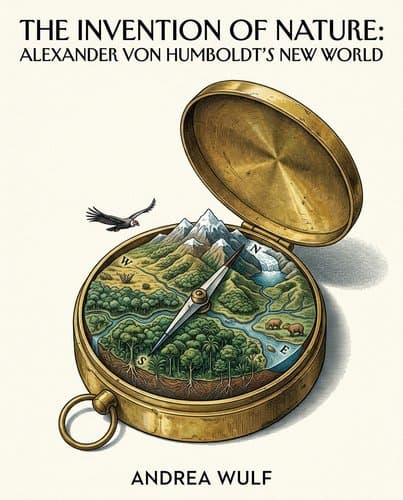
23995249_the-invention-of-nature
by Andrea Wulf
The man who invented our concept of nature as a living, interconnected web became so foundational that history forgot him entirely.
In Brief
The man who invented our concept of nature as a living, interconnected web became so foundational that history forgot him entirely. Recovering Alexander von Humboldt means recovering the unified scientific framework that first linked deforestation, climate disruption, and colonial exploitation—the one we've been desperately reconstructing ever since.
Key Ideas
Interconnected Nature: Concept Behind Modern Ecosystems
Nature as an interconnected web — where pulling one thread can unravel the whole — is not an intuition or a metaphor but a scientifically argued concept, first formulated by Humboldt at Lake Valencia in 1800 and at Chimborazo in 1802. When you use the word 'ecosystem,' you are using his idea.
Science Needs Both Feeling and Measurement
Scientific accuracy and aesthetic imagination are not opposing modes — Humboldt's insistence that 'nature must be experienced through feeling' as well as measurement produced more durable science than pure empiricism alone. The split between the two cultures (science vs. humanities) is a post-Humboldtian regression.
Deforestation, Climate, and Colonialism: One System
Deforestation, climate disruption, and colonial exploitation are a single system, not separate problems. Humboldt was the first person to argue this explicitly, in 1800. The reason this argument keeps having to be remade is partly that we've lost the framework that held it together.
Foundational Ideas Become Invisible Over Time
Ideas survive their originators by becoming anonymous — which is both their triumph and their vulnerability. Humboldt's concepts are now so foundational they're invisible. When foundational ideas lose their author, they also lose the coherent worldview that gave them power and the person's name that allowed them to be credited, debated, and developed.
Environmental Movement's Unresolved Humboldt-Rooted Contradiction
The environmental movement's internal conflict between conservation (sustainable use) and preservation (protection from use) traces to the same source — Humboldt — but reaches incompatible conclusions. Understanding this genealogy explains why environmental politics feels perpetually unresolved.
Who Should Read This
Science-curious readers interested in Scientists and Ecology who want to go beyond the headlines.
The Invention of Nature: Alexander von Humboldt's New World
By Andrea Wulf
14 min read
Why does it matter? Because the man who invented how we think about nature has been erased — and that erasure is killing us.
There's a man who invented the way we understand nature — the web of life, climate zones, human-caused environmental destruction, the idea that everything in an ecosystem is connected to everything else — and you almost certainly can't name him. His ideas flow through Darwin's Origin of Species, through Thoreau's Walden, through the word "ecology" itself, through every weather map you've ever glanced at. Rachel Carson built on him. The environmental movement descends from him. His name was Alexander von Humboldt, and the reason you've never heard of him is not an accident — it's a symptom of exactly the kind of fragmentation and forgetting that made the environmental crisis possible in the first place. What follows is the detective story of how that happened, and why recovering him now is not just interesting but urgent.
The Ideas Inside Your Head Belong to a Man You've Never Heard Of
The concepts living inside your head about nature — that ecosystems are interconnected webs, that deforestation disrupts climate, that human activity can permanently alter the planet — were invented by one person. His name was Alexander von Humboldt. You almost certainly haven't heard of him.
Here's what makes that strange: Humboldt was, for most of the nineteenth century, the most famous scientist alive. When his hundredth birthday was celebrated in 1869, 25,000 people assembled in Central Park to hear speeches and unveil a bronze bust. The New York Times ran the story on its front page with the declaration that his fame 'no nation can claim.' In Berlin, 80,000 gathered despite torrential rain. More places carry his name than any other human being's — four counties and thirteen towns in North America alone, plus a California redwood park, a penguin, a squid, a glacier in Greenland, and a dark plain on the moon. That last one is worth sitting with: somewhere right now, there is a feature on the surface of the moon named after a man that almost no one alive can identify. Someone had to vote on that.
Then the First World War arrived. In the United States, German-Americans were harassed and worse. German-language books were pulled from public library shelves in Cincinnati. 'Humboldt Street' was quietly renamed 'Taft Street.' The man himself — already dead for sixty years — was erased alongside the language he wrote in.
But that's only part of it. The deeper reason Humboldt disappeared, Andrea Wulf argues, is that his ideas succeeded too completely. They passed into how we understand the world so thoroughly that we stopped noticing where they came from. His framework became the air we breathe. And when that happens to a person's thinking, the person doesn't get a monument — they get a penguin, a squid, and a dark plain on the moon that nobody can explain.
A Boy Who Cut Open His Own Arms to Understand Life
Picture Humboldt alone in a rented room somewhere in Prussia, long after dark. On the table: metal rods, glass vials, acids, a scalpel. He makes incisions in his own arms and torso, rubs chemicals into the open wounds, presses electrodes under his tongue. Every convulsion, every burn, every stab of pain goes into the notebook. His skin ends up striped with infected welts. He reports it all went 'splendidly.'
This was the logic of his upbringing made flesh. Humboldt had been raised under a tutor who weaponized disappointment, then packed off to institutions his mother chose, studying subjects he despised. The restlessness that resulted was less ambition than pressure looking for an exit. He burned through the Freiberg mining academy in a fraction of the expected time, invented a miners' breathing mask, and ran hundreds of galvanism experiments while riding thousands of miles inspecting ore shafts — friends worried he would 'snap.' The self-experimentation wasn't separate from this pattern; it was its purest expression. If you want to understand the force animating living matter, put the instruments directly on living matter. Start with yourself.
Which is how a frog's leg, in a medieval anatomy tower in Jena, became the hinge on which everything turned. Humboldt was running electrical current through a dissected leg on a glass plate — mild twitches, unremarkable results. He leaned over to adjust the wires. The leg convulsed so violently it launched off the table. Goethe, standing beside him, was stunned. Humboldt traced it: moisture from his own breath had touched the metals and completed a circuit. He had, in a literal sense, breathed life into the dead tissue.
Both men immediately grasped what had happened beyond the mechanics. Goethe had spent years arguing that a living organism was a unified whole — not a machine you could dismantle and reassemble, but a system where every part functioned only in relation to every other. Humboldt took this further: if that was true of organisms, it was true of nature itself. Everything connected to everything else. Which meant the right tool for understanding the world wasn't abstract mathematics or taxonomic classification — it was comparison, pattern, the willingness to hold the whole in view. Imagination wasn't the enemy of scientific rigor. It was the instrument that let you see connections the instruments couldn't measure.
'Nature must be experienced through feeling,' he wrote to Goethe afterward. Schiller thought this was precisely the problem — that Humboldt dabbled too widely and would never accomplish anything great. He was the only person in the room who thought so. Within a few years, Humboldt would take that frog-leg insight to South America and spend five years testing it against a continent.
The Man Who First Warned Us About Climate Change — in 1800
When did humans first understand that we were changing the climate? The answer most people would guess — sometime in the twentieth century, after satellite data and atmospheric modeling — is off by about 175 years.
In early 1800, Humboldt rode into the Aragua Valley of Venezuela and found a lake in trouble. Lake Valencia had been shrinking for decades. Former islands now stood as dry hillocks well back from the receding shoreline. Locals assumed some underground drain was to blame. Humboldt measured the exposed sediment layers, calculated evaporation rates from lakes across three continents, and interviewed the farmers who had worked the valley for a generation. Then he traced a mechanism so precise that the logic is still taught today.
The planters surrounding the lake had cleared the surrounding forests to create fields of sugarcane and indigo. Where forest had stood, rows of cane now ran to the horizon, the soil between them dark and turned and bare under the Venezuelan sun. Those forests had done something invisible and essential: their root systems, undergrowth, and leaf cover had held water in the soil and fed it slowly into streams. Without the trees, rain that once filtered into the watershed sheeted off bare hillsides, carrying topsoil with it. The streams that had steadily fed the lake became seasonal torrents after storms and dry channels the rest of the year. The lake surface, no longer shaded by forest canopy, lost moisture directly to the sky. The water level dropped. The soil degraded. The planters moved west, clearing more forest, repeating the cycle. Humboldt scribbled in his diary: 'Forest very decimated.'
He published the finding not as an observation but as a warning. The clearing of forests by European settlers, he wrote, would dry up springs, turn rivers into intermittent floods, strip hillsides bare, and produce consequences for future generations that were already 'incalculable.' He named the mechanism — trees store water, enrich the atmosphere with moisture, cool the soil through shade and evaporation, and protect against erosion — and he named the culprit: the assumption that clearing wilderness was civilization's victory.
That assumption had two thousand years of authority behind it. Descartes had called humans 'the lords and possessors of nature.' The dominant view when Humboldt arrived in Venezuela was that orderly fields replacing primeval forest represented progress, full stop. Humboldt stood at a shrinking lake and said: the forest is not a resource to be cleared. It is a system. Disrupt it and the disruption compounds. The world you are improving is the mechanism you are breaking.
The View From 19,413 Feet That Rewired How Humanity Sees the Planet
June 23, 1802. Four men are crawling on all fours along a ridge two inches wide, with sheer drops on both sides. Clouds hide the summit above them. Their eyes are bloodshot, their gums bleeding, their hands too numb from cold to manage the fine screws on their instruments. Every few hundred feet, one of them stops anyway — plunging a thermometer into the frozen ground, reading the barometer, collecting air to analyze its chemistry. The man doing this has an infected foot and is dizzy enough to faint. He keeps going.
Humboldt and his companions reached 19,413 feet on Chimborazo — higher than any human being had ever stood, including the early balloonists over European cities. They stopped not because they chose to but because a crevasse opened across the ridge, the midday sun had melted the snow crust, and when one of them tested it, he sank completely out of sight. There was no way across. They were about 1,000 feet from the summit.
What happened next is why this story matters. Standing on that ridge, looking out over ranges he had spent years crossing, Humboldt's mind did something his instruments couldn't: it pulled everything together simultaneously. He had noticed a moss here in the Andes that was nearly identical to one from northern Germany. He had seen rhododendron-like shrubs near Caracas that matched alpine species from Switzerland. The vegetation zones he had climbed through that morning — tropical palms at the base, then cloud forest, then scrub, then lichens near the snow line — were the same zones that appeared as you moved toward the poles. The mountain was a compressed version of the entire planet's climate gradient. Everything was connected, not by taxonomy, but by latitude and altitude and temperature acting as a single global system.
Here's the part that gets overlooked. While Humboldt was crawling up Chimborazo, the dominant framework for understanding plants was Linnaeus's Sexual System — literally classifying every plant by the number of stamens and pistils in its flowers. A tomato and a deadly nightshade ended up in the same category; a tomato and the shrub growing three feet away might be in entirely different ones. The system was elegant, memorizable, and almost completely blind to how plants actually lived. Humboldt saw that what mattered wasn't what a plant was called or how it reproduced; it was where it lived, why it lived there, and how it related to every other living thing around it.
Back in the Andean foothills, he sketched what he had seen: Chimborazo in cross-section, vegetation zones mapped from valley to snowline, with flanking columns cross-referencing temperature, humidity, and atmospheric pressure at each altitude. Published eventually as a hand-colored engraving three feet wide, it was the first time anyone had presented scientific data as a visual system — not a table, not a list, but a diagram showing nature as a web. The word for what he had just done wouldn't exist for another sixty years.
Darwin's Theory of Evolution Was Born in the Margins of Someone Else's Book
Here is a fact so strange it should stop you: Charles Darwin first recorded the mechanism of natural selection not in a lab notebook, not after watching finches on the Galapagos, but in the margins of someone else's book.
In 1838, Darwin was reading the fifth volume of Humboldt's Personal Narrative — the same account that had made him want to sail on the Beagle in the first place — when he reached a passage about capybaras on the Orinoco. Humboldt had watched the enormous rodents reproduce rapidly on the riverbank, then watched jaguars chase them on land while crocodiles dragged them under the water. Remove those two predators, Humboldt had written, and capybara numbers would explode unchecked. Darwin picked up his pencil and wrote in the margin: 'What hourly carnage in the magnificent calm picture of Tropical forests. To show how animals prey on each other, what a "positive" check.' He hadn't read Malthus yet. The idea was already there, sitting in Humboldt's pages.
Four years later, Darwin finally met the man himself. Humboldt was in his seventies and talked for three unbroken hours. Darwin couldn't get a word in. He went home deflated — but he'd caught one fragment: vegetation on opposite banks of a Siberian river, Humboldt had mentioned, was widely different despite identical soil and climate. Darwin dispatched Hooker to Paris three years later to track down the full account. That's how seriously he took a throwaway remark from a conversation he'd barely participated in.
The debt runs even deeper than the margins. The famous closing lines of On the Origin of Species — the entangled bank, the birds singing in the bushes, the worms crawling through the damp earth, all of it from a single tangle of riverside vegetation — trace directly to a passage Darwin had highlighted in his copy of Personal Narrative years before. Andrea Wulf's verdict is blunt: Darwin was standing on Humboldt's shoulders.
Thoreau was standing there too, though he gets less credit for knowing it. When he went to Walden Pond in 1845, he brought his copy of Personal Narrative with him. What Humboldt had done in Venezuela — treating nature as a single living system, refusing to separate the poetic response from the scientific observation — was exactly what Thoreau was trying to do in Massachusetts. He had kept separate journals for poetry and for science. Reading Humboldt, he stopped. The two things, he decided, were the same thing. His field notes from that point read differently: longer, slower, more attentive to how one thing connects to another. Walden is, among other things, a New England Personal Narrative.
A Grief-Mad Zoologist Named the Science of Everything
On February 16, 1864, Ernst Haeckel — young naturalist, lifelong Humboldt devotee, soon to become Darwin's most ferocious German advocate — received the most prestigious scientific prize of his career. His wife Anna died the same day. It was also his thirtieth birthday. He had known her since childhood, called her his 'forest child,' described her as his life-giving sunlight. They had been married less than two years.
What followed was one of the most productive rages in the history of science. Haeckel locked himself away and worked eighteen hours a day, seven days a week, for a year. The grief didn't paralyze him — it cauterized something. He told Darwin he was now immune to praise and blame. Let his enemies attack. He had nothing left to protect.
The result was a thousand-page manifesto for Darwinian evolution, published in 1866, which Darwin himself called the most magnificent tribute his theory had ever received. But buried in that furious book was something else: a word. Haeckel took the Greek term for household — oikos — and applied it to the entire living world. All organisms share a dwelling, he argued, and like any household they help, compete with, and depend on one another. He called this new discipline Oecologie. To define it, he reached directly into Humboldt's language, describing nature as a 'system of active forces' — Humboldt's exact phrase, now given a name.
Ecology. The word that anchors every conversation about climate, extinction, and environmental crisis traces back to a man working through unbearable grief, translating a dead explorer's vision into scientific vocabulary.
Haeckel had been steeped in Humboldt since boyhood — decorating his dormitory room with his portrait, bathing in the same lake Humboldt once swam in. Humboldt had insisted that art and science must fuse. Haeckel, who could look into a microscope with one eye while drawing with the other, proved it was physically possible to see both at once. The genealogy is direct. One mind's framework, carried forward by grief into a word we use every day without knowing where it came from.
The Environmental Movement Has Two Incompatible Founding Texts — and They Both Come From the Same Source
George Perkins Marsh sailed the Nile in 1851 and read the landscape the way a forensic examiner reads a crime scene. The barren terraced hillsides between Hebron and Jerusalem, stripped by centuries of cultivation, confirmed what he had absorbed from Humboldt: that wherever humans went, the disruption compounded. He came home to Vermont, looked at a state that had already lost three-quarters of its trees, and wrote Man and Nature — published 1864 — which argued that forests regulate soil, springs, and climate, that their destruction is self-defeating, and that the Roman Empire had collapsed because the Romans ate through the ecosystem that fed them. The solution was rational management: regulated harvests, replanted zones, sustainable balance. Use nature, but use it wisely. That position eventually became the 1891 Forest Reserves Act.
Here's the part that gets overlooked: John Muir read the same Humboldt, absorbed the same interconnectedness thesis, and reached the opposite conclusion. If everything in nature is hitched to everything else, then any human intrusion unravels the web. Careful management wasn't the answer. Keeping humans out was. The moment that crystallized it for Muir came years before he ever lobbied anyone — he was walking alone into the Sierra Nevada after going temporarily blind in a factory accident, having written 'John Muir, Earth-planet, Universe' in his notebook and resolved that if his sight returned, he would give his life to wild places. When he eventually encountered logging operations moving into those mountains — the stumps, the silence where the birdsong had been — the Humboldtian logic locked into place for him as something non-negotiable. Not a policy preference. A moral position. He spent decades writing the Sierra Nevada into American parlors and co-founded the Sierra Club to defend that ground by force of numbers.
Both cited Humboldt's core insight. Both were right that the insight supported them. That's not a paradox — it's a genuine tension in the original framework, unresolved because Humboldt himself never had to fight a dam-building permit. He gave the movement its vocabulary, its emotional intensity, and its first principles. He didn't leave instructions for what to do when those principles collide. Environmental politics has been working out that argument ever since.
We Lost the Name and Kept the Crisis
Here's the uncomfortable truth: we have Humboldt's warnings without Humboldt's framework, and that's precisely why the warnings keep failing to land.
In 1800, standing at Lake Valencia in Venezuela, Humboldt watched the water level drop and traced the mechanism — cleared forests, exposed soil, disrupted rainfall, compounding degradation — and named the culprit: the assumption that human mastery over nature was progress rather than debt accumulating at compound interest. In 2014, 800 scientists working under the United Nations issued a report warning of 'severe, pervasive and irreversible impacts for people and ecosystems.' Same mechanism. Same culprit. Two centuries apart.
The reason the same warning has to be reissued is that we lost the unifying vision along with the name. At Valencia, Humboldt didn't just note that the lake was shrinking. He connected the water loss to the plantation economy surrounding it: colonial monoculture had stripped the hillsides, slave labor had cleared the forest cover, and the exposed soil could no longer hold rainfall in the watershed. These weren't separate crises happening to coincide. They were the same error — the belief that nature exists to be used rather than understood — expressing itself simultaneously in the economy, in the labor system, and in the ecosystem. Strip the name and you keep the individual warnings. You lose the framework that makes them legible as one thing requiring one kind of thinking.
Wulf closes with a detail that still lands hard. By 1801, having watched this logic play out across Latin America, Humboldt wrote that humans might eventually carry their appetite for destruction beyond earth, leaving distant stars barren and ravaged. He wasn't making a prediction. He was describing where the present trajectory pointed, and he was not optimistic. Recovering his name is a practical act — not because history needs tidying, but because the crisis he named first still lacks the vocabulary he gave it.
The Fountain That Forgot Its Name
Goethe described Humboldt as a fountain with many spouts, streams flowing outward refreshingly and without end. It's a generous image — until you ask what happens when the streams travel so far that no one can find the source anymore. That's where we are. The ideas won so completely that they became anonymous, and when ideas lose their author, they also lose the coherent pressure behind them. The same warnings keep getting issued and keep failing to accumulate, because we're receiving the streams without knowing they come from one place, one argument, one person who understood that stripped hillsides and slave labor and falling lake levels were a single problem wearing different faces. Wulf's book is a map back to the source. The fountain hasn't run dry. We just stopped looking for it.
Notable Quotes
“at the period of the great waters, their fathers went to that height in boats.”
Frequently Asked Questions
- What is 'The Invention of Nature' about?
- The Invention of Nature recovers the forgotten visionary who first conceived of nature as an interconnected living system — a framework underlying modern ecology, environmentalism, and climate science. Andrea Wulf traces how Humboldt's ideas shaped Darwin, Thoreau, and Muir while becoming so foundational they turned invisible. The book shows why reclaiming his unified worldview matters for addressing today's environmental crises. Humboldt formulated this concept at Lake Valencia in 1800 and at Chimborazo in 1802. When you use the word 'ecosystem,' you are using his idea.
- What are the key takeaways from 'The Invention of Nature'?
- The book reveals that science benefits from combining measurement with aesthetic experience. Humboldt insisted that "nature must be experienced through feeling" as well as measurement, producing more durable science than pure empiricism alone. Additionally, Humboldt was the first to argue that deforestation, climate disruption, and colonial exploitation form a single interconnected system, not separate problems—an insight he articulated in 1800. He also demonstrated that ideas become most powerful when they become invisible and foundational, yet paradoxically lose their coherence when their author is forgotten.
- How did Humboldt influence modern science and environmentalism?
- Humboldt shaped the scientific thinking of Darwin, Thoreau, and Muir, introducing concepts that became so foundational they're now invisible in modern practice. When you use the word "ecosystem," you're using his idea. His influence extends to contemporary ecology and climate science, which rest on his insight that nature functions as an interconnected web where pulling one thread can unravel the whole. However, his concepts lost potency when separated from the coherent worldview that originally held them together, explaining why foundational environmental arguments constantly need remakings.
- Why does Humboldt's unified view of nature matter for environmental crises today?
- Humboldt's integrated framework reveals that environmental crises—deforestation, climate change, colonial exploitation—are interconnected, not isolated issues. He first articulated this in 1800, yet we continually remake this argument. Understanding his genealogy of environmental thought explains why modern environmentalism remains fractured between conservation (sustainable use) and preservation (protection from use), reaching incompatible conclusions despite both tracing to Humboldt. Reclaiming his unified worldview provides the philosophical coherence necessary for addressing today's crises holistically, rather than as disconnected problems requiring separate solutions.
Related Book Summaries

Read the full summary of 23995249_the-invention-of-nature on InShort