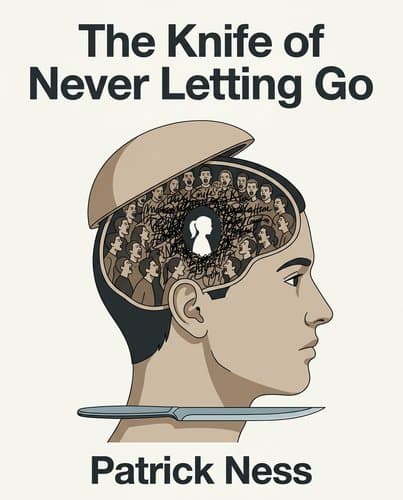
20758104_the-knife-of-never-letting-go
by Patrick Ness
In a world where every man's thoughts scream aloud, one boy's flight through a landscape of noise and violence forces a brutal question: can you grow up…
In Brief
In a world where every man's thoughts scream aloud, one boy's flight through a landscape of noise and violence forces a brutal question: can you grow up without letting the world turn you into what it wants you to be? Patrick Ness makes complicity, truth, and identity feel viscerally, urgently alive.
Key Ideas
Shared Guilt Manufactures Enforced Silence
A society maintains control most effectively not through force but through making everyone complicit — once you have participated in the founding crime, you cannot accuse others of it. Prentisstown's manhood ritual is a machine for manufacturing silence through shared guilt.
Transparency Paradoxically Produces Better Liars
Total transparency does not produce honesty — it produces better liars. When everyone can hear your thoughts, you learn to flood the signal with what you want to be true rather than what is true. The loudest Noise in the room is often the most deliberate deception.
Love's Protective Silence Still Harms
Protective ignorance and culpable ignorance are indistinguishable from the outside. Ben kept Todd innocent to protect him, but that same innocence meant Todd couldn't warn Farbranch in time. Love that withholds truth to shield someone can still become a form of harm.
Violent Initiation Creates Ownership Not Strength
The demand that you become violent to prove yourself is not a test of strength — it is an invitation to be owned. The moment you accept the terms of the initiation, you belong to the people who designed it.
Intimacy Built Through Attention Not Access
You can know someone without hearing every thought they've ever had. Todd spends the entire novel learning to read Viola — through grief, through action, through silence — and discovers that real intimacy is built from attention, not access.
Who Should Read This
Readers interested in Novels and Social Issues, looking for practical insights they can apply to their own lives.
The Knife of Never Letting Go
By Patrick Ness
11 min read
Why does it matter? Because the world you were raised in may be the very thing designed to destroy you.
Imagine being the most exposed person alive — every thought broadcasting outward like a broken radio — and still knowing nothing true about the world you live in. Todd Hewitt has grown up in a place where male minds are permanently public, where silence is considered impossible, where the absence of women is explained by a clean, practiced lie everyone repeats because everyone has always repeated it. Then he finds a hole in all that noise. Not a metaphor — a literal pocket of impossible quiet, moving through the swamp. What hides inside it will unravel everything he's been given as fact. And the cost of that unraveling is the thing the book won't let you look away from.
The Noise Is Not the Truth — It's the Lie You Can't Stop Hearing
Todd Hewitt is twelve years and twelve months old, thirty days from the birthday that will make him a man by Prentisstown's reckoning, and he has never once in his life heard silence. The settlement on New World is home to 146 men whose every thought bleeds outward as Noise — not just words but images, memories, hungers, grief. Mr. Phelps at his shop mourns his dead wife in an endless loop while cheerfully wishing Todd a good morning. The men at the pub drink to blur their own Noise and only make it worse, sending out something Todd describes as a mallet swung at your skull. Walking a single road through town requires the psychological effort of wading through a flood. To keep from dissolving into it, Todd closes his eyes and recites a mantra Ben taught him: I am Todd Hewitt. It's the only tool available for holding onto a self when 146 other selves are pushing in from every direction.
The intuition most people bring to this setup is: well, at least no one could lie. Total transparency, total honesty. That intuition is wrong, and Todd is the one who names exactly why. Visibility doesn't eliminate deception. It relocates it. When everyone can hear everything, the only move left is to make your real thought inaudible by burying it under louder, more insistent ones. You don't think the thing clearly — you convince yourself the opposite is true and broadcast that instead. Who can sort the signal from the noise when the noise never stops? Todd puts it plainly: Noise isn't truth, it's what men want to be true. The gap between those two things, he says, is wide enough to kill you.
The Silence That Cracks the World Open
Todd is deep in the swamp, following his dog Manchee through the ruins of the Spackle settlement, when he feels it: a gap. Not quiet — Prentisstown is never quiet — but a shape cut out of the Noise itself, like water molded into the form of a cup with no cup to hold it. His chest tightens. His eyes water. He bends over and, despite every instinct against it, he cries, overwhelmed by the sheer weight of an absence. He has no category for this experience because nothing in his world prepared him for it. The Noise germ, as Prentisstown's founding story goes, contaminated every living thing on New World when the Spackle released it during the war — the same war that killed every woman, including Todd's mother. Noise is the permanent condition of life on this planet. A hole in it shouldn't exist.
When Todd gets home and mentions what he found, Ben's response is instantaneous and absolute: not next week, not after the birthday, they have to get Todd out right now. The urgency tells you everything before Ben explains anything. A silence moving through the swamp isn't a curiosity or a malfunction in the natural order — it's evidence that the natural order was invented. Because what Ben knows, and what Mayor Prentiss knows, and what the whole town's founding story depends on suppressing, is this: women don't broadcast Noise. They never did. The germ that supposedly killed them all left half the planet's population untouched, and the silence Todd stumbled across in the swamp belongs to a girl named Viola, who emerges muddy and frightened from behind a tree — very much alive, wearing practical clothes, and not remotely resembling the soft, smiling, dress-wearing figures preserved in the Noise of grieving men.
Her silence tears the whole story open. In Prentisstown, every thought is audible — which means every lie, every fear, every private cruelty broadcasts itself whether you want it to or not. The Noise is supposed to be the truth of the world, unfiltered and inescapable. But Viola hears everything about the men around her while they hear nothing back. She can move through their world unseen in the one way that matters. Every fact Prentisstown rests on — the war, the germ, the necessity of the Mayor's order, the ritual that awaits Todd on his thirteenth birthday — depends on there being no women left to contradict it. Viola's mere existence is the refutation.
Every Town You Run To Has Already Been Poisoned by the Lie
Every town on New World beyond Prentisstown is supposed to represent escape. Todd and Viola run toward Farbranch the way people run toward anything that isn't burning — assuming that distance from the source of the lie means distance from the lie itself. It doesn't.
Matthew Lyle is standing in the orchard path with a machete the size of a small door when Todd first walks into Farbranch, and his Noise goes red so fast it's like watching a fire catch. He's massive, shoulders like a working animal, and he hates Todd with a fury that feels practiced, worn smooth by years of carrying it. What makes him devastating isn't the weapon — it's what happens when Hildy names the obvious: that Matthew himself once fled Prentisstown, or rather 'New Elizabeth,' as he insists the town was called before Mayor Prentiss renamed it. He reacts like a man who's been told his wound is visible. The machete rises. Then something shifts, and this hulking man crumbles right there in the dirt, weeping openly, furiously, ashamed of his own grief. His Noise opens wide in that moment, and what spills out isn't anger — it's his mother's name. Jessica. And with it, images of what happened to her, images that Todd registers as 'impossible things' before he can look away. Prentisstown didn't lose its women to a germ. The men of Prentisstown killed them.
The Noise germ was real — it just never touched women, who are immune entirely, always were, a biological fact the town's founding story converted into a massacre and then a myth. Every man in Farbranch is living downstream from that decision. When Todd and Viola flee over the ridge and look back, they see not a posse but the full male population of Prentisstown marching five across in silent, grim rows. Mr. Kearney is somewhere in that formation — the man who used to carve birthday toys for boys, whose hands knew how to make something small and delightful — now carrying a rifle, his face emptied of everything soft. The lie didn't stay in Prentisstown. It mobilized.
The Cost of Staying Human When the World Demands You Kill
What does it actually mean to become a man in a world that defines manhood as murder? Todd spends the whole book answering this question the wrong way, and the Spackle incident is where the wrong answer kills someone.
The creature is alone at a campfire, pulling scales from a fish. He is thin-limbed and alien — white skin, a mouth set mid-face where it doesn't belong, eyes like dark river stones — but his Noise broadcasts something unmistakable: fear. Pure, radiating fear, pouring out in skewed pictures of Todd approaching with a knife raised. Viola screams at Todd to stop. She can see it too. The Spackle scrambles toward his fishing spear, and Todd reads this as threat and charges, telling himself in a roar of red Noise that this is the moment he proves something. He stabs the creature twice. The blood is dark red — startlingly, humanly red — and the Spackle dies slowly, broadcasting confusion and pain the entire time, his Noise filled with bafflement at what is happening to him. Todd crawls away and vomits in the mud.
Viola's response lands like a verdict: if the Spackle were supposedly wiped out in the war, then everything else Prentisstown ever told Todd is probably a lie too. She's right. The creature wasn't a soldier or a threat. He was a fisherman. Todd didn't cross a threshold into manhood — he destroyed something that had nothing to do with him, using rage he was handed by men who needed him angry and incurious. The vomiting is not incidental. His body registers what his ideology couldn't.
Then the cost compounds. Aaron, the preacher who has hunted them since the swamp, takes Viola while Todd is still reeling from the killing. In the escape down the river, Aaron grabs Manchee — Todd's dog, whose thoughts have been a constant presence throughout, a voice that calls Todd's name with simple devotion — and holds him over the water. The choice he offers is transactional and annihilating: the girl or the dog. The current pulls the boat. Todd puts his hand on Viola's arm and stops her rowing. He chooses. The chapter ends with a single crack, and then Manchee's voice in Todd's Noise, still asking 'Todd?' with an asking mark — not accusatory, just confused, forever wondering why he was left behind.
The Truth Was Always There — Buried Under Everything You Were Allowed to Know
Ben chooses a cemetery on top of a hill to tell Todd the truth. The location matters — all that quiet stonework, all those names of people who were supposed to have died differently than they did. He starts with the Noise germ, and this first correction is almost gentle: it wasn't a Spackle weapon. It was already here, woven into the planet's air, waiting. The moment the settlers' ships landed, every man began broadcasting — not because of an attack but because New World talks to itself, always has, every living thing in constant exchange. The Spackle had evolved to live inside that conversation. The settlers couldn't manage it, and Ben says what happens when information has nowhere to go: it just becomes noise.
What came next followed a logic that feels familiar and terrible. Hard years, failing crops, no Eden anywhere on the horizon — and into that desperation came a preaching that needed somewhere to aim the blame. The Spackle were alien, they were different, and men with guns don't need a better argument than that. The genocide was efficient. The Spackle didn't have firearms.
But the war didn't stop there, and this is where Ben's voice goes quieter. Women don't carry Noise. They never did. In a settlement where every man was an open wound, walking next to someone who gave nothing back — who could hear everything about you while you heard nothing about her — became intolerable to enough men that tolerable stopped mattering. Todd is the one who finally says it out loud, the sentence the whole town spent years refusing to complete: after they killed the Spackle, the men of Prentisstown killed the women of Prentisstown. Viola goes still. Ben doesn't correct him.
Ben and Cillian stayed. They knew, and they stayed, and they raised Todd inside the lie because the alternative was leaving him to be raised by men who would have made him complicit far sooner. Every day they kept Todd ignorant and safe was another day the army grew, another day the towns ahead had no warning. The revelation doesn't arrive as liberation. It arrives as a hill full of graves and a man who loved you explaining, with his Noise laid bare, that he made the calculation and chose you over everyone else. Then Davy Prentiss Jr. appears on the road below, and Ben turns back toward him, and Todd runs.
The Ritual Was Never About Becoming a Man — It Was About Becoming Owned
The ritual that defines manhood in Prentisstown was designed from the beginning not to create men but to destroy the possibility of refusal. Aaron lays it out in the church behind the waterfall with something close to pride: every boy at thirteen must kill a man alone, witnessed by the whole town, so that everyone carries the same guilt and no one can ever stand apart from it. Mr. Royal, Todd's schoolteacher, didn't drink himself into a grave — a thirteen-year-old named Seb Mundy shot him on his birthday while the men of Prentisstown watched. One man dead, one boy conscripted. A man dies, a man is born. The elegance of it is sickening: the ritual doesn't just initiate you, it forecloses you. You can't condemn what you participated in. You can't defect from an army you've already killed for. Todd was supposed to be the last soldier in this perfect system, the final boy made irreversibly complicit.
Viola breaks it. She takes Todd's knife and drives it into Aaron's throat before Todd can, and the preacher falls into the waterfall with the blade still in him. Todd is spared the ritual. He didn't kill the man he was built to kill. But the book barely pauses to mark this as victory, because the moral weight doesn't evaporate — it transfers. Viola is immediately sick on the steps, not from weakness but from the recognition that she wanted to do it, that the wanting felt good, that Aaron engineered even this: by making himself monstrous enough, he guaranteed that whoever struck the blow would have to live with having desired it.
Then Davy Prentiss Jr. shoots her from the clifftop, and everything pivots. Todd carries Viola down through the scrub and into Haven, legs burning, shouting for help that doesn't come. The roads turn from dirt to pavement — the long-promised civilization — and the town square is empty. Every house shut. No noise, no people, no sanctuary. The Mayor didn't follow them. He went around. He sent the rumor of his army ahead and let Haven surrender to a threat rather than a battle, then rode in and renamed the place New Prentisstown before Todd ever arrived. The dust clouds they saw on the road weren't pursuit. They were conquest already happening.
What Todd couldn't outrun wasn't the army. It was the architecture of power — the understanding that hope can be defeated before it arrives, that a man who controls information controls the map. The only thing the Mayor couldn't claim, the one thing that made it through intact, is that Todd never became what the ritual required. He didn't kill to belong.
The One Thing the Army Couldn't Take
Haven was always a word before it was a place, and words are exactly what the Mayor deals in. By the time Todd carries Viola through streets that should have been salvation, the conquest is already past tense — no battle required, just the patient rerouting of hope. Everything the journey cost is real and stays real. Manchee is gone. Ben is gone. The towns behind them were warned too late. You could call it futile and be factually correct. But the Mayor's machine had one job: take the last boy and run him through, make him guilty, make him owned. The ritual needed him to kill on command, and he didn't. In a system engineered to leave no one innocent, that one refusal is the only territory that was never surrendered. And then there's what it actually looks like — not heroism, not victory. He's a twelve-year-old covered in someone else's blood, holding a girl he couldn't protect.
Notable Quotes
“This is all you! If you hadn’t shown up in that ruddy swamp, none of this woulda happened! I’d be home RIGHT NOW! I’d be tending my effing sheep and living in my effing house and sleeping in my own EFFING BED!”
“Here’s YOU! Here’s YOU and yer SILENCE! And the whole world gets SCREWED!”
“NOTHING! You’re nothing but EMPTINESS! There’s nothing in you! You’re EMPTY and NOTHING and we’re gonna die FOR NOTHING!”
Frequently Asked Questions
- How does Prentisstown maintain control over its citizens?
- Prentisstown maintains control most effectively through complicity rather than force. "Prentisstown's manhood ritual is a machine for manufacturing silence through shared guilt." Once citizens participate in the founding crime, they cannot accuse others of it, making everyone complicit in the system. This psychological mechanism is more powerful than overt force because it transforms potential rebels into unwilling participants in their own oppression. People become invested in maintaining the system because exposing it would implicate themselves, creating a self-perpetuating cycle of silence and control.
- Does total transparency lead to honesty in the novel?
- No. The novel demonstrates that total transparency actually produces better liars rather than honesty. "When everyone can hear your thoughts, you learn to flood the signal with what you want to be true rather than what is true. The loudest Noise in the room is often the most deliberate deception." This paradox reveals that enforced openness doesn't eliminate dishonesty but creates sophisticated cover-ups. People adapt by flooding communication channels with calculated falsehoods, making genuine truth harder to discern.
- Can protective ignorance become harmful in the novel?
- Yes. The novel shows how protective ignorance and culpable ignorance become indistinguishable in their effects. Ben keeps Todd innocent to shield him from harm, but that same innocence prevents Todd from warning Farbranch in time. "Love that withholds truth to shield someone can still become a form of harm." Though well-intentioned, withholding critical information can paradoxically cause the very damage it aims to prevent. The novel suggests that true protection sometimes requires difficult truths.
- What does the novel reveal about genuine intimacy?
- Genuine intimacy doesn't require total access to another's thoughts. "Todd spends the entire novel learning to read Viola — through grief, through action, through silence — and discovers that real intimacy is built from attention, not access." The novel argues that meaningful understanding develops through observation, empathy, and shared experience rather than enforced transparency. True connection requires respecting someone's privacy and autonomy. This challenges Prentisstown's ideology by showing that knowing someone profoundly comes from attentive presence, not surveillance.
Related Book Summaries


Read the full summary of 20758104_the-knife-of-never-letting-go on InShort