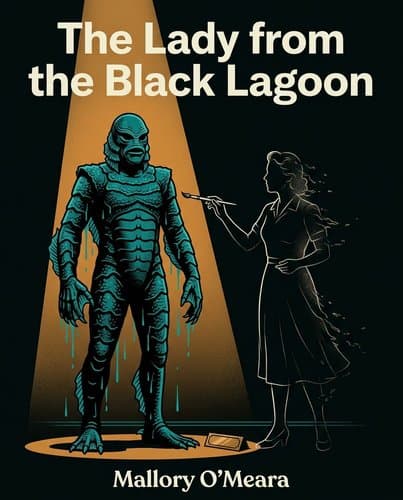
40165912_the-lady-from-the-black-lagoon
by Mallory O'Meara
The woman who designed Hollywood's most iconic monster had her credit stolen, her career destroyed, and her name buried—deliberately.
In Brief
The woman who designed Hollywood's most iconic monster had her credit stolen, her career destroyed, and her name buried—deliberately. O'Meara's forensic hunt to restore Milicent Patrick's legacy proves that women's erasure from creative history is never accidental, and recovering it is an act of resistance.
Key Ideas
Investigate Absence as Systemic Problem
When you notice women are absent from a creative field, treat it as a research question, not a natural fact. Absence is almost never organic — it has a paper trail.
Imperfection Makes Better Role Models
Role models don't need to be perfect; they need to be real. A woman who did extraordinary work while making bad decisions is more useful to aspiring creators than a myth of effortless genius. Imperfection is the point.
Institutional Silence Protects The Powerful
Institutional silence about harassment isn't neutrality — it's active protection of the person with more institutional power. The Universal memos show this explicitly: they knew Bud was wrong, they helped him anyway.
Gender Shapes Attribution of Credit
In uncredited creative work, a man's contribution gets assumed and a woman's gets questioned. The same photograph, the same behind-the-scenes presence, produces opposite conclusions depending on gender — and that asymmetry is worth naming whenever you encounter it.
Recovering History Is Political Resistance
The act of recovering erased history is itself a form of resistance. Biographical detective work, archival obsession, and refusing to accept 'she probably wasn't that important' as an answer are all political acts, not just scholarly ones.
Who Should Read This
Readers interested in Memoir and Social Issues, looking for practical insights they can apply to their own lives.
The Lady from the Black Lagoon
By Mallory O'Meara
10 min read
Why does it matter? Because the women missing from film history didn't disappear — they were specifically targeted.
The assumption most people carry into horror film history is comfortable and a little smug: women weren't there because they weren't interested, or weren't good enough. That assumption is wrong — and the proof spent sixty years in a university archive, waiting for someone to care enough to dig. Mallory O'Meara is a horror producer who grew up with a single photograph of a woman named Milicent Patrick as evidence that women could exist on a film set. She went looking for what really happened. It reached all the way to the present: to the set where O'Meara still covers her tattoos before walking in, so the production manager doesn't decide on sight that she doesn't belong.
The Women Missing from Film History Weren't Absent — They Were Pushed Out
Seventeen years old, sitting at a computer, Mallory O'Meara was doing what she always did after a great film: reading everything she could find about it. Creature from the Black Lagoon had just ended, and she was happily absorbing production trivia — shot in 3D, directed by Jack Arnold, inspired by Beauty and the Beast — when she scrolled past a black-and-white photo and stopped.
A tall woman leaned over the Creature suit with a paintbrush, working with the casual ease of someone who belonged exactly where she was. The caption read: Milicent Patrick, animator and creature designer. O'Meara had grown up obsessed with monsters. Her heroes — Rick Baker, Tom Savini, Dick Smith, Jack Pierce — were all men. She'd never thought to question that. The all-male world of horror filmmaking felt like a fact of nature, not a policy decision.
The photo demolished that assumption. Milicent wasn't assisting anyone. She wasn't decorative. She was building the thing. It was the first time O'Meara had ever seen a woman doing this kind of work, and realizing that felt like a door she'd walked past a thousand times suddenly swinging open. She hadn't noticed it was there.
We absorb female absence from industries and conclude that women simply weren't drawn there, weren't capable, didn't try. We accept the empty room as an explanation. But Milicent Patrick's story is the record of an active decision. In 1954, Universal Studios sent her on a national press tour to promote the film. She had designed its monster. No woman had ever done that at a major Hollywood studio before. The head of the makeup shop, Bud Westmore, had already claimed sole on-screen credit for the Creature. Watching Milicent receive public attention while he stayed behind at the studio curdled into something decisive. By the time she returned from the tour, she no longer had a job. He pulled her from projects already in progress and refused to hire her for anything else. She never designed another monster. Her name appears nowhere in the film's credits. The Creature became one of Hollywood's most iconic creations; Milicent Patrick became someone you'd never heard of.
The room wasn't empty. Someone cleared it.
Before the Monster, Milicent Patrick Was Already Making History No One Recorded
Milicent Patrick designed the Creature from the Black Lagoon, and that alone makes her worth finding. But the Creature was the end of the story, not the beginning. By the time she sat down with that brief, she was an artist with over a decade of work across industries that weren't sure they wanted her — and that record is almost as invisible as her name on the Creature's credits.
The clearest proof came when O'Meara finally got inside Disney. After nearly a year of dead ends, a brunch connection produced an introduction to Ken Shue (the company's vice president of Global Art, twenty-plus years at the studio, his office wall-to-wall with books on Disney's artistic history). This was the man who would know. O'Meara sat across from his desk barely containing herself. Shue stared back when she mentioned Milicent's name. He'd never heard of her.
He called historian Mindy Johnson on speaker. O'Meara had been chasing the same wall for a year, and now she was watching it fall. Mindy's voice came through without preamble: "She animated on the Chernabog sequence."
If you grew up with Fantasia, you know Chernabog. He's the enormous winged demon who fills the night sky in the film's final segment, raising ghosts and witches from the valley below with a sweep of his tar-black fingers. O'Meara had been afraid of him since childhood — watching him unfurl on her grandparents' television screen, transfixed and terrified, pressing play again and again. The most frightening figure in Disney's history was brought to life by her biographical subject.
Milicent was doing central work on Disney's most ambitious film. She and a colleague developed a color animation technique for Fantasia — sequential color drawings that built scenes the way key animators built character poses — used in four of the film's eight segments, including Chernabog's. It was animation. The department pretended otherwise because calling it women's work was easier than crediting it.
She arrived at Disney through the school that built the studio's animation pipeline. Nelbert Chouinard, who opened her art institute the year after women got the vote, said yes when Walt Disney approached her in 1929 unable to pay for classes. "Just send your boys down and we'll worry about the price later." One woman refusing to gatekeep is how another woman eventually brought a demon to life.
By the time Milicent joined Universal's makeup department in 1952, she had spent over a decade at Disney — Fantasia, Dumbo, the golden era's whole run. The Creature was her peak, and it was the thing they used to finish her.
The Problem with Being the Only Woman in the Room Is That You Have to Be Perfect
The pressure on Milicent Patrick to be extraordinary wasn't a tribute to her talent — it was a tax the industry levied on women who dared to be there at all.
O'Meara spent years believing that Milicent was born a European aristocrat, an Italian baroness who abandoned her title and her palazzo to plunge into the democratic mayhem of Hollywood. The story was everywhere in Milicent's publicity materials: "Mildred Elizabeth Fulvia de Rossi, born an Italian baroness." It sounded magnificent. O'Meara believed it entirely.
A library terminal demolished it: baronesses couldn't be born as such — the title passed through the male line only — and Italy hadn't recognized noble titles since 1948. The whole persona was fiction.
Milicent was entering her thirties in 1940s Hollywood — divorced, childless, her family refusing to speak to her after the affair that ended a man's marriage and a woman's life. The ground she stood on was self-made: her contacts, her skills, her portfolio. She wasn't crafting a persona because she was a con artist. She was crafting one because a woman in her position, with no studio backing and competing for the one slot Hollywood allowed women, couldn't afford to be merely good. You have to be exceptional by birth, immaculate by nature. Otherwise someone will find a reason to explain you away.
A room that's only ever let one woman in turns her into a symbol before she gets to be a person. O'Meara concluded that Milicent's fabrications were the argument, not the counterargument. A perfect baroness from ancient stock doesn't tell you anything about what's possible. A divorced woman from Glendale who built her own mythology and still made the Creature from the Black Lagoon — that's a beacon.
The Evidence Was Always There — Someone Just Had to Be Willing to Look
O'Meara arrived at the USC Cinematic Arts Library sick, loaded with cold medication and vegetable juice she had to smuggle past the archivist's no-food-or-drink rule. She had six hours, two carts of file boxes, no phone, no recorder — just index cards and a fast hand. The Creature from the Black Lagoon production files were on the second cart, the one she nearly didn't reach before her time ran out.
She moved through the folders: budgets, memos, test audience comment cards. One viewer, scandalized by the heroine's wardrobe choices, wrote: "How many clothes can one woman have on a boat? Terrible movie, ridiculous!" Every crew member listed was male: director, cinematographer, art director, composer, editor. Then, at the bottom of a stack of tank-test photographs, she nearly missed it.
A single photo. Ricou Browning in the suit, crew members working on it. And barely visible at the edge, identifiable only by her striped dress: Milicent. Not posed for the camera. Not standing beside someone more important. Painting the Creature suit in the middle of actual work.
O'Meara wanted to jump on the desk and dance. Instead she kept moving — an hour left, bladder punishing her for the coffee. She found publicity clippings: Milicent photographed with masks she'd designed, named in newspapers across the country. A memo listed props traveling with Milicent on tour, including a preliminary sketch of the Creature she'd drawn. Then a joyful postcard she'd sent to publicist Sam Israel mid-tour: Enjoying every moment. She had no idea what was coming.
Directly beneath the postcard: a folder of interoffice memos from Bud Westmore, beginning his campaign to destroy her reputation at the studio.
Chris Mueller, the sculptor who built the suit from her designs, said it plainly: she designed the Creature, the whole monster, from the moment the project landed in the makeup department. The man who built it from her drawings credited her. That this has been disputed for sixty years is the argument.
What has been used to manufacture that ambiguity is Ricou Browning's statement that he didn't remember Milicent on set. For decades, film historians treated this as evidence she was merely decorative, or there for publicity alone. Browning also never met Ben Chapman, the actor who played the same Creature in every land scene. Why would either of them necessarily remember the woman designing the suit being pulled over their body? Forgetting someone who was never expected to show up at all isn't oversight. It's just how erasure works. A woman who isn't expected to be there simply isn't seen.
The evidence was always in those boxes. It was never ambiguous. Only unexamined, for sixty years, by people who'd already decided Milicent wasn't the answer.
Bud Westmore Didn't Lose Control of the Story — He Stole It, and His Studio Helped
Clark Ramsay, Universal's publicist, called Bud Westmore to pitch a press tour. The studio wanted to send Milicent Patrick around the country under the banner "The Beauty Who Created the Beast." Her designs, her sketches, her story. Bud killed it on the phone. The Creature was entirely his work, he said. He hadn't spent a month on the design just to have some freelance woman tell America otherwise.
The tour happened anyway, rebranded as "The Beauty Who Lives With the Beasts." The new concept demoted Milicent from creator to caretaker, someone who tended Universal's monsters and understood them, presumably because nurturing was what women did. Bud approved this version. Milicent, who apparently never knew the first concept existed, flew out of Los Angeles in January 1954 with a suitcase of evening gowns and a collection of rubber monster masks, doing four interviews a day in the Michigan cold while the film's premiere approached.
Back in Los Angeles, Bud tracked every newspaper that covered her. City by city, publication by publication, he called editors and demanded to know what they were printing. He found no mention of himself, not because Milicent was undermining him, but because journalists weren't interested in an off-screen department head. They were interested in the beautiful woman who built the monster. Universal's internal memos confirm this: Milicent was delivering her approved lines, and Bud's name was absent from articles because reporters cut it, not because she did.
So when Bud fired her mid-tour — pulling her from every project she'd been promised, barring her from the department entirely — the publicity team's internal response acknowledged it plainly: this was ego, not cause, and Milicent had done nothing wrong. They drafted a set of letters for Universal executives to send Bud, carefully designed to look spontaneous. The letters praised him, congratulated him, reassured him that his reputation was untouched and that Milicent had been loyal to the "Westmore organization" throughout. The plan was to soothe him enough that he might, possibly, change his mind.
He didn't. And the studio let it end there.
Recovering a Stolen Life Is the Same Fight, Fought Sixty Years Later
Gwen climbed into the hospital bed beside her. Milicent was eighty-two, Parkinson's having stolen her ability to smile, breast cancer already spread by the time anyone caught it. Her sister Ruth had died years earlier without ever reconciling. Now Gwen was telling her that God loved her. Milicent shook her head. Gwen said it again. Milicent began to cry, and spoke the last words she would ever say: God doesn't love me.
She died February 24, 1998, holding a verdict her family had passed decades earlier as final. That's what erasure costs: the woman who designed the Creature from the Black Lagoon died convinced she was unworthy of love.
O'Meara's book looks, at first, like posthumous reparation: restore the record, give her the portrait she was denied. But the epilogue refuses that frame. O'Meara has been on sets. She knows the arithmetic: a production manager asking how often she sleeps with her boss, a wardrobe call requiring her to cover her tattoos to look credible. Milicent's story didn't end in 1954. The mechanism is the same; only the names changed.
Which is why Karla Ortiz, concept artist for Doctor Strange and Black Panther, names something specific about what finding Milicent actually does. A girl who sees a woman painting a monster suit doesn't just find inspiration. She finds proof. Someone did this. Someone who looked like her. Which means the door isn't sealed — it just hasn't been opened for her yet.
Here is where the book conscripts you directly. Milicent Patrick was a straight, well-off, white woman — every protection her era offered, stacked in her favor. It still wasn't enough. Bud Westmore ended her career anyway.
The book's last line: Milicent Patrick was a woman before her time. That time is now. Which means the next time a Bud Westmore is standing at a press table answering questions about work he didn't do, someone in the room knows to say something. The story is yours to carry.
She Held the Door Open — the Question Is Who's Still in the Lagoon
Milicent believed the brave thing was to let yourself be seen. She was right. She was also describing her own fate without knowing it, because hiding was never her choice. Bud Westmore and the machinery around him made that decision for her. O'Meara found her anyway, sixty years later, in a box of memos nobody had bothered to destroy — this book the vindication Milicent never lived to receive. But Milicent had every advantage her era could offer: whiteness, connections, a studio that spent real money promoting her. The women without those protections are still in archives nobody has opened, or in no archive at all. That's what this book leaves you with: not just admiration for Milicent, but the uncomfortable weight of everyone the record forgot to include.
Notable Quotes
“Bud Westmore and his staff”
“I wrote intelligent people doing intelligent things.”
“adding more of the girl”
Frequently Asked Questions
- What is The Lady from the Black Lagoon about?
- The Lady from the Black Lagoon uncovers the true story of Milicent Patrick, who designed the Creature from the Black Lagoon but whose credit was stolen by a jealous colleague. Through biographical detective work, author Mallory O'Meara reveals how women's contributions are systematically erased from creative industries. The book demonstrates that this erasure isn't accidental but has traceable origins, equipping readers to recognize absences as evidence of deliberate suppression rather than natural occurrences. By examining Patrick's case, the work exposes how institutional power protects perpetrators and silences victims, offering insights into recognizing and resisting these historical injustices.
- What are the key takeaways from The Lady from the Black Lagoon?
- The book teaches readers to recognize absence as evidence of erasure rather than accident—'Absence is almost never organic—it has a paper trail.' Role models needn't be perfect; 'a woman who did extraordinary work while making bad decisions is more useful to aspiring creators than a myth of effortless genius.' The work reveals how institutions protect harassers: Universal knew about Bud's misconduct but protected him anyway. Critical to understanding erasure is recognizing that identical evidence receives opposite interpretations based on gender. Finally, recovering erased history through archival research is a political act—not just scholarship—that resists the systematic disappearance of women's creative contributions.
- What does The Lady from the Black Lagoon reveal about women's erasure from creative industries?
- The book reveals that women's erasure is systemic and deliberate, not accidental. O'Meara demonstrates that 'absence is almost never organic—it has a paper trail.' Through Milicent Patrick's case, the work shows how institutions actively protect perpetrators while suppressing women's work—Universal knew about Bud's harassment but protected him anyway. Crucially, identical creative contributions receive opposite interpretations based on gender: 'the same photograph, the same behind-the-scenes presence, produces opposite conclusions depending on gender—and that asymmetry is worth naming.' This gendered crediting disparity reveals that women's work disappears while men's contributions are assumed and protected by institutional power structures.
- Why is The Lady from the Black Lagoon important?
- The book demonstrates that recovering erased history is itself a political act. O'Meara argues that authentic role models matter more than myths: 'a woman who did extraordinary work while making bad decisions is more useful to aspiring creators than a myth of effortless genius. Imperfection is the point.' By centering Milicent Patrick's complex story, the work provides readers relatable role models. Readers learn to recognize systematic erasure patterns and understand that institutional silence about misconduct protects the powerful. The book argues that refusing to accept women's absence as inevitable and treating it as a solvable historical question is an act of resistance against erasure.
Related Book Summaries

Read the full summary of 40165912_the-lady-from-the-black-lagoon on InShort